

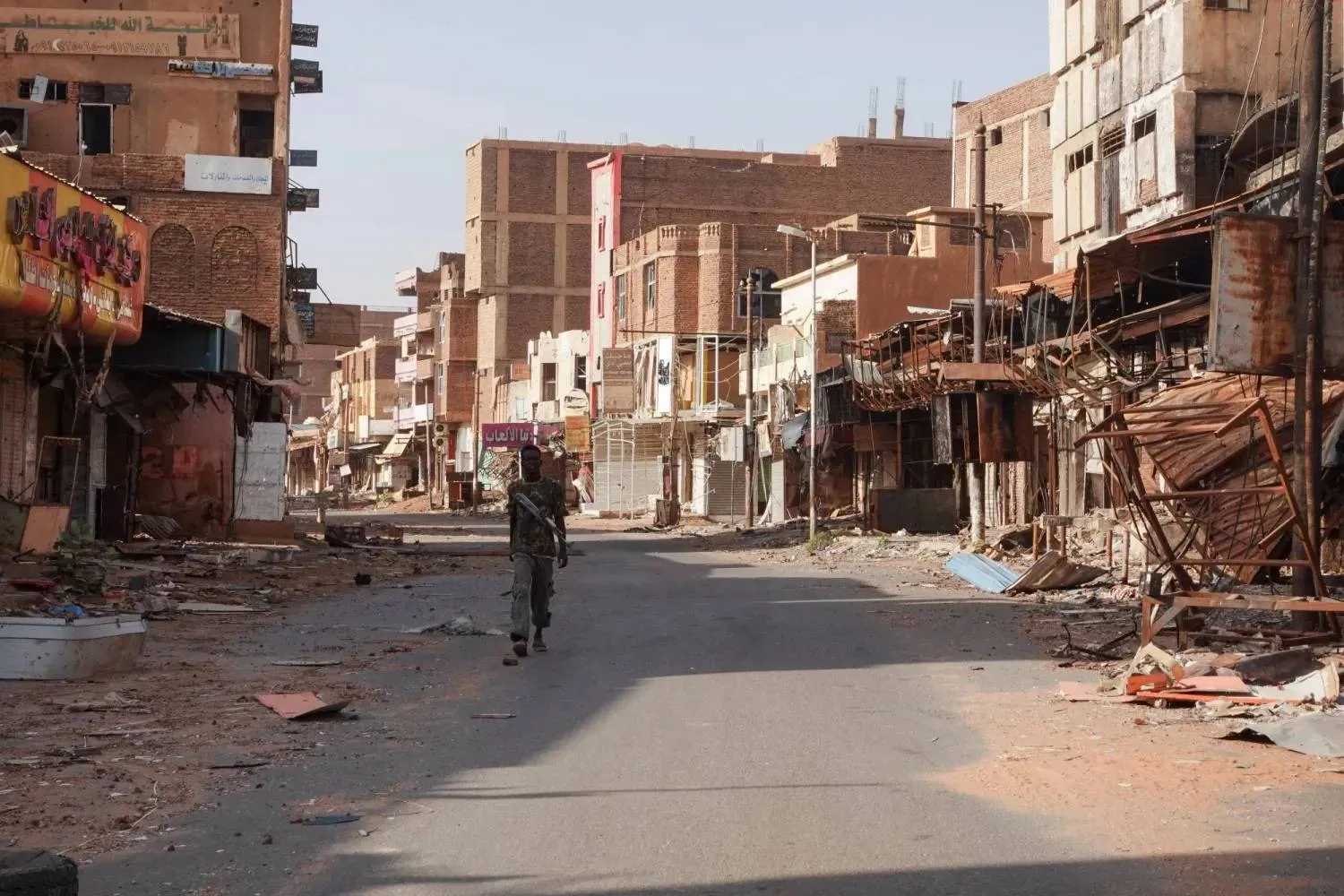

RSF Launches Drone Attacks Across Sudan

RSF Launches Drone Attacks Across Sudan
TT

RSF Launches Drone Attacks Across Sudan

RSF Launches Drone Attacks Across Sudan

Sudan's paramilitary Rapid Support Forces (RSF) launched drone strikes on capital Khartoum and other army-controlled cities on Wednesday, an AFP correspondent, witnesses and an army source said, in what appeared to be their largest coordinated attack in months.

Since April 2023, Sudan has been ravaged by war between its regular military, led by army chief Abdel Fattah al-Burhan, and the RSF, commanded by Burhan's former deputy Mohamed Hamdan Daglo.

The capital Khartoum, which was recaptured by the army last year, has been targeted by drone strikes before but enjoyed relative calm for months.

A source in the army said the RSF attacked the capital, the Kordofan city of El-Obeid, and the northern cities of Atbara and El-Damer "with a large number of drones, which our anti-aircraft defenses engaged with".

El-Obeid is located nearly 400 kilometers (248 miles) from Khartoum and around 650 kilometers from Atbara.

An AFP correspondent in the capital reported a drone attack at 5 am (0300 GMT) along with the sound of anti-aircraft missiles from the direction of the army's Wadi Seidna base, just north of the twin city of Omdurman.

In Khartoum North (Bahri), just across the Nile River, two drones hit a mosque and an electricity transformer in the El-Droshab area, according to an eyewitness.

It was not immediately clear if air defenses had shot them down.

Witnesses in the northern cities of Atbara and El-Damer -- both also under army control -- gave similar reports of hearing explosions and seeing drones in the sky.

Some 120 kilometers southeast, in the town of Tamboul, civilians were in a "state of fear" after drones appeared above them, a witness told AFP.

There were no immediate reports of casualties in the attacks, including in the Khartoum North mosque which worshippers had recently emptied after dawn prayers.

Across the country, aid workers estimate more than 200,000 people have been killed in what the UN calls a "war of atrocities". The conflict has also caused the world's largest hunger and displacement crises.

- Retaliatory strike -

The RSF has seemed to be on the back foot since the army last month pushed them off a key highway connecting Khartoum to El-Obeid, the southern Kordofan region's largest city, which they had tried to seize for months.

Daglo in the aftermath said he would "unleash" his fighters -- already accused of war crimes including genocide -- and his fighters have since repeatedly threatened a large-scale retaliatory attack.

Burhan and Daglo, allies until they fell out in a bitter power struggle, have spent most of the war in a relative stalemate, unwilling to hold negotiations while vying for a decisive battlefield advantage.

The RSF last year consolidated its hold on the vast western region of Darfur, and has since pushed to seize territory in Kordofan and along the southeastern Ethiopian border.

The army holds the country's center, north and east, and has tried to project an image of a return to normalcy in areas it controls.

But in Khartoum, 2.3 million people have returned from displacement, only to find vast amounts of uncleared war remnants, dilapidated infrastructure and limited electricity and water.

According to an eyewitness, Wednesday's drone attack "caused an explosion in an electricity transformer" in Khartoum North, where over half a million people already live without power.

Even parts of the city that have had more reliable services than Khartoum North have been without power for weeks.


Houthis Escalate Attacks Across Taiz, Yemen’s Western Coast

 The navigation bridge of a sunken vessel is all that is seen at the surface of the water in the Port of Mokha the day after an attack by the Houthis on the city Mokha, held by Yemen's legitimate government on August 10, 2026. (AFP)
The navigation bridge of a sunken vessel is all that is seen at the surface of the water in the Port of Mokha the day after an attack by the Houthis on the city Mokha, held by Yemen's legitimate government on August 10, 2026. (AFP)
TT

Houthis Escalate Attacks Across Taiz, Yemen’s Western Coast

 The navigation bridge of a sunken vessel is all that is seen at the surface of the water in the Port of Mokha the day after an attack by the Houthis on the city Mokha, held by Yemen's legitimate government on August 10, 2026. (AFP)
The navigation bridge of a sunken vessel is all that is seen at the surface of the water in the Port of Mokha the day after an attack by the Houthis on the city Mokha, held by Yemen's legitimate government on August 10, 2026. (AFP)

The Iran-backed Houthi group stepped up military operations on several fronts west of Yemen’s Taiz governorate and along the Red Sea coast on Thursday.

Houthis fired more than 12 ballistic missiles at rural areas in Taiz and Hodeidah governorates as fierce clashes erupted with government forces and the National Resistance in Maqbanah, al-Kadha, al-Tuwair and Ghabari.

Military sources said the fighting began in the early hours of Thursday when the Houthis launched a broad assault on government and National Resistance positions across several sectors. The attack developed into direct clashes and artillery exchanges that lasted for hours.

The group fired hundreds of artillery and mortar rounds during the assault and deployed drones in combat operations, the sources said. The fighting spread to hills overlooking the al-Aqma area in Mawza district, where brigades affiliated with the National Resistance are stationed.

The Houthis seized several positions during the opening hours of the attack before government forces, fighters from Taiz and the National Resistance launched a counterattack and recaptured a number of them, according to military sources.

The sources said the ballistic missiles had no effect on government forces’ battlefield operations. Most of the Houthi missile strikes targeted areas around vital facilities and civilian and military supply routes, causing panic among residents.

Government forces suffered deaths and injuries, while the Houthis also sustained casualties, the sources said, without providing figures for either side. Four Houthi fighters were reportedly captured.

Reports from the Joint Operations Room said air-defense systems and military formations on the Red Sea coast were “maintaining a high level of vigilance in confronting these repeated missile threats, which have become the group’s most prominent means of trying to offset its successive battlefield losses.”

The reports said the attacks were also intended to send a message linked to regional developments around the Red Sea shipping corridor and strategic Bab al-Mandeb Strait.

The missile attacks coincided with an attempted infiltration and ground assault by Houthi fighters against government positions in al-Kadha, west of Taiz.

Three drones downed

Government forces said they shot down three Houthi drones flying over subdistricts in Jabal Habashi district as fighting continued on fronts west of Taiz.

Military sources said the drones were intercepted as the group continued using unmanned aircraft to attack government and National Resistance positions. Clashes persisted in several sectors as forces deployed reinforcements to combat positions.

The ground escalation coincided with a new wave of Houthi missile strikes on the Red Sea coast. The group fired more than 12 ballistic missiles toward several areas east and north of the city of Mokha, as well as areas in Hodeidah’s Khokha district.

Local sources said the missiles were launched from Houthi-held positions in Ibb governorate and from al-Hawban and Sharab, east and north of Taiz. One missile caused a fire on the northern outskirts of Mokha.

The National Resistance’s military media office said the Houthis fired eight ballistic missiles toward rural areas around Mokha, while a ninth landed south of Khokha district. Local sources said three more missiles were launched shortly afterward.

Red Sea coast targeted

The missile strikes coincided with fighting on the Maqbanah and al-Kadha fronts west of Taiz, while air defenses operated by the “Taiz Military Axis” responded to drones launched by the group during the assault.

The escalation came hours after the Houthis targeted residential areas, the vicinity of camps for displaced people and front-line positions in Taiz, where fighting has intensified steadily since August.

Government forces and the National Resistance have continued to repel Houthi attacks across western Taiz and the Red Sea coast as the group persists in using ballistic missiles, drones and artillery.

The simultaneous broad ground assault and missile strikes point to an expansion of the Houthi escalation in the region, which has seen repeated attacks on military positions and areas near residential communities and civilian facilities.

Government forces in Marib and al-Dhale governorates carried out strikes on Wednesday targeting Houthi positions, gatherings and vehicles, and released footage of the operations.


Syria Says Begun Destroying Assad-Era Chemical Weapon Materials

Syrian Ambassador to the United Nations Ibrahim Olabi addresses the Security Council during the meeting on the situation in the Middle East, at UN headquarters in New York City, US, February 18, 2026. (Reuters)
TT

Syria Says Begun Destroying Assad-Era Chemical Weapon Materials

Syrian Ambassador to the United Nations Ibrahim Olabi addresses the Security Council during the meeting on the situation in the Middle East, at UN headquarters in New York City, US, February 18, 2026. (Reuters)

Syria has begun the process of destroying chemical weapon materials identified by an international watchdog, the country's UN envoy said Thursday, signaling a major step forward since the 2024 ouster of autocratic leader Bashar al-Assad.

"This is the very first destruction process since we have been liberated from the previous regime," Ibrahim Olabi told the Security Council. "It's also the first of its kind to destroy chemical materials on Syrian territory for over a decade."

In 2021, the Organization for the Prohibition of Chemical Weapons (OPCW) took the unprecedented step of stripping Syria of its voting rights after finding its air force had used nerve agent sarin and chlorine gas on its own people.

But since Assad's overthrow, the new authorities in Damascus have vowed to cooperate with the OPCW to destroy the chemical weapons the former president was repeatedly accused of using during Syria's 13-year civil war.

"We aim at protecting the Syrian people so that such weapons will not fall into the wrong hands," Olabi said Thursday.

He added that his country was "also protecting the world and the region through such work. Every site that is secured, every ammunition that is identified, does not merely remove a danger to Syria, but the entire world."


Israeli Minister Presents Plan to Remove Gaza Population

Israel's far-right National Security Minister Itamar Ben Gvir - File photo
TT

Israeli Minister Presents Plan to Remove Gaza Population

Israel's far-right National Security Minister Itamar Ben Gvir - File photo

Israel's far-right National Security Minister Itamar Ben Gvir set out a plan on Thursday to remove Palestinians from the Gaza Strip and send them abroad.

Speaking in the run-up to close-fought Israeli elections, he said the plan aimed to see the departure of 250,000 Palestinians from Gaza in the first year, followed by the rest of the roughly two million residents over the following six years.

"It's realistic," said Ben Gvir, claiming that there were countries who were "ready" to take in Gazans, without naming which ones.

Forced displacement of civilians in occupied territory is considered a war crime under the Geneva Conventions.