


Lebanon Passes Sweeping Amnesty Law for Prisoners, Wanted People

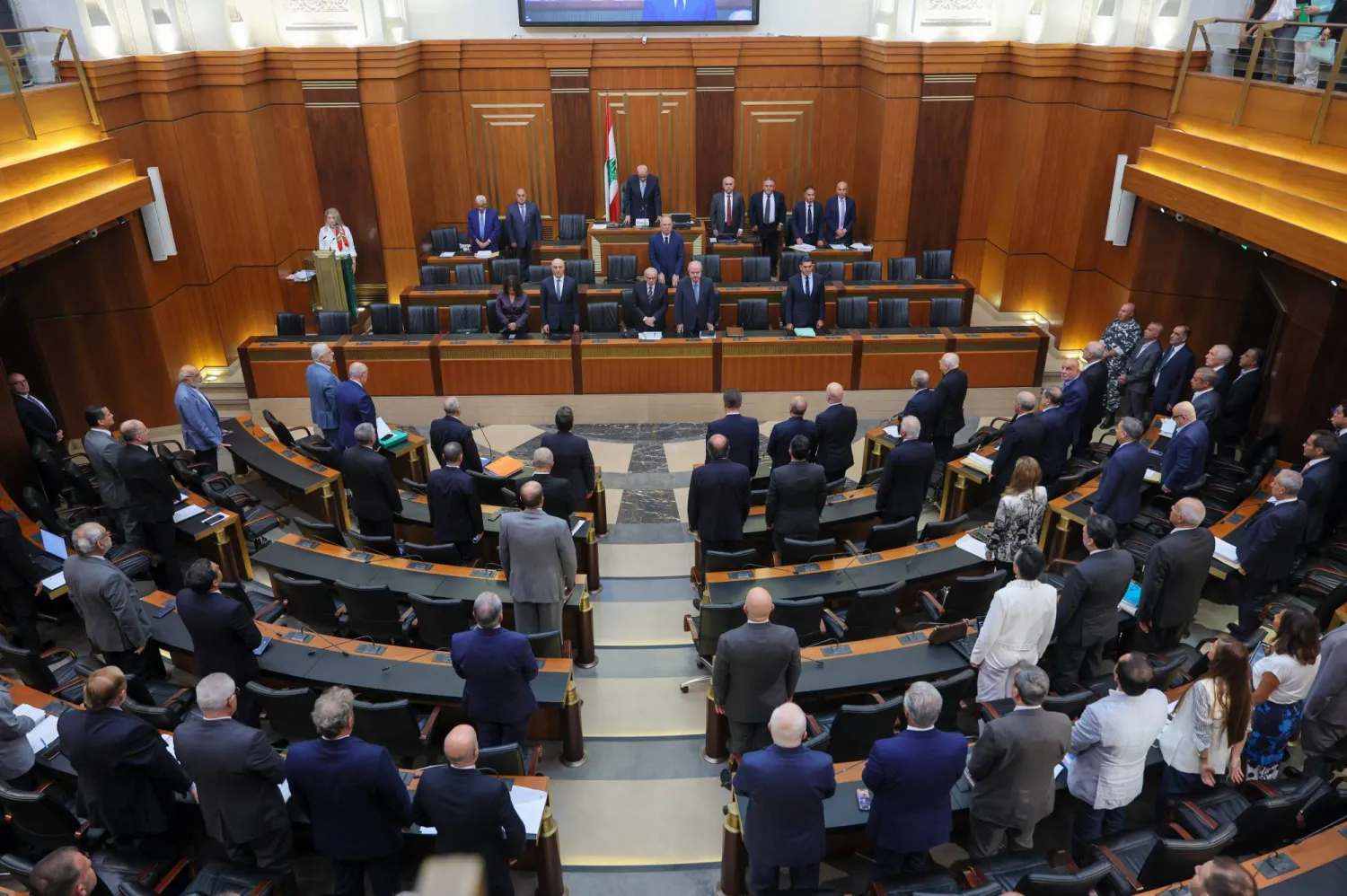
Lebanese lawmakers attend a parliamentary session to discuss a proposed general amnesty law, the abolition of the death penalty and the salaries of retired members of Lebanon's security forces in Beirut, Lebanon, 11 August 2026. (EPA)
TT

Lebanon Passes Sweeping Amnesty Law for Prisoners, Wanted People

Lebanese lawmakers attend a parliamentary session to discuss a proposed general amnesty law, the abolition of the death penalty and the salaries of retired members of Lebanon's security forces in Beirut, Lebanon, 11 August 2026. (EPA)

Lebanon's parliament on Wednesday passed a sweeping and long-awaited amnesty law that should benefit thousands of prisoners and wanted people, in the first legislation of its kind since 1991.

The law, which had been a demand of various political factions and a topic of debate for years, aims to reduce prison overcrowding with many inmates awaiting trial for years.

The office of the country's parliament speaker announced the "approval of a draft law aimed at granting a general amnesty and exceptionally reducing the terms of certain sentences".

Authorities did not immediately announce the number of people that would benefit from the law.

According to Imad al-Hout, one of the lawmakers in favor of the bill, the law reduced the sentences of those facing death and life imprisonment to 17 prison years.

That is equivalent to 12 years and nine months of actual imprisonment in Lebanon, where a prison year is calculated as nine months.

The law also calls for the release of inmates detained for more than 12 prison years without charges as their trial continues.

In its 2025 report, the country's National Human Rights Commission said that prisons had an overcrowding rate of 300 percent, with prison authorities reporting at least 6,268 inmates by the end of March.

But general amnesty was brought back into the limelight after the 2024 fall of longtime Syrian president Bashar al-Assad, as many extremist prisoners in Lebanon were jailed over events linked to the Syrian civil war.

Most of them are accused of crimes that include attacking the Lebanese army, participating in clashes and planning bombings.

Other political forces, including Iran-backed Hezbollah, have been demanding amnesty for their communities.

Thousands of families from the eastern Baalbek and Hermel regions, bastions of Hezbollah and its ally Amal where illicit cannabis cultivation is widespread, have been demanding amnesty for drug-related offenses and car theft for years.

Christian parties meanwhile have pushed for the law to include the families of those who joined an Israeli-backed proxy and fled to Israel after its withdrawal from southern Lebanon in 2000, fearing reprisals, particularly from Hezbollah and its supporters.

Lebanon previously passed a general amnesty law in the wake of its 1975-90 civil war, allowing former warlords to transition into politics without facing trial for crimes committed during the conflict.



Libya's NOC Reports Drone Attack Attempt at Fuel Depot

No casualties ‌were reported and the incident ‌did not impact supply operations. (EPA file)
TT

Libya's NOC Reports Drone Attack Attempt at Fuel Depot

No casualties ‌were reported and the incident ‌did not impact supply operations. (EPA file)

A remote-controlled drone attack targeted a fuel depot in Libya's capital Tripoli on Thursday, causing minor damage, the state-owned National Oil Corporation (NOC) said in a statement.

The NOC said that technical teams had begun drawing fuel from the tanks to reduce the fuel level as a ‌precaution.

There was ‌no immediate claim of ‌responsibility ⁠and authorities did not ⁠say who they believed was behind the attack.

The attack caused minor damage to some pipelines and tanks no. 213 and 220 due to falling shrapnel, said Ahmed Al-Masallati, ⁠spokesperson for Brega Petroleum ‌Marketing, which is ‌in charge of Libya's fuel supplies.

No casualties ‌were reported and the incident ‌did not impact supply operations.

Libyan oil facilities have been subject to repeated attacks and closures for various political and technical ‌reasons since the 2011 uprising that toppled Maammar al-Gaddafi and ⁠set ⁠off a prolonged period of chaos.

In August, fuel storage tanks at the nearby Zawiya oil complex, in western Tripoli, were targeted by several explosive-laden drone strikes that hit one of the tanks and completely burned it.

Attempts to target oil facilities represent "a direct threat to the supply system," the NOC said in the statement.


Houthis Escalate Attacks Across Taiz, Yemen’s Western Coast

 The navigation bridge of a sunken vessel is all that is seen at the surface of the water in the Port of Mokha the day after an attack by the Houthis on the city Mokha, held by Yemen's legitimate government on August 10, 2026. (AFP)
The navigation bridge of a sunken vessel is all that is seen at the surface of the water in the Port of Mokha the day after an attack by the Houthis on the city Mokha, held by Yemen's legitimate government on August 10, 2026. (AFP)
TT

Houthis Escalate Attacks Across Taiz, Yemen’s Western Coast

 The navigation bridge of a sunken vessel is all that is seen at the surface of the water in the Port of Mokha the day after an attack by the Houthis on the city Mokha, held by Yemen's legitimate government on August 10, 2026. (AFP)
The navigation bridge of a sunken vessel is all that is seen at the surface of the water in the Port of Mokha the day after an attack by the Houthis on the city Mokha, held by Yemen's legitimate government on August 10, 2026. (AFP)

The Iran-backed Houthi group stepped up military operations on several fronts west of Yemen’s Taiz governorate and along the Red Sea coast on Thursday.

Houthis fired more than 12 ballistic missiles at rural areas in Taiz and Hodeidah governorates as fierce clashes erupted with government forces and the National Resistance in Maqbanah, al-Kadha, al-Tuwair and Ghabari.

Military sources said the fighting began in the early hours of Thursday when the Houthis launched a broad assault on government and National Resistance positions across several sectors. The attack developed into direct clashes and artillery exchanges that lasted for hours.

The group fired hundreds of artillery and mortar rounds during the assault and deployed drones in combat operations, the sources said. The fighting spread to hills overlooking the al-Aqma area in Mawza district, where brigades affiliated with the National Resistance are stationed.

The Houthis seized several positions during the opening hours of the attack before government forces, fighters from Taiz and the National Resistance launched a counterattack and recaptured a number of them, according to military sources.

The sources said the ballistic missiles had no effect on government forces’ battlefield operations. Most of the Houthi missile strikes targeted areas around vital facilities and civilian and military supply routes, causing panic among residents.

Government forces suffered deaths and injuries, while the Houthis also sustained casualties, the sources said, without providing figures for either side. Four Houthi fighters were reportedly captured.

Reports from the Joint Operations Room said air-defense systems and military formations on the Red Sea coast were “maintaining a high level of vigilance in confronting these repeated missile threats, which have become the group’s most prominent means of trying to offset its successive battlefield losses.”

The reports said the attacks were also intended to send a message linked to regional developments around the Red Sea shipping corridor and strategic Bab al-Mandeb Strait.

The missile attacks coincided with an attempted infiltration and ground assault by Houthi fighters against government positions in al-Kadha, west of Taiz.

Three drones downed

Government forces said they shot down three Houthi drones flying over subdistricts in Jabal Habashi district as fighting continued on fronts west of Taiz.

Military sources said the drones were intercepted as the group continued using unmanned aircraft to attack government and National Resistance positions. Clashes persisted in several sectors as forces deployed reinforcements to combat positions.

The ground escalation coincided with a new wave of Houthi missile strikes on the Red Sea coast. The group fired more than 12 ballistic missiles toward several areas east and north of the city of Mokha, as well as areas in Hodeidah’s Khokha district.

Local sources said the missiles were launched from Houthi-held positions in Ibb governorate and from al-Hawban and Sharab, east and north of Taiz. One missile caused a fire on the northern outskirts of Mokha.

The National Resistance’s military media office said the Houthis fired eight ballistic missiles toward rural areas around Mokha, while a ninth landed south of Khokha district. Local sources said three more missiles were launched shortly afterward.

Red Sea coast targeted

The missile strikes coincided with fighting on the Maqbanah and al-Kadha fronts west of Taiz, while air defenses operated by the “Taiz Military Axis” responded to drones launched by the group during the assault.

The escalation came hours after the Houthis targeted residential areas, the vicinity of camps for displaced people and front-line positions in Taiz, where fighting has intensified steadily since August.

Government forces and the National Resistance have continued to repel Houthi attacks across western Taiz and the Red Sea coast as the group persists in using ballistic missiles, drones and artillery.

The simultaneous broad ground assault and missile strikes point to an expansion of the Houthi escalation in the region, which has seen repeated attacks on military positions and areas near residential communities and civilian facilities.

Government forces in Marib and al-Dhale governorates carried out strikes on Wednesday targeting Houthi positions, gatherings and vehicles, and released footage of the operations.


Syria Says Begun Destroying Assad-Era Chemical Weapon Materials

Syrian Ambassador to the United Nations Ibrahim Olabi addresses the Security Council during the meeting on the situation in the Middle East, at UN headquarters in New York City, US, February 18, 2026. (Reuters)
TT

Syria Says Begun Destroying Assad-Era Chemical Weapon Materials

Syrian Ambassador to the United Nations Ibrahim Olabi addresses the Security Council during the meeting on the situation in the Middle East, at UN headquarters in New York City, US, February 18, 2026. (Reuters)

Syria has begun the process of destroying chemical weapon materials identified by an international watchdog, the country's UN envoy said Thursday, signaling a major step forward since the 2024 ouster of autocratic leader Bashar al-Assad.

"This is the very first destruction process since we have been liberated from the previous regime," Ibrahim Olabi told the Security Council. "It's also the first of its kind to destroy chemical materials on Syrian territory for over a decade."

In 2021, the Organization for the Prohibition of Chemical Weapons (OPCW) took the unprecedented step of stripping Syria of its voting rights after finding its air force had used nerve agent sarin and chlorine gas on its own people.

But since Assad's overthrow, the new authorities in Damascus have vowed to cooperate with the OPCW to destroy the chemical weapons the former president was repeatedly accused of using during Syria's 13-year civil war.

"We aim at protecting the Syrian people so that such weapons will not fall into the wrong hands," Olabi said Thursday.

He added that his country was "also protecting the world and the region through such work. Every site that is secured, every ammunition that is identified, does not merely remove a danger to Syria, but the entire world."