

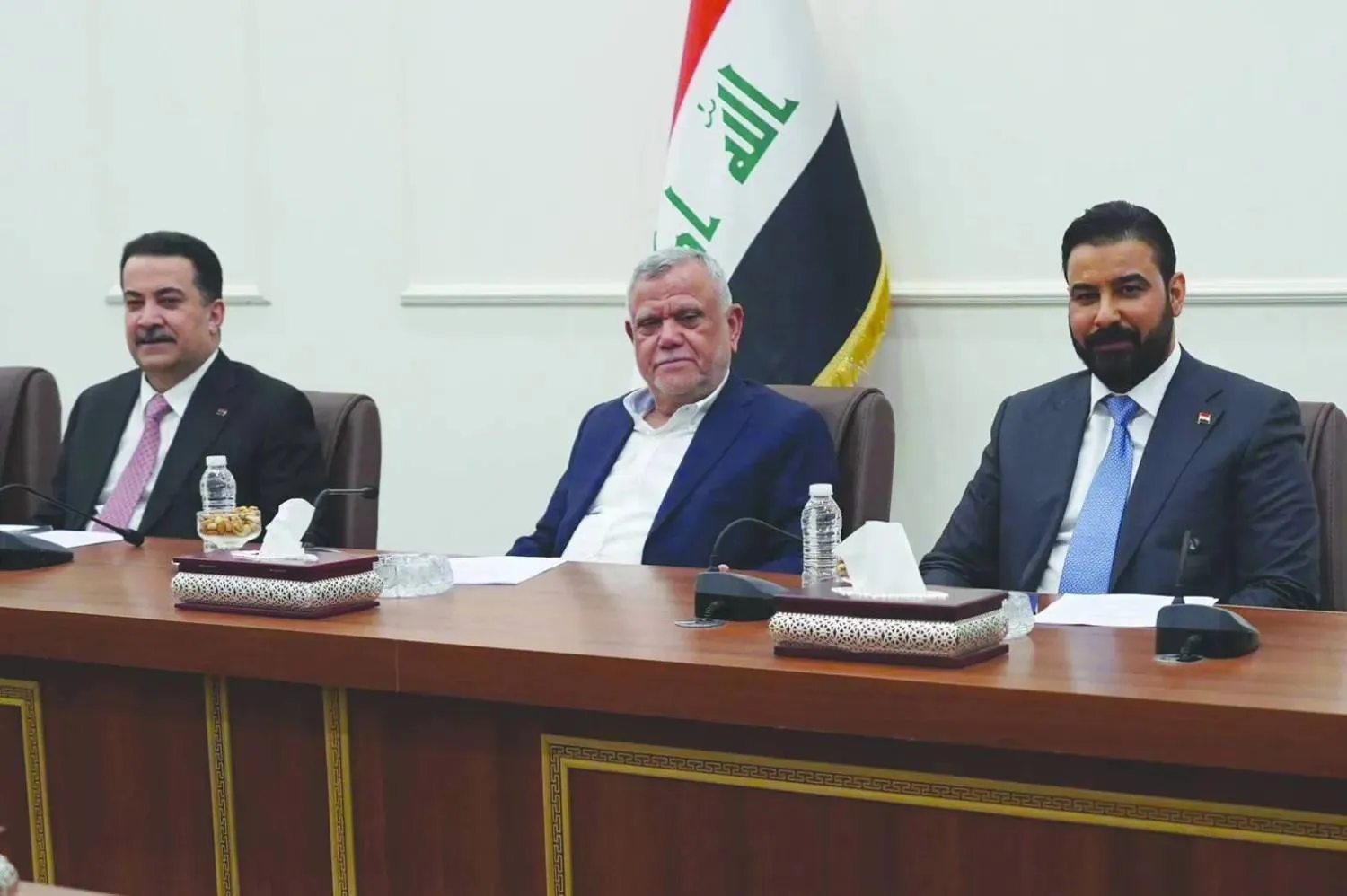

Iraqi Faction Rejects Using Force to Disarm Groups

Prime Minister Ali al-Zaidi, Coordination Framework member Hadi al-Amiri, and Reconstruction and Development Alliance leader Mohammed Shia Al-Sudani (Coordination Framework)
TT

Iraqi Faction Rejects Using Force to Disarm Groups

Prime Minister Ali al-Zaidi, Coordination Framework member Hadi al-Amiri, and Reconstruction and Development Alliance leader Mohammed Shia Al-Sudani (Coordination Framework)

Iraq's Badr Organization that is led by Hadi al-Amiri has rejected the government's attempts to using force to disarm armed factions.

The organization’s stance reflects growing disagreement within the political parties of the Coordination Framework over the future of weapons held by armed groups and their relationship with the state.

In a statement issued on Friday, head of the political bureau of the Badr Organization Mohammed Naji said the group opposes any threat to use force to seize the weapons of the factions, warning that raising the issue of disarmament in this manner could lead to tensions and internal strife.

Naji argued that the campaign to place all weapons exclusively under state control is viewed by the organization as coming under pressure from the United States.

"We will not allow the Prime Minister or anyone else to reach this level in dealing with our brothers in the resistance, because that would open the door to internal discord, the primary beneficiaries of which would be the US, the Zionist entity, and those lying in wait for us,” said Naji.

The Organization's position comes at a time when the Iraqi government is seeking to reinforce the principle that all weapons should be held solely by state institutions, amid increasing debate among political parties and armed factions on how this policy should be implemented and the timetable for doing so.

Writer and journalist Montadhar Naser believes that the issue of placing all weapons under state control has exposed contradictions within the forces that make up the Coordination Framework, with divisions extending even into some of the parties and factions themselves.

In remarks to Asharq Al-Awsat, he said the dispute is not limited to how weapons should be handled. It is also linked to defining the nature of Iraq’s relationship with both the US and Iran, and to determining the extent to which security and military decision-making can remain independent of armed groups that are connected to external actors.

The debate on the issue of weapons coincided with another unannounced visit to Baghdad by Esmail Qaani, commander of the Quds Force of Iran's Revolutionary Guard Corps (IRGC), during which he met with a number of leaders of the Coordination Framework.

The visit sparked speculation about the nature of Qaani's meetings and whether he had also met Prime Minister Ali al-Zaidi.

Iraqi sources told Asharq Al-Awsat that Tehran wants to keep the issue of factional weapons effectively unresolved, while potentially transferring nominal control of those arms to the government.

According to the same sources, this proposal may be acceptable to some leaders within the Coordination Framework, but it is not favored by the relevant Iraqi state authorities.

The disagreement places the government before a sensitive political and security test. Any attempt to impose disarmament by force could trigger a confrontation with factions that possess significant political and security influence.

Conversely, postponing the issue or settling for merely symbolic measures could undermine the state's efforts to strengthen its monopoly over military and security decision-making.



Israeli Airstrike on Southern Lebanon Kills 7 People

A photograph taken from the southern Lebanese area of Nabatieh shows smoke as it rises from the site of Israeli strikes that targeted the hilltops of the mountainous area of the strategic Ali al-Taher ridge on August 14, 2026. (Photo by AFP)
TT

Israeli Airstrike on Southern Lebanon Kills 7 People

A photograph taken from the southern Lebanese area of Nabatieh shows smoke as it rises from the site of Israeli strikes that targeted the hilltops of the mountainous area of the strategic Ali al-Taher ridge on August 14, 2026. (Photo by AFP)

An Israeli airstrike on southern Lebanon killed seven people early Saturday, the worst toll since deals in June saw a lull in hostilities between Israel and Hezbollah.

The state-run National News Agency (NNA) said Israel "escalated its attacks on the south,” reporting that "a strike launched by enemy warplanes on a home" on the outskirts of the village of Ansar "killed seven people and wounded three others.”

It said the strike destroyed the home and that emergency rescuers were removing rubble and transporting the casualties to hospital.

The death toll from the airstrike makes it the deadliest since Lebanon and Israel announced a framework agreement on June 26, laying out a plan for Israeli forces to withdraw from southern Lebanon, in exchange for Hezbollah’s disarmament.

Violence has significantly decreased since the signing of a US-Iran memorandum of understanding in June on the broader Middle East war, and the US-sponsored framework deal between Lebanon and Israel.

But Lebanon still reports intermittent Israeli strikes occasionally causing casualties, and the broad demolitions of civilian buildings in southern villages and towns.

The NNA said "the valley between Ansar and Zarariyeh was also subjected to a strike, the first at this geographical depth since the ceasefire two months ago.”

It also said "Israeli warplanes carried out a series of airstrikes targeting the Ali al-Taher ridge,” a strategic hill overlooking the Nabatieh area, also reporting Israeli shelling there.

The news agency said Israeli forces detonated homes in the town of Bint Jbeil near the border.


Hezbollah Chief Slams Lebanon-Israel Talks

Hezbollah Secretary-General Naim Qassem (Reuters)
TT

Hezbollah Chief Slams Lebanon-Israel Talks

Hezbollah Secretary-General Naim Qassem (Reuters)

Hezbollah Secretary-General Naim Qassem on Friday stepped up his criticism of the Lebanese-Israeli negotiation process, arguing that the seven rounds of talks held so far have produced no results.

He announced the party's rejection of both direct negotiations and the substance of the framework agreement, while reaffirming its commitment to the 2024 agreement.

In a speech marking the anniversary of the July 2006 War, Qassem criticized the Lebanese authorities, saying: "Give us a single achievement from the seven rounds of negotiations."

He also asserted that the Lebanese authorities must “acknowledge their failure."

Qassem accused the authorities of subjecting the country's armed forces to undue pressure by implementing the framework deal agreed with Israel to end hostilities.

The June trilateral framework, to which the United States is also a party, involves Hezbollah’s disarmament and a gradual withdrawal of Israeli forces from Lebanon's south, where it has occupied several areas.

It also includes the deployment of the Lebanese army to areas where Israel's military has pulled out, starting in test areas known as "pilot zones.”

"How can you accept this ongoing humiliation of the Lebanese army, exposing it to bombardment and Israeli pressures, instead of acting as its protectors?" Qassem said in a speech.

"Israel is attempting to bind Lebanon to an inquiry committee that oversees the army's deployment, operations, and internal details. Where is the patriotism? Where is the dignity of the army that ought to be preserved?" he said.

Hezbollah has repeatedly rejected the direct talks and refuses to surrender its weapons.


US Engaged in Shuttle Diplomacy between Lebanon, Israel to Salvage the Negotiations

Lebanese Parliament Speaker Nabih Berri receives Issa and Clearfield (National News Agency)
TT

US Engaged in Shuttle Diplomacy between Lebanon, Israel to Salvage the Negotiations

Lebanese Parliament Speaker Nabih Berri receives Issa and Clearfield (National News Agency)

Head of the Military Coordination Group for Lebanon (MCG4L) US General Joseph Clearfield met on Friday with top officials in Beirut as part of follow up efforts with Lebanon and Israel on the military aspect of the framework agreement signed between the two countries in June.

The United States has been trying to broker an end to fighting between Israel and Hezbollah, which has raged since March in parallel with the wider US-Israeli war against Iran.

The June agreement says the Lebanese army will gradually restore control over all of Lebanon, disarming Hezbollah.

The first phase ⁠began in two pilot zones. The talks did not, however, produce an agreement on the next area from which Israeli troops would withdraw so that Lebanese troops could take control.

Clearfield, US Ambassador to Lebanon Michel Issa and the accompanying military delegation, visited on Friday Speaker Nabih Berri in Ain el-Tineh.

The discussions, which were attended by Berri’s Media Advisor Ali Hamdan, touched on the situation in southern Lebanon, as well as the Group’s work in light of the start of identifying the pilot areas and establishing a mechanism to verify the Israeli withdrawal and the deployment of the Lebanese Army.

Berri stressed that "Israel has not ceased its violations and attacks against Lebanon and the south since November 2024,'' adding that the attacks have continued systematically, involving the destruction of villages, bulldozing of fields and agricultural areas, and the burning of forested areas, "not to mention targeting heritage sites and cultural heritage."

Berri said that "the key to stability remains compelling Israel to halt its war and withdraw to the international borders."

Asked about the talks between Lebanon and Israel and the date of the next round, Ambasssador Issa said: "The negotiations will continue, but no date has been set yet."

The US delegation also visited Prime Minister Nawaf Salam at the Grand Serail to discuss the military aspect of the negotiation framework and developments in southern Lebanon.

Salam stressed the need for Israel to halt its destruction operations, expand the scope of the pilot zones, and establish a clear timetable for Israeli withdrawal from Lebanese territory.

Lebanese Prime Minister Nawaf Salam receives Issa and Clearfield (National News Agency)

Previous rounds of talks had focused on the sequence of the Israeli withdrawal, the deployment of the Lebanese Army, and the verification mechanism, without reaching a decision on moving to a new area. Issa reiterated this point on Friday, stating that defining the status of the current areas must precede discussions about other areas.

Shuttle Diplomacy Between Beirut and Tel Aviv

Friday's meetings were part of a shuttle diplomacy conducted by Clearfield between Beirut and Tel Aviv to follow up on the implementation of military arrangements.

Clearfield arrived in Beirut on Wednesday from Tel Aviv, where he had held talks with Israeli officials.

In the Lebanese capital, he met with President Joseph Aoun and Army Commander General Rodolphe Haykal before departing again for Tel Aviv later that afternoon. He returned to Beirut on Friday.

During that stop in Beirut, Clearfield discussed measures related to implementing the framework agreement and developments in southern Lebanon, at a time when the implementation process continues to face issues related to the Israeli withdrawal, the deployment of the Lebanese Army, the verification mechanism, and the transition to additional pilot areas.