Egypt Warns Ethiopia against Plans to Control Nile River Flows

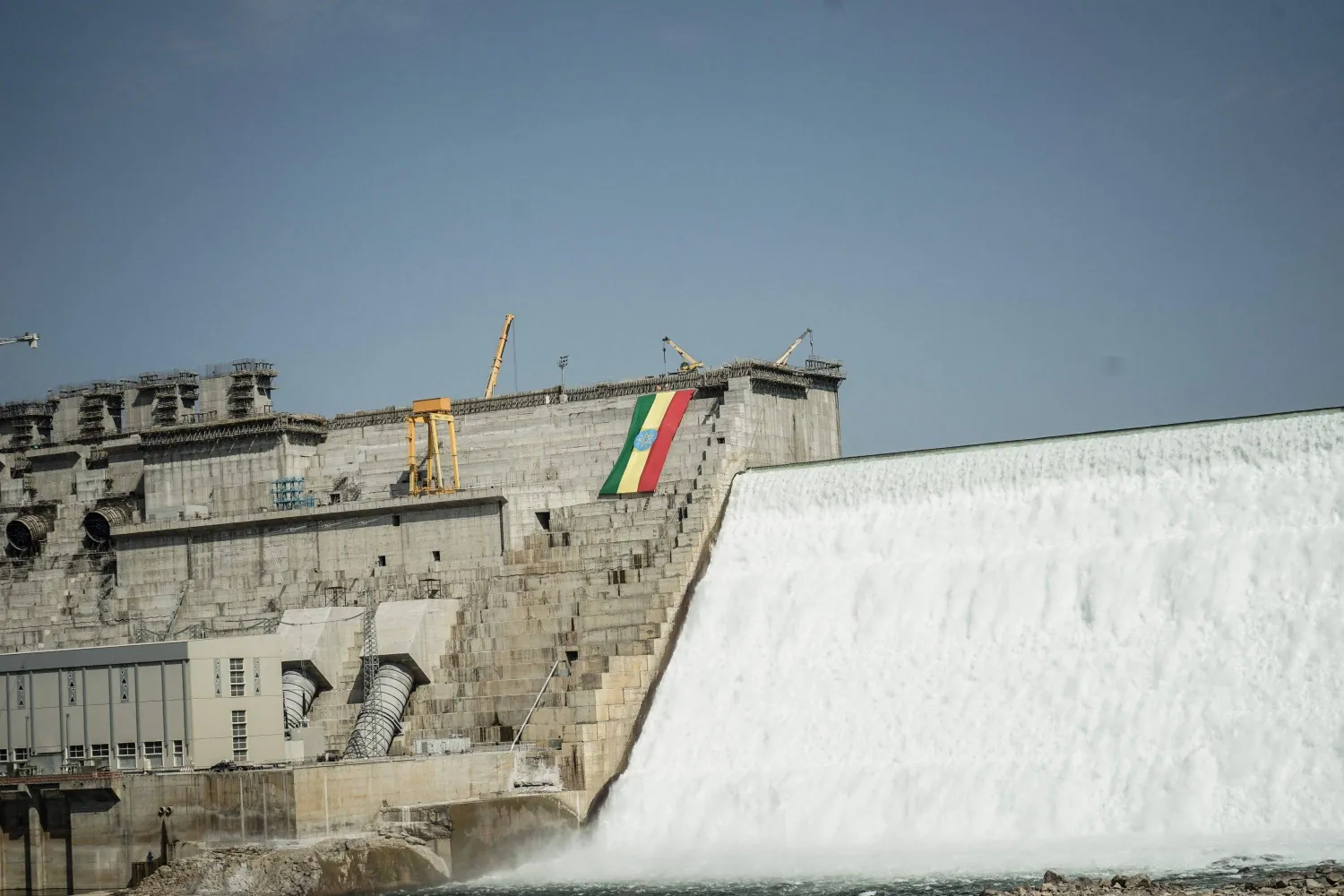
The Ethiopian national flag is seen at the Grand Ethiopian Renaissance Dam (GERD) in Guba, Ethiopia, Feb. 19, 2022. (AFP)
TT

Egypt Warns Ethiopia against Plans to Control Nile River Flows

The Ethiopian national flag is seen at the Grand Ethiopian Renaissance Dam (GERD) in Guba, Ethiopia, Feb. 19, 2022. (AFP)

An official Egyptian source warned on Sunday Ethiopia against plans to control the flows of the Nile River to downstream countries, in the latest tensions between Cairo and Addis Ababa over the Grand Ethiopian Renaissance Dam (GERD).

The official made the warning in wake of Ethiopia’s Minister of Water and Energy Habtamu Geleta saying that his country may build more dams on the river, effectively controlling its flow to Egypt and Sudan.

The source said Egypt has “several means at its disposal and is capable of defending the interests of its people when it comes to the Nile,” reported the state news agency MENA.

“Egypt will not accept or allow any party to control the Nile’s flow to downstream countries,” he declared.

Diplomats and observers told Asharq Al-Awsat that Ethipoia’s comments prove that the construction of the dam aimed to apply political pressure on Cairo and was not a development project as it had claimed.

The dispute over the Nile goes back 15 years since Ethiopia began constructing the dam and which it inaugurated around a year ago. Egypt fears that the dam will impact its share of the river water, which is vital for the people.

Arab and local media reported Geleta as saying that his country “will control the flows of the Nile” and that it is “determined to build more dams as part of its right to the fair use of its waters and achieve sustainable development.”

The Egyptian source, however, slammed the statements as more evidence of Addis Ababa’s unilateral actions and violation of international law.

They reflect its “delusions about its ability to impose control over a river it shares with others,” he added.

He warned that the statements are “dangerous” because they reveal an intent to impose a status quo on the ground and impose monopoly over a joint international water source.

“Ethiopia is using its geographic location to threaten the water rights and interests of downstream countries in violation of international law. Egypt will not allow it,” he vowed.

Cairo had previously declared before the UN Security Council that it will resort to all means at its disposal to protect the rights of people to the Nile, he noted.

‘Several options’

Salah Halima, former Assistant Foreign Minister and Deputy Chairman of the Egyptian Council for Foreign Affairs, said Cairo has “several options” at its disposal to protect its interests.

It can again resort to the Security Council and demand measures to resolve conflicts in line with Chapter 6, he told Asharq Al-Awsat.

Failure to comply, means it can resort to Chapter 7, which would then view the GERD as an act of aggression and a threat to human life, which demands self-defense, he added.

Chapter 6 calls for resolving disputes peacefully through negotiations and mediations, while Chapter 7 allows the Security Council the authority to impose measures through military and non-military means to preserve international peace and security.

Halima said Ethiopia’s latest statements demonstrate that the construction of the GERD was politically motivated to pressure Egypt.

The dam has already caused damage to Sudan where water levels are low, he noted.


Bilal Erdogan: Developments in Syria Will Restore Shared Ties Between Beirut, Tripoli and Turkish Cities

Bilal Erdogan, the son of Turkish President Recep Tayyip Erdogan, center, waves to his Lebanese supporters outside a mosque after Friday prayers in Tripoli, northern Lebanon, Friday, Nov. 13, 2026. (AP)
TT

Bilal Erdogan: Developments in Syria Will Restore Shared Ties Between Beirut, Tripoli and Turkish Cities

Bilal Erdogan, the son of Turkish President Recep Tayyip Erdogan, center, waves to his Lebanese supporters outside a mosque after Friday prayers in Tripoli, northern Lebanon, Friday, Nov. 13, 2026. (AP)

Bilal Erdogan, son of Turkish President Recep Tayyip Erdogan, called on Friday for greater regional unity to confront attacks on Gaza, the West Bank, southern Lebanon and Syria, voicing hope that recent developments in Syria would revive historic trade and economic ties between Lebanese, Syrian and Turkish cities.

Erdogan, President of the Board of Trustees of the Knowledge Dissemination Foundation, made the remarks in the northern city of Tripoli on the second day of his visit to Lebanon, where he was welcomed by political and religious figures and locals.

Speaking after prayers at the Grand Mansouri Mosque, his first stop in the city, Bilal Erdogan said he had brought a message from his father to the Lebanese people, aimed at strengthening relations and bonds of brotherhood between the two countries.

He also voiced hope for an end to war and conflict in Lebanon, paving the way for stability, recovery and prosperity similar to the development Türkiye had experienced over the past 24 years.

"God willing, this visit will help end the war in Lebanon and bring prosperity and recovery, as happened in Türkiye over the past 24 years," Bilal Erdogan said.

Turning to Syria, said recent developments could help restore the historic ties and shared economic interests linking cities across Lebanon, Syria and Türkiye.

"God willing, with the recent developments in Syria, the bonds of shared destiny between Beirut, Tripoli, Antakya, Damascus, Gaziantep and Istanbul will be restored, as they were in the past," he said.

"The people of these cities will once again engage in trade, cooperation, partnership and brotherhood."

He stressed the need to revive cooperation between Tripoli and cities in Syria and Türkiye, strengthening economic and social ties and reconnecting communities across the region.

Addressing Israeli attacks, Bilal Erdogan said regional unity and solidarity could deter further assaults and prevent wars from continuing.

He cited what he described as genocide in Gaza, violations against villages and homes in the West Bank, destruction in southern Lebanon and attacks in Syria.

“Those demolishing homes and seizing land in Gaza, the West Bank, Syria and southern Lebanon would not dare continue if the region's peoples stood united,” he said.

Bilal Erdogan toured Tripoli's old markets, the Mevlevi lodge, citadel and several Ottoman-era mosques.

He is due to visit Kouachra in the northern Akkar region on Saturday to meet residents of Turkmen descent before traveling to Beirut for talks with Prime Minister Nawaf Salam, who will host a luncheon in his honor to conclude the visit.

He kicked off his Lebanon visit on Thursday with meetings with President Joseph Aoun, Parliament Speaker Nabih Berri, former Progressive Socialist Party leader Walid Jumblatt, Lebanon's Grand Mufti Sheikh Abdel Latif Derian and Greek Orthodox Metropolitan of Beirut Elias Audeh.


UN Rights Chief Demands Houthis Return Body of Yemeni Staff Member

UN High Commissioner for Human Rights Volker Turk delivers a statement at the United Nations Offices in Geneva, on September 16, 2025. (AFP)
TT

UN Rights Chief Demands Houthis Return Body of Yemeni Staff Member

UN High Commissioner for Human Rights Volker Turk delivers a statement at the United Nations Offices in Geneva, on September 16, 2025. (AFP)

The UN's ‌human rights chief on Friday demanded the return of the body of a Yemeni staff member of his office who died of unknown causes weeks ago after being held in Houthi custody for more than two years.

Mohammad el-Shami's family learned of his death on October 30, more than a month after it occurred, but ‌they have received no ‌explanation of the cause ‌or ⁠circumstances. El-Shami ⁠had been held by the Houthi militia since June 6, 2024.

"Our colleague must be laid to rest in a dignified manner, in accordance with the wishes of his family – which was denied contact with him ⁠for two years while he ‌was in detention," ‌said United Nations High Commissioner for Human Rights Volker ‌Turk.

His family said the Houthis had ‌agreed in principle to an investigation in a statement earlier this week. "Do not allow Mohamed to die twice: once when he was taken from ‌his family and disappeared, and again when the truth about his ⁠fate ⁠is allowed to disappear from the world."

There was no immediate comment from the Houthis, who have previously alleged those detained were part of a spy network working for the United States and Israel.

More than 70 UN employees and dozens of humanitarian workers remain in detention in Yemen. A video circulating this week appeared to show one of them "confessing", Turk's office said, voicing fears that the group may be subject to torture or ill-treatment.


Palestinian Teen Reunites with Family After Month in Israeli Jail

The mother of Ezzedine al-Lahalia, a 15-year-old Palestinian teenager, kisses him as they reunite in the village of Al-Jib in the Israeli-occupied West Bank, late on November 12, 2026, after his release from an Israeli prison where he had spent a month in detention. (AFP)
TT

Palestinian Teen Reunites with Family After Month in Israeli Jail

The mother of Ezzedine al-Lahalia, a 15-year-old Palestinian teenager, kisses him as they reunite in the village of Al-Jib in the Israeli-occupied West Bank, late on November 12, 2026, after his release from an Israeli prison where he had spent a month in detention. (AFP)

Looking tiny in his adult-size grey prison jumpsuit, 15-year-old Palestinian Ezzedine al-Lahalia appeared stunned as his mother embraced him after a month in an Israeli jail.

His first request was a child's wish for his favorite food: stuffed cabbage and shawarma.

The teenager, who had been charged with throwing stones, was reunited with his family Thursday night in an emotional scene witnessed by an AFP photographer.

Ezzedine's mother held back tears as she kissed his cheeks, while the older men released alongside him greeted their wives and children.

Then Israeli troops fired tear gas, interrupting the families' reunions.

Lahalia, from the West Bank city of Sair, reunited with his family in the village of Al-Jib near Jerusalem, where Israeli authorities typically release Palestinian prisoners on Thursdays.

"After the Israelis brought the prisoners out, after we had received them, they fired tear gas," Ezzedine's mother, Rania Jaradat told AFP, adding that the scene was reminiscent of when soldiers took the boy from the family home on October 14, 2026.

"They were afraid that the families would assemble near the gate and celebrate," she said.

After Lahalia's release, she said, "the first thing he asked for was stuffed cabbage and shawarma". She happily complied.

He was released after the family paid 5,000-shekels (around $1,500) in bail.

As the eldest of five, his absence was particularly felt by his younger siblings.

"They're happy that I've returned, but they were very distressed while I wasn't with them," Ezzedine told AFP.

According to the Addameer Prisoner Support and Human Rights Association, 9,300 Palestinians are currently held in Israeli jails, including 350 minors.

Earlier this week, the military said it had shot a 14-year-old in a group of boys it suspected of throwing stones at a passing car in the north of the West Bank.

The Israeli human rights group B'Tselem noted an increase in deaths of Palestinians after the easing of open-fire rules in 2022 for stone throwers.