


Tel Aviv Says Kushner Accepts Netanyahu’s Position on Gaza

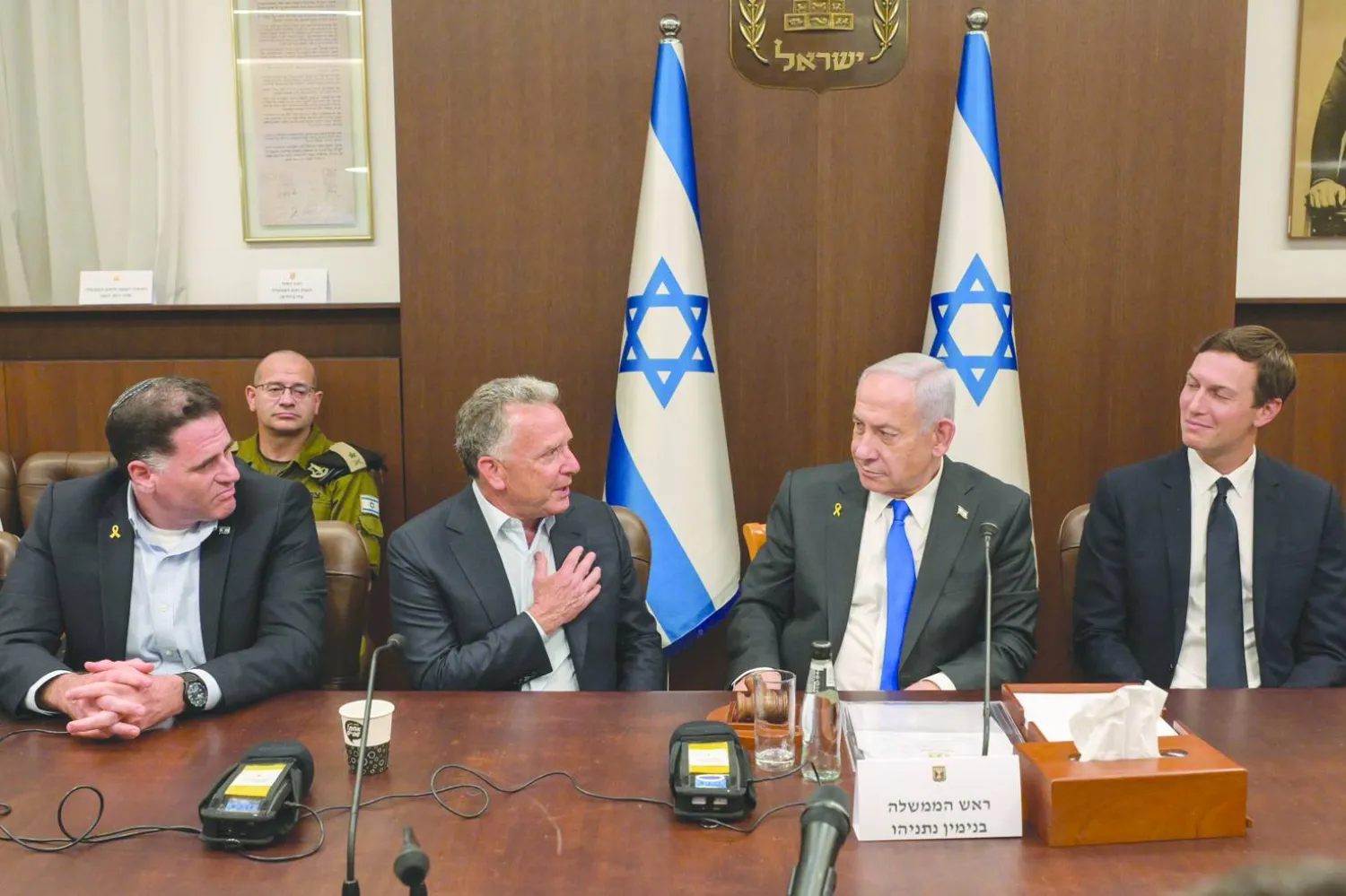
A handout photo made available by Israel's Government Press Office (GPO) shows Israeli Prime Minister Benjamin Netanyahu (2-R)  meeting with US President Trump's special envoy for the Middle East, Steve Witkoff, (2-L), the president's son-in-law, Jared Kushner (L), and Minister Ron Dermer (R), attending the Israeli cabinet meeting in Jerusalem , 09 October 2025  (EPA/Handout)
A handout photo made available by Israel's Government Press Office (GPO) shows Israeli Prime Minister Benjamin Netanyahu (2-R) meeting with US President Trump's special envoy for the Middle East, Steve Witkoff, (2-L), the president's son-in-law, Jared Kushner (L), and Minister Ron Dermer (R), attending the Israeli cabinet meeting in Jerusalem , 09 October 2025 (EPA/Handout)
TT

Tel Aviv Says Kushner Accepts Netanyahu’s Position on Gaza

A handout photo made available by Israel's Government Press Office (GPO) shows Israeli Prime Minister Benjamin Netanyahu (2-R)  meeting with US President Trump's special envoy for the Middle East, Steve Witkoff, (2-L), the president's son-in-law, Jared Kushner (L), and Minister Ron Dermer (R), attending the Israeli cabinet meeting in Jerusalem , 09 October 2025  (EPA/Handout)
A handout photo made available by Israel's Government Press Office (GPO) shows Israeli Prime Minister Benjamin Netanyahu (2-R) meeting with US President Trump's special envoy for the Middle East, Steve Witkoff, (2-L), the president's son-in-law, Jared Kushner (L), and Minister Ron Dermer (R), attending the Israeli cabinet meeting in Jerusalem , 09 October 2025 (EPA/Handout)

US President Donald Trump’s envoy and son-in-law, Jared Kushner, agreed to the position of Israeli Prime Minister Benjamin Netanyahu to continue assassinations and military operations in Gaza until Hamas fully disarms, Tel Aviv claimed on Monday.

The announcement came after Kushner met with ‌Netanyahu in Israel and a day after the American envoy met the political leader of Hamas in Egypt in a bid to revive a US plan to end the war in Gaza.

But as the two officials were meeting in Jerusalem, the Israeli military issued a warning saying Hamas was deceiving the US and mediators with a false appearance of moderation while maintaining their long-term objective of destroying Israel.

‘Lifeline’

According to the Israeli newspaper Maariv, security assessments indicate that Hamas views ongoing diplomatic US mediation efforts as a strategic “lifeline” while simultaneously attempting to repair its military infrastructure in Gaza under constraints.

Israeli security officials cited by the newspaper said that despite visible pragmatic statements, Hamas has not abandoned its core goals and actively identifies international and US-backed diplomatic tracks as a way to navigate pressure.

The newspaper doubted Hamas will fully honor its promises to relinquish all its weapons. It said Hamas will attack Israel again when given the chance, meaning that Israel must stay alert.

While Kushner and Netanyahu met for four hours on Monday, the Israeli army spokesman confirmed that its forces continued to launch raids on several areas in Gaza , as well as in the Ali Taher heights in southern Lebanon.

Washington’s concerns

According to Yedioth Ahronoth, Washington is increasingly concerned that Israel is trying to buy time, introduce new reservations and change the sequencing set out in Trump’s 15-point plan to end the war in Gaza.

“They feel Israel is playing games,” one source familiar with the details told the newspaper.

The message from Trump’s circle, according to sources cited by Yedioth Ahronoth, is essentially that Netanyahu must agree to the deal because the president has already delivered what Israel asked of him and now expects Israel to do the same.

People familiar with the president’s thinking also said Trump believes he has already given Netanyahu significant political support, including signals connected to the PM’s pardon request, and does not intend to keep paying for the same commitment.

Maariv cited US sources as saying that Netanyahu prioritizes his domestic political survival ahead of Israel's election in October, often discounting how his public rejections of US-led initiatives impact the Republican party, which is preparing for midterm elections in November with a slim House majority.

According to Haaretz, Trump has declined to endorse Netanyahu as a candidate in the October 27 election in part due to his poor showing in opinion polls and partially due to wartime disagreements.

Tougher message

According to people involved in the talks, the US wants Netanyahu to immediately implement a number of steps: halting attacks in Gaza, advancing withdrawals toward the yellow line, significantly increasing humanitarian aid deliveries and allowing reconstruction and civilian governance mechanisms to begin moving forward.

Unlike previous negotiation rounds, the message from Washington is now considerably tougher.

Trump wants agreements that have already been discussed to be implemented rather than reopened for another round of bargaining. A source familiar with the talks said the purpose is “to translate the roadmap commitments into concrete and verifiable steps.”



Risk of Escalation in Lebanon as Israeli Military Prepares for ‘Intensified’ Fighting

The rubble and debris of flattened buildings litter the hillside following an Israeli airstrike that targeted a neighborhood in the southern Lebanese village of Nabatieh al-Fawqa on August 15, 2026. (AFP)
TT

Risk of Escalation in Lebanon as Israeli Military Prepares for ‘Intensified’ Fighting

The rubble and debris of flattened buildings litter the hillside following an Israeli airstrike that targeted a neighborhood in the southern Lebanese village of Nabatieh al-Fawqa on August 15, 2026. (AFP)

The confrontation in southern Lebanon is entering a sensitive phase as Israeli military operations continue alongside US-mediated negotiations, while Israel’s Channel 12 has reported that the Israeli military is preparing for the possibility of several days of intensified fighting in Lebanon.

The report has raised questions over whether any escalation would remain contained or spread, although there has been no public indication of a decision to launch a wider war or set a deadline for negotiations.

Channel 12 reported that Israel remains determined to complete its operations in the Ali al-Taher Heights and linked the intensity of military activity to the negotiations. Washington, meanwhile, has reiterated its commitment to the “pilot zones” plan, maintaining that Hezbollah’s disarmament is part of the process.

Retired Lebanese Brig. Gen. Khalil Gemayel told Asharq Al-Awsat that Israeli preparations for several days of fighting did not, in his assessment, mean Israel intends to launch a broader war.

Rather, it wants to settle the battle for the Ali al-Taher Heights, securing a battlefield achievement, he added.

Any expansion of the confrontation would largely depend on the scale of Hezbollah’s response, particularly if it broadened its operations and struck Israeli communities, potentially prompting Israel to widen the fighting, he explained.

Gemayel described Ali al-Taher as a key defensive hub for Hezbollah in southern Lebanon, noting that Israeli forces were attempting to advance gradually along the hills toward sensitive positions, tunnel entrances and underground facilities with the assistance of specialized engineering units.

Hezbollah intervenes locally when Israeli troops approach critical points in its defensive network, he remarked.

Capturing the area could give Israeli Prime Minister Benjamin Netanyahu a military and political achievement while dealing Hezbollah a significant military loss, he noted.

15 August 2026, Lebanon, Nabatieh District: First responders are searching the rubble following an Israeli airstrike on a house in a tourist area of Ansar, southern Lebanon, before dawn, completely destroying the building and causing extensive damage to surrounding properties. (dpa)

Retired Brig. Gen. Naji Malaeb, meanwhile, said Israel’s escalation could be part of an attempt to draw Hezbollah into a response that would provide grounds for widening its operations.

He told Asharq Al-Awsat Israel may have used an incident that caused casualties in the Ali al-Taher Heights as a pretext to expand its operational reach beyond areas it occupies. He questioned whether Israel was attempting to provoke Hezbollah into a response that would allow it to broaden its military campaign.

Malaeb said increasingly forceful rhetoric from Hezbollah and its secretary-general, Naim Qassem, including warnings that Israel would “pay the price,” made that scenario worth considering.

A wider escalation would not necessarily begin with a ground advance. Israel could instead rely heavily on air power and expand its strikes to other areas, he went on to say.

Malaeb warned that expanding the conflict from the south deeper into Lebanon could also bring Iran into the confrontation, particularly if Beirut’s southern suburbs were targeted.

An Iranian response could provide Israel with a pretext to resume attacks on Iran even without US participation, he argued.

On the ground, the United Nations Interim Force in Lebanon (UNIFIL) reported a “significant increase in Israeli military activity in southern Lebanon” over the previous two weeks, recording an average of 137 projectiles a day between August 5 and 16.

Israeli operations continued across several areas. Drones dropped explosives around the Ali al-Taher Heights and Dabsha Hill, while Mansouri came under artillery fire. Strikes and shelling were also reported around Wadi al-Hujeir, Qantara, Aitaroun, Khiam, Hadatha and Mais al-Jabal, while Israeli forces carried out explosions in Bani Hayyan and Majdal Zoun.


Iraq to Probe Drone Attack on Kurdistan PM’s Office

Smoke billows after strikes near Erbil airport on July 24, 2026. (AFP)
TT

Iraq to Probe Drone Attack on Kurdistan PM’s Office

Smoke billows after strikes near Erbil airport on July 24, 2026. (AFP)

Iraq said on Monday it would launch an investigation into an overnight drone attack on the Iraqi Kurdistan prime minister's office, as Iran portrayed the incident as a ploy to undermine bilateral relations.

Kurdistan's authorities had earlier blamed the attack -- which also targeted the home of the autonomous region's intelligence chief -- on Tehran, saying the two drones had been launched from Iranian territory.

Since the start of the Middle East war, the Kurdistan region, which hosts US troops and foreign oil firms as well as rebels exiled from Iran, has been targeted with more than 1,000 attacks by Tehran and pro-Iran armed groups inside Iraq.

Drones have repeatedly been intercepted over Kurdistan's capital Erbil, while others have struck the rebels and US interests.

The office of Iraq's Prime Minister Ali al-Zaidi said he had "directed the formation of an investigative committee tasked with identifying the sources and launching points of the attack that targeted the office of" Kurdistan's Prime Minister Masrour Barzani.

Iranian foreign ministry spokesman Esmaeil Baqaei condemned the attack, "describing it as a highly suspicious development that requires vigilance and careful attention", according to a statement carried by state news agency IRNA.

Iran's foreign ministry said its top diplomat Abbas Araghchi held a phone call with his Iraqi counterpart on Monday.

"Nothing justifies the reckless attack on PM Barzani's office. Kurdish friends should be vigilant against false-flag ploys to sow discord between neighbors," Araghchi said on X.

US President Donald Trump's special envoy to Iraq, Tom Barrack, said "we strongly condemn the attack on our friend and valued Kurdish partner" Barzani, adding that the aggression was "unacceptable and a direct threat to regional stability".

Separately, an explosion at a petroleum products depot in eastern Iraqi Kurdistan injured 18 people, Kurdish media outlet Rudaw reported, without specifying the cause of the blast.

Hirsh Salim, deputy director general of health in Sulaimaniyah governorate, told the outlet that there were no fatalities.

Under pressure from the United States, Iraq has given pro-Iran armed groups in the country until September 30 to disarm, coinciding with the end of the US-led anti-ISIS coalition's mission.

Iraq is home to several powerful Iran-backed armed factions, which have seen their political and financial clout increase over the years.

Many emerged in the wake of the 2003 US-led invasion of Iraq and gained further power and prominence during the fight against the ISIS group from 2014 onwards.

They have long called for the withdrawal of American troops deployed within the coalition, and they have frequently hit bases hosting US troops.

While some armed groups announced they will cooperate to hand over weapons to the state, others remain adamant that the issue should not be discussed under US pressure.

- 'Dangerous escalation' -

Kurdish authorities said earlier on Monday that two Iranian drones had targeted Barzani's office and the home of the autonomous region's intelligence chief.

"Following an investigation by the Kurdistan Counter-Terrorism Unit, my personal office and the home of the head of the Security and Intelligence Agency were targeted by Iranian drone attacks earlier today," Barzani said in a post on X.

"This is a dangerous escalation and a direct threat to the security and stability of the Kurdistan region."

The regional Counter-Terrorism Directorate said there were no casualties in the attack.

"Two Hadid-110 type explosive-laden drones were launched from across the Iranian border toward the private office of the Kurdistan region prime minister and the residence of the Parastin Agency director," it said.

Tehran accuses the exiled Kurdish opposition groups of serving Western and Israeli interests, and continued to launch strikes against them even during a regional ceasefire announced in April, which eventually broke down.

The groups have mostly evacuated their bases and camps in Kurdistan since the war began.


Houthis Fire 5 Ballistic Missiles at Bab el-Mandeb

 Damage in the aftermath of Houthi strikes on the Red Sea port city of Mokha, Yemen, August 10, 2026 in this screengrab taken from a handout video. (Reuters/Handout)
Damage in the aftermath of Houthi strikes on the Red Sea port city of Mokha, Yemen, August 10, 2026 in this screengrab taken from a handout video. (Reuters/Handout)
TT

Houthis Fire 5 Ballistic Missiles at Bab el-Mandeb

 Damage in the aftermath of Houthi strikes on the Red Sea port city of Mokha, Yemen, August 10, 2026 in this screengrab taken from a handout video. (Reuters/Handout)
Damage in the aftermath of Houthi strikes on the Red Sea port city of Mokha, Yemen, August 10, 2026 in this screengrab taken from a handout video. (Reuters/Handout)

The Iran-backed Houthi group fired on Monday five ballistic missiles at the Bab el-Mandeb Strait in the Red Sea, days after their attacks on Yemen’s Mokha all but left it destroyed, taking it out of service.

Legitimate government media said that the Houthis fired two ballistic missiles near the al-Hamza camp in the Ibb provinces and three east of Taiz city.

The Houthis also continued their attacks on Mokha city, in the Taiz province, using rockets and drones.

The government forces continued to counter the Houthi attacks on several fronts.

In Mokha, dozens of sailors staged a protest against the Houthi attacks, calling on the international community to intervene urgently to stop them.

They urged the need to provide effective protection to marine waterways and to workers in the marine sector.

Mokha Port head Abdul Malik Al-Sharabi said the Houthi attacks in recent days left four security forces and three port staff dead.

The militants fired over 25 missiles at the facility, leaving extensive damage throughout, including vessels, the pier, and vital infrastructure, he revealed.

Sailors stage a protest against Houthi attacks on Bab el-Mandeb and the Red Sea. (AP)

He warned of the humanitarian and economic repercussions of the halt in navigation at the port, saying that some 1,300 workers have lost their sources of income.

Meanwhile, in Taiz, government forces repelled Houthi advances north of the city.

A statement from the armed forces, said the troops clashed with the Houthis, leaving casualties in their ranks.

Houth artillery strikes on northwestern Taiz left material damage, said military sources. No casualties were reported. The national resistance retaliated to the attacks.

The Yemeni Network for Victims Associations documented the killing and injury of 18 civilians in Houthi ballistic missile and drone attacks on Taiz, Marib, Hodeidah and Dhale between August 4 and 15.

During a press conference, the association said the attacks targeted homes, displacement camps and civilian infrastructure.

It called on the United Nations, its Security Council and the international community to take measures to protect civilians and hold the perpetrators accountable.

It also called for an independent international probe into the violations related to the use of ballistic missiles and drones.