
Syria Accuses Israel of Striking Military Airfield

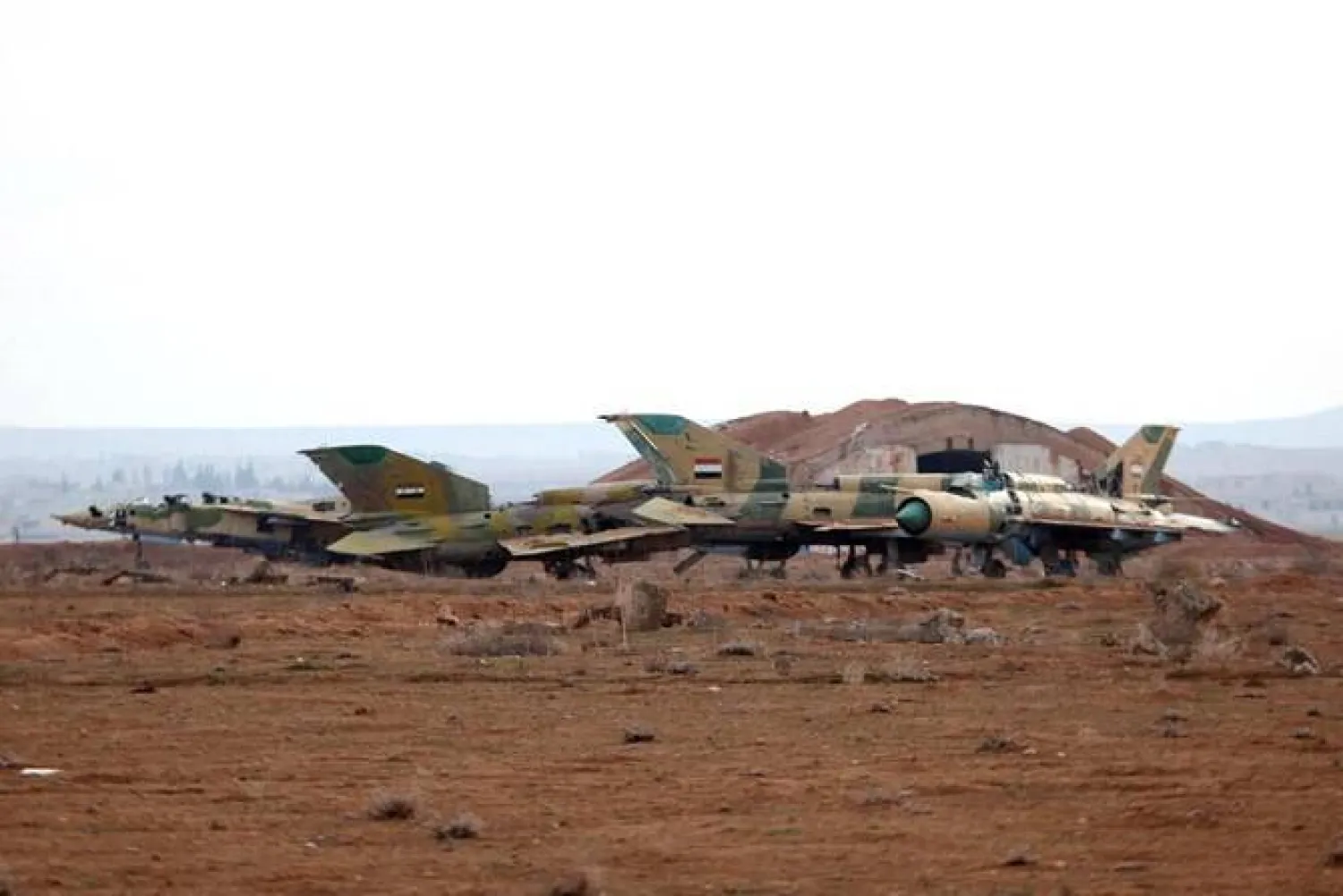
A picture taken on January 21, 2018 shows damaged Syrian air force fighter planes at the Abu Duhur military airport area in Syria's Idlib province. (File/AFP)
TT

Syria Accuses Israel of Striking Military Airfield

A picture taken on January 21, 2018 shows damaged Syrian air force fighter planes at the Abu Duhur military airport area in Syria's Idlib province. (File/AFP)

Syria accused Israel of striking a military airfield in the country's northwest on Tuesday, after a security source told AFP the out-of-service military facility had been hit. 

Israel has been carrying out incursions into Syrian territory since the December 2024 overthrow of longtime ruler Bashar al-Assad, including sending troops into a UN-patrolled buffer zone that separated Israeli and Syrian forces in the Israeli-occupied Golan Heights since 1974. 

It has also hit key military sites including several airfields, according to a Syria war monitor. 

"Israeli occupation aircraft early this morning targeted the runway of the Abu Duhur military airport... with eight strikes," Syrian state television quoted an unidentified military source as saying. 

It added that "the attack resulted in material damage to the airport's infrastructure, without causing casualties". 

Israeli officials have said they intend to keep forces in a "security zone" in southern Syria, where they seek a broader demilitarized zone. 

Damascus has repeatedly condemned incursions in the country's south. 

During a joint press conference with his French counterpart Emmanuel Macron in Damascus last month, Syrian President Ahmed al-Sharaa called for an "active French role" to halt Israeli escalations in his country. 

- 'Violations' - 

Syrian Foreign Minister Asaad al-Shaibani also last month condemned "the continuation of Israeli military actions" and warned that "the unlawful occupation of our land beyond the 1974 line is a direct threat to the security of the region". 

He demanded an "immediate and unconditional withdrawal". 

But last week Israeli Defense Minister Israel Katz said that his country planned to keep troops in Syria. 

Israel captured most of the Golan from Syria in the 1967 Arab-Israeli War and later annexed the areas under its control, in a move not recognized by most of the international community. 

The incursions have been condemned by the United Nations chief as "violations of Syria's sovereignty and territorial integrity". 

Despite tensions between the neighbors, Israel and Syria's new authorities have held several rounds of direct talks and have agreed to establish an intelligence-sharing mechanism. 

Syrian President Ahmed al-Sharaa in June denied that his country sought to intervene militarily in Lebanon where Israel and Hezbollah are at war, after US President Donald Trump suggested Damascus could get involved. 

Hezbollah fought alongside Assad in the country's civil war, making Sharaa and the new authorities who toppled the former leader in 2024 deeply hostile to the group. 

Syria's war shattered the country's infrastructure and pushed millions of people to flee internally and abroad. 


Syria Arrests Nine Former Assad-Era Pilots

The Internal Security Forces arrested the nine former military pilots following a series of operations in Latakia. (SANA)
TT

Syria Arrests Nine Former Assad-Era Pilots

The Internal Security Forces arrested the nine former military pilots following a series of operations in Latakia. (SANA)

Syrian authorities said Thursday nine former pilots, including three generals, who are accused of having taken part in lethal bombings of towns and villages under the former rule of Bashar al-Assad, had been arrested.

For more than 13 years of a civil war that claimed over half a million lives, Syrian forces relentlessly shelled areas held by the opposition before Assad was toppled in December 2024 and the current government came to power.

Following a series of operations in Latakia in the country's west, the Internal Security Forces arrested nine former military pilots "involved in war crimes against the Syrian people... in several regions", news agency SANA reported, citing authorities.

Among them are generals Menhel Anwar Saleh, Sami Ibrahim Mahmoud, and Ghayath Ali Rehye.

"Their crimes caused a large number of casualties... and inflicted extensive damage on towns and villages, in addition to displacing residents and destroying homes and civilian infrastructure," SANA added.

Since al-Assad was overthrown, the new authorities have arrested dozens of former security officials, and trials began in April.

Syrian authorities said Monday they had arrested a former general accused of involvement in the bloody repression of protests in 2011 that sparked the country's civil war and the 1982 Hama massacre.

Syria sentenced Assad, his brother Maher al-Assad, and five other security officials to death in absentia in August for atrocities committed during the civil war, the first such ruling under the new authorities.

The former president fled Syria as his government fell and is believed to be living in Russia.


Israel Assassinates Qassam’s Commander of the Khan Younis Brigade

Mohammad al-Yazouri, also known as "Abu Al-Haitham," commander of Gaza's Khan Younis Brigade in the Qassam Brigades.
TT

Israel Assassinates Qassam’s Commander of the Khan Younis Brigade

Mohammad al-Yazouri, also known as "Abu Al-Haitham," commander of Gaza's Khan Younis Brigade in the Qassam Brigades.

The Israeli army assassinated Mohammad al-Yazouri, also known as "Abu Al-Haitham," commander of Gaza's Khan Younis Brigade in the Qassam Brigades, the armed wing of the Hamas movement.

He and Hudhaifa Abu Muammar, an engineer in the Qassam Brigades, were killed in an Israeli drone strike while they were walking in the Al-Mawasi area at midnight Thursday-Friday.

Field sources told Asharq Al-Awsat that al-Yazouri was not quickly identified, as he was in pieces and his body, including his face, was disfigured.

The sources revealed that the sudden loss of contact with him prompted some of those close to him to try to find out if he was the target, and it became clear in the early hours of dawn that he was among the victims.

According to two sources, Al-Yazouri assumed responsibility for the Khan Younis Brigade shortly after the assassination of the brigade leaders Ezzedine al-Haddad and Mohammad Oudeh, who were assassinated within ten days in May.

Al-Yazouri was the commander of central and western Khan Younis, before becoming the general commander of the brigade.

He worked for years in other positions within the Qassam leadership, including the intelligence apparatus, which was one of the agencies that worked on gathering security information in preparation for the October 7, 2023, attack.

A third source said al-Yazouri escaped several assassination attempts, whether during the current war or years before it.

One of the most prominent attempts occurred when he was with Rafe Salama, Mohammad Sinwar, and Yahya Sinwar in a tunnel in Khan Younis in 2021. Israeli planes bombed the site with several missiles during what was known as the battle of the "Sword of Jerusalem," which Israel named "Guardian of the Walls." Everyone survived the attack.

Al-Yazouri was one of the leaders who supervised the October 7 attack, and he also played a role in the operations of handing over the abducted Israelis during the exchange deals.

Abu Muammar was an engineer in the Qassam Brigades who was responsible for developing the military capabilities of the brigades and was close to its prominent leaders.

He was responsible for several attacks against Israeli forces during the Gaza war and others before it.


Iraq Says Dialogue over Factions’ Weapons to Continue After Sept. 30 Deadline

Vehicles of the Iraqi army at the entrance to the capital Baghdad’s suburb of Sadr City. (AFP file)
TT

Iraq Says Dialogue over Factions’ Weapons to Continue After Sept. 30 Deadline

Vehicles of the Iraqi army at the entrance to the capital Baghdad’s suburb of Sadr City. (AFP file)

The Iraqi government said on Thursday that the plan to impose state monopoly over weapons will begin after the complete withdrawal of anti-ISIS coalition forces by the September 30 deadline.

It stressed that dialogue is taking place at the highest levels with armed factions to ensure the success of the plan.

Spokesperson for the commander-in-chief of the Iraqi Armed Forces Sabah al-Numan said September 30 is the final deadline for ending the mission of the coalition and for the remainder of foreign forces to pull out of Iraq.

The withdrawal process is accelerating with the foreign forces showing a commitment to the deadline to end their mission in the country, he added.

ISIS has been defeated militarily in Iraq despite the continued presence of cells and remnants of the group, he remarked.

The armed forces are at the highest level of readiness to confront and destroy them, he declared.

On the armed factions, Numan said dialogue was ongoing with them over having them lay down their weapons, but the implementation will take place after the coalition ends its mission in Iraq.

Prime Minister Ali al-Zaidi had set as a priority the issue of imposing state monopoly over weapons. In remarks in June, he said there was no need for the “resistance” to remain after US troops pull out of Iraq.

The plan to impose state monopoly over weapons has lost momentum in recent weeks. Circles close to the government said they were hoping that negotiations with the factions would be a success.

Security expert Hussein Allawi told Asharq Al-Awsat that the negotiations between the government and factions have entered a second phase through the formation of a committee that will facilitate the dialogue and reach common ground over “organizing the weapons”.

The government’s strategy after September 30 will focus on implementing its program with regards to development, reconstruction, investment and economic reform, as well as consolidating security, he added.

Professor at Al-Mustansiriya University Taleb Karim told Asharq Al-Awsat that the success of the plan is not measured by its existence on paper, but by the state’s ability to unify security decision-making and invest years of field experience in institutions and sustainable abilities in order to prevent Iraq from being used as an arena for the conflicts of others.

On the Kurdistan Region, spokesman Numan said coordination is ongoing between it and the federal government in Baghdad.

A high-level security meeting was held this week that included leaders of the Peshmerga forces during which urgent recommendations were raised for implementation, including securing border crossings.

The Kurdistan government is meanwhile ensuring that counter-terrorism efforts will continue with the international coalition.

President Nechirvan Barzani received Vice Admiral Edward Ahlgren, the UK Defense Senior Advisor to the Middle East and North Africa, for talks on joint coordination to fight ISIS remnants and terrorist threats,

A joint statement said they tackled the Iraqi government’s efforts to impose state monopoly over weapons and to unify Peshmerga forces.