

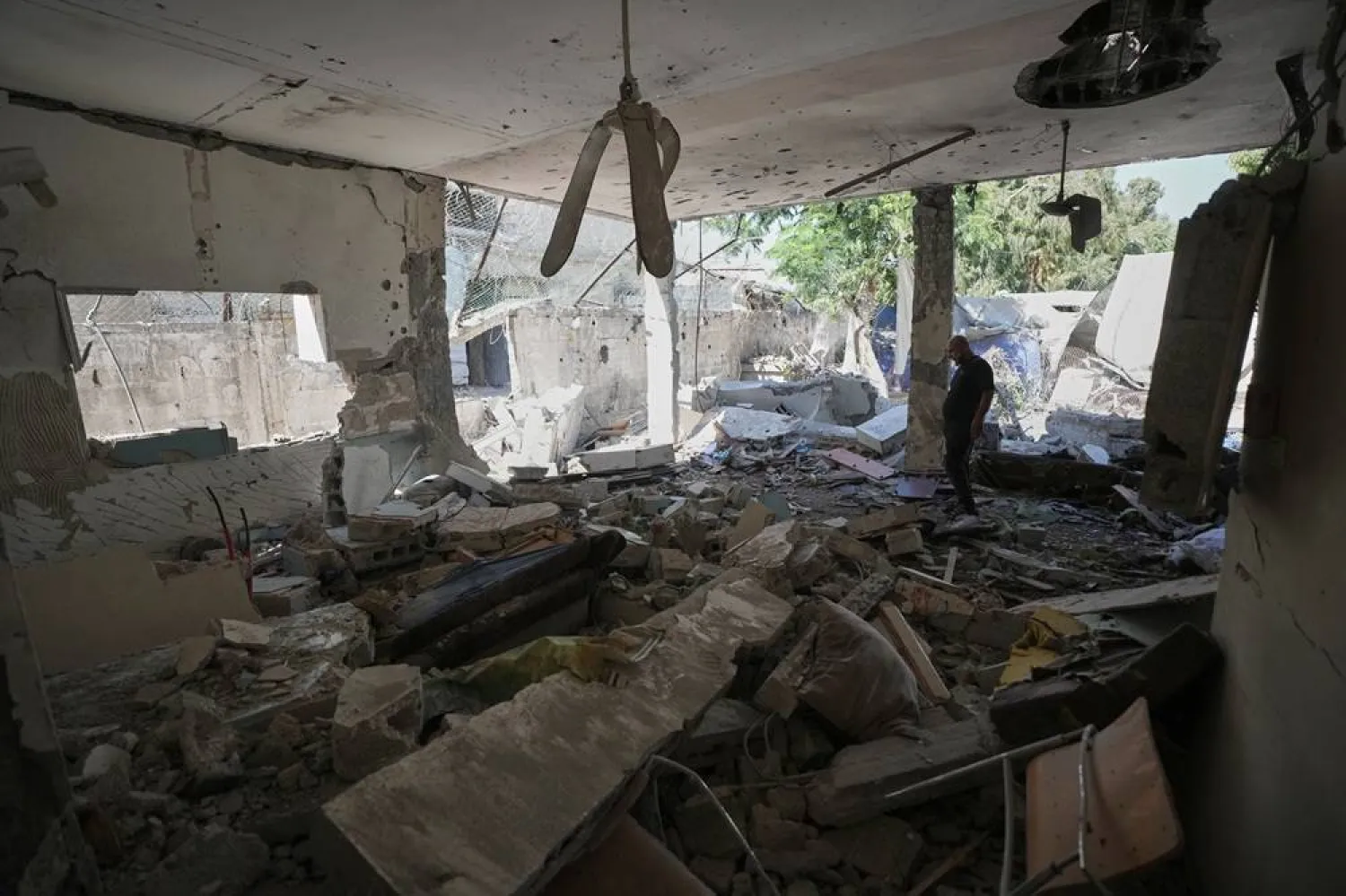

Gaza Health Officials Say Israeli Strike on Police Station Kills 9

Palestinians inspect the damage at a police station that was hit by an Israeli airstrike in Gaza City, Wednesday, Aug. 19, 2026. (AP)
TT

Gaza Health Officials Say Israeli Strike on Police Station Kills 9

Palestinians inspect the damage at a police station that was hit by an Israeli airstrike in Gaza City, Wednesday, Aug. 19, 2026. (AP)

Gaza health officials said an Israeli strike on the municipal police headquarters in Gaza City killed nine people on Wednesday, with the Israeli military saying it targeted a Hamas commander in that strike and another further south.

Attacks in the Palestinian territory have continued in recent days, despite a renewed push by the United States to advance a long-term Gaza peace plan.

Gaza City's Al-Shifa Hospital reported the arrival of nine bodies, including a woman and a girl, and at least 20 wounded following the strike in Gaza City.

The territory's civil defense agency, which operates as a rescue service under Hamas, confirmed the toll.

The Israeli military said the strike on the police headquarters targeted a Hamas commander who it said had planned to carry out attacks against troops in the territory.

"Prior to the strike, steps were taken to mitigate harm to civilians, including the use of precise munitions and aerial surveillance," it added.

It said it had also struck a commander in Hamas's military wing in the Nuseirat area in the central Gaza Strip.

Hamas spokesman Hazem Qassem condemned what he called Israel's "complete disregard for all calls for a ceasefire".

He said US President Donald Trump's Board of Peace, which is tasked with implementing the ceasefire plan agreed last October, "bears responsibility for this escalation due to its failure to fulfill its obligations by pressuring the occupation" to abide by its commitments.

Trump's envoy Jared Kushner had said on Monday that progress towards disarming Hamas and moving forward with the Gaza peace plan could begin within a month following a meeting with Israeli Prime Minister Benjamin Netanyahu.

The sit-down came two weeks after Hamas endorsed the latest stage of Trump's Gaza plan.

Netanyahu, however, has refused to support the roadmap, vowing not to withdraw troops until the Palestinian movement is "genuinely disarmed".

Gaza health officials said Tuesday that an Israeli airstrike killed six people in the port of Gaza City, with the Israeli army saying it had targeted several Hamas commanders.



Lebanon Says Received French Invitation to Meeting on Army Support

13 August 2026, Lebanon, Zawatar al-Gahrbiyeh: Lebanese army soldiers secure the premises of "Our Lady of the Annunciation" Monastery in Zawatar al-Gahrbiyeh. (dpa)
TT

Lebanon Says Received French Invitation to Meeting on Army Support

13 August 2026, Lebanon, Zawatar al-Gahrbiyeh: Lebanese army soldiers secure the premises of "Our Lady of the Annunciation" Monastery in Zawatar al-Gahrbiyeh. (dpa)

Lebanon said Wednesday it had received an invitation from France for a meeting to prepare for an international conference on support for the Lebanese army, an event postponed by the Middle East war.

The conference in Paris was supposed to take place in March but was delayed after the Hezbollah group drew Lebanon into the regional war by attacking Israel in support of its backer Iran.

Lebanon said in a statement Wednesday that President Joseph Aoun had "received from the French charge d'affaires in Lebanon, Bruno Da Silva, a letter from French President Emmanuel Macron that included an invitation for Lebanon to participate in a preparatory meeting to be held in Paris on September 17".

Aoun thanked Macron for the invitation, praising "the constant interest he shows towards Lebanon and its national institutions, foremost among them the army and the Internal Security Forces".

He said the invitation highlighted the importance of "supporting the Lebanese army with the aim of enabling it to possess the capabilities and resources necessary to carry out its responsibilities effectively".

The army "requires international support and a collective effort to meet its operational needs, logistical equipment, training and capacity building", the statement by the Lebanese presidency added.

Army chiefs from several countries, as well as representatives from governmental and international organizations, along with experts, are expected to attend the meeting, according to the presidency.

France did not announce anything on Wednesday related to the conference.

In February, French Foreign Minister Jean-Noel Barrot visited Lebanon to prepare for the event.

Beirut received pledges of international support for its troops after Lebanon's government committed to disarming Hezbollah last year and tasked the army with the process.

Hezbollah has been weakened by over a year of hostilities with Israel, which a November 2024 ceasefire sought to end, although the fighting has not been completely halted.

Lebanon and Israel have since entered US-sponsored direct talks in an effort to end hostilities. In June they signed a framework agreement that calls for the disarmament of Hezbollah, a gradual withdrawal of Israeli forces from south Lebanon and the deployment of the Lebanese army to the region, starting in "pilot zones".

But the Lebanese military faces major challenges amid a shortage of equipment, personnel, and technical capabilities necessary to carry out its mission.


Visiting Iraq, Iran’s Parliament Speaker Hails ‘New Order’ in the Region

 Iran's Parliament Speaker Mohammad Bagher Ghalibaf (C) speaks during a press conference at the site where Qassem Soleimani, commander of the Quds Force of Iran's Revolutionary Guards Corps (IRGC), was killed by a US airstrike in 2020, near the airport, upon his arrival in Baghdad on August 19, 2026. (AFP)
Iran's Parliament Speaker Mohammad Bagher Ghalibaf (C) speaks during a press conference at the site where Qassem Soleimani, commander of the Quds Force of Iran's Revolutionary Guards Corps (IRGC), was killed by a US airstrike in 2020, near the airport, upon his arrival in Baghdad on August 19, 2026. (AFP)
TT

Visiting Iraq, Iran’s Parliament Speaker Hails ‘New Order’ in the Region

 Iran's Parliament Speaker Mohammad Bagher Ghalibaf (C) speaks during a press conference at the site where Qassem Soleimani, commander of the Quds Force of Iran's Revolutionary Guards Corps (IRGC), was killed by a US airstrike in 2020, near the airport, upon his arrival in Baghdad on August 19, 2026. (AFP)
Iran's Parliament Speaker Mohammad Bagher Ghalibaf (C) speaks during a press conference at the site where Qassem Soleimani, commander of the Quds Force of Iran's Revolutionary Guards Corps (IRGC), was killed by a US airstrike in 2020, near the airport, upon his arrival in Baghdad on August 19, 2026. (AFP)

Iran's parliament speaker Mohammad Bagher Ghalibaf on Wednesday stressed the importance of strengthening the "new order" in the region, on the first stop in a three-day visit to Iraq.

Ghalibaf's trip comes at a time when Iraq is facing American pressure to disarm factions close to Tehran, which wields significant political influence in Iraq.

Prime Minister Ali al-Zaidi, who took office three months ago with US backing, has pledged to restrict weapons to the control of the state.

Speaking from the site near Baghdad airport where Iranian Revolutionary Guards Quds Force commander general Qassem Soleimani was killed in a 2020 US strike, Ghalibaf said: "Our trip to Iraq today is aimed at strengthening the new order in the region and accelerating the strengthening of cooperation between all countries in the region without foreign interference."

"Resistance in Iraq is... one of the elements of this country's power. Today, resistance has gone beyond the borders of Iran and Iraq... and has become global," he added.

Ghalibaf is scheduled to meet Zaidi later on Wednesday and then hold a meeting with the Coordination Framework, the largest bloc in parliament, made up of Shiite parties with varying degrees of proximity to Tehran.

Iraq has been pulled into the Middle East war, with pro-Iran factions have launching attacks on US interests, which Washington has responded to with deadly strikes. Iran has also shelled positions belonging to Iranian Kurdish opposition groups.

Iraq is facing mounting challenges in maintaining a balance between Iran and the United States, and since the US invasion in 2003 it has been an arena of rivalry between the two powers.

Zaidi has given the armed factions -- some of which belong to the Iran’s so-called “Axis of Resistance” -- until September 30 to hand over their weapons to the state, coinciding with the scheduled end of the mission of the US-led coalition against the ISIS group.

Some of the most powerful factions, however, and those closest to Iran, refuse to cooperate.

On Thursday, Ghalibaf will head to the city of Karbala where he will take part in ceremonies marking 40 days since the funeral of former Iranian supreme leader Ali Khamenei, who was killed in US-Israeli strikes on February 28.


Canadian Official Condemns Israel’s ‘Unlawful Invasion’, Announces New Aid to Lebanon

Canada's Secretary of State for International Development Randeep Sarai speaks during an interview with The Associated Press in Beirut, Lebanon, Tuesday, Aug. 18, 2026. (AP)
TT

Canadian Official Condemns Israel’s ‘Unlawful Invasion’, Announces New Aid to Lebanon

Canada's Secretary of State for International Development Randeep Sarai speaks during an interview with The Associated Press in Beirut, Lebanon, Tuesday, Aug. 18, 2026. (AP)

A Canadian government official condemned Israel’s “unlawful invasion” of Lebanon, saying Beirut should govern its own space and have sovereignty over its lands.

Randeep Sarai, Canada’s secretary of state for international development, visited Lebanon to announce new humanitarian aid to the crisis-hit country, where the UN says some 360,000 people remain displaced as a result of the latest conflict between Israel and the Iran-backed Lebanese Hezbollah group.

“We have been working actively, I think, through diplomatic channels to do whatever possible to stop that and to allow Lebanese communities that are from those areas to be able to move back," Sarai said in an interview with The Associated Press late Tuesday.

The latest Israel-Hezbollah war started when Hezbollah fired rockets into northern Israel on March 2, two days after the US and Israel began attacks on Iran. The war has killed over 4,000 people, caused wide destruction in southern Lebanon and at one point displaced over 1 million people.

Israel launched a ground invasion and is now occupying dozens of towns and villages in southern Lebanon, many of which have been almost completely demolished. Israeli officials have said they will not pull out from Lebanon until Hezbollah is disarmed.

Canada has criticized Israel's military actions in Gaza and Lebanon. It lists Hezbollah as a terrorist organization and has condemned its attacks on Israel.

During his visit, Sarai announced that Canada is launching three new programs in Lebanon to support vulnerable families and women, raising the total of its assistance to the nation so far this year to more than 71 million Canadian dollars ($50.23 million).

Canada, which is home to a large Lebanese diaspora, has given Lebanon about 800 million Canadian dollars ($575 million) in assistance over the past 10 years, including nearly $38 million in funding in March to provide basic necessities such as food, medical and health services, Sarai said.

“Our commitment is long-term, and we’re there for Lebanon,” said Sarai, who visited shelters housing people displaced by the war and Syrian refugees during his visit.

Sarai also met President Joseph Aoun and Prime Minister Nawaf Salam, who both took their posts last year promising to reinstate state authority over all parts of Lebanon and to implement reforms to fight corruption. The country is still struggling with an economic crisis that began in late 2019 rooted in decades of corruption.

“There’s a lot of optimism and I hope Lebanon will be able to deliver on these,” said Sarai about the pledged reforms. “The world is really watching and supportive of this government, and optimistic that they will achieve those goals."

Sarai said Canada is trying to help create a safe environment in Syria with access to food, drinking water and schools, so that more refugees can return.

“We’ll do whatever we can to make sure that environment is safe when they do decide to go back,” he said.

At one point during Syria's nearly 14-year civil war, Lebanon hosted an estimated 1.5 million refugees.

Some half-million Syrians have returned since former Syrian President Bashar al-Assad was ousted in December 2024, according to Lebanon’s social affairs minister.