


Sudan: More Than 200,000 People Displaced Since Eruption of Blue Nile Fighting

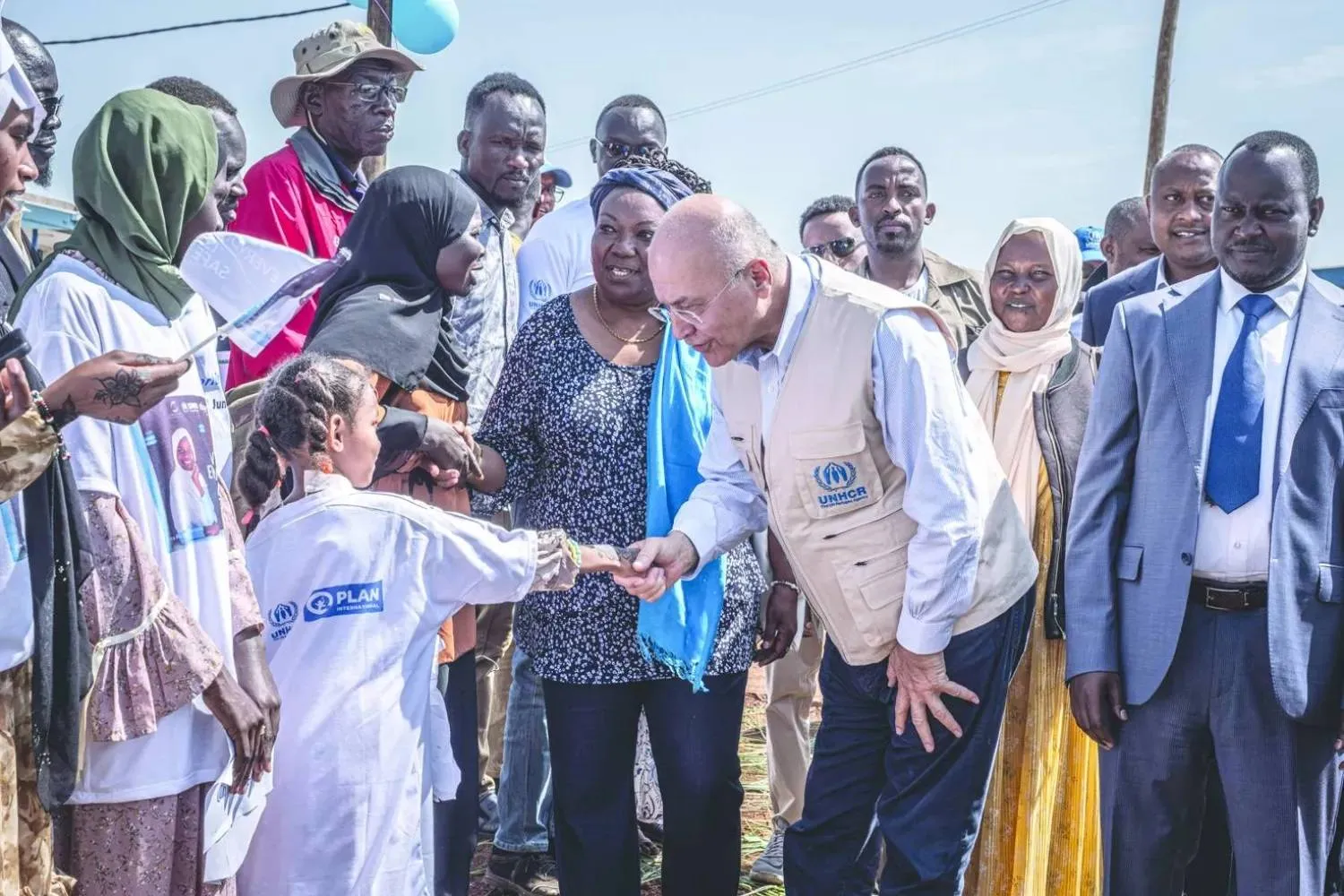
UN High Commissioner for Refugees Barham Salih meets Sudanese refugees in Ethiopia's Ura camp. AFP
TT

Sudan: More Than 200,000 People Displaced Since Eruption of Blue Nile Fighting

UN High Commissioner for Refugees Barham Salih meets Sudanese refugees in Ethiopia's Ura camp. AFP

A Sudanese government official has confirmed that more than 200,000 people have been displaced from the cities of Kurmuk and Qeisan, as well as other areas in the Blue Nile state in southeastern Sudan, as a result of fighting between the Sudanese army and the Rapid Support Forces (RSF).

Warnings have been issued about the worsening humanitarian and health conditions facing the displaced, amid heavy rainfall, shortages of food and shelter materials, and difficulties in delivering aid.

Last week, forces belonging to the Tasis (Foundation) alliance, led by the RSF, announced that they had taken control of the strategic cities of Kurmuk and Qeisan, located near the Ethiopian border.

This development triggered a large wave of displacement toward safer areas, particularly the cities of Damazin, the regional capital, and Roseires, the state's largest city.

Hashim Orta, Commissioner of Voluntary Return and Displaced Persons in the Blue Nile region, told Asharq Al-Awsat that the number of people displaced from Kurmuk, Qeisan, and other towns had exceeded 200,000 since the outbreak of hostilities.

He stressed that they are living under “extremely difficult humanitarian conditions.”

The Commission of Voluntary Return and Displaced Persons in the Blue Nile is a local government body responsible for monitoring the conditions of displaced persons and refugees, coordinating their return, and supporting their reintegration.

The origins of Sudan’s voluntary return mechanism date back to 2003, when a displacement and voluntary return unit was established under the Humanitarian Aid Commission.

Orta added that pregnant women and elderly men and women died while attempting to flee the fighting, enduring arduous displacement journeys that lasted several days. Many were forced to walk long distances through heavy rain and over difficult terrain.

According to Orta, displacement camps and reception centers around Damazin have received tens of thousands of civilians in recent days, most of them women and children. Their needs for food, drinking water, healthcare, and shelter materials continue to grow.

The total figure provided by the local official could not be independently verified.

The Commission of Voluntary Return and Displaced Persons is not affiliated with the United Nations, but it works in cooperation with UN agencies and international organizations, including the UN Refugee Agency (UNHCR) and the International Organization for Migration (IOM), on issues related to displacement, return, and humanitarian assistance.

Fears of Disease Outbreaks

The local government official warned of increasing health risks within displacement sites, particularly during the rainy season. He expressed concern about the potential spread of malaria, dengue fever, and other seasonal diseases, amid overcrowded shelters and weak healthcare services.

He said local authorities were making efforts to provide food, water, and shelter materials, but the available resources were far from sufficient to meet the scale of needs and the growing numbers of people arriving each day.

“The need is immense compared to the numbers flowing into the camps,” he said, calling on local, regional, and international organizations to intervene urgently and provide humanitarian assistance to those affected.

The continuing fighting has further complicated the humanitarian response, as insecurity in several areas is preventing aid organizations and supplies from reaching residents and displaced people. At the same time, local authorities are facing mounting pressure to provide basic necessities for the large numbers of people fleeing the violence.

Displacement Journey Amid Heavy Rains

Eyewitnesses described harsh conditions faced by civilians traveling from conflict areas toward Damazin and Roseires. They said heavy rainfall had severely damaged dirt roads and made them difficult to cross, forcing some families to walk long distances under extremely challenging conditions.

The crisis is compounded by the geography of the Blue Nile region, where seasonal rains cause rivers and streams to swell and cut off a number of roads, making civilian movement and the delivery of humanitarian aid even more difficult.



Khaddam Recounts Final Damascus Meeting… Bashar to Hariri: ‘Whoever Defies Me, I Will Break His Bones’

Former Syrian Vice President Abdul Halim Khaddam (Reuters)
TT

Khaddam Recounts Final Damascus Meeting… Bashar to Hariri: ‘Whoever Defies Me, I Will Break His Bones’

Former Syrian Vice President Abdul Halim Khaddam (Reuters)

Former Syrian Vice President Abdul Halim Khaddam reveals new details in his memoirs about a meeting between former Syrian President Bashar al-Assad and Lebanese Prime Minister Rafik Hariri in Damascus in the summer of 2004, describing it as the harshest encounter in the period leading up to Hariri’s assassination.

The memoirs, edited and introduced by Ibrahim Hamidi, are due to be published in early September by Raff Publishing, a subsidiary of the Saudi Research and Media Group (SRMG).

The book cover

According to the memoirs, Assad summoned Hariri in July for a meeting at 7:30 a.m. attended by Maj. Gen. Ghazi Kanaan, Brig. Gen. Rustom Ghazaleh and Col. Mohammed Khallouf. Assad’s harsh words caused Hariri’s blood pressure to rise and his nose to bleed.

The memoirs trace the roots of the crisis to the 1998 election of Lebanese army commander Gen. Emile Lahoud as president. Khaddam recounts that Bashar al-Assad pushed for Lahoud to succeed President Elias Hrawi, persuading his father, President Hafez al-Assad, to back the army commander despite objections from most Lebanese leaders close to Damascus, including Walid Jumblatt, Nabih Berri and Hariri. Khaddam also says Ghazi Kanaan pressured Lebanese lawmakers to support Lahoud.

Khaddam says he subsequently asked Hafez al-Assad to relieve him of responsibility for the Lebanon portfolio because his opposition to Lahoud was well known. The file then passed to Bashar al-Assad.

“Thus ended the political management of this complicated file, and it fell into the hands of the Syrian security services,” Khaddam writes.

Later that same morning, Khaddam says he was scheduled to meet Assad and found him “agitated and tense.” Assad recounted his meeting with Hariri directly to him.

“Rafik Hariri was here, and I spoke to him clearly and frankly in the presence of the officers,” Khaddam quotes Assad as saying. “I told him he was not allowed to work to bring in a president other than Emile Lahoud. I am the one who chooses who governs Lebanon, and whoever defies me, I will break his bones.”

From right: Fares Boueiz, Rafik Hariri, Farouk al-Sharaa, Elias Hrawi, Abdel Halim Khaddam, and Ghazi Kanaan during a meeting at Baabda Palace (Getty)

Khaddam says he was stunned by the remarks and challenged Assad: “You are speaking to the prime minister of Lebanon, who represents the Sunni Muslims in his country. Have you considered the repercussions if your words reach the media? How can you address Lebanon’s prime minister this way in the presence of these officers?”

According to Khaddam’s account, Assad then calmed down and asked his vice president to invite Hariri to meet him in an effort to “erase the consequences” of the encounter.

The memoirs say Hariri initially refused, telling Khaddam by telephone: “After my last visit, I will not visit Damascus.”

He later agreed to meet Khaddam in Bloudan, northwest of Damascus, where he appeared “hurt.”

“I will never forget my meeting with Bashar al-Assad as long as I live,” Hariri told him.

Bashar al-Assad meeting with Emile Lahoud, Nabih Berri, and Rafik Hariri (Getty)

The memoirs go on to recount the dispute over extending Lahoud’s presidential term. On Aug. 18, 2004, Khaddam says Assad told him he had decided against an extension.

“No one in the world supports Lahoud. The Arab states do not support him, and the majority of Lebanese oppose him,” Assad is quoted as saying, adding that he had been “firm” with the Lebanese president.

Just three days later, however, while Khaddam was in France, Hariri called to tell him that Assad had changed his mind and summoned him to Damascus for a brief and tense meeting.

“You have to decide where you stand. Are you with Syria or against it?” Assad told Hariri, according to Khaddam’s account of what Hariri later told him.

Khaddam writes that Hariri told him Jumblatt had advised him to accept the extension and then resign. Khaddam himself advised Hariri to agree to the extension, leave Lebanon and announce his resignation from abroad.

Hariri subsequently informed Rustom Ghazaleh that he accepted the extension and traveled to Sardinia to join his family. Days later, Khaddam says, Hariri called him and asked: “If I return to Lebanon, will my life be in danger?”

Khaddam reassured him that he had agreed to everything demanded of him and that Assad “still needs him because the constitutional amendment has not yet been completed.”

The memoirs also recount a last-minute attempt, through Spanish mediation, to avert a UN Security Council meeting. After five hours of contacts, Washington, Paris and London agreed to cancel the session in return for a Syrian commitment to abandon the extension.

But Syrian Foreign Minister Farouk al-Sharaa told his Spanish counterpart: “Lebanon is an independent state and we have nothing to do with the matter.”

Hafez al-Assad and to his left, Abdul Halim Khaddam in 1999 (Getty)

The Security Council met the following day and adopted Resolution 1559, which called for respect for Lebanon’s sovereignty and political independence, the withdrawal of remaining foreign forces and a presidential election free from foreign interference.

The memoirs characterize the resolution as having been adopted under Chapter VII and as placing the Syrian regime under Security Council scrutiny.

Khaddam’s testimony carries particular significance because of his position at the heart of Syria’s governance of Lebanon. For decades, he was the Syrian official responsible for the Lebanon portfolio before, as he recounts, responsibility passed to Bashar al-Assad and the Syrian security services.

In his account, a single threat uttered during a deeply personal confrontation becomes a key to understanding a period that culminated in a complete breakdown between Damascus and broad segments of Lebanese society.

The full account of the meeting, as well as the events preceding and following it, appears in the book’s chapter titled “The Assassination of Rafik Hariri.”


Lebanon Hands Assad-era General to Syria in 1st Such Transfer Since Assad’s Fall

Former Syrian Major General Adel Issa. Photo: Syria’s interior ministry
TT

Lebanon Hands Assad-era General to Syria in 1st Such Transfer Since Assad’s Fall

Former Syrian Major General Adel Issa. Photo: Syria’s interior ministry

Lebanese authorities handed a former senior Syrian army officer to Damascus on Wednesday to face charges including murder and torture, Syria’s interior ministry said, marking the first handover of an Assad-era military officer by Lebanon since former President Bashar al-Assad was toppled in 2024.

Major General Adel Issa, a former commander of the Syrian army’s 17th Division and later ground forces in the eastern province of Deir Ezzor, was transferred to Syrian custody after Lebanese authorities detained him earlier this month.

The ministry said Issa was wanted under an arrest warrant on charges including intentional homicide, facilitating a felony, killing more than two people, torture leading to death, and crimes aimed ⁠at inciting civil war ⁠and sectarian strife.

His case is now before a Damascus referral judge before it can be sent to a criminal court for trial, the ministry added.

Issa denied the accusations while held in Lebanon, according to two people familiar with his arrest and extradition.

The transfer could set a precedent for scores of former Syrian security and military officials ⁠believed to have fled across the border after fighters led by now President Ahmed al-Sharaa ousted Assad in December 2024.

Issa, 67, was detained on August 8 after going to the Syrian embassy in Beirut to complete paperwork. Embassy officials alerted Lebanon’s prosecutor’s office that he was wanted in Syria, and Lebanese investigators took him into custody, the people said.

His transfer follows months of pressure by Damascus on Beirut to act against former Assad officers who sought refuge in Lebanon after his government collapsed.

Reuters reported in January that Syrian authorities had given Lebanese security officials ⁠a list ⁠of more than 200 former senior officers wanted by Damascus. A senior Syrian security official had travelled to Beirut in December to discuss their whereabouts, legal status and possible prosecution or extradition.


Berri Puts War’s End in Washington’s Hands, Links Army Deployment to Israeli Withdrawal

Parliament Speaker Nabih Berri receives a delegation from the American Task Force on Lebanon (ATFL) (Parliament Speaker’s Office)
TT

Berri Puts War’s End in Washington’s Hands, Links Army Deployment to Israeli Withdrawal

Parliament Speaker Nabih Berri receives a delegation from the American Task Force on Lebanon (ATFL) (Parliament Speaker’s Office)

Lebanese efforts are continuing on several fronts to advance negotiations and implement the “Framework Agreement,” as Parliament Speaker Nabih Berri tied the immediate deployment of the Lebanese army south of the Litani River to an end to Israel’s war, a ceasefire and an Israeli withdrawal to the international border.

Berri said only the United States and President Donald Trump could compel Israel to take those steps.

His remarks come as Israeli escalation continues in southern Lebanon, while uncertainty persists over the eighth round of Lebanese-Israeli negotiations, with no official date set.

Berri: The Army should be the sole security force

Berri made the comments during a meeting with a delegation from the American Task Force on Lebanon (ATFL), headed by Ambassador Edward Gabriel.

The talks covered political and field developments, Israel’s continued military operations and destruction of southern villages, as well as direct negotiations and the “Framework Agreement,” according to a statement from the parliament speaker’s office.

Berri said what was happening in the south was “unbearable,” citing the destruction of villages, attacks on civilians and violations of international and humanitarian laws and norms.

He said some of the destruction and attacks had surpassed “the crimes and massacres against people, buildings and heritage that have occurred and continue to occur in Gaza.”

Berri said the United States was the only country capable of ending the situation.

“The United States is the only country, and its president, Donald Trump, is the only president capable of compelling Israel to end its war, cease fire and withdraw to the international border in the south,” he said.

Berri, whom Hezbollah had previously tasked with negotiating on its behalf, linked those steps to Lebanon assuming security responsibility in the south.

“At that point, I guarantee the immediate deployment of the Lebanese army in the area south of the Litani,” he said.

He said the army should be the sole force responsible for security and the only armed force in the area.

Berri also said the area south of the Litani belonged to its residents, adding that southerners were eager to see the army protect their security and stability.

Ali al-Taher and US pressure

Gabriel described the meeting as “very good,” saying talks covered reform, Lebanon’s security situation and developments in the south, particularly the direct negotiations and the Framework Agreement.

He said the delegation saw strong interest from Berri in making progress on the “pilot zones” and a personal commitment to their success.

On the Ali al-Taher hill, Gabriel said Israel needed to make clear whether it accepted Lebanese army control of the position.

He said people in the south did not want war and wanted to return home, adding that he would convey Berri’s views to US policymakers.

Asked about US pressure on Israel, Gabriel said Trump was working very hard to push the Israelis to stop the death and destruction.

He said Trump had told the Israelis, “Enough, enough”, adding that he expected Washington to keep pressing Israel to end the war.

Eighth round: Tentative timing, low expectations

The timing of the eighth round of Lebanese-Israeli negotiations remains unclear.

Ministerial sources told Asharq Al-Awsat that a date under discussion for early September “remains tentative” and that official invitations have not yet been sent. They said invitations could be issued in the coming days.

The sources said Lebanon would attend any negotiating meeting but voiced limited optimism about the next round, given the current political and military conditions and Israel’s escalating positions.

“There are no high expectations for the outcome of the negotiations, especially before the next Israeli elections in October,” the sources said.

Still, they said Lebanon hoped the talks would produce positive results.

They said Israel’s positions were “clear and concerning to Lebanon” and that Washington needed “to exert pressure to deter Israel.”

Lebanon’s diplomatic outreach has taken on added importance in that context, including President Joseph Aoun’s visit to Rome.

Ministerial sources said the visit has two main objectives.

The first is to meet Pope Leo XIV and brief him on the latest developments surrounding the Framework Agreement, particularly the role he could play in supporting the political track.

The second is to meet with Italian President Sergio Mattarella and Prime Minister Giorgia Meloni to discuss what will follow the end of UNIFIL’s mandate if the international force cannot be extended.

The sources said the issue is linked to an earlier French-Italian initiative proposing that international forces could take on security responsibilities in the south if UNIFIL’s mandate is not renewed at the end of this year.