


State Return to South Lebanon Extends Beyond Security to Services, Recovery

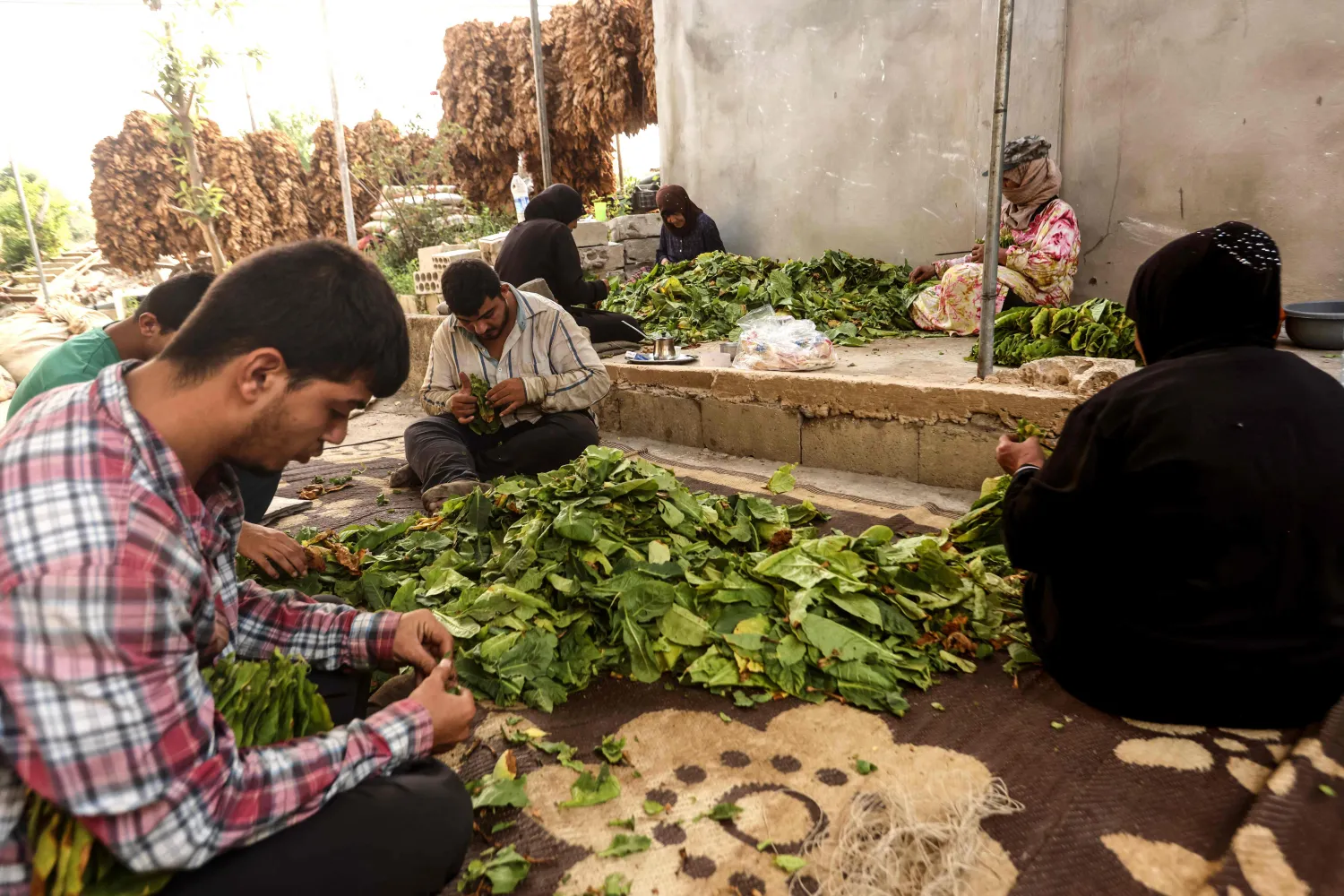
Workers sort tobacco leaves grown by the Issa family at a farm in the southern Lebanese village of Deir Qanoun Ras al-Ayn on August 21, 2026. (AFP)
TT

State Return to South Lebanon Extends Beyond Security to Services, Recovery

Workers sort tobacco leaves grown by the Issa family at a farm in the southern Lebanese village of Deir Qanoun Ras al-Ayn on August 21, 2026. (AFP)

Lebanon’s push to reassert the state’s presence in the south is moving beyond security deployments to a harder test: restoring schools, services, and livelihoods in communities battered by war.

Recovery programs are beginning to take shape, but a wide funding gap threatens efforts to keep residents in their towns and revive areas where infrastructure, agriculture, and education have sustained extensive damage.

A framework for return, but funding lags

In 2026, the government launched the “National Framework for Return, Early Recovery and Restoration of Basic Services,” covering the return of residents, social protection, the restoration of services and livelihoods, and preparations for reconstruction.

No consolidated budget has been announced yet.

One of its main financing tools is the Lebanon Emergency Assistance Project (LEAP), implemented by the Council for Development and Reconstruction.

The project was designed to scale up to $1 billion. So far, only $250 million has been secured, leaving a $750 million funding gap.

Of the available financing, $50 million is earmarked for immediate response measures, including debris removal, securing buildings, and reopening roads. Another $175 million is allocated to restoring water, energy, transport, health, and education services, while $15 million is set aside for studies and designs, and $10 million for project management.

Under the full framework, $455 million is allocated for reconstruction, most of it still unfunded.

In a parallel effort, the government launched a program in May worth about 32 million euros for southern Lebanon and the Bekaa, running through 2029.

The European Union is providing 24.8 million euros, Denmark 5.35 million euros, and the French Development Agency 2 million euros. The program targets local authorities, small businesses, and the agricultural sector, while seeking to create jobs.

Lebanese ministerial sources told Asharq Al-Awsat that “the new response framework provides a basis for attracting funding, but it is still not fully financed.”

They said the Ministry of Social Affairs was “continuing to work intensively to secure additional funding to help respond to the needs of affected groups.”

A safety net for more than one million people

Social protection is a central part of efforts to keep residents in their communities and support their return.

The sources said one of the main response measures was cash assistance provided by the Ministry of Social Affairs, covering about 230,000 families through the ministry’s shock-responsive social safety net.

Based on the average household size, more than 1 million people receive support.

The assistance is particularly significant in areas where returning home still depends on families' ability to repair their homes, restore access to services, and find work.

That makes social support part of the effort to re-establish communities, rather than simply an emergency measure.

Agriculture: getting farmers back to their land

The Ministry of Agriculture has divided its response plan into five tracks: emergency support for farmers; protection of food supply chains and markets; protection of livestock production and assets; continuity of programs and services; and coordination and needs assessment.

Measures include monitoring food supply chains, accelerating imports of plant products, extending import deadlines for some essential goods, and monitoring markets and prices in coordination with the Ministry of Economy.

The plan also provides emergency assistance to farmers in high-risk areas and steps up operations at ports, border crossings, quarantine centers, and laboratories to speed the entry of goods.

The report does not set an overall budget for the agricultural response.

Instead, it says the ministry is working with partners and donors to identify priorities, assess possible interventions, and secure resources.

Resources reported by the ministry’s network of agricultural partners that are being mobilized include $1,650,150 in cash assistance targeting 4,840 farmers.

In-kind assistance is expected to reach 1,850 farmers and includes solar-powered irrigation pump kits, agricultural inputs, animal feed, treatment support, and infrastructure.

The ministry has also launched a platform with the food security sector to identify and track available resources.

Schools face a September test

Education is emerging as one of the clearest tests of whether state institutions can resume normal operations in the South and Nabatieh governorates.

Sources at the Ministry of Education and Higher Education told Asharq Al-Awsat that the ministry aims to start the 2026-2027 academic year with in-person classes at schools that meet safety and readiness requirements, starting Sept. 15.

Schools in the affected areas of the South and Nabatieh will temporarily rely on remote learning until technical and operational assessments are completed.

The scale of the challenge is substantial.

Of 267 schools in the two governorates, 198 have been damaged. Eighty-nine sustained very minor damage, 64 moderate damage, and 15 severe damage. Another 30 were completely destroyed.

The ministry is using a “school cluster” model for planning, grouping schools and alternative learning spaces within the same geographical area.

Each cluster will have a file detailing student and teacher numbers, building conditions, capacity, and the locations of displaced students.

Students whose schools cannot reopen will remain enrolled in their original schools while temporarily attending a host school or alternative learning space.

Schools being used as shelters will operate under conditions designed to ensure the safe separation of their educational and shelter functions.

The ministry is also building an operational database to track schools and students and setting up a hotline.

Each school will receive an official operational decision specifying how classes will resume.

The ministry has also expanded its use of “Teaching Hubs,” or teaching and learning centers, aimed at restoring teachers’ roles in affected areas while providing students with places to receive support and continue their education.

The sources said the objective went beyond repairing damaged buildings.

“The goal is not limited to rehabilitating damaged school buildings, but also includes preserving the school as an existing institution even if its building has been destroyed, by maintaining its administration, teachers, and students,” they said.

That, they added, would ensure that each school retains its identity and educational role until it can be rehabilitated or rebuilt.



Lebanon, Britain to Hold Joint Military Exercise Starting Tuesday

A Lebanese flag flies as buildings lie in ruins in Mansouri, as seen from Henniye, Lebanon, September 29, 2026. (Reuters)
TT

Lebanon, Britain to Hold Joint Military Exercise Starting Tuesday

A Lebanese flag flies as buildings lie in ruins in Mansouri, as seen from Henniye, Lebanon, September 29, 2026. (Reuters)

Lebanon's army will hold exercises with the British military this month, both sides said on Monday, with the drills also to involve personnel and representatives from countries including the United States and France.

Britain has been a key supporter of the cash-strapped Lebanese army and has provided millions of dollars in assistance over the years, including helping train Lebanese soldiers to secure the country's land borders.

The Lebanese army said that the joint "Pegasus Cedar 2026" exercise would begin on Tuesday and aimed to "bolster the capabilities of military units and raise the level of coordination between the Lebanese army and friendly armies".

It said the exercise would include "training on reconnaissance, raids and combat in built-up areas", among other activities.

A British embassy statement said British soldiers based in Cyprus would "join their Lebanese counterparts in the Air Assault Regiment in a landmark military exercise aimed at strengthening bilateral defense ties and enhancing operational readiness".

"Personnel from the armies of the United States and Italy will also take part, with representatives from the armies of France, Cyprus, Qatar, and Jordan joining as observers," it added.

The exercise, to be held over three weeks, builds on a previous UK-Lebanon military training exercise held in September 2023, the embassy statement added.

Lebanese authorities have called for increased support for the country's under-resourced army, which counts some 80,000 personnel and depends heavily on foreign aid.

The military faces enormous challenges in completing its deployment to south Lebanon under a framework agreement reached in June between Israel and Lebanon that involves the disarmament of the Hezbollah group and the gradual withdrawal of Israeli forces.

Hezbollah drew the country into the Middle East war in March by attacking Israel, which responded with massive airstrikes and a ground invasion.

While violence has dropped since June, Israel still carries out attacks and demolitions, and its troops are occupying a self-declared "security zone" running around 10 kilometers (six miles) inside Lebanon along the border.

The fighting followed another conflict that erupted in 2023 that led to an all-out war the following year.

Last month in Paris, Lebanese President Joseph Aoun met his French counterpart Emmanuel Macron and Jordan's King Abdullah II, and discussed international support for the country's military.


UN Chief Calls for Gaza Ceasefire Ahead of Oct 7 Anniversary

A photograph shows destruction at the Jabalia refugee camp in the northern Gaza Strip, with an Israeli flag fluttering in the background, on October 5, 2026. (AFP)
TT

UN Chief Calls for Gaza Ceasefire Ahead of Oct 7 Anniversary

A photograph shows destruction at the Jabalia refugee camp in the northern Gaza Strip, with an Israeli flag fluttering in the background, on October 5, 2026. (AFP)

United Nations Secretary General Antonio Guterres on Monday called for a permanent ceasefire in Gaza ahead of the third anniversary of the October 7, 2023 Hamas attack on Israel.

"It is time for the ceasefire to become permanent. It is time to allow humanitarian assistance at scale. And it is time to respect international law," Guterres said in a statement, calling for a "political path to lasting peace across the whole region."

"Let this anniversary mark not only another year of mourning, but also a renewed determination to build a different future: one in which Israelis and Palestinians can live side by side in peace and security, with their rights, dignity, and aspirations fulfilled," Guterres said.

The UN chief acknowledged Israel's casualties in the statement, calling the Hamas attack "abhorrent" for "killing more than 1,200 Israelis and foreign nationals" and the hostage-taking of another 251 people.

Guterres also said Palestinians in Gaza have faced a "massive loss of life, displacement and destruction," without specifying their death toll.

"Their suffering, too, demands an end, now," Guterres said.

Israel's years-long military campaign in Gaza has killed more than 74,200 people according to the Palestinian Health Ministry, which is under Hamas' authority and whose figures are deemed reliable by the UN.

Guterres acknowledged that a brief ceasefire, announced by US President Donald Trump in October 2025, "brought some relief. But it has yet to deliver security, adequate humanitarian assistance or a credible path to recovery and peace."

Israel, which still controls most of Gaza, refuses to withdraw its soldiers until Hamas' disarmament has been verified.

Hamas, for its part, has advocated for gradual disarmament rather than immediate and unilateral surrender of its arsenal.

Since the 2023 attacks, Israel has waged military attacks on several fronts, notably invading southern Lebanon to confront Hezbollah, the movement backed by Tehran, and launching war against Iran in late February alongside the United States.


ISIS Attack Kills Iraqi Policeman Near Kirkuk

Iraqi police patrol vehicles are stationed outside the Karkh Court house during the trial of six French citizens accused of terrorism in Baghdad, on October 5, 2026. (AFP)
TT

ISIS Attack Kills Iraqi Policeman Near Kirkuk

Iraqi police patrol vehicles are stationed outside the Karkh Court house during the trial of six French citizens accused of terrorism in Baghdad, on October 5, 2026. (AFP)

At least ‌one Iraqi federal policeman was killed and four others wounded on Monday when ISIS militants attacked a federal police site southwest of the oil-rich city of Kirkuk, two security sources told Reuters.

The attackers used semi-automatic machine guns and sniper fire against the federal police regiment stationed near Hawija, about 70 km (43 miles) southwest of Kirkuk, the sources said.

There ‌was no ‌immediate claim of responsibility. But ‌security and ⁠army sources said ⁠ ISIS militants, who are still active in the area, were involved in the attack.

The attack is the first reported assault by ISIS on Iraqi security forces since US forces completed their withdrawal ⁠from Iraq on September 30, ending ‌the military mission in ‌the country.

The United States had led a ‌coalition that supported Iraqi forces in the fight ‌against ISIS, including efforts to prevent the militant group from regrouping.

Washington said it would continue to provide targeted training and intelligence support after ‌the withdrawal, while Iraqi forces would take full responsibility for the country’s security ⁠and ⁠for suppressing ISIS remnants.

Despite the defeat of ISIS nearly a decade ago, the group retains sleeper cells in Iraq, Iraqi security officials told Reuters ahead of the US withdrawal.

The withdrawal had raised concerns that a security vacuum could provide an opening for ISIS to regain strength, with some officials warning that Iraqi forces would now have to contain the group without the coalition’s military presence.