


Sudan Farms Lie Barren as El Nino Leaves Nile Banks Dry

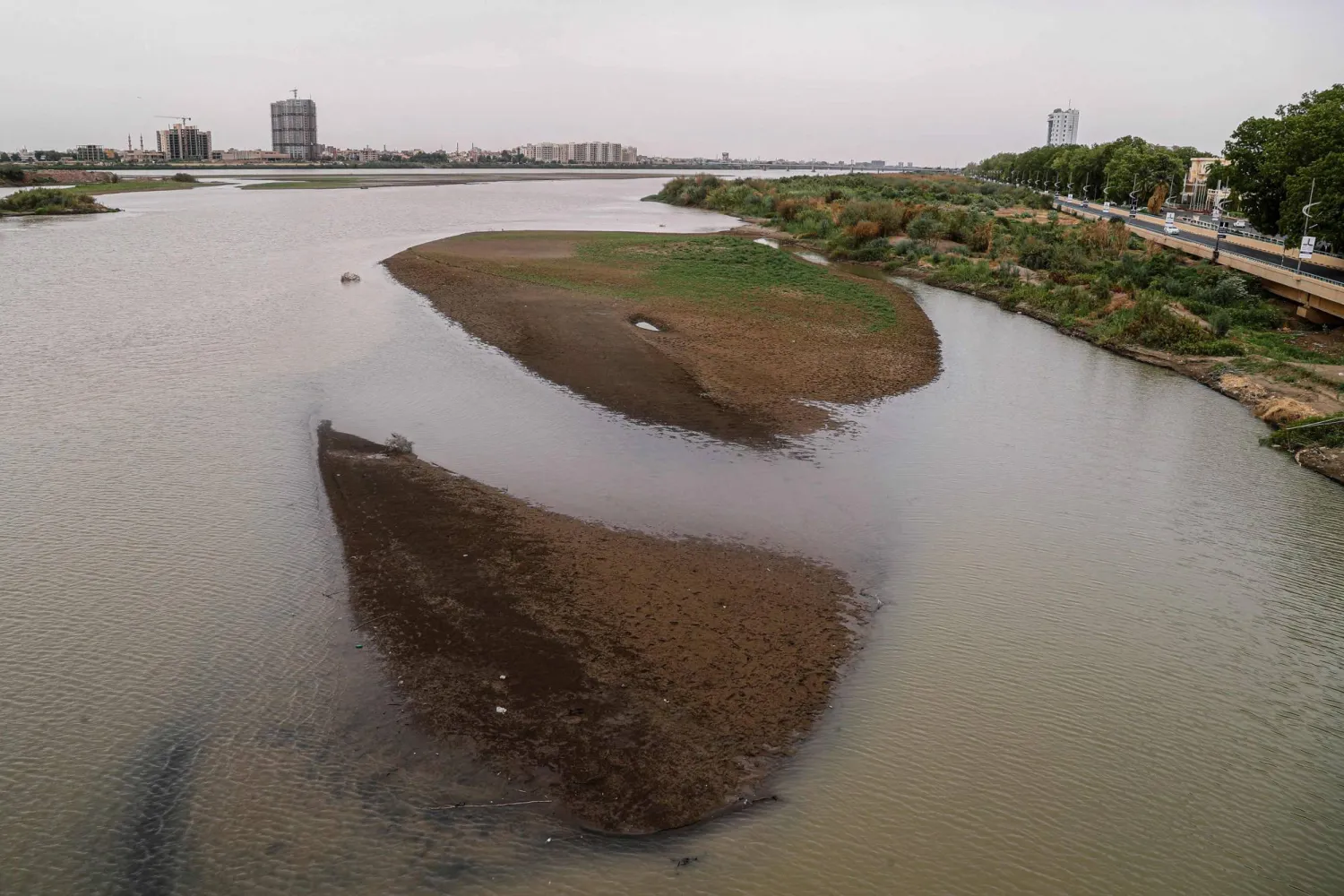
A photograph shows the exposed riverbed of the Blue Nile in Khartoum on July 27, 2026. (AFP)
TT

Sudan Farms Lie Barren as El Nino Leaves Nile Banks Dry

A photograph shows the exposed riverbed of the Blue Nile in Khartoum on July 27, 2026. (AFP)

Along the bone-dry riverbanks of the Nile in Sudan, farmers struggle to pull water to their crops. Others gather to pray for rainfall over cracked earth.

Across the country, farmland that could feed the world's largest hunger crisis many times over lies fallow, as weary farmers once again find themselves in the crosshairs of faraway destruction.

First came war between the country's army and rival paramilitaries, which since April 2023 has killed more than 200,000 people and pushed nearly 20 million into crisis levels of hunger.

Then a more distant conflict, between Iran and the United States, crippled fuel and fertilizer supply through the Strait of Hormuz, causing costs to soar.

And now the powerful El Nino climate pattern strengthening in the Pacific Ocean, which impacts winds and rains across the world, has delayed crucial rains and led water levels in the life-giving Nile to drop precipitously.

Just south of the capital Khartoum, farmer Al-Tigani Fadlallah points to an island that shouldn't be there.

"The water usually covers it by July, but you can see it even now," he told AFP this month, seeing in the sunbaked sandbank a bad omen for his parched crops.

Through the length of Sudan, from the northern fields near Egypt, along the Nile river to the Ethiopian border, farmers told AFP reporters the water they need is not rising from the riverbanks nor falling from the sky.

The UN's food and agriculture organization says the season "is unfolding under heightened climate risk, driven by El Nino conditions" including delayed and below average rains, and long and frequent dry spells.

Farmers say it is one of the hardest seasons in recent memory, but climate research shows it will not be the last.

- Pray for rain -

Climate and hydrology scientist Elfatih Eltahir, at the Massachusetts Institute of Technology, has studied the link between El Nino and the Nile for thirty years.

His research has shown El Nino is closely associated with low Nile flow and, when it begins in late spring, as it did this year, brings a high probability of drought in southeastern Sudan and northwestern Ethiopia, where the Blue Nile originates.

Water levels at the reservoir behind Ethiopia's massive Grand Renaissance dam on the Blue Nile, which contributes the majority of water feeding the Nile river, was six meters lower this July compared to the same month last year, according to data from Germany's University of Tubingen.
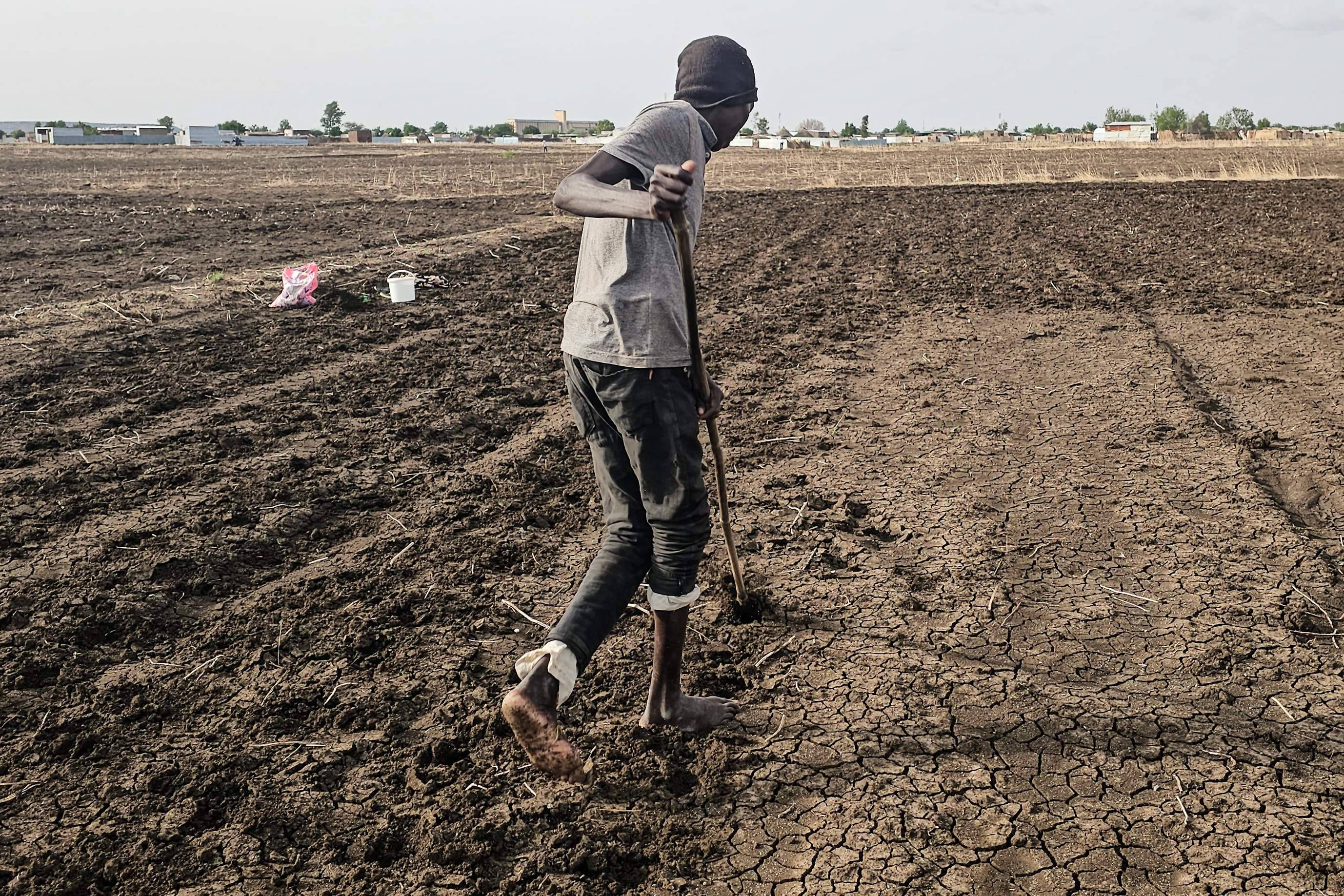
A Sudanese farmer ploughs agricultural land in Gedaref State, eastern Sudan, on July 18, 2026. (AFP)

But Eltahir warns "more transparency and cooperation" are also needed between Ethiopia, Egypt and Sudan over Addis Ababa's management of the reservoir, especially as climate change brings more extreme floods and droughts.

This summer, the Blue Nile basin has already seen as little as half of its usual rainfall, according to UC Santa Barbara's Climate Hazards Center, and regional forecasts predict below average rainfall for the rest of the rainy season.

Farmers in Gedaref state on the Ethiopian border, where the bulk of Sudan's staple crops such as sorghum and sesame are planted, are already feeling it.

When August rolled in and their usually-verdant fields were still a dull brown, frustrated farmers gathered behind local imams for rain-invoking prayers.

"We need these rains for our crops and our livestock, and they're late," local farmer Abdelmajid Hussein told AFP after a prayer.

Agriculture minister Ismat Qurashi told AFP farmers are being told to choose drought-resistant crops and to delay planting.

Moussa Yaacoub, 75, has planted sesame for decades, including three wartime growing seasons each harder than the last.

Now, standing sentinel over the cracked earth, he wonders if he will make it through the next, with his land now costing him "four times as much to plant".

- Can't catch a break -

Downstream, in Sudan's other breadbasket state Al-Jazira, Hassan Ahmed stares out at the farm that has been in his family for 100 years.

When Ahmed returned to it last year, after the army recaptured Al-Jazira from the Rapid Support Forces, he found it had been ransacked by looting paramilitaries, and his trees stood wilting in the sun.

He and his sons got to work bringing it back to life, but this year have struggled anew.

"I'm 63 and I have never seen the Nile this low in August," he told AFP. "By now we should have taken our water pump out because the flood had drenched the soil several meters in."

Buffeted by a perfect storm -- low water, soaring costs and a crippled market -- many farmers have abandoned their lands, at a time when 65 percent of Sudan's vast arable land is already out of commission.

Some farmers, hopeful at the start of the season, "planted their crops but then left them to die because it just wasn't worth the harvest," young farmer Mohamed al-Tijani told AFP near Khartoum.

Sudan imports all of its fuel and most of its fertilizer, costs for which have multiplied by up to five this year as a result of war in the Middle East.

Veteran farmer Ahmed Othman is one of many who know he won't break even in the market, already devastated with most of the country out of work.

"But at least I can say I'm working at all," he told AFP, back bent from decades of toiling in the fields.


EU Top Diplomat Says Bloc Wants to 'Upgrade' Syria Partnership

29 September 2026, Syria, Damascus: Syrian Foreign Minister Asaad Al-Shaibani receives the EU High Representative for Foreign Affairs Kaja Kallas at Tishreen Palace. Photo: Moawia Atrash/dpa
TT

EU Top Diplomat Says Bloc Wants to 'Upgrade' Syria Partnership

29 September 2026, Syria, Damascus: Syrian Foreign Minister Asaad Al-Shaibani receives the EU High Representative for Foreign Affairs Kaja Kallas at Tishreen Palace. Photo: Moawia Atrash/dpa

EU foreign affairs chief Kaja Kallas said on Tuesday in Damascus that the European Union wanted to "upgrade" its partnership with Syria and help boost its recovery but called for further domestic reform.

"The European Union is using its political and economic tools to help Syria on the path of inclusive and peaceful transition," Kallas told a press conference with Syrian Foreign Minister Asaad al-Shaibani.

After the new authorities toppled longtime ruler Bashar al-Assad in December 2024, the EU lifted its economic sanctions on Syria and in May this year restored an EU-Syria cooperation agreement.

"Now we aim to mobilize even more investment and upgrade our partnership. But that's also very much dependent on Syria's side," Kallas said, while also calling for institutional and security improvements.

"Aid alone cannot build Syria. Foreign and domestic investment needs trust, and trust needs security, clear rules, rule of law, functioning institutions" and the equal participation of women in society, as well as reconciliation and transitional justice, she said.

"We are ready to help to build the institutions," she said.

The 27-nation bloc has launched a new chapter with Syria since Assad's fall, with EU chief Ursula von der Leyen telling President Ahmed al-Sharaa in January that Europe would "do everything it can" to support Syria's recovery.

The country is trying to rebuild, reboot its economy and attract investment after more than 13 years of conflict that killed more than half a million people and ravaged the country's infrastructure and industry.

Kallas noted that the EU "is already providing 620 million euros for recovery, humanitarian needs and strengthening institutions".

The war also sent millions of Syrians fleeing abroad, and Syrians have made up the lion's share of asylum-seekers in the bloc over a decade, with a push for large numbers to eventually return home.

Shaibani said that he and Kallas had "discussed several tracks, beginning with achieving a new partnership agreement" to replace the one dating to the 1970s, indicating that steps to advance the issue would continue into next year.

He noted that Syria had been "active in combatting cross-border crime, combatting illegal migration, drugs and human trafficking".

"We discussed ways to support the capacities of the Syrian coast guard, in the belief that the security of the Mediterranean also begins with our shores," he said.

"Syria's security is an integral part of Europe's own security," he added.


UN Expands List of Companies Linked to Israeli Settlements

This picture taken from the Israeli-occupied West Bank village of Bruqin shows homes belonging to Palestinians in the foreground, and the Israeli settlement of the same name in the background on September 21, 2026.  (Photo by JAAFAR ASHTIYEH / AFP)
This picture taken from the Israeli-occupied West Bank village of Bruqin shows homes belonging to Palestinians in the foreground, and the Israeli settlement of the same name in the background on September 21, 2026. (Photo by JAAFAR ASHTIYEH / AFP)
TT

UN Expands List of Companies Linked to Israeli Settlements

This picture taken from the Israeli-occupied West Bank village of Bruqin shows homes belonging to Palestinians in the foreground, and the Israeli settlement of the same name in the background on September 21, 2026.  (Photo by JAAFAR ASHTIYEH / AFP)
This picture taken from the Israeli-occupied West Bank village of Bruqin shows homes belonging to Palestinians in the foreground, and the Israeli settlement of the same name in the background on September 21, 2026. (Photo by JAAFAR ASHTIYEH / AFP)

The United Nations human rights office issued a list on Friday adding 61 more companies operating in Israeli West Bank settlements, which the global body considers illegal.

The database is highly sensitive as firms could be targeted for boycotts or divestment to pressure Israel over settler expansion in the territory that is home to over 3 million Palestinians.

The database, first released in 2020, now includes 214 firms, mostly from Israel, but also from 10 other countries including France, Germany, China and the US.

Newly added firms included Israeli pesticides maker ADAMA, part of Chinese-owned Syngenta Group, Israel-based real estate investment holding company Alony Hetz and Spain's Salvat Logistica.

The Spanish logistics company said it had not been informed of any investigation and that its inclusion in the list was "surprising and entirely inconsistent with the facts". A UN rights office spokesperson said Salvat was contacted along with all other firms and given the opportunity to respond.

Companies already on the list include travel agency Expedia and home-rental company Airbnb already on the list.

Israel, which views the West Bank as disputed rather than occupied, has previously said the list unfairly vilifies companies working legally.

"This is a distorted mechanism — created by a deeply flawed body with an automatic majority against Israel," Israel's diplomatic mission said on Friday, alleging that the database was establish to "persecute" the Jewish state.

There has been a surge in settler attacks against Palestinians as outposts proliferate, prompting Britain, France and Canada to block imports from settlements this month.

The UN rights office assessed companies active in a group of sectors including energy, food, hospitality, transport and agriculture, based on confidential submissions to the UN rights office.

Another 60 or so companies were assessed but not included since they did not meet the UN criteria of involvement in activities that violate the Palestinian right to self-determination.

Examples include supplying demolition equipment to destroy Palestinian buildings, provision of surveillance for settlements and other services like transport that help maintain their existence, according to the UN website.

Other companies, like British-registered online travel company Opodo and Spanish-domiciled online travel agent eDreams, have been dropped from the original list after submitting a reassessment request.

The UN found that there were reasonable grounds to believe they were no longer involved in the activities that previously justified their inclusion.

eDreams said last year it had withdrawn and would continue to block listings of accommodation in illegal Israeli settlements, saying that some had appeared on its website automatically after owners uploaded them.

Palestinians want the West Bank to be part of a future independent homeland.

But Prime Minister Benjamin Netanyahu's nationalist government has largely backed settlers, with building ramped up since the militant Hamas group's attack on Israel in October 2023 and the ensuing Gaza war.

Travel firm Expedia has previously said that the listings in what it called "disputed areas" were clearly labelled, complied with international laws and sanctions and undergo enhanced due diligence guided by UN standards.


Yemen Parliament Approves General Mobilization Against Houthis

This frame grab taken from AFPTV video footage shows Yemeni government fighters engaging in clashes with Houthis in Al-Jawf province on September 15, 2026.  (Photo by AFPTV / AFP)
This frame grab taken from AFPTV video footage shows Yemeni government fighters engaging in clashes with Houthis in Al-Jawf province on September 15, 2026. (Photo by AFPTV / AFP)
TT

Yemen Parliament Approves General Mobilization Against Houthis

This frame grab taken from AFPTV video footage shows Yemeni government fighters engaging in clashes with Houthis in Al-Jawf province on September 15, 2026.  (Photo by AFPTV / AFP)
This frame grab taken from AFPTV video footage shows Yemeni government fighters engaging in clashes with Houthis in Al-Jawf province on September 15, 2026. (Photo by AFPTV / AFP)

The confrontation between the Yemeni government and the Iran-aligned Houthi group has entered a new phase, following Parliament's approval of a request by Chairman of the Presidential Leadership Council Rashad al-Alimi to declare a general mobilization.

Authorities said the move is aimed at strengthening the capabilities of state institutions and the armed forces in confronting the Houthi escalation, and protecting the republican system and the country's sovereignty.

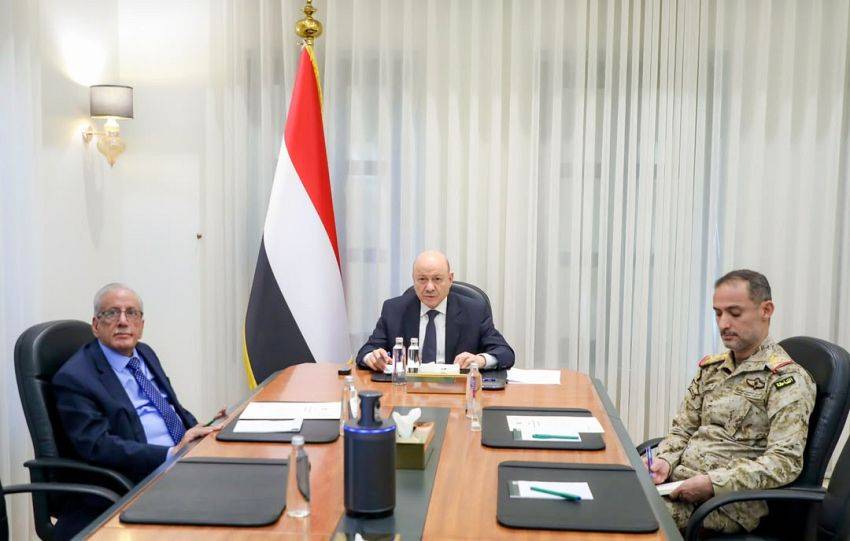
The parliamentary decision came after an expanded meeting held by the council under the chairmanship of Speaker Sultan al-Barakani via videoconference to discuss military and political developments in the country, as well as al-Alimi's memorandum requesting approval for the declaration of general mobilization. The request was based on constitutional provisions and laws governing mobilization, general reserve, and civil defense.

Under the decision, general mobilization takes effect from the date it is announced and will remain in place until the reasons that prompted it have ended. It will be implemented in accordance with the constitution, the power transfer decision, and the laws governing the general reserve, the National Defense Council, and civil defense.

During a meeting with several governors, attended by Prime Minister Shaya al-Zindani and military and security leaders, al-Alimi presented general mobilization as a measure that goes beyond simply recruiting fighters or reinforcing the front lines. He said it encompasses human, material, and moral resources, as well as strengthening the ability of state institutions, the armed forces, and security forces to carry out their duties.

Yemeni Presidential Leadership Council Chairman Rashad al-Alimi during a videoconference with military and civilian leaders (government media)

Al-Alimi praised Parliament's response to his request, saying that the legislature's approval reflects an understanding of the scale of the challenges facing the country and provides a constitutional framework for unifying the capabilities of state institutions in the coming phase.

The decision comes amid a broad military escalation on several fronts, at a time when the government says its forces have regained the initiative in a number of areas. Fighting, however, continues in parts of Taiz, Lahj, Marib, Al-Jawf, and Al-Bayda, as well as on northern fronts.

"Safe Return"

Alongside the mobilization, al-Alimi proposed another course of action based on what he called a "safe return," urging residents of areas under Houthi control not to send their children to the battlefronts.

He said the state is asking them only to align themselves with the values of the republic and its institutions, stressing that the announced guarantees and procedures cover those who leave the group and stop fighting or working on its behalf.

He explained that the process also includes settling the status of members of the armed forces and security forces and safeguarding their legal rights, in an effort to open a channel for withdrawing from the Houthi ranks while simultaneously increasing military pressure.

The Yemeni Parliament based its decision on Article 37 of the constitution concerning the declaration of general mobilization, Article 38 concerning the National Defense Council, and Article 119 concerning the president's powers to declare a state of emergency and general mobilization in accordance with the law.

The council also cited the Law Establishing the National Defense Council, the General Reserve Law, and the Civil Defense Law.

The decision stipulates that the National Defense Council will remain in continuous session once general mobilization is declared and will oversee mobilization matters and its implementation in accordance with the relevant laws.

The measure follows a September 25 speech by al-Alimi calling for general mobilization, at a time when the government is seeking to rally state institutions and political and military forces behind a unified position in confronting the Houthis.

Parliament said its decision came amid what it described as risks threatening the lives and property of citizens, as well as their security and stability. It also pointed to the regional and international repercussions of the Yemeni conflict.

A Message to the Country and Abroad

The parliamentary decision also carried a political message extending beyond the military dimension. It called for overcoming divisions, unifying ranks, and coordinating with the coalition supporting the legitimate government, led by Saudi Arabia.

The council renewed its condemnation of Houthi attacks targeting Saudi Arabia, considering threats to the security and sovereignty of countries in the region to have repercussions for regional and international security and stability.

It also praised Saudi support for Yemen and the role played by the coalition in supporting the government and forces aligned with it.

Al-Alimi, meanwhile, stressed that the coming phase requires governors to treat residents of areas under Houthi control as part of Yemeni society, rather than as a party separate from the state. He emphasized that the government wants to restore its institutions, security, and stability in those areas.

Parliament's decision gives the general mobilization a formal framework for shifting the government's response from separate military measures to a broader institutional mobilization policy encompassing the armed forces, security forces, human and material resources, and state agencies.

The impact of the decision, however, will remain linked to the mechanisms for its implementation and the ability of government institutions and allied military forces to operate under more coordinated leadership, given the number of formations and forces on the ground and the differences in their areas of deployment.
