


The 'Ali al-Taher' Battle: A Test of Hezbollah’s Capabilities

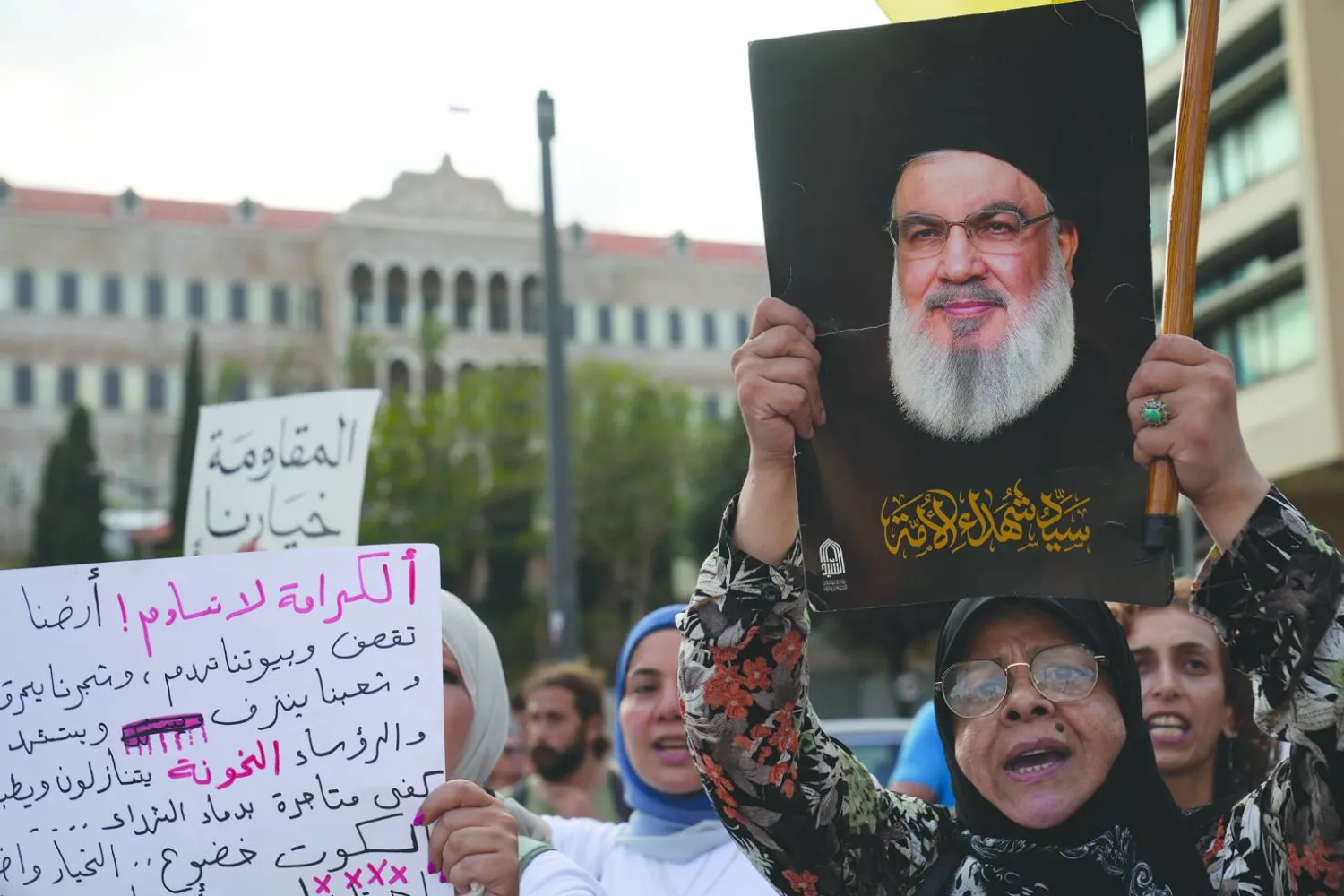
A protester shouts slogans while holding a portrait of the late Hezbollah leader Hassan Nasrallah during a protest against the backdrop of Lebanon-Israel talks and the normalization of relations, in Beirut, Lebanon, Friday, Aug. 7, 2026. (AP Photo/Hussein Malla)
TT

The 'Ali al-Taher' Battle: A Test of Hezbollah’s Capabilities

A protester shouts slogans while holding a portrait of the late Hezbollah leader Hassan Nasrallah during a protest against the backdrop of Lebanon-Israel talks and the normalization of relations, in Beirut, Lebanon, Friday, Aug. 7, 2026. (AP Photo/Hussein Malla)

The battle for the “Ali al-Taher” heights is placing Hezbollah before a difficult test that goes beyond its ability to defend the hill and prevent its fall. It also tests the effectiveness of the military strategies it has recently developed after conventional strategies failed over the past two years to counter Israel’s military and technological superiority.

Can Israel, through firepower, air power and surveillance, suffocate the force deployed in the area and undermine the conditions needed for its survival? Or can the underground fortifications, tunnels, storage facilities and combat capabilities prepared by Hezbollah give it room to continue wearing down Israeli forces and prolong the confrontation?

Ability to Maneuver

Retired Brigadier General Bahaa Hallal says that, regarding Hezbollah’s military position, “the land still has strategic value for it, but its defensive value automatically declines if it shifts from a controlled area to an exposed area under surveillance.” He explains: “The party’s core strength is not simply holding the hilltop, but its ability to operate in depth and particularly in the surrounding area, while Israel seeks to turn its air and intelligence superiority into permanent ground superiority.”

Hallal told Asharq Al-Awsat that “the main challenge facing Hezbollah is maintaining its ability to maneuver. If Israel manages to establish a presence, impose a buffer zone around the hill and prevent the party from moving, the balance of power will gradually begin to shift in its favor.”

In this context, underground fortifications are among the most important tools available to the defender. They can reduce the impact of air superiority, preserve a degree of continuity and survivability, and prevent the battle from being decided simply by control of the ground surface. Hallal cautions, however, that fortifications that provide protection from bombardment can become a burden if the area around them becomes besieged or isolated.

Isolated Pockets?

According to Hallal, this raises the central question in the “Ali al-Taher” battle: “Do the underground facilities still constitute an integrated network for maneuvering and communication, or have they become isolated pockets?”

Hallal says the ability to make decisions, communicate and implement them, while maintaining communication channels under pressure, will be among the main challenges facing Hezbollah. However, Hezbollah’s model, historically based on a degree of decentralization and flexibility, may mean that targeting a local position or commander would not necessarily be enough to bring down the entire system.

Hallal says the party’s strengths include geographical knowledge, organizational depth, the ability to exploit the mountainous terrain, and the capacity to continue operating despite losing positions. By contrast, he identifies Israel’s superiority in surveillance and air power, as well as the risk of isolation, as its main weaknesses.

He says that if Israel succeeds in separating “Ali al-Taher” from Hezbollah’s broader operational theater, the force there will face a more difficult defensive situation. He also considers the destruction of villages, roads and homes to be a major strategic pressure because it strikes part of the social and geographical environment in which any local force operates.

A Network of Tunnels

Retired Brigadier General George Nader describes the “Ali al-Taher” hill as being of major tactical importance because it overlooks a wide area north of the Litani River and large parts of the area south of it. He also points to its historical significance, as it was previously under Israeli occupation.

Nader told Asharq Al-Awsat that, according to the information on which he relies, the hill is an important position for the command of the Radwan Forces. It contains underground facilities and a network of tunnels linked to ammunition, logistics, missiles, drones, fighters and operations rooms.

A Bargaining Chip in Negotiations

Nader believes that Israeli control of the hill would give Israel greater leverage and a greater ability to impose its terms in future rounds of negotiations, particularly if it manages to turn military control into an established reality on the ground.

He believes Israel’s destructive and technological capabilities make the targeting of these facilities and tunnels a possibility, warning that the presence of large quantities of ammunition and missiles in the area could mean that any large-scale destruction operation would have major repercussions.

Major Israeli Attack

Based on this, Nader expects a major Israeli attack to seize the hill, considering that the objective could have political implications for Israeli Prime Minister Benjamin Netanyahu, who seeks to use control of the site to demonstrate that he has succeeded in striking Hezbollah’s command center in the south, thereby enhancing the security of the northern settlements on the eve of Israeli electoral events.

As for Hezbollah’s options in response, Nader believes they appear limited given the difficulty of movement south of the Litani River. This, in his assessment, makes it difficult to divert Israeli forces or force them to disperse their efforts by opening other fronts of movement in the area.




Sudan Gold Mine Collapse Kills 10, Injures 21

Workers break rocks at a gold mine near Abu Delelq in Gadarif State, Sudan. (Reuters)
TT

Sudan Gold Mine Collapse Kills 10, Injures 21

Workers break rocks at a gold mine near Abu Delelq in Gadarif State, Sudan. (Reuters)

A gold mine collapsed in northern Sudan killing at least 10 people and injuring 21 others, two survivors told AFP on Sunday after overnight rescue efforts.

Shafts of the Awny mining area near Sudan's border with Egypt collapsed on Saturday.

By Sunday morning "10 bodies had been recovered and 21 injured miners pulled out", said one of the survivors who was working at the mine when it collapsed, requesting anonymity for security reasons.

Another survivor, also requesting anonymity, told AFP the rescue operation was "being carried out by the miners themselves" with little equipment available.

More miners were feared dead under the rubble and survivors said the search for the missing was ongoing.

Many young Sudanese have joined a dangerous gold rush, working in unregulated mines with their hands and rudimentary tools for meagre daily wages.

They face chemical poisoning and regular mine collapses.

Last week at least 82 people were killed and dozens injured in a collapse in the southern Kordofan region.

Artisanal and small-scale mining, which takes place in unofficial zones or decommissioned mines, accounts for the majority of gold extracted in Sudan.

Even before the war pushed nearly 20 million Sudanese into severe hunger, artisanal mining employed more than two million people, according to industry figures.


CIA Chief Meets Egypt's Sisi in Cairo

FILED - 18 October 2023, Egypt, Cairo: President of Egypt Abdel Fattah El-Sisi is pictured in Cairo. Photo: Michael Kappeler/dpa Pool/dpa
TT

CIA Chief Meets Egypt's Sisi in Cairo

FILED - 18 October 2023, Egypt, Cairo: President of Egypt Abdel Fattah El-Sisi is pictured in Cairo. Photo: Michael Kappeler/dpa Pool/dpa

US Central Intelligence Agency Director John Ratcliffe met Egyptian President Abdel Fattah al-Sisi Sunday in a rare visit to Cairo, as the United States warned of rapid escalation in the Middle East war.

Sisi's office said the meeting, attended by Egypt's spy chief Hassan Rashad, discussed the wars in Iran, the Gaza Strip and Sudan, as well as attacks on Gulf countries and threats to maritime security.

Sisi stressed "the paramount importance of settling regional crises through political and diplomatic tracks," according to a presidency statement.

"This military conflict has the potential to escalate rapidly," it warned.

Sisi's office said Ratcliffe on Sunday "lauded Egypt's pivotal role in supporting efforts aimed at reaching peaceful, comprehensive settlements to regional crises".


Arab Parliament Condemns Houthi Militia Attack Targeting Riyadh

Arab Parliament Condemns Houthi Militia Attack Targeting Riyadh
TT

Arab Parliament Condemns Houthi Militia Attack Targeting Riyadh

Arab Parliament Condemns Houthi Militia Attack Targeting Riyadh

The Arab Parliament has strongly denounced the terrorist Houthi militia's continued attacks, including the attack targeting Riyadh, stressing that it constitutes a flagrant violation of international law and a threat to Arab national security and regional stability.

In a statement on Sunday, Arab Parliament Speaker Mohammed Al-Yamahi expressed the parliament's full solidarity with the Kingdom of Saudi Arabia and its support for the measures it takes to defend itself against any attacks targeting its security and territorial integrity, SPA reported.

Al-Yamahi called on the international community, particularly the UN Security Council, to assume its legal and political responsibilities to stop these blatant attacks, ensure that they are not repeated, and hold those responsible accountable.