


Lebanon Accuses Israel of Burning Forest, Farmland in South

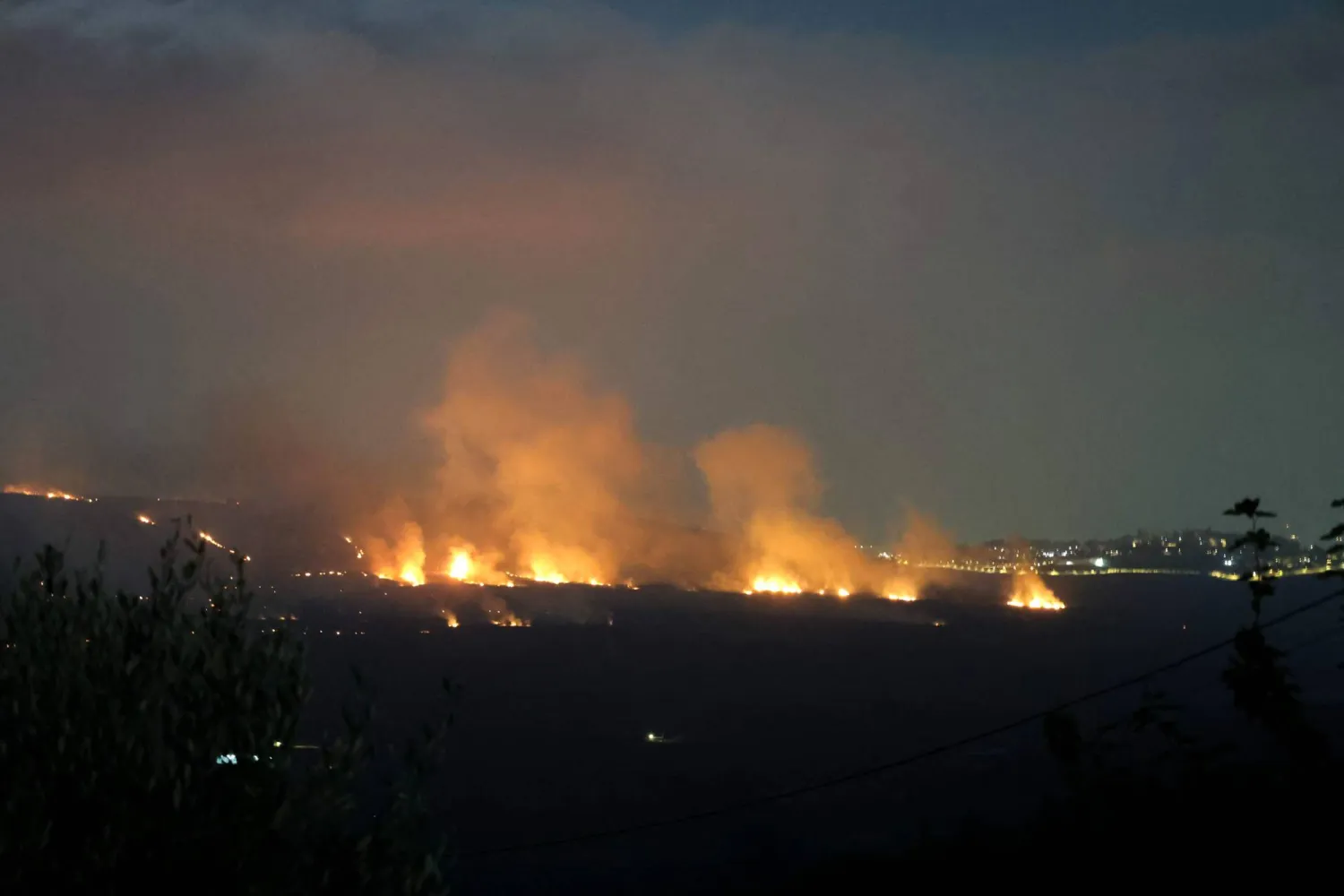
Smoke rises from fires ignited by Israeli shelling that targeted the plain of Marjeyoun in southern Lebanon on August 25, 2026. (AFP)
TT

Lebanon Accuses Israel of Burning Forest, Farmland in South

Smoke rises from fires ignited by Israeli shelling that targeted the plain of Marjeyoun in southern Lebanon on August 25, 2026. (AFP)

As extreme heat fuels wildfires worldwide this summer, Lebanese officials and residents have accused Israel's military of systematically sparking blazes that have burnt swathes of forest and farmland in the country's south.

In the village of Chaqra, Haidar Qoteish, 36, says he has watched fires devour fields and orchards in his hometown of Houla, just five kilometers (three miles) away but under Israeli military control.

"They've burnt everything. You can see the fields are all black," the father of four told AFP by telephone.

"Those whose land they didn't burn, they've bulldozed," he said. "It's a great loss, and there's nothing we can do."

Lebanon's governmental National Council for Scientific Research (CNRS) says Israeli military activity has caused 160 square kilometers of land, half of it agricultural, to go up in flames since hostilities between Israel and Hezbollah began in October 2023.

The latest bout of fighting flared in March when the Iran-backed group drew Lebanon into the Middle East conflict by attacking Israel, triggering massive Israeli airstrikes and a ground invasion.

An AFP photographer this month saw multiple fires raging in south Lebanon, mostly inside Israel's self-declared occupied "security zone", which runs around 10 kilometers (six miles) deep inside Lebanese territory along the border.

- 'Scorched earth' policy -

Despite a lull in hostilities since June and an Israel-Lebanon deal that month, Israel still bombs the south and has been demolishing border villages.

Lebanon's Prime Minister Nawaf Salam has accused Israel of pursuing a "scorched-earth policy" in the south.

The Israeli army told AFP's Jerusalem bureau it "is aware of the potential environmental impact of its operations", which it said are "conducted while taking precautionary measures to mitigate harm to civilians and the environment".

Hussein Fakih, the head of the civil defense agency for the Nabatieh region, said that since July his teams have observed fires both inside and adjacent to areas where Israeli troops are stationed.

He told AFP the blazes had been sparked by Israeli "bombs and drones" and sometimes incendiary phosphorous shells and cluster munitions.

In Kfar Shouba, which abuts Israel's "security zone", mayor Qassem al-Qadri said an Israeli attack this month sparked a fire that spread across a broad area of "mostly forest".

He said residents desperately tried to fight the blaze themselves while waiting for the Israeli army to grant firefighters access to the area, in accordance with a ceasefire monitoring mechanism.

They only got the green light "the following day when the fire had burnt everything", said the civil defense's Fakih.

Kfar Shouba residents with property close to Israeli positions are afraid to take fire prevention measures like clearing undergrowth, the mayor said.

"They talk about the 'security zone' but... we don't know where its (exact) boundaries are," Qadri added.

"We feel like the whole area is under Israeli control."

- 'Ecocide' -

Environment Minister Tamara Elzein has condemned what she called "ecocide" in the south, accusing Israel's army of "deliberately" burning swathes of Lebanese land.

CNRS director Chadi Abdallah told AFP "fires were limited to the border strip" during the 2023-2024 hostilities, but have broadened since the conflict reignited this year.

He accused the Israeli army of "systematically burning land" and of "trying to create a buffer zone devoid of homes, people and the natural environment".

"During the previous war, around 8,500 hectares (85 square kilometers) of land was burnt," Abdallah said, while this year, "the Israelis have burnt around 7,500 hectares", including 350 hectares after the June deal.

CNRS satellite imagery showed formerly green areas that have now disappeared due to fires, as well as Israel's bulldozing and uprooting of vegetation.

Lebanon's state-run National News Agency this month said Israeli forces had uprooted 600 olive trees in one southern village alone.

Lebanese environmental group Green Southerners says it has recorded widespread damage to forest, woods and farmland since 2023.

This month, it warned that "major nature reserves in southern Lebanon have also been subjected to extensive and repeated destruction".

In Chaqra, Qoteish lamented the environmental losses.

"Demolished homes maybe can be rebuilt in a year, but trees don't grow back" so quickly, he said.



Netanyahu Vows More West Bank Settlements, Defying International Pressure

 Israeli settlers, holding sticks, arrive to confront left-wing activists at an Israeli outpost in the Israeli-occupied Palestinian village of Jannatah, south of Bethlehem, on August 25, 2026. (AFP)
Israeli settlers, holding sticks, arrive to confront left-wing activists at an Israeli outpost in the Israeli-occupied Palestinian village of Jannatah, south of Bethlehem, on August 25, 2026. (AFP)
TT

Netanyahu Vows More West Bank Settlements, Defying International Pressure

 Israeli settlers, holding sticks, arrive to confront left-wing activists at an Israeli outpost in the Israeli-occupied Palestinian village of Jannatah, south of Bethlehem, on August 25, 2026. (AFP)
Israeli settlers, holding sticks, arrive to confront left-wing activists at an Israeli outpost in the Israeli-occupied Palestinian village of Jannatah, south of Bethlehem, on August 25, 2026. (AFP)

Israeli Prime Minister Benjamin Netanyahu vowed to keep establishing settlements in the West Bank despite mounting international pressure, promising a major wave of immigration to the occupied Palestinian territory.

Netanyahu, who is facing tight elections in October, leads one of the most right-wing governments in Israel's history that has rapidly approved construction and expansion of Israeli settlements in the West Bank, which are illegal under international law.

The outposts, often made up of just a few mobile homes or makeshift structures, are illegal even under Israeli law, but their approval and legalization have surged in recent years.

"We cannot ignore the numbers: 104 communities that we established and legalized together, and 160 farms, with more to come," Netanyahu told an event for settlers late on Tuesday, according to a statement from his office.

He told attendees: "You are fulfilling the vision of the Land of Israel, and this is our land.

"You are preparing the ground for a very large wave of immigration that will come," he added, hailing "a tremendous effort by the government to fulfil the vision of generations".

Israel has faced growing international outrage over its settlement expansion, as violence by settlers against Palestinians soars.

Last week, key European leaders condemned a major settlement project after Israeli authorities opened bidding for more than 1,200 homes in the area.

The E1 plan was given the green light by Israel last year and threatens the territorial contiguity of the northern and southern parts of the West Bank, further dimming prospects for a functioning independent Palestinian state.

Israel has since 1967 occupied the West Bank, where more than 500,000 Israelis now live in settlements. The territory is home to about three million Palestinians.

Netanyahu's government, which contains ministers who openly call for the territory's annexation, is advancing more construction ahead of October 27 elections.

Violence against Palestinians by Israeli settlers has increased dramatically since the October 7, 2023 attack on Israel by Hamas from the Gaza Strip.

- US pressure -

US Senate Democrats on Wednesday urged Netanyahu to rein in a "surge" of violence by West Bank settlers and mass arrests of Palestinians by Israeli security forces in the occupied territory.

In the letter to Netanyahu, seen by Reuters and signed by 42 of the Senate's 47-member Democratic caucus, the lawmakers noted increasing levels of "fatal violence by settlers."

They also appealed to Israel's leader to step up investigations into the deaths of nine American citizens they said have been killed by settlers or security forces in the West Bank since 2022.

The "significant surge" ‌of violence in ‌recent weeks has resulted in "a large-scale response by Israeli security ‌forces, mass ⁠arrests of Palestinians, ⁠and reported attacks by settlers on mosques," the letter stated.

The letter marks the latest sign of growing friction between Democrats in Congress and the Israeli government over its handling of the West Bank, with many in the party also calling for curbs on US military aid to Israel over its conduct of the war in Gaza.

It was drafted by Senator Adam Schiff of California, Democratic Leader Chuck Schumer of New York – long one of Israel's most prominent supporters in ⁠Congress – and Senator Cory Booker of New Jersey.

Last week, an Israeli ‌man guarding a group of Jewish settlers walked onto ‌Palestinian land and opened fire toward civilians, killing a 17-year-old and a 70-year-old man, officials said.

The senators urged ‌Netanyahu to issue clear instructions to Israeli police and military to prevent and intervene ‌in violent West Bank confrontations "regardless of the perpetrators."

Rights groups have repeatedly documented how Israeli forces are slow to respond to settler violence in Palestinian communities – or stand by as attacks are carried out. Israeli officials have said authorities including the president and prime minister have repeatedly condemned violence against Palestinians.

The letter also ‌called on the Israeli government to stop approving additional settlements and construction of "illegal outposts in the West Bank" and to take steps ⁠to remove existing outposts.

Democrats ⁠in Congress and many of the party's candidates running in this year's midterm elections have become increasingly critical of Netanyahu and his government in the wake of Israel's war in Gaza.

More than 73,000 Palestinians have been killed in the conflict, according to Gaza health officials, which began after the Hamas-led October 7, 2023, attack on Israel.

Nearly 1,200 Israelis and foreign nationals were killed in the assault and more than 250 people were taken hostage.

Amid a flagging US-brokered peace deal in Gaza, and escalating settler violence in the West Bank, many Democrats have called for either significantly curtailing – or completely shutting off – billions of dollars in annual US military aid to Israel.

President Donald Trump has said little about the situation in the West Bank. His ambassador to Israel, Mike Huckabee, has denounced militant settlers as "Israeli terrorists" and told Reuters this month that those responsible for besieging the Palestinian village of Qusra could face US sanctions.


Russia’s Putin and Syria’s Sharaa Discussed Deepening Ties, Kremlin Says

Syria's interim president Ahmad al-Sharaa attends a meeting with his foreign minister and the leader of the Kurdish-led Syrian Democratic Forces (SDF), at the People's Palace in Damascus on August 25, 2026. (AFP)
TT

Russia’s Putin and Syria’s Sharaa Discussed Deepening Ties, Kremlin Says

Syria's interim president Ahmad al-Sharaa attends a meeting with his foreign minister and the leader of the Kurdish-led Syrian Democratic Forces (SDF), at the People's Palace in Damascus on August 25, 2026. (AFP)

Russian President Vladimir Putin and Syrian President Ahmad al- Sharaa on Wednesday spoke by phone ‌and ‌discussed deepening ‌political ⁠dialogue and cooperation in ⁠trade and other areas, the Kremlin said.

It said ⁠in a ‌statement ‌that the ‌two leaders ‌had noted the importance of an August 9 ‌memorandum of understanding to settle the ⁠future ⁠of Russia's bases at Tartous and Hmeimim after 18 months of negotiations.


Khaddam: Syria’s $12 Billion Reserve Was Registered Under Hafez Al-Assad's Name

Late Syrian President Hafez al-Assad during a visit to Moscow in 1999. (AFP)
TT

Khaddam: Syria’s $12 Billion Reserve Was Registered Under Hafez Al-Assad's Name

Late Syrian President Hafez al-Assad during a visit to Moscow in 1999. (AFP)

Former Syrian Vice President Abdul Halim Khaddam’s recent memoirs revealed sensitive information about wealth and power in the country, notably that the Syrian state reserve, which according to the late official amounted to twelve billion dollars at the time, was registered under the name of late President Hafez al-Assad, rather than state institutions.

The memoirs, edited and introduced by Ibrahim Hamidi, are due to be published in early September by Raff Publishing, a subsidiary of the Saudi Research and Media Group (SRMG).

"No one imagined that an amount of this magnitude would be placed under the personal name of the head of state, given that it belongs to the Syrian state, not him," Khaddam wrote.

The memoirs are due to be published in early September by Raff Publishing, a subsidiary of the Saudi Research and Media Group (SRMG).

According to Khaddam, the issue did not remain a mere formality, but turned into an internal crisis when the president received a document indicating that a sum of money had been withdrawn from the account registered in his name abroad.

Assad found the issue strange and requested the transfer document from the bank. Days later, a copy of the request arrived, and upon reviewing the signature, it turned out to be forged.

When the bank was questioned about the recipient of the transferred amount, $65 million, it was revealed to belong to Prime Minister Mahmoud Al-Zoubi.

Khaddam recalled that Assad was infuriated and ordered a security chief to summon Al-Zoubi, warning him to return the money or face execution. The funds were returned to the bank.

Al-Zoubi remained prime minister from November 1987 until March 2000, marking the longest premiership since the Syrian state’s establishment in 1918.

Khaddam painted a harsh picture of the man who "not only into facilitated corruption, but also practiced it."

Hafez al-Assad and late Prime Minister Mahmoud Al-Zoubi. (AFP)

He recounted how he built his network of trust upward toward the office of Bassel al-Assad and Mohammad Makhlouf, while Khaddam himself had been overseeing the corruption file with Hafez al-Assad since 1989.

Khaddam recalled how Al-Zoubi's political career came to an end. In mid-May 2000, Assad, who was showing "signs of death," invited a number of members of the ruling Baath Party leadership to his home and told them: "Mahmoud Al-Zoubi has betrayed me. Investigate him and hold him accountable." Assad did not disclose more details.

Al-Zoubi was expelled from the party and a decision was made to refer him for investigation. Upon being informed of the decision, he repeatedly asked: "What did I do?"

He warned Khaddam: "If they call me for investigation, I will commit suicide."

On May 24, 2000, when the Damascus police chief and two officers arrived to escort him to interrogation, Al-Zoubi went up to the second floor of his house and shot himself in the head.

Khaddam wrote that he learned about the forgery incident and the reserve "shortly after" the suicide.

Hafez al-Assad with Vice President Abdul Halim Khaddam to his left in 1999. (Getty)

The memoirs include other incidents related to Al-Zoubi's tenure, most notably a contract to purchase Airbus aircraft in the early 1990s: a committee headed by the PM, a transport minister who was excluded from the deal after contacting the French company "to obtain a commission," and a contract approved by the government despite objections "after Al-Zoubi insinuated that the President had approved it."

Khaddam noted that a few days after Al-Zoubi's suicide, Deputy Prime Minister Salim Yasin and Minister of Transport Mufid Abdel Karim, both of whom had objected to the contract, were "unjustly" arrested and sentenced to 15 years in prison alongside a fine exceeding the total value of the aircraft.

He also recalled that an economic reform study prepared by experts commissioned by late Lebanese Prime Minister Rafik al-Hariri, with Assad’s approval, and costing three million dollars, "was read by no one other than myself among the members of the government and leadership."

Independent verification of the referenced banking documents was not possible and the account remains the sole responsibility of its author. The details of the incident and corruption files appear in the book's chapter titled "The Suicide of Mahmoud Al-Zoubi."