Libya Rivals Agree Roadmap for Elections Within 24 Months at UN-Led Talks

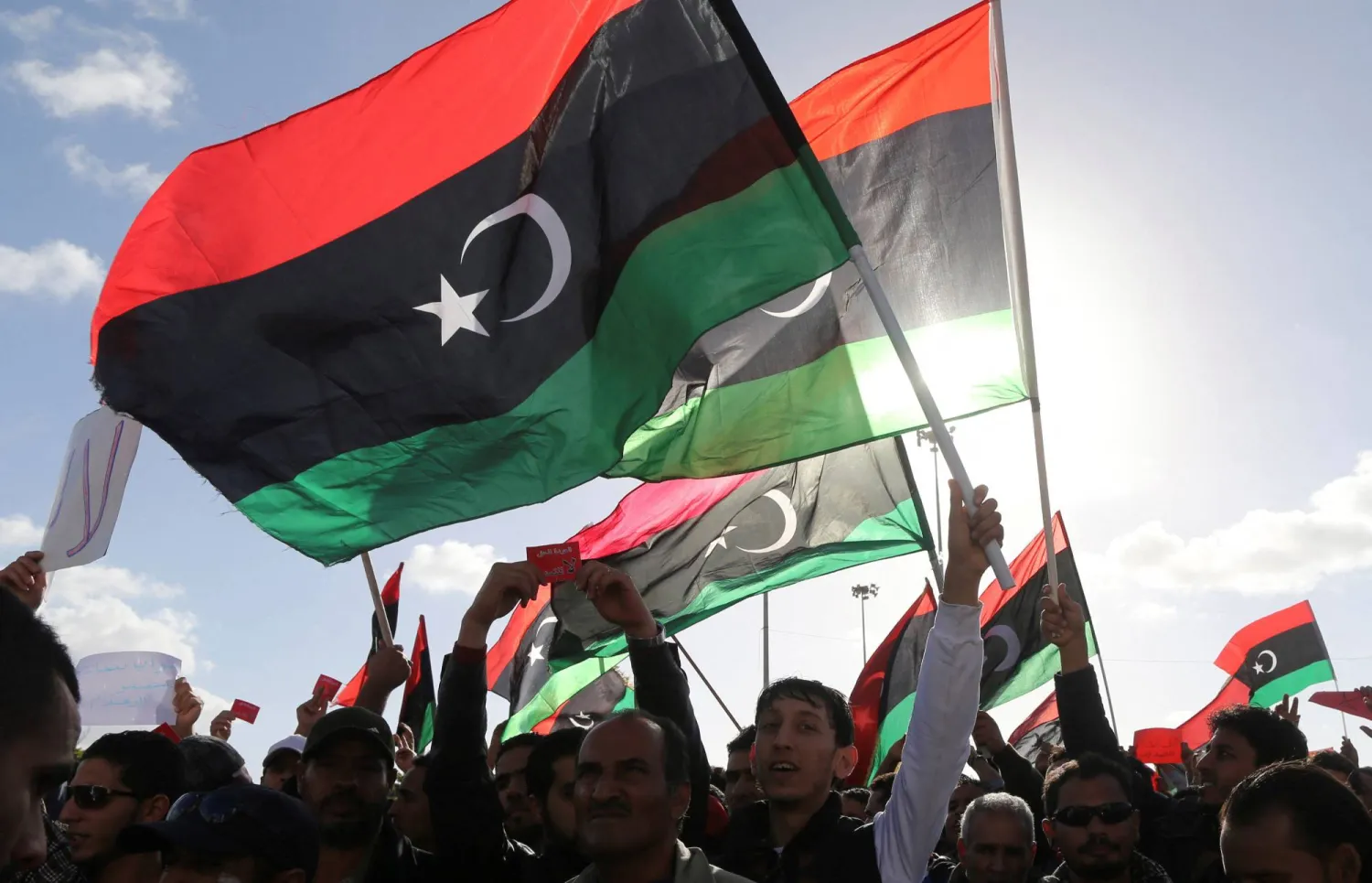
People wave Libyan flags during a demonstration in Benghazi February 7, 2014. (Reuters)
TT

Libya Rivals Agree Roadmap for Elections Within 24 Months at UN-Led Talks

People wave Libyan flags during a demonstration in Benghazi February 7, 2014. (Reuters)

Representatives of ‌Libya's rival political parties on Sunday signed an agreement on holding long-delayed national elections within two years to resolve contentious issues over electoral laws and reform the national elections body.

The political process to resolve more than a decade of conflict in Libya has been stalled since an election scheduled for December 2021 collapsed following disputes over the eligibility of the main candidates.

Sunday's signing ceremony was held at the United Nations Support Mission in Libya, UNSMIL, in ‌the Libyan capital ‌Tripoli.

It followed talks in a ‌smaller ⁠format, known as ⁠the 4+4, that involved two representatives of each of Libya's four main institutions: the Government of National Unity, the High Council of State, the House of Representatives and the Libyan National Army.

Walid Ellafi, state minister of political affairs and communications in the Government of National Unity, said legislative and ⁠presidential elections should be held "within a period not ‌exceeding 24 months" under a ‌single executive authority and unified national institutions.

Shibani AbuHamoud, head ‌of the army's general command, said the 4+4 would work ‌with UNSMIL "to develop a framework within one month of the signing of the agreement to follow up on all matters related to its implementation".

The agreement says that if Libya's House ‌of Representatives and High Council of State fail to approve the deal within a month, the ⁠parties ⁠will seek to adopt it nationally as a constitutional document through broad national mechanisms and secure international backing through the UN Security Council.

Libya has had little stability or security since a 2011 NATO-backed uprising.

It split in 2014 between warring eastern and western factions but there has been little major warfare since a 2020 ceasefire.

All Libya's major political players have repeatedly called for elections, but many Libyan people have voiced doubts that they would want a vote that could push most of them from positions of authority.


US Envoy Accuses UK of Antisemitism over Gaza Criticism

Britain's Foreign Minister Ed Miliband arrives to attend an informal meeting of EU foreign affairs ministers at Druids Glen in Wicklow, south of Dublin, Ireland, on September 2, 2026. (Photo by Paul Faith / AFP)
TT

US Envoy Accuses UK of Antisemitism over Gaza Criticism

Britain's Foreign Minister Ed Miliband arrives to attend an informal meeting of EU foreign affairs ministers at Druids Glen in Wicklow, south of Dublin, Ireland, on September 2, 2026. (Photo by Paul Faith / AFP)

The US ambassador to Israel on Saturday accused ally Britain's government of antisemitism after its top diplomat described the situation in Gaza as "horrific".

"The Brits have lost it. The Jew hate of their government knows no boundaries and knows no facts," Ambassador Mike Huckabee wrote on X of remarks by Foreign Secretary Ed Miliband, the son of Jewish refugees to Britain.

While President Donald Trump has often criticized allies, such loaded remarks by a US official are unusual against Britain, among the closest US allies, said AFP.

Miliband posted a video in which he described a meeting on Gaza and said that the British government had to take action.

"Frankly, it was horrific what is unfolding. You know, the stories that people were telling me of medicines being blocked, children dying while waiting for vital life-saving equipment," Miliband said in the video.

The Israeli foreign ministry accused him of ignoring facts and "making a video for a political audience".

The Israeli foreign ministry said that 22,500 tons of medical supplies entered the Gaza Strip since a US-brokered ceasefire in October 2025, which has reduced but not ended the violence with Israel routinely striking what it says are Hamas targets.

The UN humanitarian chief, Tom Fletcher, said in June that while more aid has been entering Gaza, it was not enough, with Israel restricting goods it says could have dual use -- including, at times, prosthetic limbs, he said.

Aid groups say Israel's restrictions on engine oil and spare parts have also made it difficult to operate hospitals and other medical infrastructure.

British Prime Minister Andy Burnham, who took office in July, has said his predecessor Keir Starmer was too soft on Israel.

His government has said it is planning measures in response to rising attacks against Palestinians by Israeli settlers in the occupied West Bank, a move that Israel says will trigger retaliation.


Israel Army Says Striking Southern Lebanon, Urges Evacuation

04 September 2026, Lebanon, Tyre District: Smoke rises after Israeli forces carried out an explosion targeting homes in Mansouri, southern Lebanon. Photo: Abdul Kader Al Bay/ZUMA Press Wire/dpa
TT

Israel Army Says Striking Southern Lebanon, Urges Evacuation

04 September 2026, Lebanon, Tyre District: Smoke rises after Israeli forces carried out an explosion targeting homes in Mansouri, southern Lebanon. Photo: Abdul Kader Al Bay/ZUMA Press Wire/dpa

The Israeli military said on Sunday it was carrying out strikes in southern Lebanon after Hezbollah launched drones at its soldiers, and urged residents of the town of Arab Salim to evacuate. 

The Israeli army said in statement that “terrorists from the Hezbollah terrorist organization launched two drones” towards the Israeli army “operating in the Security Zone in southern Lebanon” and that the military in response is now striking in southern Lebanon. It added that there were no reports of Israeli soldiers wounded. 

In another message, the Israeli military warned residents of Arab Salim to leave ahead of imminent attacks. 

"You are situated near a facility belonging to the terrorist organization Hezbollah”, against which the Israeli army will be operating, it wrote in Arabic on Telegram. 

Lebanon was drawn into the Middle East war in March after Iran-backed Hezbollah attacked Israel, which responded with airstrikes and a ground invasion that Lebanon says have killed more than 4,300 people. 

Violence has lessened since a US-Iran memorandum of understanding on the broader conflict in June and a framework agreement between Israel and Lebanon later that month. 

Israeli forces are operating inside a self-declared "security zone" around 10 kilometers (six miles) deep inside Lebanon along the border. 

Authorities in Lebanon said on Saturday that Israeli strikes killed four people in the country's south and east. 


Iraqis Queue for Fuel as Regional War Disrupts Imports

An Iraq's traffic police officer controls the queues at a petrol station in the Iraqi capital Baghdad on September 5, 2026. (AFP)
TT

Iraqis Queue for Fuel as Regional War Disrupts Imports

An Iraq's traffic police officer controls the queues at a petrol station in the Iraqi capital Baghdad on September 5, 2026. (AFP)

Drivers formed long lines outside fuel stations in Baghdad on Saturday as gasoline supplies dropped in oil-rich Iraq due to import disruptions caused by the Middle East war.

Despite being OPEC's second largest oil producer, Iraq imports oil derivatives because its refineries do not produce enough gasoline to meet domestic demand.

In recent weeks, as regional hostilities drag on, long queues have been reappearing every few days, mostly outside government-run fuel stations in Baghdad and other provinces.

Baghdad resident Ibrahim Hashem waited for two hours outside a fuel station on Friday without any luck, only to return early the next day hoping to fill his car.

"It is unreasonable that we produce so many barrels of oil a day, yet still do not have enough gasoline to meet our daily needs," Hashem told AFP outside a fuel station in central Baghdad.

"We already suffer from traffic congestion because of the roads and lack of services. Now, it has become worse due to the gasoline shortage," he added.

Iraq's average daily consumption of gasoline is 33 million liters, but demand rises to 38 million when people panic over shortages, according to authorities.

The oil ministry said Friday that "regional events and the ongoing conflict are causing logistical challenges to tanker traffic, delaying their arrival at Iraqi ports."

It urged citizens to buy only the quantities they need and avoid crowding fuel stations for small amounts of gasoline.

Oil Minister Bassem Mohammed Khudair said on Friday that his ministry was addressing the "temporary shortage of gasoline" and that new shipments will arrive soon to help stabilize supplies.

Like other oil producers, Iraq has been greatly affected by the US-Iran conflict, which has choked off the strategic Strait of Hormuz.

Iraq is hugely dependent on oil exports, which make up about 90 percent of its budget revenues.

Before the war erupted in February, Iraq produced around four million barrels per day, and exported an average of 3.4 million bpd, mostly via Hormuz.

After a significant drop, Iraqi oil exports recovered to more than 2.2 million bpd in August, according to the oil ministry.

Last month, Iran's state news agency IRNA said that over the past six months, Tehran has granted permission to "a number of Iraqi oil tankers" to pass through Hormuz.