China’s Xi Urges New Middle East Security Framework During Egypt Visit

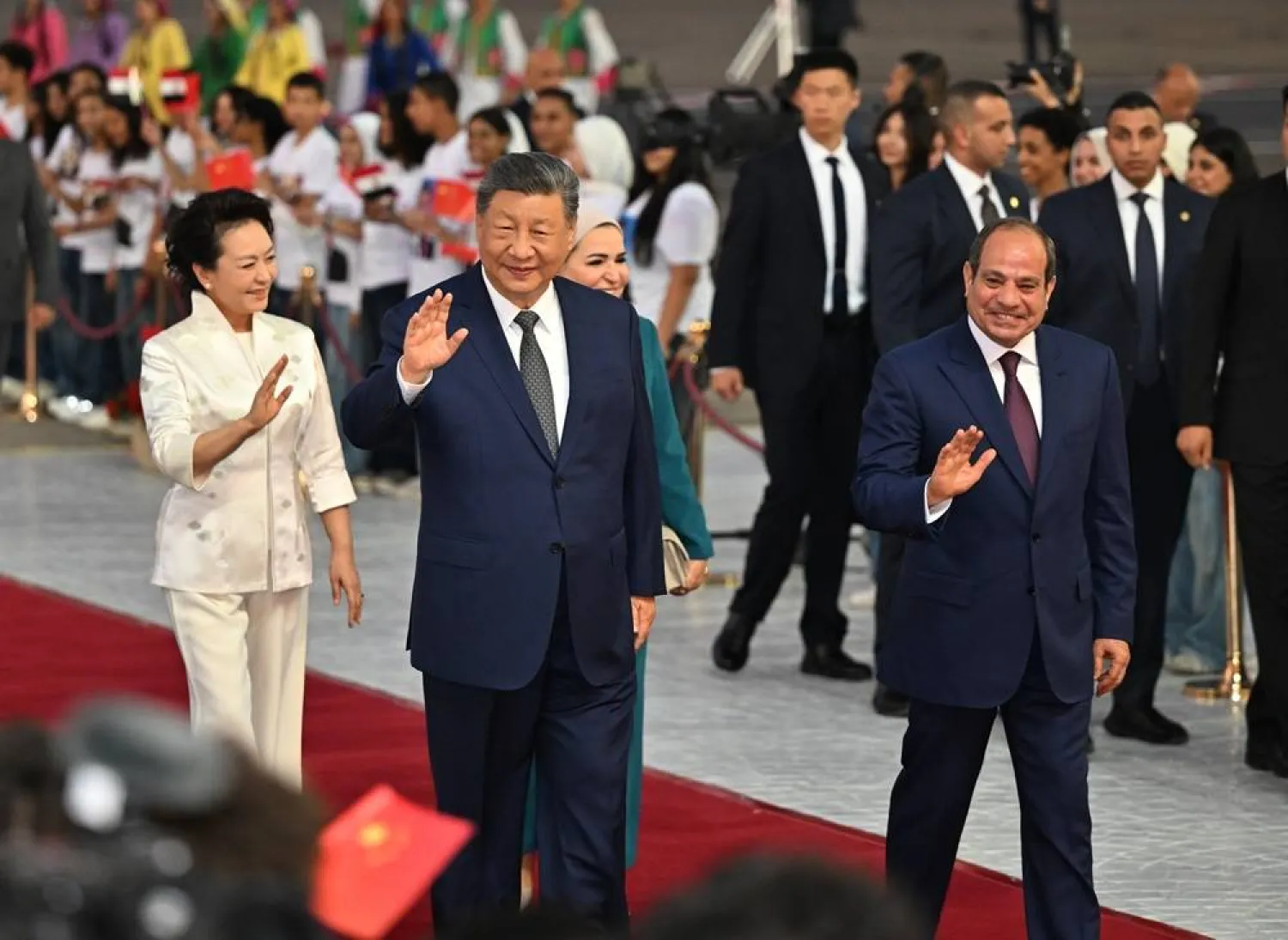
 In this photo released by Xinhua News Agency, Chinese President Xi Jinping, second left, and his wife Peng Liyuan, left, are welcomed by Egyptian President Abdel Fattah al-Sisi, right, and his wife Entissar Amerupon on their arrival at Cairo International Airport in Cairo, Tuesday, Sept. 1, 2026. (Yin Bogu/Xinhua via AP)
In this photo released by Xinhua News Agency, Chinese President Xi Jinping, second left, and his wife Peng Liyuan, left, are welcomed by Egyptian President Abdel Fattah al-Sisi, right, and his wife Entissar Amerupon on their arrival at Cairo International Airport in Cairo, Tuesday, Sept. 1, 2026. (Yin Bogu/Xinhua via AP)
TT

China’s Xi Urges New Middle East Security Framework During Egypt Visit

 In this photo released by Xinhua News Agency, Chinese President Xi Jinping, second left, and his wife Peng Liyuan, left, are welcomed by Egyptian President Abdel Fattah al-Sisi, right, and his wife Entissar Amerupon on their arrival at Cairo International Airport in Cairo, Tuesday, Sept. 1, 2026. (Yin Bogu/Xinhua via AP)
In this photo released by Xinhua News Agency, Chinese President Xi Jinping, second left, and his wife Peng Liyuan, left, are welcomed by Egyptian President Abdel Fattah al-Sisi, right, and his wife Entissar Amerupon on their arrival at Cairo International Airport in Cairo, Tuesday, Sept. 1, 2026. (Yin Bogu/Xinhua via AP)

Chinese President Xi Jinping called on Middle Eastern nations to oppose external interference and consider reshaping the region's security order during a visit to Egypt on Wednesday, as Beijing seeks to expand its influence amid the US war against Iran. 

Xi's first trip to the Middle East in four years comes after months of conflict that have disrupted trade, shaken economies and raised questions about Washington's long-term role. 

Egypt is a major US defense partner that receives around $1.3 billion annually in military aid from Washington. It has also been steadily increasing economic and military cooperation with China in recent years. 

Welcomed by President Abdel Fattah al-Sisi with ‌a military ceremony in ‌Cairo, Xi said countries in the region should be "masters of their ‌own ⁠destiny" and explore ⁠a new regional "security architecture", according to China's state news agency Xinhua. 

Xi also said China was ready to work with regional countries to safeguard shipping routes, an issue that has taken on greater importance after conflict disrupted traffic through the Strait of Hormuz and Bab al-Mandeb. 

The leaders agreed to deepen security cooperation and counterterrorism coordination, Xinhua said. The two sides also agreed to expand cooperation in data centers, semiconductors and critical metals supply chains and strengthen the use of each other's currencies in trade and investment, according to a joint statement. 

'STRATEGIC BALANCE' 

For Egypt, stronger ⁠ties with China fit a broader effort to diversify international partnerships. In an ‌article published ahead of the visit, Sisi said Egypt pursued a ‌policy of "strategic balance" at a time of growing global rivalry. 

"Egypt wants to widen the circle of its ‌relations with major world powers, including China," former Egyptian diplomat Ayman Zaineldine told Reuters. "So the visions converge." 

For ‌China, Egypt's regional influence and strategic location make it an important partner as Beijing seeks a broader economic role in the region. 

"Egypt represents something quite valuable to Beijing – a large domestic market for investment opportunities, and a lot of diplomatic weight in the region, including the Palestine question, as well as ‌connectivity to Africa," said H. A. Hellyer, a scholar at the Royal United Services Institute think tank. 

Growing military ties were on display last month during Egypt's "Eagles ⁠of Civilization" exercises with ⁠China, which included a rare air combat drill involving Chinese-made J-16 jets and French-made Rafale aircraft. 

Enthusiasm for the Chinese president's visit has been evident for days in Egypt's capital, where streets have been decked out in Chinese flags and images of iconic sites including Egypt's Sphinx and China's Great Wall. 

ECONOMIC TIES EXPAND 

Home to the Suez Canal and a population of more than 110 million, Egypt is an important market for China, importing some $10 billion of Chinese goods in the first half of this year alone. 

Chinese investment has risen rapidly since Sisi visited China and signed a strategic partnership agreement in 2014, with Chinese companies pouring billions into container ports, green hydrogen projects and facilities to make iron pipes, car tires, and satellites. 

Egypt's cabinet says the Suez Canal Economic Zone has attracted about $4 billion in Chinese investment. On Wednesday, Egyptian authorities announced plans to expand a Chinese-developed industrial area in the zone, while ZC Rubber Group signed a preliminary agreement to study a $500 million tire making complex. 


Houthis Target Sanaa Bakeries to Fund War Effort

Houthis shut dozens of bakeries to extort money from owners. (Facebook)
TT

Houthis Target Sanaa Bakeries to Fund War Effort

Houthis shut dozens of bakeries to extort money from owners. (Facebook)

Yemen's capital Sanaa is facing a looming bread shortage after the terrorist Houthi militia shut dozens of bakeries in a campaign to extract illegal payments from owners, targeting even charitable bakeries that feed poor families while forcing others to use low-quality flour.

Local sources told Asharq Al-Awsat that Houthi-controlled industry and trade authorities had deployed about 12 inspection teams since the middle of last week to raid, shut down and extort money from some 78 bakeries in the Maeen and Al-Wahda districts, citing alleged violations of bread weight regulations.

Bakery owners said the inspections were a pretext to impose more levies and force them to fund the Houthi war effort under threat of closure.

Only 25 of the 78 shuttered bakeries have reopened, after their owners were forced to pay. The rest remain closed and subject to restrictions, fueling fears that the crackdown could spread to other neighborhoods, further disrupting bread production and deepening residents' hardship.

Although Houthi inspection teams said the campaign was aimed at enforcing weight regulations, they also targeted charitable establishments known as "bakeries for the poor," demanding zakat payments despite having no authority to collect the Islamic charitable levy.

The crackdown on charitable bakeries has deprived hundreds of poor and displaced families of bread they once received free or at discounted prices.

Bakery owners in Sanaa told Asharq Al-Awsat that harassment and extortion had intensified, accusing the Houthis of turning bread production into a source of revenue.

The demands include contributions to the war effort under the banner of "supporting the front lines," as well as funding mobilization and recruitment campaigns.

Owners said the mounting costs threatened their ability to stay in business.

Residents reported dwindling bread supplies and visible shortages in several neighborhoods, warning that prolonged closures would hurt more than bakery owners.

The Houthis also face accusations of increasingly exploiting regulatory bodies under their control to squeeze money from the remaining businesses, imposing ever-higher levies instead of policing markets, protecting consumers, improving product quality and keeping prices stable.

The practices threaten one of the most essential staples in Yemeni households, adding to the strain on residents.

Beyond the closures, bakery owners in Sanaa said the Houthis had forced them in recent weeks to buy poor-quality wheat flour, some of it stored for years in warehouses belonging to the Houthi-run Zakat Authority, and mix it with the white flour used to make bread and pastries.

Bakers condemned the orders, saying they showed disregard for potential health risks to consumers.

The measures coincided with a surge in white flour prices, with bags now costing several times their previous prices.

Bakery owners said the mounting levies and restrictions, which threatened to bankrupt them, had left them with little choice but to accept and use the poor-quality flour.

With product quality deteriorating and customer demand falling, workers in the bread industry fear their businesses could collapse.


Debate Intensifies in Syria Over Stalled Kurdish Integration Process

Syria's interim President Ahmed al-Sharaa and Commander of Syrian Kurdish-led forces Mazloum Abdi shake hands, after Syria reached a deal to integrate the Kurdish-led Syrian Democratic Forces (SDF) with state institutions, the Syrian presidency said on Monday, in Damascus, Syria, in this handout released on March 10, 2025. (SANA/Handout via Reuters)
TT

Debate Intensifies in Syria Over Stalled Kurdish Integration Process

Syria's interim President Ahmed al-Sharaa and Commander of Syrian Kurdish-led forces Mazloum Abdi shake hands, after Syria reached a deal to integrate the Kurdish-led Syrian Democratic Forces (SDF) with state institutions, the Syrian presidency said on Monday, in Damascus, Syria, in this handout released on March 10, 2025. (SANA/Handout via Reuters)

A row over Syria's agreement to integrate Kurdish-led civilian and military institutions into the state has intensified after presidential adviser Mazloum Abdi accused unnamed parties of trying to derail the process.

Abdi's remarks drew a sharp response from local Arab media outlets, which portrayed them as part of an "escalation campaign" by former commanders of the disbanded Kurdish Syrian Democratic Forces (SDF) to unravel existing agreements.

The Hasakah Media Center and Hasakah Observatory were among outlets that branded his comments "provocative."

Stoking Kurdish sentiment

Political researcher and Arab tribal elder Mudar Hammad al-Asaad accused some former SDF commanders of exploiting Kurdish sentiment to win over hardliners opposed to integration.

Al-Asaad told Asharq Al-Awsat that the commanders were making statements detached from reality and outside the terms of the agreement, particularly to appeal to the Kurdish Revolutionary Youth.

"Some leaders in Hasakah and Afrin remain affiliated with the Kurdistan Workers' Party (PKK) and take orders from foreign parties," he said.

Al-Asaad said the Arab community supported integration and an end to divisions in Hasakah and Afrin, noting that most Afrin residents were Arab.

"No one wants the region to descend into tribal or ethnic conflict," he added.

Obstacles to integration

Mohammed Ibish, an official in the Kurdish Democratic Union Party (PYD), acknowledged that obstacles were inevitable but said his party remained committed to integration.

"Some see no benefit in completing the process, but our party is working to see it through and bring the autonomous administration's institutions into state structures," he told Asharq Al-Awsat.

He said some parties failed to grasp the importance of integration and contributing to rebuilding the country, while certain regional players sought to keep Syria unstable.

The PYD recently warned at a general council meeting that some parties were seeking to obstruct integration, while rising hate speech and incitement threatened civil peace.

Afrin force fuels controversy

The dispute intensified after Abdi told Kurdish broadcaster Nuçe TV on Monday evening that a special force for Afrin was undergoing training and would soon formally begin operations.

He also said the Syrian government had agreed to accept the Women's Protection Units (YPJ) as two special counterterrorism forces in the Jazira and Kobani regions.

But how either arrangement would work remains unclear.

Asharq Al-Awsat sought clarification from Syria's Interior Ministry and the presidential team overseeing the agreement, particularly on the YPJ's integration, but received no response.

Al-Asaad said Abdi's remarks about the Afrin force appeared to reinforce a system of ethnic or sectarian quotas.

He said that military or security formations based on ethnic or sectarian identity were unacceptable because the agreement required volunteers from all communities to enlist individually, without discrimination.


UN Peacekeepers Say Came Under Fire in Southern Lebanon

United Nations Spanish UNIFIL forces inspect chalets after the Israeli army booby-trapped and blew them up at dawn, on the outskirts of the town of al-Khiam, southern Lebanon, Jan. 31, 2026. (AFP)
TT

UN Peacekeepers Say Came Under Fire in Southern Lebanon

United Nations Spanish UNIFIL forces inspect chalets after the Israeli army booby-trapped and blew them up at dawn, on the outskirts of the town of al-Khiam, southern Lebanon, Jan. 31, 2026. (AFP)

The United Nations peacekeeping force in Lebanon (UNIFIL) said on Tuesday that one of its patrols came under fire in the country's south, without saying who was responsible.

The force, whose mandate in Lebanon expires at the end of this year, said the patrol "was fired upon with about a dozen rounds" near Wadi Jilu and returned fire, after which the shooting stopped.

It reported no casualties and called for an investigation.

"We reiterate the obligation under international law for all actors to ensure the safety and security of UN personnel and property at all times," it said.

UNIFIL has served as a buffer between Israel and Lebanon since 1978, but its presence has been unable to prevent several rounds of conflict, including the latest between Israel and Hezbollah, which broke out in March amid the wider Middle East war.

Despite a patchy ceasefire and recent direct talks between Israel and Lebanon, Hezbollah still refuses to disarm and Israeli troops continue to occupy parts of the south.

Under US pressure, the UN Security Council last year voted to end UNIFIL's mandate on December 31, 2026.

Lebanese officials have called for it to be extended.

At a meeting in Paris on Tuesday, G7 foreign ministers agreed on "the need to avoid a security void" in Lebanon after UNIFIL withdraws, French Foreign Minister Jean-Noel Barrot said.

But he acknowledged there had been no breakthrough on what should replace the force, which numbers around 7,500 personnel from nearly 50 countries.