Hezbollah Throws Blame on Lebanese State for Israeli Escalation

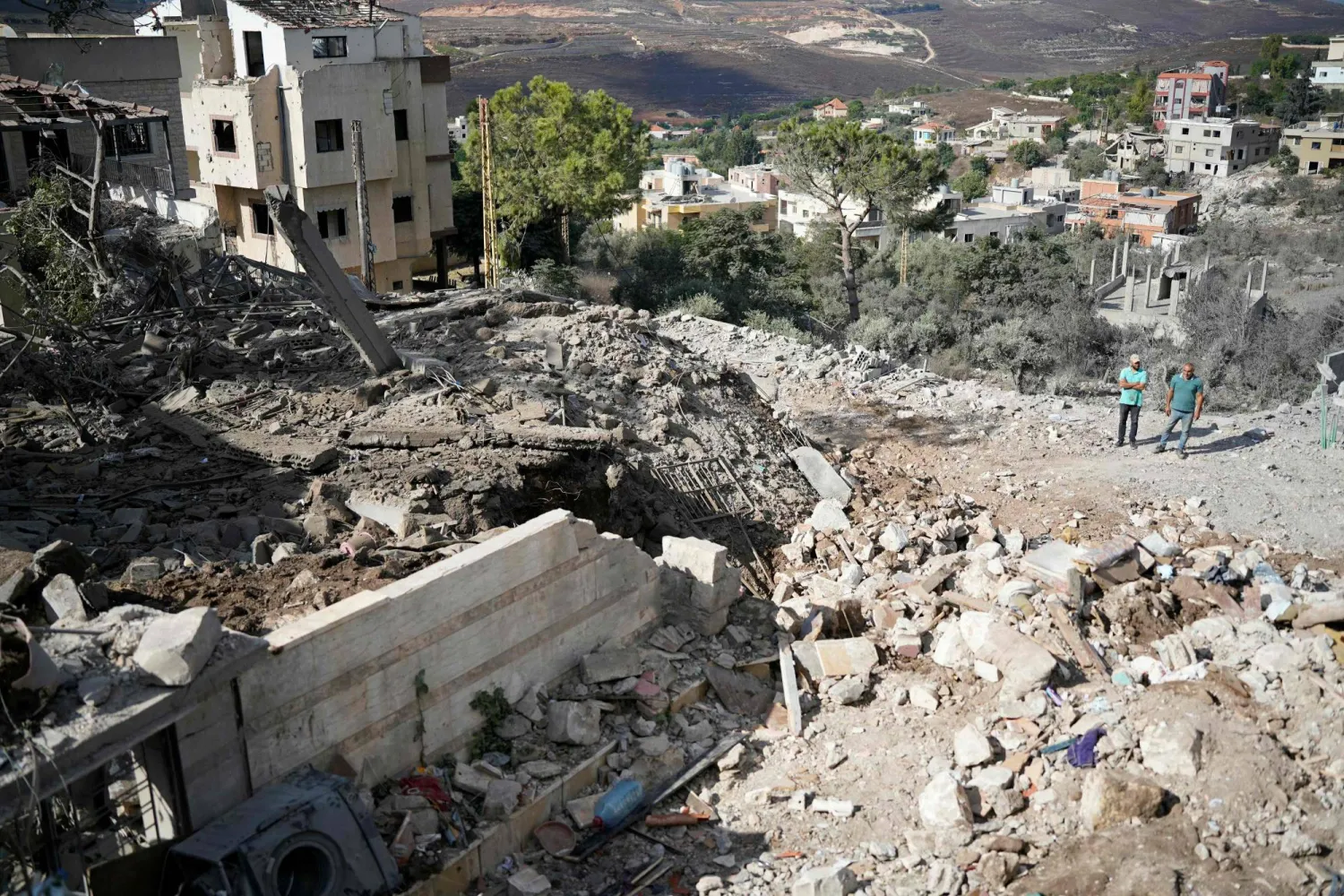
TOPSHOT - Residents inspect the destruction the morning after a night airstrike by the Israeli military that targeted the southern Lebanese village of Mayfadoun on September 5, 2026. (Photo by ammar ammar / AFP)
TT

Hezbollah Throws Blame on Lebanese State for Israeli Escalation

TOPSHOT - Residents inspect the destruction the morning after a night airstrike by the Israeli military that targeted the southern Lebanese village of Mayfadoun on September 5, 2026. (Photo by ammar ammar / AFP)

Lebanon’s Hezbollah party continues to throw the blame on Lebanese authorities for Israel’s military escalations in the South, as a ministerial source questions the party’s silence over the fall of the strategic Ali al-Taher hill following reports of an Iranian-US deal.

“It is unfortunate that this rhetoric of holding the authorities responsible continues, while everyone knows who dragged the country into this war and whose interests they served by doing so”, the source told Asharq Al-Awsat on condition of anonymity on Sunday.

Hezbollah didn’t issue any clear position after the downfall of Ali al-Taher into Israel’s control.

The source questioned why the group had not defended it or explained to its supporters what had actually happened there. “Why did they not defend Ali al-Taher? Why don’t they tell their supporters the truth about what actually happened there, instead of maintaining this complete silence?” said the source.

The source also pointed to a shift in Hezbollah’s rhetoric, from portraying Ali al-Taher as strategic and issuing threats over it, to downplaying its significance following its downfall.

Israeli Escalation in the South and Bekaa

Israeli strikes on southern and eastern Lebanon on Friday killed four people and wounded 32, according to Lebanon’s Health Ministry. The strikes hit seven villages mainly striking Nabtieh. In Mayfadoun, an 18-year-old woman was killed.

Israel said it targeted Hezbollah personnel and weapons infrastructure in response to a drone launch toward its forces.

Also, Israeli drones flew at low altitude over Beirut and its southern suburbs on Saturday, while Israeli aircraft struck homes in Mansouri and carried out several explosions in the area. Large explosions were also reported in Bani Hayyan, with footage showing extensive smoke.

Hezbollah Steps Up Rhetoric against the Government

Hezbollah escalated its rhetoric against the Lebanese authority, considering Israel’s continued aggression against Lebanon showed the failure of the state’s approach toward Israel.

In a statement it issued on Saturday, Hezbollah said: “The Israeli enemy continues to escalate its aggression and crimes against Lebanon, through killings, bombardment, destruction and the systematic demolition of homes and villages, amid complete international silence, blatant US complicity and the total absence of the Lebanese authorities from assuming their responsibilities”.

It added that the authorities’ continued pursuit of “wrong choices and a concessionary and submissive approach” had only served to entrench the occupation and allow the enemy to continue its aggression and crimes against the Lebanese people.

Hezbollah said the Israeli aggression was putting pressure on the Lebanese authorities to carry out what it described as “agendas” with known objectives, warning that continuing along the negotiating path “gives the enemy cover to continue its aggression and more time to achieve its goals and impose its conditions and dictates on Lebanon.”

Hezbollah also criticized the direct US-sponsored Lebanese-Israel talks and the “framework agreement,” arguing that the continued occupation and Israeli attacks undermined any claims of progress achieved through the process.


Sudan’s Currency Tumbles to New Low as War Hammers Economy

People stand at a market in Omdurman, Sudan, September, 19, 2026. (Reuters)
TT

Sudan’s Currency Tumbles to New Low as War Hammers Economy

People stand at a market in Omdurman, Sudan, September, 19, 2026. (Reuters)

Sudan's currency ‌hit a new low of 10,000 Sudanese pounds to the dollar on Wednesday in parallel market trading, continuing a dramatic fall over recent months as wartime conditions take their toll on the economy.

The rapid 60% depreciation has heaped hardship on Sudanese still trying to regain their footing after devastating conflict and ‌forced displacement caused ‌by the war between ‌Sudanese ⁠armed forces and the ⁠paramilitary Rapid Support Forces, putting basic food items out of reach.

Sudan's official exchange rate remains stuck at 4,200 SDG to the dollar, a rate last seen on the parallel market ⁠in army-controlled areas in May.

A large ‌portion of ‌that fall has happened over the past month, ‌as the pound fell from a ‌previous low of 8,000, depreciating 20%. Prior to the start of the war in April 2023, the rate was about 600 ‌pounds to the dollar.

Currency traders cited import demands as a ⁠chief ⁠factor as the government increased the tightly controlled customs dollar, used to calculate duties, to more than 5,600 this week.

As the war continues Sudan has decreased production of key dollar earners while its chief export, gold, has increasingly been smuggled abroad. Meanwhile, the army-controlled government has said the war and reconstruction efforts require dollar-draining imports.


France Says to Hold Conference for Lebanese Forces after Israeli Elections

French President Emmanuel Macron gestures as he speaks to members of the media on the day of the 9th Annual One Planet Sovereign Wealth Funds (OPSWF) Summit, in Lusail, Qatar, 21 October 2026.  EPA/BENOIT TESSIER
French President Emmanuel Macron gestures as he speaks to members of the media on the day of the 9th Annual One Planet Sovereign Wealth Funds (OPSWF) Summit, in Lusail, Qatar, 21 October 2026. EPA/BENOIT TESSIER
TT

France Says to Hold Conference for Lebanese Forces after Israeli Elections

French President Emmanuel Macron gestures as he speaks to members of the media on the day of the 9th Annual One Planet Sovereign Wealth Funds (OPSWF) Summit, in Lusail, Qatar, 21 October 2026.  EPA/BENOIT TESSIER
French President Emmanuel Macron gestures as he speaks to members of the media on the day of the 9th Annual One Planet Sovereign Wealth Funds (OPSWF) Summit, in Lusail, Qatar, 21 October 2026. EPA/BENOIT TESSIER

French President Emmanuel Macron said on Wednesday that this country will organise a conference to support the Lebanese armed forces after the Israeli elections this month, as truce talks between the two sides stall.

"We will also coordinate to carry out this work of support for the Lebanese armed forces and a conference will be set up in the coming weeks by France... I think it is useless to do it before the Israeli elections, but we will organise such a conference because it is unavoidable," he told reporters in Qatar.

Israel goes to the polls on October 27.

Lebanese authorities last year committed to disarming Hezbollah after months of cross-border hostilities culminated in a 2024 war between the group and Israel.

But Hezbollah drew Lebanon into the Middle East war this year by attacking Israel, which responded with heavy strikes and a ground invasion.

In June, Lebanese and Israeli authorities signed a framework agreement which involves the disarmament of Hezbollah, a gradual Israeli withdrawal from territories it occupies, and the deployment of the Lebanese army to the area.

Hezbollah has rejected surrendering its weapons and the direct negotiations with Israel.


Syria: Israeli Forces Shell Quneitra Countryside

An Israeli military vehicle is seen near the border between the Israeli-occupied Golan Heights and Syria, May 4, 2025. REUTERS/Shir Torem/File Photo
TT

Syria: Israeli Forces Shell Quneitra Countryside

An Israeli military vehicle is seen near the border between the Israeli-occupied Golan Heights and Syria, May 4, 2025. REUTERS/Shir Torem/File Photo

Israeli forces fired several artillery shells on Wednesday at the area around eastern Tell al-Ahmar in the southern Quneitra countryside in southern Syria.

The Syrian Arab News Agency (SANA) said that “occupation forces fired two projectiles that landed on agricultural land around eastern Tell al-Ahmar, causing no injuries".

Israel continues to violate the 1974 Disengagement Agreement through repeated incursions into southern Syria, raids on and arrests of civilians, land bulldozing and shelling, among other attacks, the agency said.

Syria has repeatedly called for Israeli forces to withdraw from its territory, stressing that all measures taken by Israel are null and void and have no legal effect under international law. Damascus has also urged the international community to fulfil its responsibilities and compel Israel to withdraw fully from southern Syria.