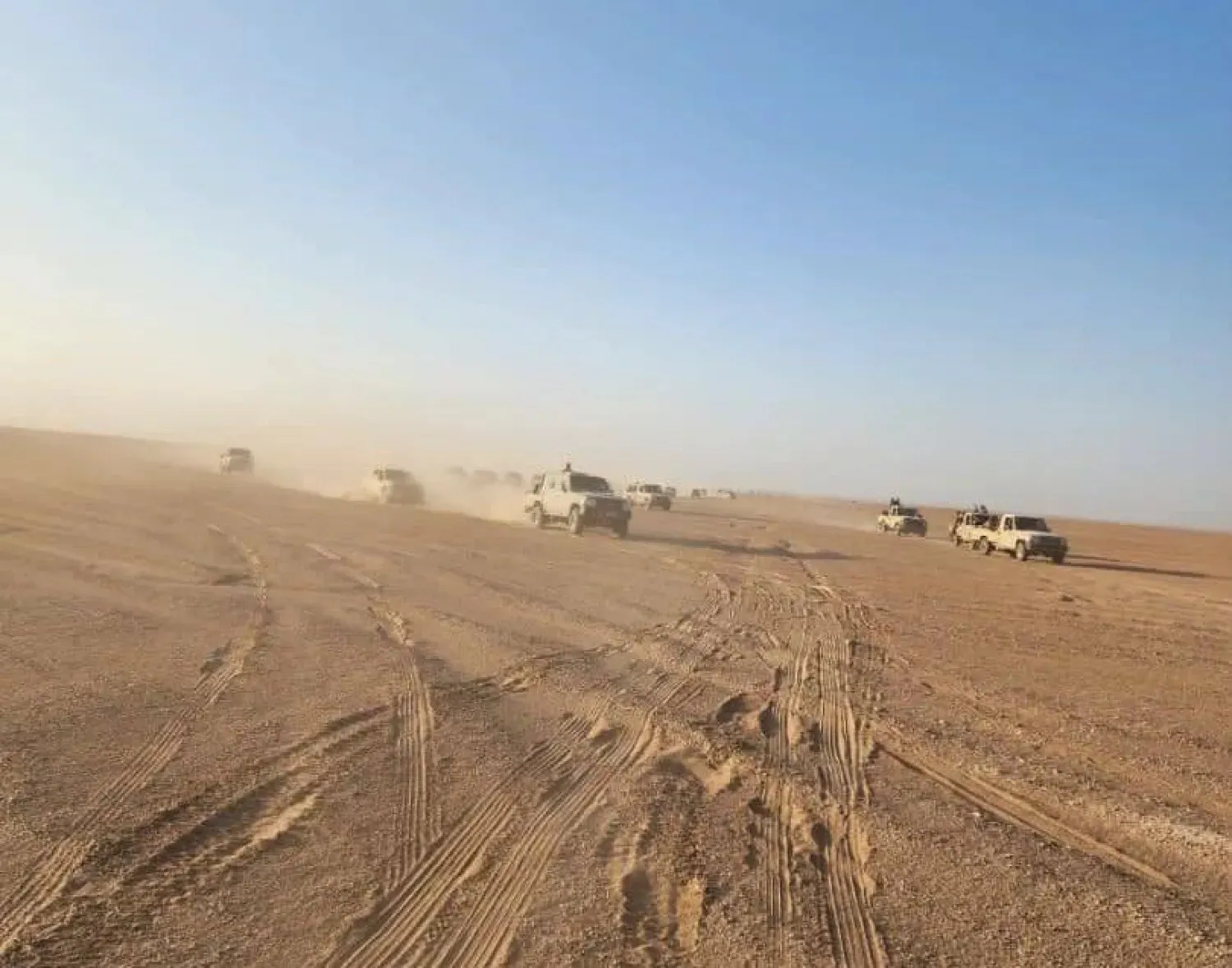
Yemeni Army Makes Battlefield Gains in Al-Jawf, Marib

Yemeni army forces advance in Al-Jawf governorate (government media)
TT

Yemeni Army Makes Battlefield Gains in Al-Jawf, Marib

Yemeni army forces advance in Al-Jawf governorate (government media)

Yemeni government forces expanded military operations against the Houthis on several fronts Wednesday, making battlefield gains east of Al-Hazm in Al-Jawf province and cutting Houthi supply lines toward the eastern fronts.

The advances coincided with the launch of a major operation south of Marib, intensified fighting in southern Taiz and along the western coast, and the thwarting of a Houthi boat attack in the Red Sea.

A military source told the Yemeni Armed Forces Media Center that government forces continued advancing east of Al-Hazm to the outskirts of Bir al-Maraziq and cut Houthi supply lines on the city’s eastern fronts.

Operations were continuing amid what the source described as heavy Houthi personnel and material losses. Several Houthi fighters were detained or neutralized and others wounded in the clashes, the source added.

The advance followed several days of government military moves in Al-Jawf, as forces sought to consolidate gains and pressure Houthi supply lines rather than merely retake frontline positions.

Marib and Taiz Developments

In Marib, the Yemeni army’s Third Military Region launched a major operation on the province’s southern fronts targeting Houthi positions and concentrations. Government forces said the operation aimed to secure Marib’s southern belt and push the group away from its defensive lines.

According to a statement from the Third Military Region, the operation, which began early Wednesday and was still underway, killed, wounded and captured a number of Houthis and destroyed vehicles and combat equipment. Army and Popular Resistance forces also seized several positions and brought Houthi supply lines under fire.

The operation coincided with military activity in Marib in recent days and fighting across the province’s northern, western and southern axes, as government forces sought to capitalize on battlefield pressure to prevent the Houthis from regrouping or sending reinforcements to other fronts.

In Taiz, clashes continued on southeastern fronts, alongside artillery fire and airstrikes targeting Houthi positions and concentrations in Al-Mamshat, Al-Ahkum, Ayrim, Al-Qubaytah, Al-Rahidah and Karsh.

A military source said the Houthis had sent reinforcements to several positions, including Al-Akboush School, Al-Zubayrah market, the Al-Ahkum junction, Hawd Hill, Al-Khazjah, Al-Aabous and Al-Manzarah Hill.

On the western coast, the National Resistance’s military media said its forces shot down a Houthi suicide drone over Al-Barh and reported the killing and capture of several commanders linked to a Houthi plan to attack toward Bab al-Mandab.

Among those reportedly captured by the Giants Brigades was Murtada al-Nuami, known as “Abdul Samad,” identified as head of the medical division of the Houthi reserve and rapid intervention forces.

Naval forces separately said they thwarted a Houthi boat attack in the Red Sea after detecting the vessels and engaging them, forcing them to retreat north toward Hodeidah port.

In Al-Dhale, Yemeni Defense Minister Lt. Gen. Taher al-Aqili inspected front lines to assess operations, readiness and deployments, urging troops to remain vigilant and prepared to counter any Houthi attempt to target government positions.


Yemeni Forces Consolidate West Coast Gains, Reinforce Bab al-Mandab Positions

 Yemeni government fighters sit in the back of a vehicle near Dhubab, Taiz Governorate, Yemen, in this still image taken from video released October 5, 2026.    Southern Giants Brigades/Handout via REUTERS
Yemeni government fighters sit in the back of a vehicle near Dhubab, Taiz Governorate, Yemen, in this still image taken from video released October 5, 2026. Southern Giants Brigades/Handout via REUTERS
TT

Yemeni Forces Consolidate West Coast Gains, Reinforce Bab al-Mandab Positions

 Yemeni government fighters sit in the back of a vehicle near Dhubab, Taiz Governorate, Yemen, in this still image taken from video released October 5, 2026.    Southern Giants Brigades/Handout via REUTERS
Yemeni government fighters sit in the back of a vehicle near Dhubab, Taiz Governorate, Yemen, in this still image taken from video released October 5, 2026. Southern Giants Brigades/Handout via REUTERS

Yemeni armed forces consolidated gains along the western coast and reinforced positions overlooking the Bab al-Mandab Strait as they pushed ahead in al-Wazi'iyah district in western Taiz province under Operation “Dawn of Yemen.” Fighting with the Houthis continued in the southern Taiz countryside and on fronts around the city.

The armed forces said they had neutralized more than 1,800 Houthi fighters in recent hours. Army figures put Houthi losses at nearly 10,000 killed or wounded over two weeks of air and ground strikes across multiple fronts.

Nation Shield forces, the Giants Brigades and the Joint Forces took full control of the Kahboub front, according to Yemeni military media. The advance strengthens government forces’ hold on heights overlooking Bab al-Mandab and boosts their ability to secure the strategic corridor as operations continue along the western coast.

Taiz province’s emergency committee suspended classes at public, community and private schools, institutes, colleges and universities in districts that have come under Houthi control. It also placed government employees there on temporary leave, citing exceptional security conditions.

The United Nations warned of a worsening humanitarian situation in Taiz as Houthi attacks spread, displacement rises and aid access faces growing restrictions. Major roads remain closed, adding to pressure on services and limited resources.

The eastern road into Taiz city remains closed, the United Nations said in a recent report. Road closures between Aden and Taiz have disrupted a major supply route from warehouses in Aden, hampering aid agencies’ ability to reach those affected and meet growing needs.


Iraq Rejects Syrian Request to Repatriate 4,000 Suspected ISIS Detainees

Members of the Iraqi border forces patrol along a concrete wall on the Iraqi-Syrian border, in the town of al-Baghuz in the Al-Qaim district of western Iraq, on January 21, 2026. (AFP)
TT

Iraq Rejects Syrian Request to Repatriate 4,000 Suspected ISIS Detainees

Members of the Iraqi border forces patrol along a concrete wall on the Iraqi-Syrian border, in the town of al-Baghuz in the Al-Qaim district of western Iraq, on January 21, 2026. (AFP)

Iraq has rejected Syria's request to repatriate thousands of suspected ISIS members transferred from Syrian detention centers to Iraqi custody earlier this year, a senior Iraqi security official said on Wednesday.

Iraqi National Security Advisor Qasim al-Aboudi said that a meeting had been held recently between Syria, Iraq and the United States to discuss the fate of the prisoners.

Al-Aboudi said Syria had requested that the 4,000 Syrian prisoners be handed over to be tried in Syria, but Iraq refused. Iraq has repatriated about 50 Syrian detainees who were determined not to be ISIS members, he told The Associated Press, while the Syrian prisoners remaining in Iraq include about 400 who are believed to be high-level members of the extremist group.

“Iraq is conducting investigations, and anyone proved to have committed crimes in Iraq will be tried under Iraqi law,” he said.

Some prisoners could later be transferred to their home countries to complete their sentences, he said.

Syria did not immediately respond to requests for comment.

More than 5,700 prisoners with alleged ISIS ties — including some 4,000 Syrians — were transferred from northeast Syria to Iraq after fighting broke out in January between Syrian government forces and the Kurdish-led Syrian Democratic Forces, which had long guarded the detention centers where they were held.

Some ISIS-linked prisoners managed to flee during the chaos of the clashes, and there were fears that a larger-scale escape would take place. While the extremist group lost control of the territory it once seized in Iraq and Syria years ago, its cells still periodically carry out attacks in both countries.

The discussions about the prisoners' fate come as the United States has ended a 12-year mission to fight ISIS in Iraq, with the last US troops withdrawing from the country last month.

Al-Aboudi said Iraq has asked for financial support from the US and other countries taking part in the global coalition against ISIS to help with the costs of housing the prisoners.

“Iraq asked for an allocation of $500 million. The coalition promised support, but Iraq is still waiting,” he said.

A US defense official and the office of Tom Barrack, the US envoy to Syria and Iraq, referred questions about the prisoners to Iraqi and Syrian authorities.

Many of the prisoners transferred to Iraq had been held in Syria for years without charges. Rights groups have raised concerns about detention conditions in both countries.


Arab Parliament President Stresses Houthi Attacks on Saudi Arabia Pose Direct Threat to Regional Security

Arab Parliament President Stresses Houthi Attacks on Saudi Arabia Pose Direct Threat to Regional Security
TT

Arab Parliament President Stresses Houthi Attacks on Saudi Arabia Pose Direct Threat to Regional Security

Arab Parliament President Stresses Houthi Attacks on Saudi Arabia Pose Direct Threat to Regional Security

President of the Arab Parliament Mohammed bin Ahmed Al-Yamahi stressed that repeated terrorist attacks by the Houthi militia against Saudi Arabia and its civilian and oil facilities pose a direct threat to regional security.

During his speech at the 153rd Assembly of the Inter-Parliamentary Union in Arusha, United Republic of Tanzania, Al-Yamahi addressed Iranian attacks that targeted several Arab countries and threatened civilians, infrastructure, and vital facilities, SPA reported.

He also discussed regional escalation and related threats to the security of Arab countries. He called on the international community to move beyond condemnation and take measures to protect states and their sovereignty and compel the parties to respect international law.