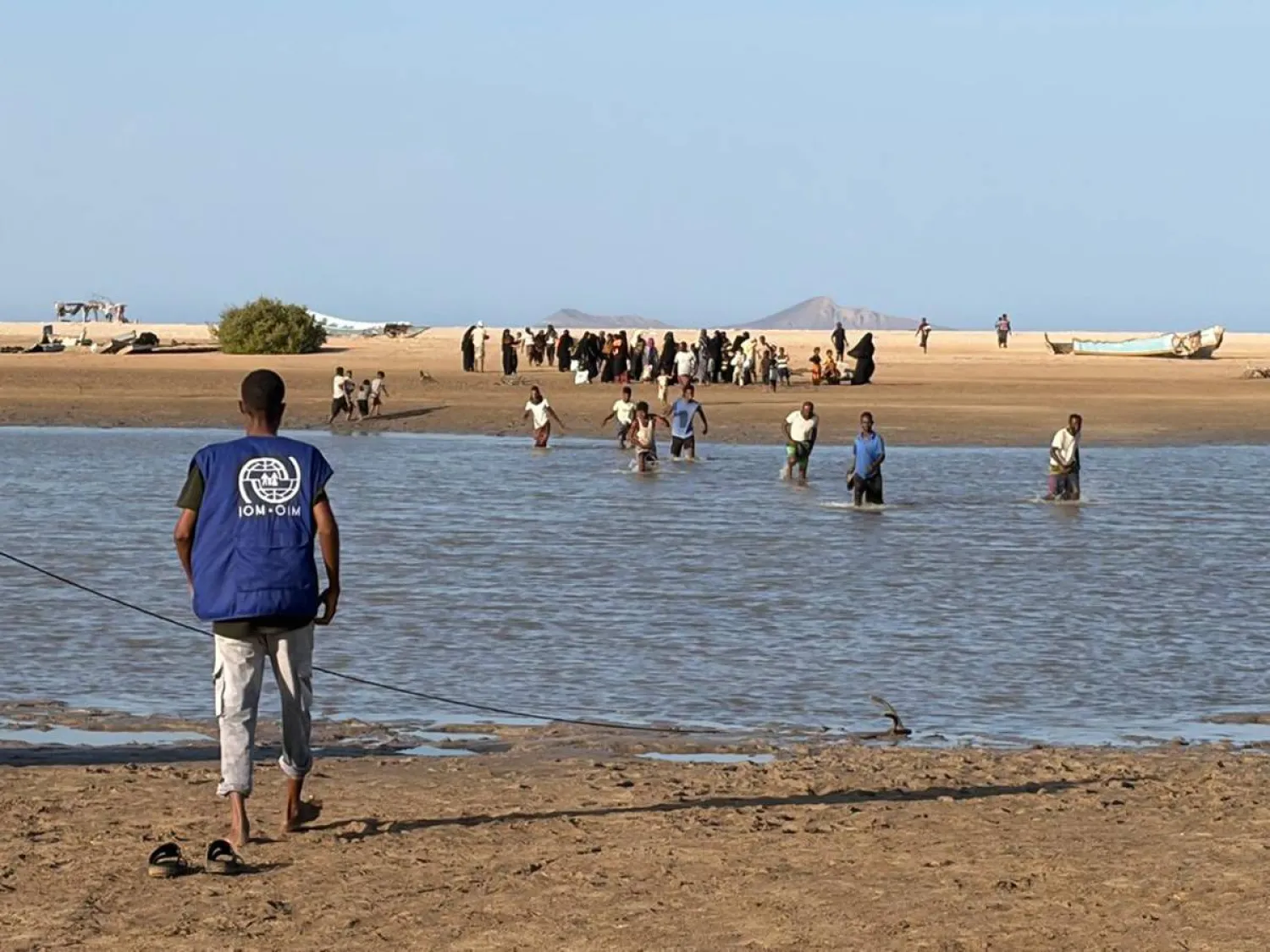
Fuel Shortage in Yemen Hampers Migrants Fleeing Conflict and Seeking Safety in Djibouti

This handout picture taken and released by the International Organization for Migration (IOM) Djibouti shows refugees from Yemen fleeing fighting between government forces and Iran-backed Houthi militants as they arrive at a Djibouti Coast Guard post in Khor Angar on September 13, 2026. (Handout / IOM Djibouti / AFP)
TT

Fuel Shortage in Yemen Hampers Migrants Fleeing Conflict and Seeking Safety in Djibouti

This handout picture taken and released by the International Organization for Migration (IOM) Djibouti shows refugees from Yemen fleeing fighting between government forces and Iran-backed Houthi militants as they arrive at a Djibouti Coast Guard post in Khor Angar on September 13, 2026. (Handout / IOM Djibouti / AFP)

A fuel shortage in Yemen is hampering the movement of people fleeing the country’s escalating fighting and seeking safety across the Red Sea in Djibouti, with the UN migration agency warning that more Yemenis are ready to make the crossing by boat.

More than 2,000 Yemenis are currently in Djibouti, where the country's government and the International Organization for Migration are providing food and shelter.

Yemen’s legitimate government has been battling the Iranian-backed Houthi militants for 12 years. The recent escalation has ended a ceasefire that had largely stopped civil war across Yemen since 2022. The Houthis kept to the sidelines during the initial, heavy phase of the Iran war, but in July they resumed attacks on Saudi Arabia and escalated attacks in Yemen.

Now the number of people from Yemen fleeing the fighting is soaring, with nearly 94,000 people displaced in the country.

IOM Regional Director for East and Southern Africa Frantz Celestin told The Associated Press on Monday that arrivals had slowed because of the fuel shortage, but warned that more people were expected to make the dangerous crossing.

“We expect more to come. What we were told is that there are a lot of people who are willing and ready to come. They simply don’t have fuel to make the journey,” Celestin said. “There’s a fuel shortage in Yemen that may explain the lull that we’ve seen today.”

The prospect of more arrivals is raising concerns that Djibouti, the small Horn of Africa nation, could struggle to accommodate the influx.

“When you have that many people come in a short amount of time, it’s bound to overwhelm the system,” Celestin said. “But so far, they (Djibouti) are managing it quite well. But there may be a time, if they continue to come, where they may overwhelm the capacity of the country to house and accommodate all of them.”

Djiboutian Finance Minister Ilyas M. Dawaleh said on X that the situation was “becoming increasingly difficult for our country, despite our unwavering commitment to humanitarian assistance.”

“We cannot allow those who have sought refuge among us to suffer. I am proud of my fellow Djiboutians for their collective mobilization and their remarkable solidarity with our Yemeni brothers and sisters,” he wrote.

Dawaleh also praised residents of Obock, a coastal town in northern Djibouti that has been on the front line of the humanitarian response.

The IOM's Celestin said the arrivals were putting additional pressure on communities and called for more international support, including additional tents and medical services.

Djibouti sits across the Bab al-Mandeb Strait from Yemen, making it one of the closest places of refuge for Yemenis fleeing the conflict.


Libya Suspects Drone Strike on Russian Ship Caused Blast in Benghazi

A satellite image of smoke rising from a fire after an explosion aboard a Russian ship docked at Benghazi port, Libya, November 22, 2026. (2026 Planet Labs PBC/Handout via Reuters)
TT

Libya Suspects Drone Strike on Russian Ship Caused Blast in Benghazi

A satellite image of smoke rising from a fire after an explosion aboard a Russian ship docked at Benghazi port, Libya, November 22, 2026. (2026 Planet Labs PBC/Handout via Reuters)

Authorities in divided Libya's east said a Russian ship docked at the Benghazi port was hit on Sunday in a suspected drone attack, causing a blast but no casualties.

There was no immediate claim of responsibility for the strike, but it comes as Ukrainian forces have stepped up their long-range barrages against Russia far beyond the front lines.

On Saturday, a drone hit a Russian cargo ship in the eastern Baltic Sea, close to the waters of Finland, whose border guard said the strike was Ukrainian.

Libya's eastern administration did not identify those behind Sunday's attack but said Libya was "not a party to the Russian-Ukrainian war".

The conflict, that began with Moscow's 2022 full-scale invasion of Ukraine, has killed hundreds of thousands of people and displaced millions.

Earlier reports said a fire broke out inside an ammunition depot at a naval base, but the authorities in Libya's east said "the explosion occurred on board a Russian ship docked in the port".

"It is suspected that the ship was attacked by drones," an official statement said.

"The ship was en route back to Russia and its stop was for refueling and resupply."

Libya's eastern authorities said they would launch a joint investigation with Russia.

The Government of National Unity in Tripoli said in a statement it was alarmed by "risks posed by involving civilian ports and facilities in activities linked to external conflicts".

- 'Shadow fleet' -

In March, a Russian liquefied natural gas carrier sank off the Libyan coast following an attack, which Russian President Vladimir Putin pinned on Ukraine.

The ship had been among Russia's so-called "shadow fleet" of tankers that carry its oil and gas around the world, skirting Western restrictions.

Ukraine has at times admitted to attacking Moscow's shadow fleet, including in the Mediterranean Sea last December.

The Tripoli government said it "rejects the transformation of Libya into an arena for international conflicts" and the use of Libyan territory "for any military or logistical activities that could jeopardize the security of Libyans or the sovereignty of the state".

Earlier on Sunday, Al-Masar TV channel cited local civil defense forces as saying response teams were deployed at a military facility to contain a blaze after the reported blast.

Libya Alhadath TV said the civil defense urged locals to avoid the area, later reporting that the fire had been put out.


Aoun: Lebanon Cannot Be Liberated Through Mini-States

Lebanese national flags line a highway ahead of the country's 83rd Independence Day celebrations in the Dbayeh coastal suburb, north of Beirut, Lebanon, 20 November 2026. (EPA)
TT

Aoun: Lebanon Cannot Be Liberated Through Mini-States

Lebanese national flags line a highway ahead of the country's 83rd Independence Day celebrations in the Dbayeh coastal suburb, north of Beirut, Lebanon, 20 November 2026. (EPA)

Lebanese President Joseph Aoun stressed on Sunday that "Lebanon will neither be liberated, nor stabilize, nor prosper except through sovereignty resting solely with the state, not through mini-state projects."

He made his remarks on 37th anniversary of the assassination of President Rene Moawad, building upon the position he declared on Independence Day on the state's exclusive control over arms and the need to establish a state with sole decision-making authority. His stance was met with support and praise from religious authorities and political forces, and backlash from Hezbollah and its allies.

Separately, Marking Independence Day, Parliament Speaker Nabih Berri said that "independence this year is incomplete and unfulfilled, and will only be realized by liberating the land and restoring unity across official and popular Lebanon."

Speaking on the anniversary of Moawad’s assassination, Aoun said: "They blew up President Rene Moawad because he refused to trade the presidency for sovereignty, refused to relinquish independence in exchange for stability, and confronted the equation of surrendering to the tutelage of a friend as a coercive price imposed to confront the occupier."

"He realized 37 years ago that Lebanon will neither be liberated, nor stabilize, nor prosper, nor remain a final homeland for all its citizens, except through sovereignty resting solely with the state, not through mini-state projects; through consensus anchored in balance, not illusions of hegemony; and through complete and responsible national freedom, with belonging and loyalty solely to Lebanon, not to the dreams of foreign powers of control, annexation, and encroachment,” he noted.

Lebanon’s Grand Mufti Sheikh Abdul Latif Derian said the speeches delivered by Aoun and Prime Minister Nawaf Salam on Independence Day fostered reassurance, describing their positions as "bold, courageous, and firm" at this critical juncture for the country.

Derian stressed that both addresses are rooted in the Taif Agreement, which mandates the state's monopoly on weapons and the extension of its authority across all Lebanese territory.

He also underscored support for the diplomacy pursued to end the Israeli occupation, calling it the best path for residents of the South to return to their villages and towns and launch the reconstruction process.

In his Independence Day address, Aoun declared: "Completing our independence today faces two main obstacles: the Israeli occupation of parts of our land, and foreign interference in our affairs, specifically by certain influential quarters within the Iranian regime, through weapons and decision-making outside the authority of the Lebanese state."

Salam stressed that the state alone holds the power over war and peace, and that its authority will extend across all territory under a single legitimate armed force.

Support for Aoun's speech

Lebanese Forces party leader Samir Geagea said Aoun's speech reflects "the voice of an overwhelming majority of Lebanese," urging that the address be translated into tangible steps on the ground as quickly as possible.

MP Ashraf Rifi declared his full backing for the president, describing his address as "the true Independence Day speech" because it clearly identified the obstacles to completing Lebanon's independence: Israeli occupation, Iranian interference, and weapons outside state authority.

Rifi questioned critics of the president’s remarks: "What has Lebanon gained from the 'support wars' and regional axes other than destruction, displacement, and losses? And who granted any faction the right to drag the nation into regional conflicts in service of foreign interests?"

Along the same lines, Maronite Patriarch Beshara al-Rahi stressed in his Sunday sermon that independence must not remain "merely written in history," but must be tangible on the ground and embodied in national will and decision-making.

He urged the necessity of protecting the South, reclaiming all Lebanese territory, and keeping the country neutral from conflicts and wars.

Qabalan attacks Aoun

Senior Jaafari Mufti Sheikh Ahmad Qabalan rejected Aoun’s characterization of Iranian involvement as foreign interference.

Qabalan said: "There is no party tied to Iranian interference; rather, there is a Lebanese resistance faction that fought Israel for decades, made the greatest sacrifices to defeat the occupying Zionist army, defeated it with God's help and Tehran's assistance, and liberated our country, Lebanon."

He added that the price paid by the "resistance duo" - comprising the Amal Movement, Hezbollah, and their popular base - was paid "so that Lebanon and the Middle East region remain, and so that Your Excellency remains in Baabda Palace."

Hezbollah

Hezbollah bloc MP Hassan Fadlallah said Lebanon's independence remains incomplete due to the ongoing Israeli occupation of parts of its land and foreign interference in state decisions and the shaping of its policies and stances.

Fadlallah accused the US administration and foreign embassies of inciting certain Lebanese parties to confront other Lebanese, aiming to undermine internal unity and push the country into a clash serving foreign interests.

By contrast, he expressed confidence in Iran, asserting that it is "shaping a new equation in the region from which Lebanon will be the primary beneficiary."


Lebanon Army Arrests 3 Accused of Smuggling 264 Kg of Explosives

The explosives that were seized by the Lebanese army. (Lebanese Army)
TT

Lebanon Army Arrests 3 Accused of Smuggling 264 Kg of Explosives

The explosives that were seized by the Lebanese army. (Lebanese Army)

Lebanon's army on Sunday announced the arrest of three people accused of smuggling more than 260 kilograms (573 pounds) of explosives from Syria, after a separate shipment belonging to Hezbollah was seized last month.

"As a result of surveillance and monitoring operations along the northern and eastern borders, an army unit seized approximately 264 kilograms of explosives... smuggled from Syrian territory," the army said in a statement.

It said three suspects had been arrested and an investigation launched.

A Lebanese security source also told AFP the explosives entered Lebanon from Syria via rugged terrain and an "illegal crossing point", adding the three arrested men were "civilian smugglers with no party affiliation".

While the army's statement did not mention Hezbollah, pressure has been mounting on the Iran-backed group, and a judicial source told AFP on Wednesday that five Hezbollah members had been charged with recruiting and arming others.

The five were arrested earlier this month in northern Lebanon, a region far from Hezbollah's main strongholds, the source said.

They were charged with "forming an armed group, recruiting members, equipping them and supplying them with weapons", it added.

A Hezbollah MP on Friday slammed the decision, saying the individuals had been "arbitrarily detained".

"This unacceptable and condemnable prosecution... constitutes a dangerous course of action," said lawmaker Hussein al-Hajj Hassan.

"It raises serious questions about the motives and objectives behind these practices," he added.

Hezbollah media officer Youssef al-Zein said last week only one of the five was a member of the group and had not been carrying out a "party-related mission at the time of their arrest".

Last month, a Lebanese court charged 13 people for their alleged involvement in shipping explosives to Hezbollah, after authorities seized the half-ton cargo.

In a rare acknowledgement, the group said the vehicle and its load "belong to the resistance" against Israel and demanded that the shipment be returned.