


UN Urges Access for International Investigators to Gaza After Bodies Found

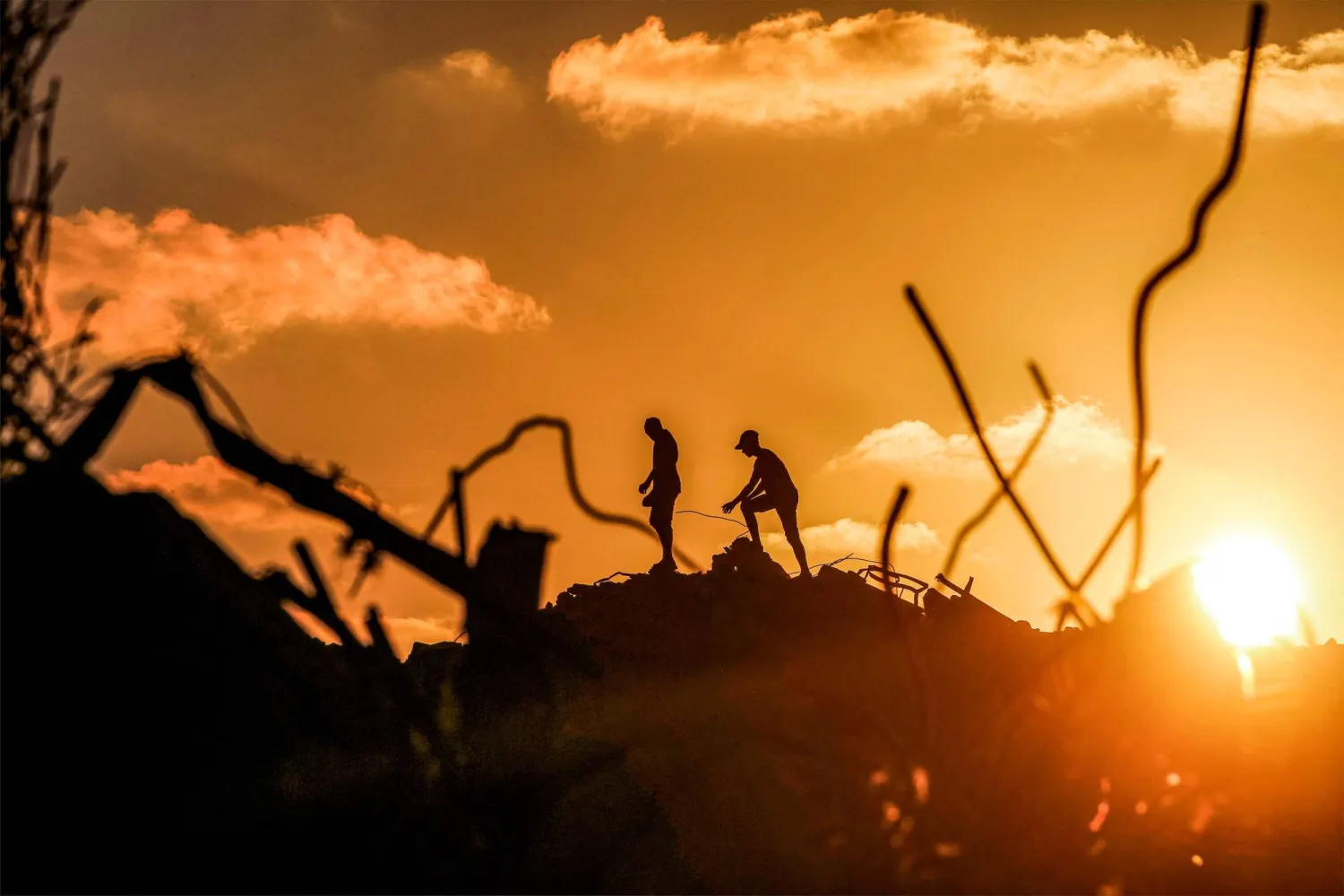
Men walk through rubble at the Bureij camp for Palestinian refugees in the central Gaza Strip on September 14, 2026. (AFP)
TT

UN Urges Access for International Investigators to Gaza After Bodies Found

Men walk through rubble at the Bureij camp for Palestinian refugees in the central Gaza Strip on September 14, 2026. (AFP)

The United Nations called Tuesday for international investigators to be granted to access to all of Gaza "to assist with evidence-gathering" as hundreds of bodies are pulled from the rubble.

The ongoing recovery of extensive human remains in Gaza, mostly of women and children, nearly three years after Israel heavily bombed their homes, highlights the possibility that war crimes have been committed, the UN warned.

"The remains of what appears to be entire families are now being unearthed at locations that were pulverized by Israeli attacks," UN rights chief Volker Turk pointed out in a statement.

"I worry the remains recovered so far may only be the tip of the iceberg," he said, pointing to how "much of Gaza has been flattened by Israeli bombing or demolition and clearing by heavy machinery and explosives".

"Today, many areas in Gaza where the Israeli military is deployed continue to be levelled by bulldozers with no respect for the dead under the rubble," he lamented.

The rights office said it was critical that evidence of violations, including at destroyed sites, calling for "international investigators to be allowed into all parts of Gaza to assist with evidence-gathering".

It pointed out that the Palestinian Civil Defense had reported that more than 630 bodies and other human remains had been recovered from beneath destroyed buildings across Gaza since last November.

"It estimates the total number of missing under the rubble at over 8,000," it said.

Turk insisted that "every feasible effort must be taken to document and identify these victims, preserve forensic information and biological samples, record their burial locations and inform their families".

"The discovery of extensive remains under the rubble in Gaza City resurfaces (the) concerns of war crimes and other atrocity crimes," he warned.

Israel's full-scale war on Gaza, which began after a Hamas attack inside Israel on October 7, 2023, reduced much of the Palestinian territory to rubble.

The relentless Israeli bombardment and ground offensive has killed more than 73,000 Palestinians, including more than 1,350 since a ceasefire agreed last October, according to Gaza's health ministry, which is under Hamas authority.

Hamas's October 7 attack resulted in the deaths of 1,221 people, according to an AFP tally based on official Israeli figures.


Israeli Army Kills Palestinian Man in West Bank Raid

Flowers are placed on the body of a 54-year-old Palestinian man killed by Israeli forces during a raid, as people mourn over him at a hospital in Ramallah in the Israeli-occupied West Bank, September 15, 2026. (Reuters)
TT

Israeli Army Kills Palestinian Man in West Bank Raid

Flowers are placed on the body of a 54-year-old Palestinian man killed by Israeli forces during a raid, as people mourn over him at a hospital in Ramallah in the Israeli-occupied West Bank, September 15, 2026. (Reuters)

Israel's military shot and killed a Palestinian man during a raid in the occupied West Bank on Tuesday, Palestinian health officials said, while the army said it fired at someone who tried to seize a soldier's weapon.

The Palestinian health ministry announced the death of 54-year-old Ziad Mohammad Jaber by "Israeli army gunfire in Umm al-Sharayet, in the city of Al-Bireh", near Ramallah in the central West Bank.

In the early hours of Tuesday, the Palestine Red Crescent Society said its crews were treating someone who sustained "a critical live-fire gunshot wound to the abdomen and thigh" during a military raid in Umm al-Sharayet.

It said the casualty was being transferred to hospital.

When contacted by AFP, the Israeli military said troops were carrying out "counterterrorism activity" in the area overnight when "a terrorist attempted to seize a weapon from one of the soldiers".

"The soldier responded by firing towards the terrorist. A hit was identified," it added.

Jaber's brother, Ramadan Mohammad Jaber, told AFP that the military raided his home at around 4 am (0100 GMT) after blowing up the front door.

He said soldiers handcuffed him and held him with his daughter in a room before arresting his son.

He added that soldiers had also blown up the door of the adjacent apartment where his brother lived.

"I heard him screaming but I did not hear the sound of gunfire," he said, adding that his brother "was left bleeding in the apartment for about an hour and a half before the army allowed ambulance crews to take him to the hospital".

A spokesperson for the Palestinian health ministry confirmed that Jaber was pronounced dead on arrival at hospital.

The West Bank, occupied by Israel since 1967, has seen a surge in violence since the outbreak of war in the Gaza Strip following Hamas's attack on Israel on October 7, 2023.

At least 1,109 Palestinians, including a number of gunmen, have been killed by Israeli soldiers or settlers, according to an AFP tally based on Palestinian official figures.

Settler attacks against Palestinians have soared, often with little or no legal consequence.

At least 48 Israelis, both civilians and security forces, have been killed in the West Bank in attacks carried out by Palestinians or during clashes with Israeli forces, according to Israeli official figures.


Fuel Shortage in Yemen Hampers Migrants Fleeing Conflict and Seeking Safety in Djibouti

This handout picture taken and released by the International Organization for Migration (IOM) Djibouti shows refugees from Yemen fleeing fighting between government forces and Iran-backed Houthi militants as they arrive at a Djibouti Coast Guard post in Khor Angar on September 13, 2026. (Handout / IOM Djibouti / AFP)
TT

Fuel Shortage in Yemen Hampers Migrants Fleeing Conflict and Seeking Safety in Djibouti

This handout picture taken and released by the International Organization for Migration (IOM) Djibouti shows refugees from Yemen fleeing fighting between government forces and Iran-backed Houthi militants as they arrive at a Djibouti Coast Guard post in Khor Angar on September 13, 2026. (Handout / IOM Djibouti / AFP)

A fuel shortage in Yemen is hampering the movement of people fleeing the country’s escalating fighting and seeking safety across the Red Sea in Djibouti, with the UN migration agency warning that more Yemenis are ready to make the crossing by boat.

More than 2,000 Yemenis are currently in Djibouti, where the country's government and the International Organization for Migration are providing food and shelter.

Yemen’s legitimate government has been battling the Iranian-backed Houthi militants for 12 years. The recent escalation has ended a ceasefire that had largely stopped civil war across Yemen since 2022. The Houthis kept to the sidelines during the initial, heavy phase of the Iran war, but in July they resumed attacks on Saudi Arabia and escalated attacks in Yemen.

Now the number of people from Yemen fleeing the fighting is soaring, with nearly 94,000 people displaced in the country.

IOM Regional Director for East and Southern Africa Frantz Celestin told The Associated Press on Monday that arrivals had slowed because of the fuel shortage, but warned that more people were expected to make the dangerous crossing.

“We expect more to come. What we were told is that there are a lot of people who are willing and ready to come. They simply don’t have fuel to make the journey,” Celestin said. “There’s a fuel shortage in Yemen that may explain the lull that we’ve seen today.”

The prospect of more arrivals is raising concerns that Djibouti, the small Horn of Africa nation, could struggle to accommodate the influx.

“When you have that many people come in a short amount of time, it’s bound to overwhelm the system,” Celestin said. “But so far, they (Djibouti) are managing it quite well. But there may be a time, if they continue to come, where they may overwhelm the capacity of the country to house and accommodate all of them.”

Djiboutian Finance Minister Ilyas M. Dawaleh said on X that the situation was “becoming increasingly difficult for our country, despite our unwavering commitment to humanitarian assistance.”

“We cannot allow those who have sought refuge among us to suffer. I am proud of my fellow Djiboutians for their collective mobilization and their remarkable solidarity with our Yemeni brothers and sisters,” he wrote.

Dawaleh also praised residents of Obock, a coastal town in northern Djibouti that has been on the front line of the humanitarian response.

The IOM's Celestin said the arrivals were putting additional pressure on communities and called for more international support, including additional tents and medical services.

Djibouti sits across the Bab al-Mandeb Strait from Yemen, making it one of the closest places of refuge for Yemenis fleeing the conflict.


As the Last US Troops Pack Up in Iraq, Factions Signal Their Weapons Will Stay

Fighters from the Badr Brigades clash with the ISIS group at the front line on the outskirts of Fallujah in the Anbar province of Iraq, June 1, 2015. (AP)
TT

As the Last US Troops Pack Up in Iraq, Factions Signal Their Weapons Will Stay

Fighters from the Badr Brigades clash with the ISIS group at the front line on the outskirts of Fallujah in the Anbar province of Iraq, June 1, 2015. (AP)

Two deadlines are looming for Iraq at the end of the month: the end of a decades-long US military presence and the disarmament of non-state armed groups.

The US withdrawal is underway, and officials say the hundreds of troops remaining in northern Iraq will be out by the Sept. 30 deadline.

The Iraqi government has linked the US withdrawal to an ultimatum for factions to lay down their weapons. But most have indicated they have no plans to do so.

That leaves major questions about what the day after will look like in Iraq.

Iranian-backed Iraqi factions have struck US-linked targets both inside and outside of Iraq since the US and Israel attacked Iran on Feb. 28. They also have coordinated with Yemen’s Houthis to attack Saudi Arabia.

With the war between the US and Iran raging, Tehran is unlikely to give up the leverage it has in neighboring Iraq. US officials are concerned about the factions' ability to continue carrying out attacks, but not enough to delay their withdrawal.

A US army soldier flashes a V for victory sign as he begins his journey home, at the al-Asad Air Base west of Baghdad, Iraq, Nov. 1 , 2011. (AP)

The end of the US mission

US troops invaded Iraq in 2003 to topple Saddam Hussein. They departed in 2011, but three years later, Iraqi authorities invited a smaller US-led mission to fight the ISIS group, which had rampaged across Iraq and Syria, seizing large swaths of territory.

With the extremist group now reduced to scattered sleeper cells — a result of the intervention of Iran-backed factions, as well as the US-led coalition -- Washington and Baghdad agreed in 2024 to wind the mission down.

US troops pulled out of bases in most areas of Iraq last year but maintained a presence in the semiautonomous northern Kurdish region. Bases there have regularly come under attack since the US and Israel launched their war against Iran.

A US military official said the withdrawal would be completed by Sept. 30, and the hundreds of troops still present in northern Iraq would mostly be redeployed to other countries in the region. Military equipment, including air defense systems, will also be removed. He spoke on condition of anonymity because he was not authorized to comment publicly.

A “normal bilateral security cooperation” agreement could then be negotiated with the central government in Baghdad, he said, but it remains unclear what form that would take.

The official said that the counterterrorism base in Erbil had lost its importance for US troops with the ISIS threat receding.

During the war with Iran, northern Iraq for the most part did not serve as an “offensive platform,” but US forces there were frequently targeted by Iran and Iran-backed Iraqi factions, so pulling troops out “will reduce our risk,” he said.

But the US military remains concerned about the ability of the Iraqi factions to launch attacks on targets elsewhere in the region, including in Saudi Arabia, Jordan and Israel, and about the presence of Houthi militants in Iraq, he said.

In the past, the US has sometimes struck faction sites in Iraq in retaliation for attacks. Washington has slapped sanctions on some of the groups and could impose more.

Factions take a hard line on disarmament

Iraqi government officials have waffled over whether Sept. 30 is a hard deadline for disarmament of factions or merely the starting point for negotiations.

“There will be no disarming of any groups by the 30th of September,” said Iraqi analyst Sajad Jiyad, speaking at a panel convened by the Atlantic Center think tank last week. “I think that’s probably clear to anybody who watches Iraqi politics.”

While a handful of less-influential factions have agreed to turn over their weapons, the most powerful groups — and closest to Iran — Kataib Hezbollah, Harakat al-Nujaba and Kataib Sayyid al-Shuhada have rejected the prospect or set conditions for disarming that they know the government is unlikely to meet in the near future.

Those include bringing the Kurdish peshmerga security forces in northern Iraq under control of the central government’s military and expelling Iranian Kurdish dissident groups and the Kurdistan Workers’ Party, or PKK, that have bases in the region.

“After establishing these parameters, discussions will focus on regulating weapons, not surrendering them,” an official with one of the Iran-backed Iraqi factions said. “There is absolutely no decision among the factions to surrender weapons, and we have not surrendered any weapons.”

A government official said the government’s strategy currently focuses on bringing armed factions under the control of the Iraqi military. Already many of the factions are part of the Popular Mobilization Forces, a coalition of armed groups that is officially part of the Iraqi armed forces, although the individual factions often act on their own.

The official said the government wants the armed factions to hand over “dynamic weapons” including missiles and long-range aircraft, to the central leadership of the PMF and for the individual factions to be dissolved and placed under the command of the PMF and the Iraqi army.

The officials spoke on condition of anonymity because they were not authorized to speak publicly.

Iraqi government spokesperson Sabah al-Numan said last week that “discussions and dialogues are ongoing, and the file will be resolved after the withdrawal of the international coalition forces."

While a handful of less-influential factions have agreed to turn over their weapons, the most powerful groups and closest to Iran have not. (Reuters file)

Kurds are anxious about the day after Sept. 30

While the withdrawal of US troops removes one target from the Kurdish region, it may not halt the attacks.

Mohammed A. Salih, a non-resident senior fellow at the US-based Foreign Policy Research Institute, and an expert on Kurdish and Iraqi affairs, noted that Iran and affiliated groups “have targeted other locations in the Kurdistan region that have not been related to the US troops’ presence.”

Those include the bases of exiled Iranian Kurdish dissident groups, energy facilities, and even the office of the Kurdish region’s Prime Minister Masrour Barzani.

“The withdrawal will expose the Kurdistan region even further and make it an even easier target,” Salih said.

Regional government officials declined to comment, but Barzani has publicly expressed anxiety that the removal of US air defenses would leave the area more vulnerable.

Numan said last week that the Iraqi government was close to procuring new air defense systems from South Korea, Türkiye and the US

He told The Associated Press that the new systems “will be deployed according to carefully devised military plans to ensure the complete protection of Iraqi airspace, including the Kurdistan region.”
