Syria’s Al-Sharaa: Economic Transition Demands ‘Shock’ Decisions

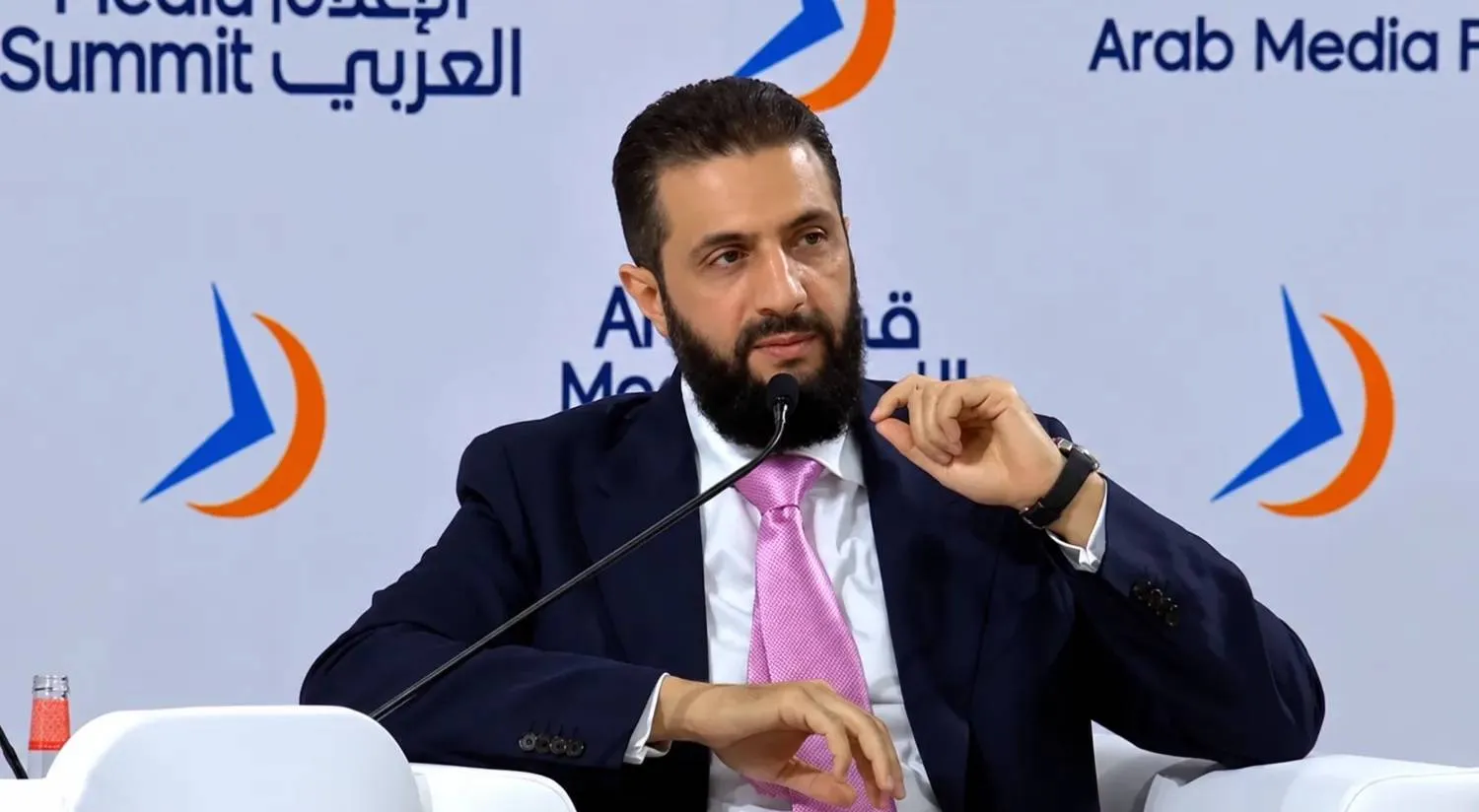
Syrian President Ahmad al-Sharaa speaks at the Arab Media Summit in Dubai on Tuesday. (Asharq Al-Awsat)
TT

Syria’s Al-Sharaa: Economic Transition Demands ‘Shock’ Decisions

Syrian President Ahmad al-Sharaa speaks at the Arab Media Summit in Dubai on Tuesday. (Asharq Al-Awsat)

Syrian President Ahmad al-Sharaa said his country has gone from being a security and political “problem” troubling the region to an economic and strategic opportunity that could contribute to the security of supply chains, energy and trade between East and West.

Speaking at the Arab Media Summit in Dubai on Tuesday, al-Sharaa projected Syria’s economy would reach about $50 billion this year, up from roughly $20 billion in 2024.

He acknowledged that the economic transition requires “shock” decisions, in what appeared to be an implicit reference to measures such as fuel price increases that have triggered protests in several Syrian regions in recent days.

He stressed that his government did not want to pursue a “policy of complaints or promises,” but instead focus on work, with success measured by results felt by Syrians.

Syria is moving away from an economic model marked by heavy bureaucracy, state dominance and corruption toward one giving greater scope to the private sector and investment, he explained.

A sudden transition, however, could cause “a kind of shock”, he added.

The government had studied the experiences of countries that underwent similar transformations and managing the transition required a degree of gradualism alongside decisions that could sometimes be “shocking”, he warned.

Syria’s economy stood at about $60 billion at its prewar peak in 2010 before falling to around $20 billion in 2024. It grew to roughly $32 billion in 2025 and is expected to reach about $50 billion in 2026, before recovering to around its 2010 level in 2027.

Al-Sharaa said ambitions extended beyond a return to prewar levels, with economic programs targeting the possibility of expanding the economy to about $200 billion over the following five to 10 years, provided stability prevailed and the region and world avoided major upheaval.

Regional risks

Regional risks remain among Syria’s biggest challenges, according to al-Sharaa.

The country faces a “heavy legacy resulting from 60 years of destruction and 14 years of continuous war,” he remarked, adding that ending Syria's conflict was not enough to ensure lasting stability without greater regional and strategic security.

“What frightens us most is that wars expand further and further,” he said.

Damascus is working with Arab countries to reduce the impact of wars and mitigate future risks, he added, stressing that Syria could play a pivotal role in strengthening regional stability.

He said the country was undergoing a broad transition involving the rebuilding of state institutions, economic transformation, attracting investment and rehabilitating infrastructure, alongside efforts to consolidate domestic stability and restore its place in its Arab and regional surroundings.

Al-Sharaa described Syria as having gone from “a source of Captagon and human trafficking, and a foothold for spreading conflicts and problems in the region” to a country seeking to become “an area of stability.”

He pointed to growing discussions of its potential role in regional trade, supply-chain and energy security, as well as its position on routes linking East and West.

‘Syria is not a follower’

Turning to foreign policy, al-Sharaa stressed that Damascus sought relations based on “credibility and trust” while preserving the independence of its decision-making.

“Syria does not need to be a follower of any party,” he declared, adding that the country had the civilization, expertise and human resources to make independent decisions while drawing strength from “its brothers and its surroundings.”

Moreover, he stressed that Syria cannot do without its Arab and Islamic surroundings, and relies heavily on Arab states for political support and to benefit from their expertise and development experience.

The country does not want “to start from the zero where these countries began, but from the 100 they have reached,” he revealed.

On international sanctions, he noted that Syria had been among the world’s most heavily sanctioned countries for decades, with the impact extending beyond state institutions to society and the economy.

Generations of Syrians had been unable to engage normally with financial transactions, bank guarantees and the global financial system because of the country’s prolonged isolation, he continued.

He further praised efforts by Prince Mohammed bin Salman, Saudi Crown Prince and Prime Minister, and Turkish President Recep Tayyip Erdogan with US President Donald Trump over sanctions, describing their lifting as a historic turning point for his country.

“I believe Syria was born again after the sanctions were lifted,” al-Sharaa said, adding that the main restrictions had been broken and responsibility now lay in adopting the right “policies, procedures and choices” to move the economy and the state forward.


UN Experts Urge Israel to Protect West Bank Olive Farmers

Palestinian volunteers douse an olive tree set on fire by Israeli settlers, near the village of Turmus Ayya, north of Ramallah, in the Israeli-occupied West Bank on October 16, 2026.  Ahmad Gharabli, AFP
Palestinian volunteers douse an olive tree set on fire by Israeli settlers, near the village of Turmus Ayya, north of Ramallah, in the Israeli-occupied West Bank on October 16, 2026. Ahmad Gharabli, AFP
TT

UN Experts Urge Israel to Protect West Bank Olive Farmers

Palestinian volunteers douse an olive tree set on fire by Israeli settlers, near the village of Turmus Ayya, north of Ramallah, in the Israeli-occupied West Bank on October 16, 2026.  Ahmad Gharabli, AFP
Palestinian volunteers douse an olive tree set on fire by Israeli settlers, near the village of Turmus Ayya, north of Ramallah, in the Israeli-occupied West Bank on October 16, 2026. Ahmad Gharabli, AFP

UN rights experts on Monday called on Israel to protect Palestinian farmers in the West Bank as settler attacks worsen with the annual olive harvest.

"Palestinian farmers must be protected and able to access their land safely. Yet, year after year, the violence, destruction and restrictions intensify," the experts said in a statement.

"The olive harvest should be a time when farmers can enjoy, in safety and dignity, the food and livelihoods their nature and land provide, not another season of fear, loss, violence and destruction."

The experts urged Israel to ensure that its forces protect Palestinian farmers from settler attacks and refrain from interference with their access to land. They also urged the international community to "exercise maximum pressure to protect Palestinian civilians", reported AFP.

Israel has occupied the West Bank since 1967. About 500,000 Israelis live in the West Bank, alongside three million Palestinians.

Violence is surging in the territory ahead of Israel's bitterly fought October 27 elections. The vote coincides with Palestinians' annual olive harvest which has been repeatedly disrupted by Israeli settlers as Prime Minister Benjamin Netanyahu seeks to shore up his pro-settlement right-wing base.

According to the UN humanitarian agency OCHA, 178 settler attacks related to the 2025 olive harvest were recorded in the West Bank, affecting 88 Palestinian communities.

More than 6,000 trees and saplings were "vandalised", it said -- nearly double the number in 2024 and the highest figure in six years.

"The olive harvest is an essential source of food, income and livelihood for thousands of Palestinian families," the UN experts said.

"Olive trees take years to mature and can sustain families for generations. Their destruction deprives families of far more than a single harvest: it undermines local food systems, cultural practices and ways of life, as well as the right to food and the food sovereignty of Palestinian communities."

The seven signatories to the statement include Sofia Monsalve Suarez, special rapporteur on the right to food; and Francesca Albanese, special rapporteur on human rights in the occupied Palestinian territories.

The special rapporteurs are independent experts mandated by the Human Rights Council. They do not speak for the United Nations itself.


UK Urges Firms Not to Take Part in E1 Settlement Tender or Risk Sanctions

Israeli settlers (foreground) harvesting olives confront a Palestinian family outside the settlement of Alei Zahav, near the Palestinian town of Kafr al-Dik in the Israeli-occupied West Bank, on October 13, 2026. (AFP)
TT

UK Urges Firms Not to Take Part in E1 Settlement Tender or Risk Sanctions

Israeli settlers (foreground) harvesting olives confront a Palestinian family outside the settlement of Alei Zahav, near the Palestinian town of Kafr al-Dik in the Israeli-occupied West Bank, on October 13, 2026. (AFP)

British foreign minister Ed Miliband on Monday urged companies and individuals not to proceed with bids for the E1 West Bank settlement project on Monday, warning those involved in the ‌construction of ‌illegal settlements could face ‌sanctions.

"We ⁠urge businesses and ⁠individuals not to proceed with bids for E1 construction tenders," Miliband said in a statement. "They should be ⁠aware of legal ‌and ‌reputational consequences, including the risk ‌of involving themselves in ‌serious breaches of international law."

The E1 project would bisect the Israeli-occupied West Bank and ‌cut it off from East Jerusalem, fragmenting ⁠the ⁠land Palestinians hope will form the heart of a state.

Many Western states and campaign groups have opposed the project over concerns that it could undermine a future peace deal with the Palestinians.


Syrian State Media: Armed Groups Ban UN Delegation from Entering Sweida

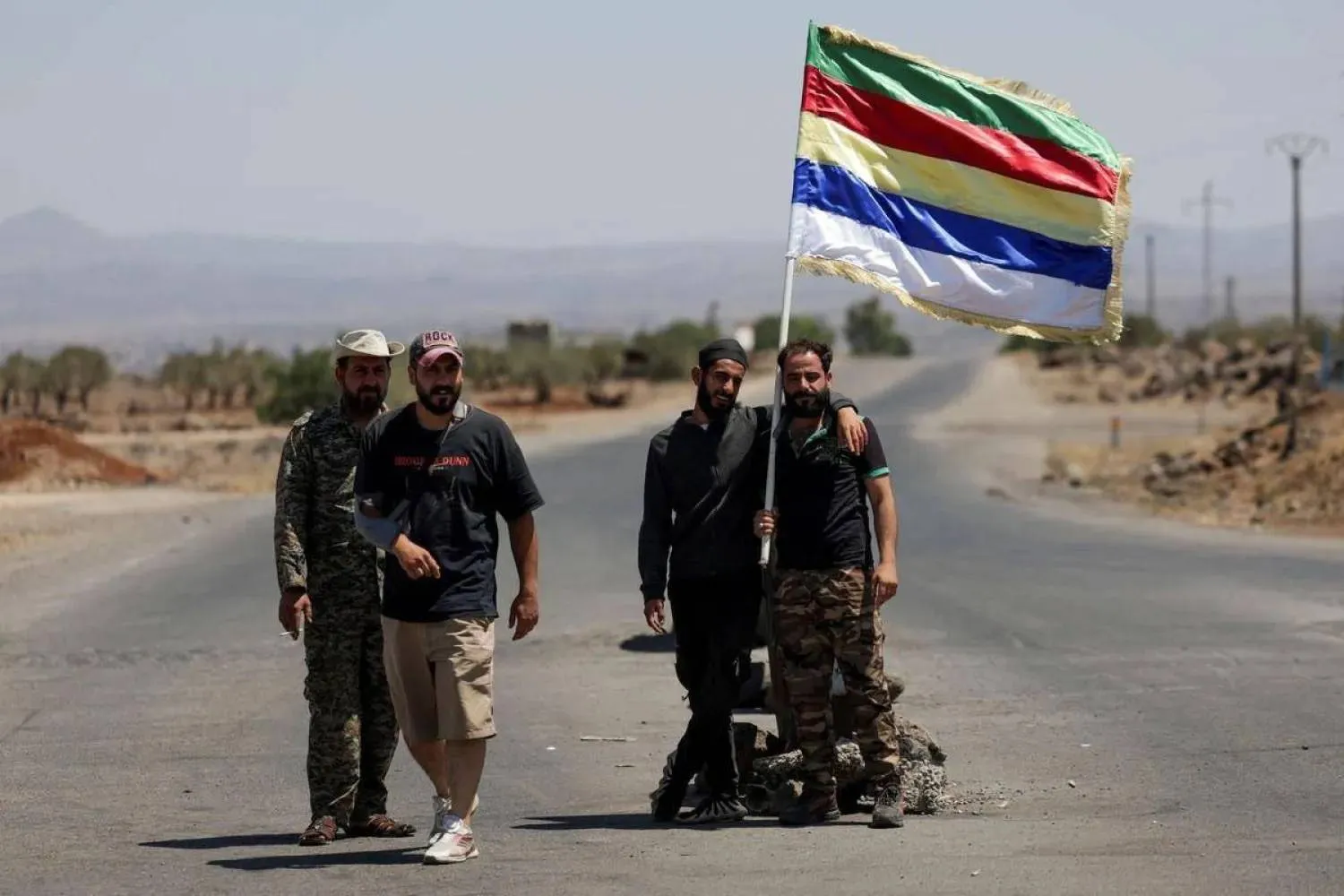
Members of the National Guard affiliated with Sheikh Hikmat al-Hijri in Sweida (File photo: Sweida 24). 
TT

Syrian State Media: Armed Groups Ban UN Delegation from Entering Sweida

Members of the National Guard affiliated with Sheikh Hikmat al-Hijri in Sweida (File photo: Sweida 24). 

Groups described by Syrian state media as operating outside the law prevented a joint UN humanitarian delegation from entering the southern Syrian city of Sweida on Sunday, citing a lack of coordination with them, according to Syria’s Al-Ikhbariya television channel.

The delegation included representatives of the UN Office for the Coordination of Humanitarian Affairs (OCHA) and international organizations. Its visit had been coordinated with the Sweida branch of the Syrian Arab Red Crescent, whose team was expected to accompany the delegation on field visits to Sweida city, Shahba and the village of Ara.

Al-Ikhbariya reported that the groups stopped the delegation at the Umm al-Zeitoun checkpoint for two to three hours before informing its members that entry was prohibited.

The delegation had earlier passed through the Al-Matouna checkpoint, operated by the Sweida Security Directorate.

The broadcaster also recalled that groups affiliated with Druze spiritual leader Sheikh Hikmat al-Hijri had blocked commercial trucks carrying essential goods and fuel from entering Sweida province on September 10.

According to Al-Ikhbariya’s correspondent at the time, the restrictions on commercial convoys coincided with the groups preventing approximately 12,000 students from reaching examination centers to sit special make-up exams for students in Sweida.