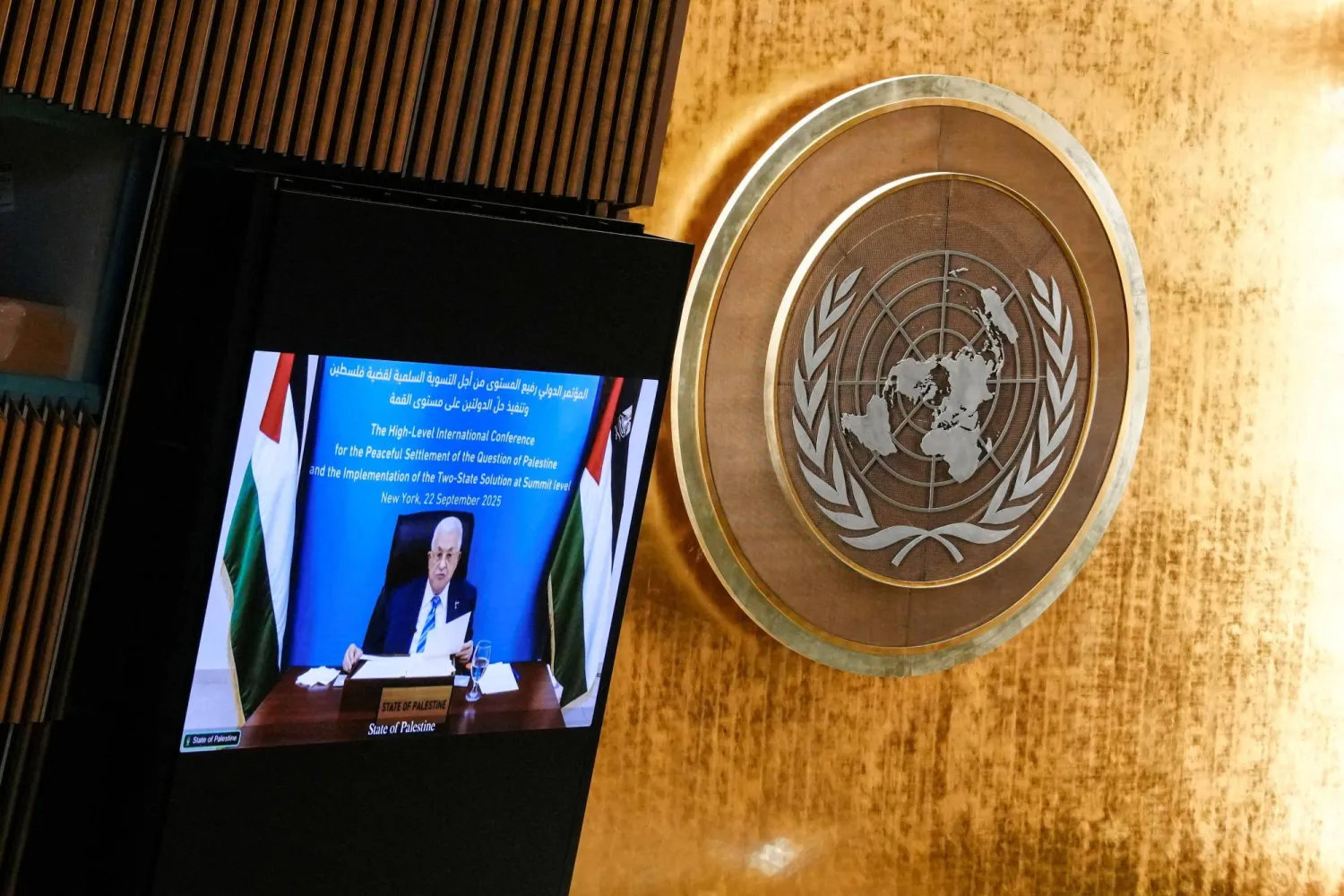
Palestinian Authority: US Denial of Abbas Visa to Attend UN 'Unjustified'

FILE PHOTO: Palestinian President Mahmoud Abbas appears on a screen as he addresses delegates during a high-level meeting of heads of state on a two-state solution between Israel and the Palestinians at United Nations headquarters in New York City, US, September 22, 2025. REUTERS/Eduardo Munoz/File Photo
TT

Palestinian Authority: US Denial of Abbas Visa to Attend UN 'Unjustified'

FILE PHOTO: Palestinian President Mahmoud Abbas appears on a screen as he addresses delegates during a high-level meeting of heads of state on a two-state solution between Israel and the Palestinians at United Nations headquarters in New York City, US, September 22, 2025. REUTERS/Eduardo Munoz/File Photo

The Palestinian Authority on Thursday slammed a decision by the United States to refuse visas for its officials to attend the UN General Assembly in New York next week, a move which includes President Mahmoud Abbas.

In a statement, the Palestinian foreign ministry called it "an unjustified measure that runs counter to efforts to rebuild trust, develop Palestinian-US relations, and create the necessary political climate for implementing the two-state solution and achieving peace and stability.”

In a statement that did not mention Abbas by name, the State Department said Wednesday it would deny visas to members of the Palestine Liberation Organization (PLO) and officials with the Palestinian Authority (PA), "as a consequence of their failure to reform, contrary to their commitments to the United States, and their ongoing activities that undermine the prospects for peace."

The Trump administration took the same step last year, forcing the Palestinian leader, a regular at the UN General Assembly, to address the body of global leadership by video.


Jordanian Source: Areas Outside Govt Control in South Syria Are Haven for Terrorists, Drug Traffickers

 Men inspect the aftermath of a Jordanian airstrike in Al-Tuff, in the countryside of Daraa province in southern Syria, Tuesday, Oct. 27, 2026. (AP)
Men inspect the aftermath of a Jordanian airstrike in Al-Tuff, in the countryside of Daraa province in southern Syria, Tuesday, Oct. 27, 2026. (AP)
TT

Jordanian Source: Areas Outside Govt Control in South Syria Are Haven for Terrorists, Drug Traffickers

 Men inspect the aftermath of a Jordanian airstrike in Al-Tuff, in the countryside of Daraa province in southern Syria, Tuesday, Oct. 27, 2026. (AP)
Men inspect the aftermath of a Jordanian airstrike in Al-Tuff, in the countryside of Daraa province in southern Syria, Tuesday, Oct. 27, 2026. (AP)

An informed Jordanian source confirmed that “areas near the northern border with Syria have provided, and continue to provide, a haven for terrorists and drug traffickers.”

The source told Asharq Al-Awsat that “numerous targets inside Syria are not under the control of the Syrian government,” noting that these gatherings “have served as a launchpad to target Jordanian security.”

Jordanian security asserted that it “seeks to protect its borders from sites that serve as a launchpad for operations targeting its security and stability, which are areas outside the control of regular Syrian security forces.”

Meanwhile, Jordan has found itself “at the forefront of confronting the risks of terrorist activity on its borders,” according to the source.

The source stated that the death toll from Jordanian airstrikes targeting ISIS operatives in southern Syria has risen “to at least 24 terrorists.”

The same source linked “ISIS to drug trafficking networks, which have recently resumed their operations in southern Syria.”

The Jordanian source maintained that the strikes were based on precise intelligence.

Amman also expressed its willingness to cooperate with Damascus on security assessments, intelligence sharing and border protection.

Syria, however, condemned the bombardment, denied any prior coordination with Jordan and accused Amman of carrying out strikes that killed several civilians.

Jordanian sources disputed that account, insisting the operation had been coordinated with Syrian authorities and targeted locations identified through confirmed intelligence.

They linked the ISIS operatives targeted in the strikes to the cell behind last Friday’s attack at a church in the village of Hammoud, in Jordan’s Karak governorate.

The Jordanian source noted that the kingdom had largely secured its northern border through its own efforts since 2012, confronting militias and militant groups operating in southern Syria that have repeatedly threatened Jordanian civilians.

The airstrikes destroyed warehouses holding large quantities of weapons and narcotics near Sweida and in the Syrian desert, according to intelligence information obtained by Asharq Al-Awsat.

The intelligence also pointed to cooperation between militant groups in southern Syria and smuggling networks along the Jordanian border.

An informed source described the links, coupled with a recent rise in intercepted smuggling attempts, as a dangerous development for the kingdom’s security.

Jordanian forces have intercepted 160 infiltration and smuggling attempts along the Syrian border since the beginning of the year, including 22 infiltration attempts and 138 operations involving drugs and weapons.

Seized contraband included large quantities of narcotic pills and other drugs, weapons, explosives, drones, GPS devices and communications equipment.

Smugglers have increasingly used drones and balloons, complicating border surveillance and efforts to trace the origins of cross-border operations.

Jordanian Minister of Government Communication Mohammad Momani warned that his country’s patience was running out over militant activity threatening national security.

Between 2024 and 2026, Jordan carried out several airstrikes against drug-traffickers, arms smugglers and militant groups under security and intelligence-sharing arrangements with the Syrian government.

The operations were aimed at protecting civilians on both sides of the border from militant and criminal networks.


Two Drones Shot Down Near US Embassy in Baghdad, Sparking Security Alert

The US Embassy building in Baghdad. (Iraqi News Agency)
TT

Two Drones Shot Down Near US Embassy in Baghdad, Sparking Security Alert

The US Embassy building in Baghdad. (Iraqi News Agency)

Air defenses at the US Embassy in Baghdad shot down two suspected reconnaissance drones over the heavily fortified Green Zone on Tuesday, Iraqi security sources said, triggering a security alert in the capital.

The sources said the drones were believed to be unarmed and intended for surveillance.

The embassy sounded its alarms as the aircraft flew over the Green Zone, which houses government buildings and foreign diplomatic missions.

Iraq’s Security Media Cell, however, reported the interception of only one unidentified drone.

“The sound heard in Baghdad resulted from the interception of an unidentified aircraft near the Green Zone,” Lieutenant General Saad Maan, head of the cell, said in a statement.

Witnesses told Asharq Al-Awsat they heard two loud explosions near the interception sites, while residents reported finding drone wreckage near Al-Rasheed Street in Baghdad’s old city center.

Reuters cited two security sources as saying the embassy’s air defenses were activated after detecting the drones approaching the Green Zone. Both were shot down, with wreckage recovered at separate locations.

Security forces were investigating their origin and intended destination, the sources added.

The US Embassy has faced rocket and drone attacks since the United States and Israel launched strikes on Iran.

Sources told Asharq Al-Awsat that debris was scattered around the Green Zone, the Shorja market, Al-Rasheed Street and the Kadhimiya district. No civilian casualties or injuries were reported.

The incident marked the first breach of its kind in the area in many months. In previous years, the Green Zone had repeatedly come under attacks targeting the US Embassy and other diplomatic missions, often blamed on Iran-backed armed factions.

Motives

The incident came less than a month after the withdrawal of US-led coalition forces from Iraq, whose presence armed factions had long cited to justify attacks on diplomatic and military facilities.

The purpose of the drone flights remains unclear.

Some observers linked the incident to tensions between Washington and Tehran, while others suggested it could be political signaling between rival groups within the Coordination Framework and armed factions.

Baghdad launched a campaign months ago to bring factional weapons under state control and integrate armed groups into the security forces.

The initiative was initially due to be completed by September 30, coinciding with the coalition’s withdrawal, but the government later postponed the deadline until June 2027.

While some factions have complied, others continue to oppose the plan, including the Iran-backed Kataib Hezbollah.

The group calling itself the Islamic Resistance in Iraq had previously pledged to support Iran if the United States resumed its war in the region.


Al-Sharaa: Syrian-Iraqi Borders Are Completely Secure, ISIS Threats Have Dropped

Syrian President Ahmad al-Sharaa. (AFP)
TT

Al-Sharaa: Syrian-Iraqi Borders Are Completely Secure, ISIS Threats Have Dropped

Syrian President Ahmad al-Sharaa. (AFP)

Syrian President Ahmad al-Sharaa stressed on Tuesday that the Syrian-Iraqi borders are completely secure, saying joint coordination was underway between the two neighbors.

In an interview with Iraq’s Dijlah TV, he added that the threats posed by the ISIS terrorist group have dropped, saying that no organization currently presents a danger to the two countries.

Al-Sharaa also said he welcomes a visit by Iraqi Prime Minister Ali al-Zaidi to Syria. The Syrian and Iraqi governments are in agreement over several issues that bind them.

Iraqi media have reported that al-Zaidi is set to kick off an official visit to Syria on Wednesday. He will visit at the head of a large ministerial delegation to discuss bilateral ties, and issues related to water, oil and trade between the two countries.

The relationship with Iraq is not based on sectarian or ethnic considerations but on shared history and deep economic ties, al-Sharaa stressed.

He said visiting the shrine of Sayyida Zeinab is available while ensuring security conditions, noting that individuals who tried to exploit the issue to stir sectarian strife have been arrested.

"Syria does not view Iraq through a sectarian lens. We share a great deal in common, and social relations between Iraq and Syria have remained healthy for years. Since we came to power, Baghdad's policies have been positive, despite attempts by some factions to adopt differing stances,” al-Sharaa said.

“I did not intervene in any sectarian conflict in Iraq following the events of 2003. I was released from prison in Iraq in 2011, after which I returned to Syria,” he remarked.

"Syria’s stability is in the interest of Iraq and vice versa. We must build upon our common ground and establish an appropriate environment for relations, free of fears. What unites us is greater than what divides us, and we have had enough of wars and disputes. I have not assaulted any civilian in Iraq," he declared.

“We are communicating with international companies to connect the Baniyas pipeline to oil refineries, and memorandums of understanding have been signed between Syria and Iraq regarding the Baniyas–Kirkuk pipeline,” al-Sharaa went on to say.

“Syria is Iraq's gateway and maritime outlet, serving as the strategic route to the West. Syria is considered Iraq's gateway to the Mediterranean Sea for oil exports,” he noted.