Hamas Silent on Killings: Ceasefire Restraint or Inability to Retaliate?

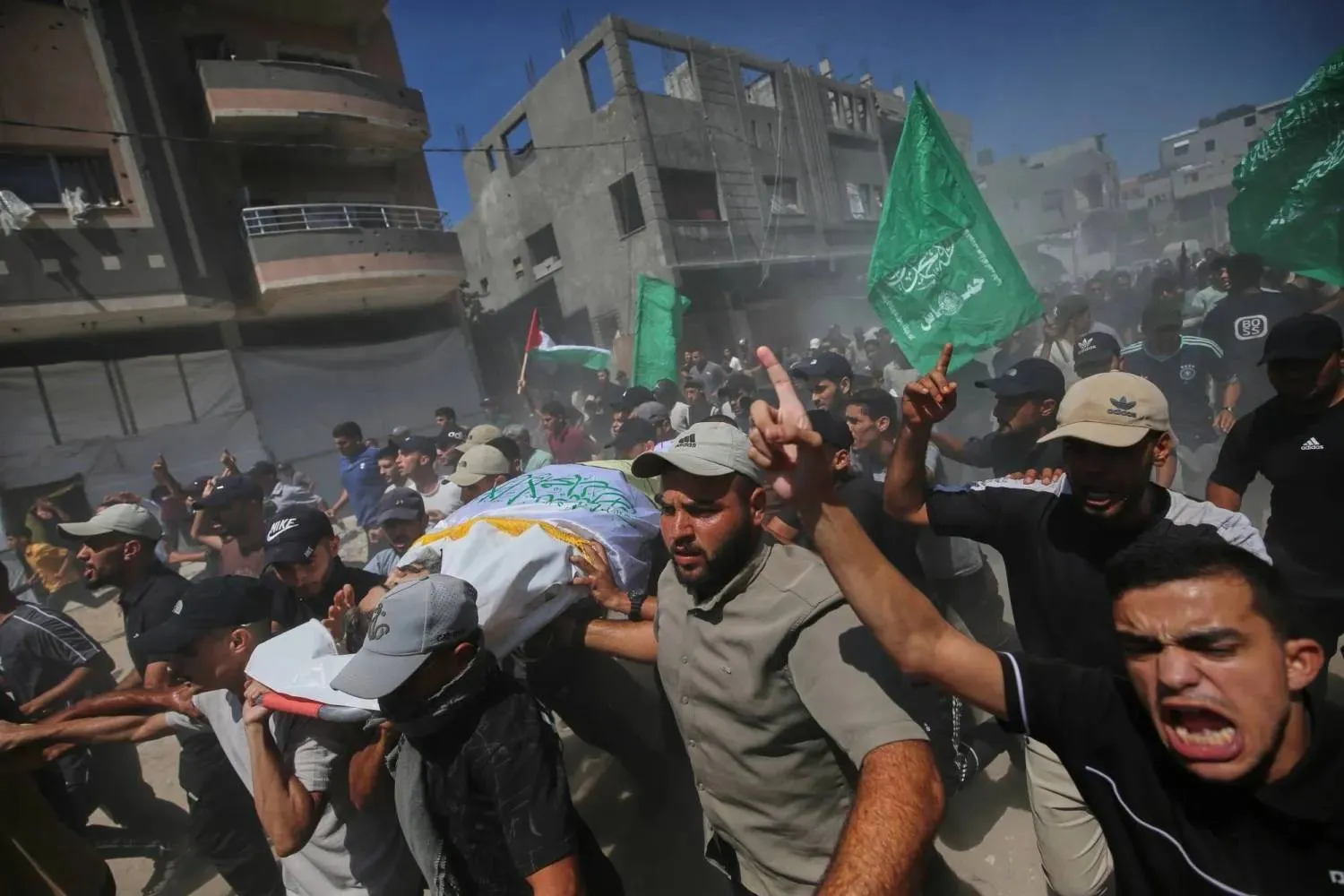
Palestinians carry the body of Nael Abu Obeid, commander of the Rafah Brigade, after he was killed in an Israeli strike in Khan Younis on Wednesday. (AP)
TT

Hamas Silent on Killings: Ceasefire Restraint or Inability to Retaliate?

Palestinians carry the body of Nael Abu Obeid, commander of the Rafah Brigade, after he was killed in an Israeli strike in Khan Younis on Wednesday. (AP)

After killing the most prominent members of the Qassam Brigades’ military council during the Gaza war, Israel has turned its focus to the Hamas armed wing’s second-tier commanders, who now oversee military operations in the enclave.

Over the past week, Israel killed Mohammed al-Yazouri and Nael Abu Obeid, commanders of the Khan Younis and Rafah brigades, in separate strikes on the Mawasi area of Khan Younis in southern Gaza. Both were among the Qassam Brigades’ most prominent commanders in the south.

Al-Yazouri took command of the Khan Younis Brigade shortly after commanders Izz al-Din al-Haddad and Mohammed Ouda were killed in separate strikes less than 10 days apart in May.

Hudhayfa Abu Muammar was killed alongside al-Yazouri. A Qassam Brigades engineer close to its senior commanders, Abu Muammar, was responsible for developing the group’s military capabilities.

Abu Obeid took command of the Rafah Brigade after Mohammed Shabana was killed in May 2025, when Israel struck a tunnel in Khan Younis where he was with Mohammed Sinwar, the Qassam Brigades’ commander-in-chief.

Sinwar had succeeded Mohammed Deif, who was killed in an Israeli strike on July 13, 2024, alongside Rafa Salama, the former commander of the Khan Younis Brigade.

Hamas and its armed wing have notably confined their responses to mourning the commanders, omitting the threats of retaliation common in their statements during and before the war.

Some observers say Hamas has been weakened and can no longer respond militarily. Others say it is merely seeking to avoid provoking a harsher Israeli response or giving Israel a pretext to resume the war.

Israeli media

Israeli media have portrayed Hamas as incapable of responding.

Israel’s Channel 12 said the group feared Israel’s reaction and did not intend to retaliate for the killings, adding that it had “come to realize that the Israeli military has the upper hand on the battlefield.”

Haaretz quoted a former senior Palestinian security official in Gaza as saying Hamas could no longer operate freely in response to the killing of its senior commanders.

Signs of this had emerged even before the October 2025 ceasefire, the official said. Rocket fire from Gaza toward Israel had become “almost nonexistent” during the final months of the war, and there had been no major military operations.

Yedioth Ahronoth quoted Israeli military Chief of Staff Eyal Zamir as telling a closed-door security meeting attended by Prime Minister Benjamin Netanyahu and Defense Minister Israel Katz that Hamas had been defeated and Israel had prevailed in the confrontation.

An official in the military intelligence directorate, however, warned that Hamas still posed a threat and was seeking to rebuild its capabilities and restore its rule.

Katz said Hamas faced a “difficult strategic reality,” adding that Israel would “continue working to achieve its security objectives and ensure that the threat of Oct. 7 is not repeated.”

“We have eliminated Hamas leaders inside and outside Gaza, and even in Iran,” Katz said. “We will not allow Iran or any other party to arm Hamas again.”

Hamas’ Priorities

Four Hamas sources — a political official abroad, another source in Gaza and two field operatives in the enclave — separately told Asharq Al-Awsat that the group and its armed wing had other priorities, chiefly denying Israel any pretext to exploit the situation and resume the war.

The political source abroad said there was “a clear decision not to respond to any assassination, because what Israel wants is a reaction that would lend credibility to its narrative that Gaza contains real weapons capable of affecting it and that these weapons must be removed by force.”

The Gaza-based source said Hamas did not want to drag the enclave’s residents back into war. Palestinian factions had therefore reached broad understandings on the need to avoid any action that could be described as “provocative” and might trigger an unpredictable Israeli response.

Both sources said Hamas remained committed to the ceasefire agreement reached last year and to understandings with the Board of Peace on the second phase.

The problem lay with Israel, they said, accusing it of continuing to violate the agreement and refusing to honor any deal.

They said Hamas, in coordination with the other factions, had decided to move forward with the agreement, including transferring governing authority to the National Committee for the Administration of Gaza and placing all weapons exclusively under its authority, rather than under the control of Israel or the United States.

Israel’s obstruction of the agreement was preventing that process from beginning, they said, adding that Israel was still blocking the committee from entering Gaza and assuming its duties.

The two field sources said Hamas and other factions retained what they described as “limited” capabilities, including small arms, explosive devices and anti-vehicle munitions that could be used to carry out attacks.

The political and military leaderships had decided, however, to preserve calm for as long as possible and prepare only for defensive, not offensive, operations.

One source said the decision reflected a desire to protect civilians, rather than fear of confronting Israel. It was also intended to prevent Israel from exploiting any attack to displace Palestinians, force them to move from one area to another and destroy more of the homes still standing in Gaza.

“The prevailing belief in Israel that Hamas has been defeated is merely a slogan with no value on the ground,” the source said.

“Hamas would rather spare Gaza’s residents the horrors of war than disprove that slogan through an attack whose outcome would have no significance at this time.”

Board of Peace Criticism

Separately, Israel’s i24NEWS quoted a Board of Peace official as criticizing Israel’s current strategy in Gaza: killing commanders while armed operatives remain and Hamas continues to govern.

The Board of Peace seeks to dismantle Hamas and eliminate it completely, while Israel is killing operatives without destroying the movement itself, the official said, according to the channel.

The official said Israel’s policy resembled the approach that prevailed before Oct. 7, 2023.

Dismantling Hamas, the official said, would require 14 days of calm, except for action needed to counter immediate threats; the Israeli government’s full cooperation with all preparations and logistical measures required for voluntary disarmament; and adherence to the Board of Peace’s deadline for halting attacks.

That would allow the parties to agree on a timetable for beginning to bring weapons under a single authority, as agreed in Cairo, the official said.

“If Hamas begins dismantling itself quickly and provides the coordinates of all the tunnels, that would be excellent,” the official added. “If it does not disarm, the Israeli military will receive international support to do so by force.”


Egypt Keeps Communication Channels Open Over Mediterranean Maritime Disputes

Egyptian Foreign Minister Badr Abdelatty and his Turkish counterpart Hakan Fidan during a previous meeting (Egyptian Foreign Ministry). 
TT

Egypt Keeps Communication Channels Open Over Mediterranean Maritime Disputes

Egyptian Foreign Minister Badr Abdelatty and his Turkish counterpart Hakan Fidan during a previous meeting (Egyptian Foreign Ministry). 

Egypt said it remains in contact with Türkiye, Libya, Cyprus and Greece to resolve maritime boundary disputes through dialogue and international law, despite its rejection of a disputed Turkish-Libyan maritime agreement.

Cairo’s remarks came after Ankara renewed its offer to negotiate a maritime boundary agreement with Egypt that would serve both countries’ interests. The proposal followed Egypt’s rejection of the Libyan parliament’s ratification last week of a maritime memorandum signed with Türkiye in late 2019.

Egyptian Foreign Ministry spokesman Ambassador Nader Zaki told Asharq Al-Awsat that Cairo believes maritime differences must be resolved through “serious dialogue, adherence to international law and mutual respect for sovereign rights.”

“Channels of communication remain open with all parties, including Cyprus, Greece, Türkiye and Libya,” he said, citing Egypt’s commitment to its longstanding ties with countries on both shores of the Mediterranean.

Zaki stressed that those relations must be built on respect for international law and sovereign rights that “cannot be compromised,” while avoiding disputes that could undermine stability and relations among Mediterranean states.

Cairo Reaffirms Rejection of Turkish-Libyan Agreement

Libya’s House of Representatives voted last week to approve two agreements with Türkiye covering maritime boundaries and security cooperation, prompting Cairo to reiterate its rejection of the maritime deal as “absolutely null and void.”

Zaki said Egypt’s latest objection was consistent with its position since 2019, arguing that the memorandum infringes on its sovereign rights in the exclusive economic zone and continental shelf.

“Egypt’s position on this invalid memorandum is based on national interests and the rejection of any infringement upon them,” he said.

The spokesman also challenged the agreement’s legal basis, saying it violates several binding principles of international law, including the principle that treaties do not create obligations for third parties.

“An agreement signed by two states is not binding on other states,” he explained.

Zaki also cited the prohibition against infringing on the rights of third countries and the principle of equitable maritime delimitation, arguing that the memorandum disregards these established legal rules.

“Egypt’s legal position is extremely strong and is shared by many countries,” he said.

Erdogan Calls for Regional Dialogue

The Turkish-Libyan memorandum has also drawn objections from Greece, Cyprus and the European Union.

Responding to criticism on Monday, Turkish President Recep Tayyip Erdogan said Ankara was not seeking political gains at the expense of any party in the Eastern Mediterranean.

He called for dialogue with all countries in the region and pledged to maintain Türkiye’s relations with all parties involved in Libya.


Türkiye, Egypt to Hold Naval Drills Amid Eastern Mediterranean Tensions

Egypt and Türkiye resumed the Sea of Friendship naval exercises in September 2025 after a 13-year suspension. (Turkish Defense Ministry)
TT

Türkiye, Egypt to Hold Naval Drills Amid Eastern Mediterranean Tensions

Egypt and Türkiye resumed the Sea of Friendship naval exercises in September 2025 after a 13-year suspension. (Turkish Defense Ministry)

Türkiye and Egypt will hold joint naval exercises in Alexandria from November 4 to 9, Ankara announced, amid renewed tensions over a disputed maritime boundary agreement between Türkiye and Libya.

The announcement follows the Libyan parliament’s ratification of the 2019 agreement, drawing objections from Egypt, Greece, Cyprus, the European Union and Israel.

The Turkish Defense Ministry said the Sea of Friendship 2026 exercises would involve naval units and personnel from both countries in surface warfare, anti-submarine operations, air defense and underwater assault training involving combat divers.

Defense Ministry spokesman Zeki Akturk said the Turkish warship TCG Burgazada would visit Alexandria from November 1 to 3, following a port call in Souda, Greece, from October 25 to 28.

Growing military cooperation

The exercises reflect expanding military cooperation between Cairo and Ankara, including defense industry agreements, technology transfers, high-level military exchanges and joint training.

Turkish Land Forces Commander Gen. Metin Tokel visited Egypt on October 26 and 27, although the ministry provided no details about his meetings or itinerary.

The two countries resumed the Sea of Friendship exercises in September 2025 at the Aksaz naval base in Mugla, southwestern Türkiye, following a 13-year suspension amid tensions over the ouster of Egypt’s Muslim Brotherhood government. Cairo designates the Brotherhood a terrorist organization.

The drills had previously been held annually from 2009 to 2013.

Following the normalization of relations in 2024, Egypt and Türkiye signed a letter of intent on defense cooperation in July 2026 during Egyptian Defense Minister Ashraf Salem Zaher’s visit to Ankara.

Zaher held talks with his Turkish counterpart, Yasar Guler, on expanding military cooperation, particularly in joint training, defense manufacturing, technology transfer and exchanges of expertise.

The two countries have since conducted several joint exercises, including Golden Eagle, involving Egyptian paratroopers and commandos alongside Turkish special forces, as well as air force training.

Egyptian aircraft also participated in the annual Anatolian Eagle 2026 exercise in Konya, central Türkiye, in June, alongside Azerbaijan and a NATO airborne early warning aircraft.

Regional tensions

The exercises come against a backdrop of renewed tensions following the Libyan House of Representatives’ October 20 ratification of a maritime boundary memorandum signed on November 27, 2019, between Türkiye and Libya’s former Government of National Accord, led by Fayez al-Sarraj.

The agreement remains contested by neighboring countries and the European Union.

Ankara has renewed its offer to negotiate maritime boundaries with Egypt, saying that an agreement with Türkiye would give Cairo more than 15,000 additional square kilometers of maritime jurisdiction compared with a potential deal with Greece.

Greek Foreign Minister Giorgos Gerapetritis rejected the proposal’s underlying approach, telling the newspaper Kathimerini that maritime zones were “not up for auction.”

He reaffirmed Greece’s strategic ties with Egypt and their shared commitment to international law, warning that disregarding maritime rules could have repercussions for global trade, food and energy security, and ocean protection.

Gerapetritis also pointed to a joint statement issued Monday by the UN representatives of Egypt, Greece, Cyprus, Bahrain, the United Arab Emirates and the European Union opposing the Türkiye-Libya agreement.

He noted that Egypt’s permanent representative to the United Nations stood alongside him in New York as he delivered the statement.

Despite the maritime dispute, Türkiye and Greece are continuing military confidence-building efforts.

Akturk said the commander of Greece’s Tactical Air Force and an accompanying delegation would visit Türkiye’s Combat Air Force Command from November 3 to 5 under the two countries’ confidence-building plan.


Lebanese Forces Boycott Cabinet Meeting Over Hezbollah Explosives Case

Prime Minister Nawaf Salam chairs a cabinet meeting in the absence of Lebanese Forces ministers. (Prime Minister’s Office)
TT

Lebanese Forces Boycott Cabinet Meeting Over Hezbollah Explosives Case

Prime Minister Nawaf Salam chairs a cabinet meeting in the absence of Lebanese Forces ministers. (Prime Minister’s Office)

Ministers from the Lebanese Forces party boycotted a cabinet meeting on Thursday over the government’s failure to refer a case involving Hezbollah explosives seized in Dahr al-Baidar to Lebanon’s Judicial Council.

The boycott marked an escalation in the dispute after the case was left off the agenda of a meeting chaired by Prime Minister Nawaf Salam at the Grand Serail and devoted to waste management.

Lebanese Forces sources told Asharq Al-Awsat that the party could continue boycotting cabinet sessions as long as its demands remained unmet, although it might participate in meetings addressing matters of major strategic importance.

The standoff follows the cabinet’s decision at its previous meeting to postpone a ruling on whether to refer the case to the Judicial Council, pending further progress in the investigation.

Hezbollah has acknowledged responsibility for the explosives shipment, but the Lebanese Forces argue that the seriousness of the case warrants an immediate referral.

Ahead of Thursday’s meeting, Justice Minister Adel Nassar, who is affiliated with the Lebanese Forces, vowed to press the issue.

“I will raise the question of referring the Dahr al-Baidar explosives case to the Judicial Council. There will be no concessions or compromise,” he declared.

Nassar added that he would demand a date for discussing the referral if Salam refused to address it during the session.

Lebanese Forces sources accused the government of repeatedly avoiding a decision on the explosives case.

“The waste management issue is certainly important, but there are more pressing priorities today, foremost among them a case of the magnitude of the Dahr al-Baidar explosives,” they told Asharq Al-Awsat.

They criticized the repeated postponements, arguing that successive Cabinet meetings had failed to produce a decision on referring the case to the Judicial Council.

The party had taken a clear position against attending Cabinet sessions until the matter was resolved, the sources explained.

“A case of this magnitude cannot continue to be handled through repeated delays while meetings are held to discuss other issues, however important they may be,” they added.

The Lebanese Forces stepped up criticism of the judicial investigation, accusing authorities of overlooking public admissions by senior Hezbollah officials while pursuing lower-ranking operatives who lacked the authority to order the explosives shipment.

In a statement, the party’s media office noted that senior Hezbollah officials, including lawmakers and party leaders, had publicly acknowledged that the group was transporting the explosives and that they belonged to it.

The Lebanese Forces described the Dahr al-Baidar case as a matter of national security affecting all Lebanese citizens.

Whatever justification was offered for transporting the explosives, the shipment posed a serious danger even if Hezbollah’s claim that the materials were intended for use against Israel proved true, it added.

The explosives represented a grave threat to residents of South Lebanon in particular and to the Lebanese population as a whole, the statement warned.