

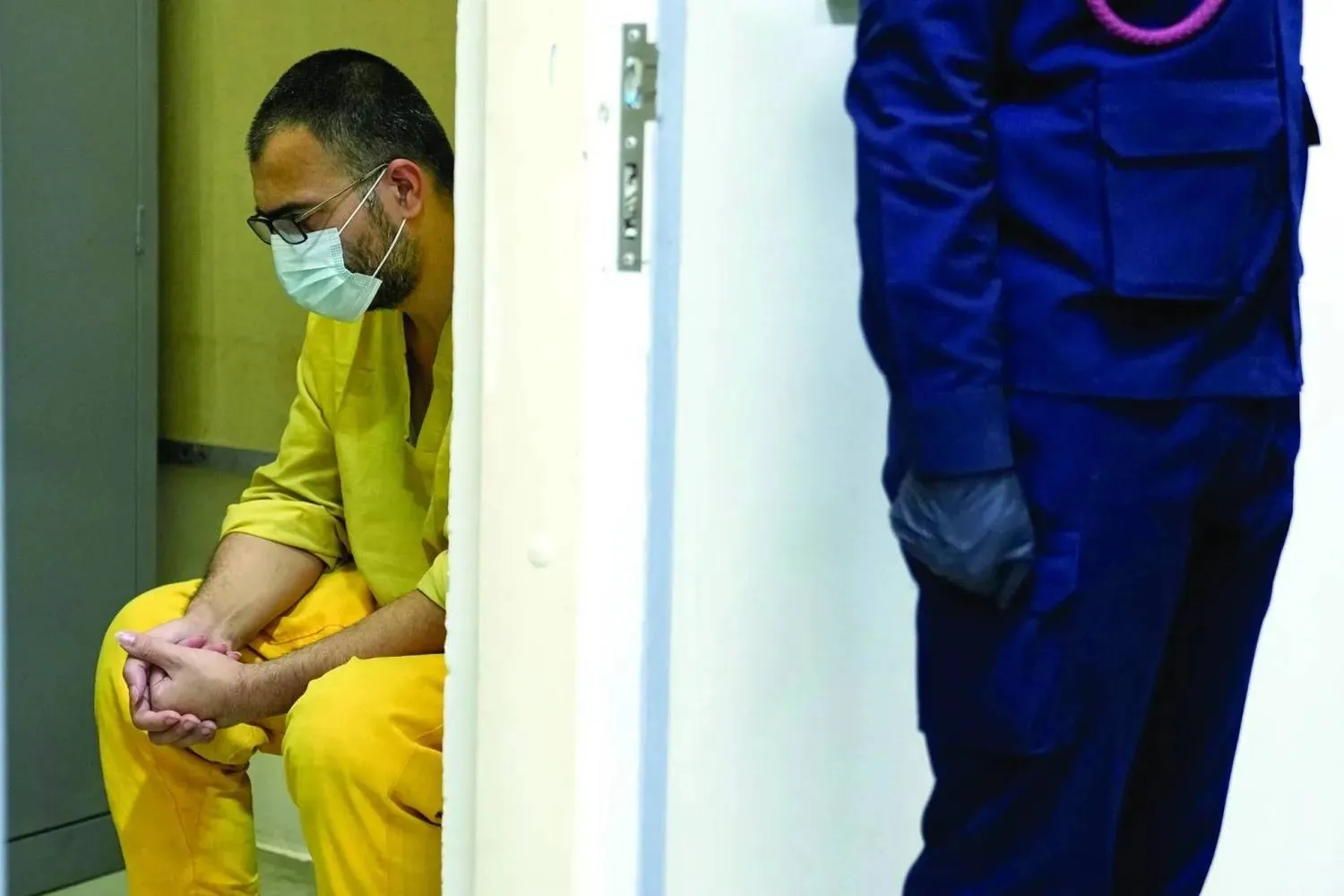

French Lawyers Object to Handling of ISIS Detainees in Iraq

A suspected ISIS member arrives for questioning at Karkh Prison in Baghdad (AP) 
TT

French Lawyers Object to Handling of ISIS Detainees in Iraq

A suspected ISIS member arrives for questioning at Karkh Prison in Baghdad (AP) 

An Iraqi official said the cases of ISIS detainees transferred from Syria to Iraq earlier this year were being handled exclusively by the Counter-Terrorism Service and the Supreme Judicial Council because of the sensitivity of the issue.

The official told Asharq Al-Awsat that the cases remained “an Iraqi national security matter,” adding that they went beyond “formal defense requirements.”

“Their files are still being reviewed by senior authorities, and it may take some time before they are referred to trial,” the official added.

The comments came after a team of French lawyers accused Iraqi authorities of refusing them permits to follow the cases of French clients accused of belonging to ISIS after their transfer from northeastern Syria to Iraq.

The lawyers warned that their clients could face death sentences after trials they described as “lacking the minimum standards of justice.”

In a statement Thursday, the defense team said several French nationals they represented had been “unlawfully transferred from northeastern Syria to Iraq” and were due to appear before courts in Baghdad in the coming days.

The lawyers reported meeting some of the detainees in Iraq and witnessing what they described as inhumane and degrading treatment and violence.

They also informed French authorities of torture suffered by the detainees in Iraq and the arbitrary nature of the proceedings.

The lawyers said they had been denied access to their clients’ case files and could not speak to them without Iraqi authorities present.

They also alleged that court-appointed lawyers assigned to defend the detainees — some of whom had been able to meet them for only 10 minutes — insulted them in front of their guards.

‘They Were Children’

The lawyers noted that some of the detainees were young men who had been children when their parents forcibly took them to Syria and were now adults. They applied over the summer for new permits to travel to Iraq, but Iraqi authorities “rejected our requests at the last minute,” they added.

The lawyers recently renewed their request to meet their clients, “but we learned that their trials would be held without us.”

According to the defense team, French authorities merely confirmed the information, explaining that Iraq did not recognize the French lawyers’ right to represent the detainees in the country or intervene in local judicial proceedings concerning them.

“France knows very precisely the fate awaiting these French nationals,” the lawyers warned, noting that 11 French citizens transferred to Iraq in 2018 “under the same circumstances” were sentenced to death by Baghdad’s Central Criminal Court.

They argued that those trials “did not meet the minimum standards of a fair trial guaranteed by Article 6 of the European Convention on Human Rights.”

The defense team urged French authorities to “urgently return them to France” to prevent them from facing the death penalty and becoming victims of a “flagrant denial of justice,” noting that the request had been submitted “many months ago.”

Al-Hol and Prisons

Deputy Minister of Migration and Displacement Karim al-Nouri, meanwhile, told Asharq Al-Awsat that “a distinction must be made between two matters.”

The first concerns al-Hol camp in northeastern Syria’s Hasakah region, which he said held “more than 60,000 people from countries around the world, including more than 25,000 Iraqis, most of them children and women.”

Al-Nouri distinguished them from detainees in prisons held by the SDF.

“The camps were under the SDF (Syrian Democratic Forces) and then came under the control of official Syrian forces,” he explained.

Iraqis who returned from prisons were also different from those repatriated from Hasakah and al-Hol after security screening, he added.

“A distinction must be made between those who returned to Iraq, most of whom returned to their homes and have had no security violations recorded against them, and those who are currently in prisons,” al-Nouri said, adding that those in prison had different cases that fell outside the remit of the Migration and Displacement Ministry, with responsibility resting with the judiciary.

Iraqi Judicial Jurisdiction

Legal expert Ali al-Tamimi told Asharq Al-Awsat that Iraq’s refusal to allow French lawyers to represent their clients rested on “two aspects: the Iraqi Law of Lawyers and the law governing criminal jurisdiction,” both of which he said gave Iraq the right to refuse.

Under Iraq’s Law of Lawyers No. 173 of 1965, lawyers registered to practice must hold Iraqi citizenship, al-Tamimi explained, noting an exception for Palestinians residing in Iraq as refugees.

A foreign lawyer who is not a member of a bar association in an Arab country may only appear alongside an Iraqi lawyer, he added. This requires approval from both the head of the Iraqi Bar Association and the president of the Supreme Judicial Council for a specific case, after confirming that the foreign lawyer continues to practice law.

On jurisdiction, al-Tamimi said Iraq considered the detainees to have “committed crimes on its territory.”

He cited an Iraqi judicial source as saying they had “all held senior positions in ISIS,” with some involved in planning attacks in the Iraq-Syria region.

Al-Tamimi noted that Article 6 of Iraq’s Penal Code applies Iraqi law to crimes committed in the country, while Anti-Terrorism Law No. 13 of 2005 gives Iraqi courts jurisdiction over terrorism cases.

He continued that proceedings are governed “exclusively by Iraqi Code of Criminal Procedure No. 23 of 1971, which guarantees the right to a defense, but through an Iraqi-licensed lawyer.”

“If the defendant has no lawyer, the court appoints one.”

Asked whether international law required Iraq to allow foreign lawyers to represent the defendants, al-Tamimi said the Vienna Convention on Consular Relations gave France the right to consular visits and access, “not the right to impose its lawyers to plead cases.”

“National security considerations and the integrity of the proceedings prevent this,” he underlined.



Watchdog Chief Says Urgent to Find Remaining Assad-Era Chemical Weapons

Syrian Foreign Minister Asaad al-Shaibani (R) and OPCW Director General Dallafior (L) attend a joint press conference at the Tishreen Palace in Damascus, Syria, 13 October 2026. (EPA)
TT

Watchdog Chief Says Urgent to Find Remaining Assad-Era Chemical Weapons

Syrian Foreign Minister Asaad al-Shaibani (R) and OPCW Director General Dallafior (L) attend a joint press conference at the Tishreen Palace in Damascus, Syria, 13 October 2026. (EPA)

The head of the world's chemical weapons watchdog on a visit Tuesday to Syrian capital Damascus said the remaining chemical weapons from the era of ousted president Bashar al-Assad must be urgently identified and destroyed.

Assad was repeatedly accused of using chemical weapons during Syria's 13-year civil war, and there has been widespread concern about the fate of Syria's stocks since his 2024 ousting.

Sabrina Dallafior, the head of the Organization for the Prohibition of Chemical Weapons (OPCW), hailed cooperation with the new authorities over chemical weapons which Assad allegedly used in mass attacks against his own citizens during the war.

"The most urgent priority now is to assess those sites of most concern from a proliferation perspective," Dallafior said during a joint press conference with Syria's foreign minister.

"That means identifying and securing any remnants of the Assad-era chemical weapons program," she said.

She said that "the OPCW verified the destruction by Syria of 42 chemical aerial bombs for the first time. Verified destruction in cooperation with the new government. This is a milestone."

Syrian Foreign Minister Asaad al-Shaibani meanwhile said that eliminating chemical weapons was "a responsibility towards the victims and a commitment to ensuring that future generations never experience such atrocities again".

He said he had discussed with Dallafior "a roadmap to build on the progress made and move towards the final closure of the file".

The top diplomat said Syria had handed over more than 100,000 official documents to the OPCW and granted the watchdog access to records and witnesses.

Izumi Nakamitsu, head of the UN disarmament office, said an OPCW team in August "verified the irreversible destruction of 42 aerial bombs" by Syrian authorities.

"This significant development means that, for the first time since 2014, the OPCW has verified the destruction of chemical munitions from the Syrian Arab Republic," she said.

The OPCW reinstated Syria in July, following an unprecedented move in 2021 of stripping Syria of its voting rights after finding its air force had used nerve agent sarin and chlorine gas on its own people.

In 2013, Syria agreed to join the OPCW and disclose and hand over its toxic stockpile under Russian and US pressure, and to avert the threat of air strikes by Washington and its allies.

This came after a suspected chemical attack on the Eastern Ghouta suburb of Damascus that killed more than 1,000 people, according to US intelligence, and was attributed to the Syrian government, which denied involvement and blamed opposition forces.


Move to Repeal Syria’s Anti-Brotherhood Law Raises Questions over Group’s Political Return

Syrian President Ahmed al-Sharaa and several ministers attend a military parade in Damascus. (Syrian Defense Ministry)
TT

Move to Repeal Syria’s Anti-Brotherhood Law Raises Questions over Group’s Political Return

Syrian President Ahmed al-Sharaa and several ministers attend a military parade in Damascus. (Syrian Defense Ministry)

Syrian lawmakers are gathering signatures to propose repealing a law that makes membership in the Muslim Brotherhood punishable by death, as the group signals it wants to return to politics after decades of prohibition.

The parallel moves have raised questions about whether Syria’s transitional authorities will allow the Brotherhood back into political life, and how much room they will give political parties.

Abdel Nasser Houshan, chairman of the People’s Assembly’s Constitutional and Legislative Affairs Committee, told Asharq Al-Awsat that the proposal to repeal Law No. 49 of 1980 was still at the signature-gathering stage and had not been submitted to the assembly.

Under the assembly’s rules, 17 members must first approve the proposal before a bill can be drafted and submitted for referral to the relevant committee, he said.

The legacy of Law 49

Media leaks had suggested lawmakers could discuss the proposal at their next session, expected in the middle of this month. Houshan’s comments indicate that the steps needed to bring it before the assembly remain incomplete.

Enacted in July 1980 under former President Hafez al-Assad, Law 49 classified every member of the Muslim Brotherhood as a criminal punishable by death. It became a key weapon in the former government’s confrontation with the group, whose members and supporters faced decades of arrests and persecution.

Hussam Jazmati, a researcher on Islamist organizations and groups, expects “broad support inside and outside the assembly” for repealing the law, given the abuses associated with it under the former government.

Repealing the “strange” law matters regardless of whom it targeted, he told Asharq Al-Awsat.

He called it “one of the instruments of state terror under the Assad regime,” saying security agencies used it to pursue people merely suspected of belonging to the Brotherhood.

The law left a deep legacy of intimidation in Syrian society, particularly in conservative and religious communities, he said.

“Sympathy for its victims could provide a basis for supporting its repeal, even among groups that do not support the Brotherhood politically.”

Yet the law’s legal status is itself unclear.

The declaration issued at the “Victory Conference” on Jan. 29, 2025, after the fall of Bashar al-Assad’s government, suspended all exceptional laws. It remains unclear whether that covered Law 49 — or whether the law still requires a legislative repeal.

The declaration also dissolved the Baath Party, the parties of the National Progressive Front and their affiliated organizations, and banned their reconstitution.

It dissolved military factions and revolutionary political and civilian bodies, requiring their integration into state institutions.

But it did not dissolve all political parties without exception, leaving unresolved the legal basis for party activity during the transition.

A test of political will

For Abdel Rahman al-Haj, a researcher specializing in Islamist movements, bringing the repeal before the People’s Assembly would be “a test of the transitional government’s political will.”

An indefinite delay could signal that the authorities do not want to ease the Brotherhood’s return to politics or allow it an active role in the next phase, he told Asharq Al-Awsat.

“Leaving the law in place without invalidating it in the constitutional declaration, and leaving it to the People’s Assembly, will be understood as additional pressure on the group,” he said.

The Brotherhood had already faced various forms of pressure to dissolve itself, he added.

The Syrian Brotherhood’s Shura Council held its fifth regular session on Sept. 27, 2026, issuing a 16-point statement on political, security and economic developments, as well as regional and international issues.

The statement affirmed the group’s desire to participate in political life and called for pluralism and rules governing party activity. Observers read it as preparation for a return to politics inside Syria.

Al-Haj said its second and sixth points showed that “the group wants to engage in party competition and is preparing for the return of political life as set out in the constitutional declaration.”

The Brotherhood appears to feel it faces “systematic exclusion and marginalization,” he said. At this stage of the transition, he added, it needs to test how serious the government is about establishing a legal framework for political activity ahead of an agreed political transition.

Jazmati sees a more immediate obstacle.

“The return of political life depends on the authorities’ will,” he said, adding that they do not appear to want organized parties, at least during the transition.

Still, he believes the Brotherhood could return to political activity “in one way or another.” Syria has a broad religious current that could find expression in several political parties and organizations, whether or not a new political parties law is enacted.

Sympathy for victims, doubts about the group

Jazmati draws a distinction between sympathy for the Brotherhood’s treatment under Assad and support for the organization today.

“There is widespread sympathy for the victims of arrests, persecution and abuses committed by the former regime, and support for addressing the injustices and providing redress for the harm they suffered,” he said.

That sympathy, however, “does not necessarily mean support for the group’s return in its current organizational form.”

The Brotherhood’s record during the Syrian revolution draws a less favorable assessment, he said, citing accusations that it tried to dominate opposition institutions and bore some responsibility for their failures, along with criticism of its management of political and relief work.

He described that negative view as resting on “a set of facts as well as a set of exaggerations,” stressing the need to distinguish between former detainees and victims of the government and the political organization that exists today.

Early in the revolution, sections of the Brotherhood’s support base welcomed its participation in preparatory conferences to establish the opposition Syrian National Council. Criticism of its performance within opposition institutions later intensified.

“The group’s popularity declined during those years, while other Islamist currents rose, particularly the current from which the leaders of Syria’s present authorities emerged,” Jazmati said.

Could a return spur other groups?

The Brotherhood’s signals have also raised questions about what its return could mean for Islamist organizations and other political forces waiting for rules governing party activity.

Al-Haj sees the prospect of its return encouraging other Islamist organizations as “possible, but unlikely.”

The Brotherhood’s presence rests on “its organizational and political history, rather than solely on its Islamist ideology,” he said. Other currents compete to represent that ideology, including the one from which Hayat Tahrir al-Sham emerged.

He expects the group to attract some Syrians who share its ideological outlook and are dissatisfied with the course of the transition.

Its return could do more to encourage non-Islamist organizations than Islamist ones to prepare for political participation, he said. But the transition’s uncertain contours make the consequences difficult to predict.

With the repeal proposal still at an early stage and the rules for party activity unresolved, the Brotherhood’s return to politics would test more than its own future.

It would also test the limits of pluralism Syria’s transitional authorities are prepared to allow.


Asharq Al-Awsat Reveals How Hamas Leader in Gaza Survived Israeli Assassination Attempt

Hamas official Ali al-Amoudi (Hamas-affiliated Palestinian Information Center)
TT

Asharq Al-Awsat Reveals How Hamas Leader in Gaza Survived Israeli Assassination Attempt

Hamas official Ali al-Amoudi (Hamas-affiliated Palestinian Information Center)

Hamas sources have disclosed how an urgent intelligence warning helped Ali al-Amoudi, who oversees the movement’s political bureau in Gaza, escape an Israeli assassination attempt on Oct. 3.

Amoudi survived a strike on a residential building hit by several missiles and suicide drones. Five Palestinians were killed.

An urgent warning

Three sources told Asharq Al-Awsat that an urgent intelligence report reached Amoudi about three hours before the attack, prompting him to leave. It did not, however, confirm that he was the intended target.

In separate, matching accounts, the sources said Amoudi was in the apartment later struck. He took the warning seriously and moved to a safe location.

The warning followed hours of drone surveillance. During daylight on Oct. 2, two members of the air unit of the al-Qassam Brigades, Hamas’ armed wing, spotted two Israeli reconnaissance drones repeatedly circling the building and the port area west of Gaza City.

The drones were of a type Palestinian security personnel knew for its dangerous capabilities, the sources said. They use artificial intelligence and other technologies to pinpoint targets.

After tracking the drones for hours, the two members suspected preparations for an assassination attempt against a senior figure in the area. They alerted higher-level security officials. Their urgent report reached those responsible for protecting senior Hamas figures, including Amoudi.

The sole person responsible for Amoudi’s security, who knew his location, went to him immediately after receiving the report and briefed him.

Amoudi suspected he was the target and decided to leave without delay. About an hour or more later, powerful guided missiles and one or two suicide drones struck the apartment, confirming his suspicions, the sources said.

A central figure

Amoudi was very close to former Hamas leader Yahya Sinwar, both inside and outside Israeli prisons. They were imprisoned together before their release. Amoudi was freed in the prisoner exchange for Israeli soldier Gilad Shalit, which Hamas called “Loyalty to the Free.”

In the days and weeks before the assassination attempt, Amoudi contested an internal election to lead Hamas in Gaza against Nizar Awadallah. Neither secured a decisive result. A runoff was halted after it was challenged.

Amoudi is a central figure in Hamas, both in Gaza and beyond.

Reading the drones

Operatives on the ground are becoming more adept at identifying the drones that constantly fly over Gaza and assessing their danger, the sources said. Some conduct reconnaissance; others are suicide drones. Their capabilities vary by model.

Israel deploys several types, some with known military names and others whose names remain unknown, the sources said. Palestinian factions and others in Gaza give some drones their own names, drawing on information about their models and capabilities from websites covering Israeli military affairs.

With drones constantly overhead, the factions’ armed wings monitor the skies to try to avert attacks on potential targets or limit their impact.

Gaza residents call drones of all types “zannana,” or “buzzers.” Many know little about their actual names or differing missions, while Palestinian factions are building their capacity to observe them and learn more.

Similar warnings

Senior Hamas security official Moein al-Arabid received a warning about similar drones before his abduction on Sept. 2, one source said. Other security officials received the warning too, but it was ignored.

No one expected a ground operation to abduct Arabid or anyone else. They anticipated an aerial assassination attempt instead, and some officials took precautions to conceal themselves.

The sources said drones are constantly monitored across Gaza to assess whether Israel is preparing to target a senior figure.

Izz al-Din al-Bayk, commander of the al-Qassam Brigades’ Northern Brigade, received a similar report days before his assassination, one source said. He left one location for another but was killed there, in a residential building in the al-Nasr neighborhood of northwestern Gaza City.

The source suggested that certain technologies had pinpointed Bayk’s new location, citing Israel’s heavy reliance on artificial intelligence and other technologies, alongside collaborators working with its domestic security agency, Shin Bet.

The source said the agency exploited collaborators’ economic circumstances and personal and social vulnerabilities to recruit them.