


‘Mechanism’ Defuses Lebanese-Israeli Military Standoff

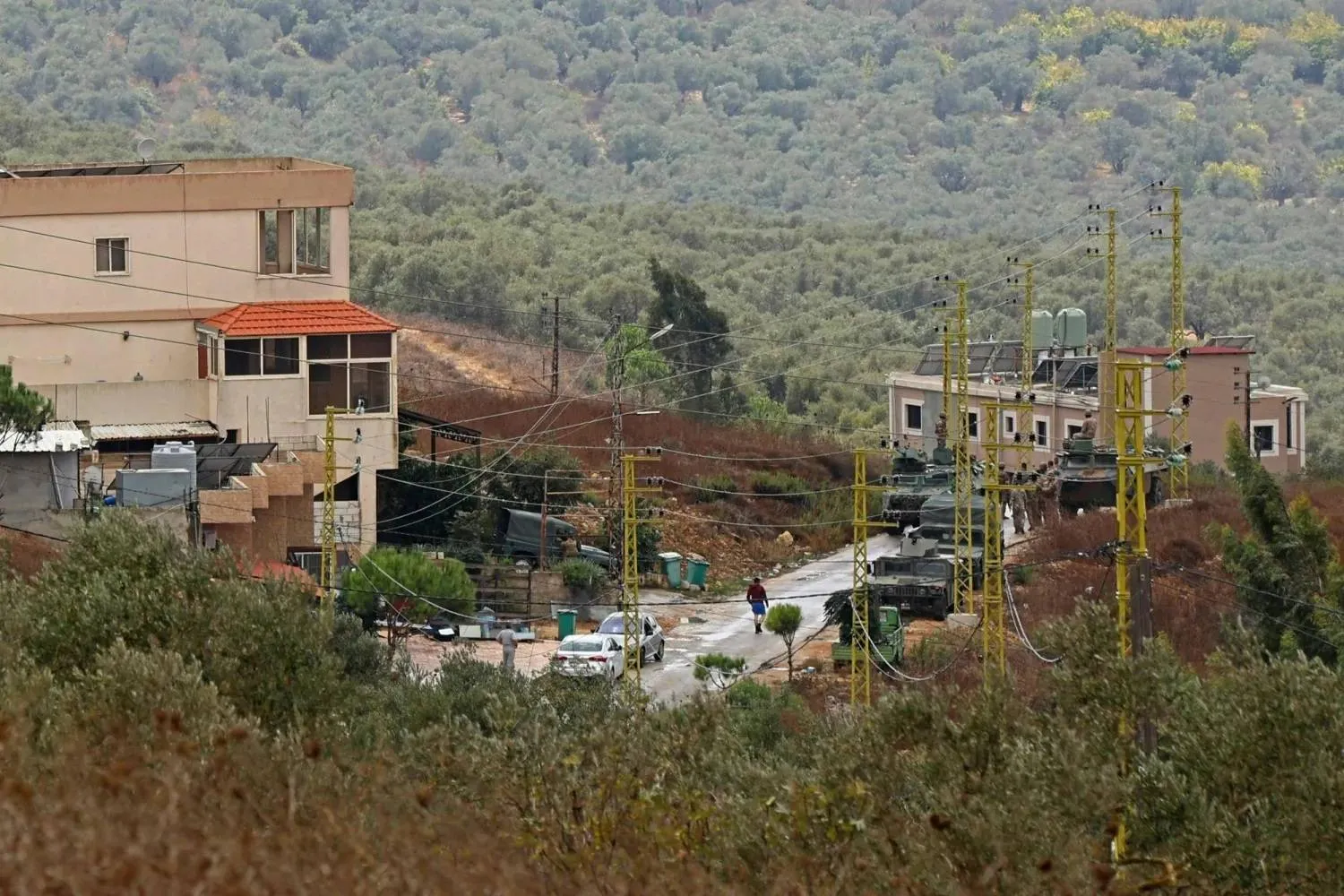
Lebanese soldiers deploy on the outskirts of Deir Mimas in southern Lebanon after Israeli forces advanced toward the town, positioned tanks, and threw stun grenades (AFP)
TT

‘Mechanism’ Defuses Lebanese-Israeli Military Standoff

Lebanese soldiers deploy on the outskirts of Deir Mimas in southern Lebanon after Israeli forces advanced toward the town, positioned tanks, and threw stun grenades (AFP)

Tensions flared between the Lebanese army and Israeli forces on the outskirts of the southern Lebanese town of Deir Mimas on Friday after an Israeli unit advanced toward a newly established army position and demanded that it be evacuated.

Contacts through the ceasefire monitoring “mechanism” helped contain the situation, and the Israeli force later withdrew to its position at Tall al-Nahhas. The Lebanese army maintained its deployment in the area and reinforced its presence along the main road in Burj al-Muluk.

The confrontation began when an Israeli force advanced toward the outskirts of Deir Mimas, reaching an intersection near a position recently established by the Lebanese army to support local residents and secure their movement in the area, particularly during the olive harvest.

According to information from the scene, the Israeli force ordered Lebanese soldiers to dismantle the position and leave the area before throwing stun grenades nearby in an attempt to drive them away. The incident prompted a military alert but no exchange of fire.

The Lebanese army initially sent reinforcements to the newly established position, as contacts were initiated through the relevant military channels to prevent the confrontation from escalating.

Dispute over position’s location

The Israeli military said the Lebanese position was located inside what it calls the “Yellow Line,” an Israeli designation for the area that Lebanon does not recognize as an official border or demarcation line.

The military coordination group for Lebanon, operating under the “mechanism,” intervened to address the dispute. Intensive contacts sought to prevent the confrontation from developing into a direct clash between the two armies.

The Lebanese army temporarily evacuated the contested position during efforts to resolve the standoff, allowing the Israeli force to move into the area for a limited period.

The Israeli troops withdrew about 90 minutes later from the position near the entrance to Deir Mimas and returned to their post at Tall al-Nahhas.

Lebanon’s state-run National News Agency said Israeli troops searched several homes in Deir Mimas during their presence in the area.

The Lebanese army, meanwhile, maintained its deployment, with units remaining stationed along the main road in Burj al-Muluk as they monitored Israeli movements and other developments along the route.

The confrontation was among the most significant recent incidents of direct contact between the Lebanese army and Israeli forces. It centered on a dispute over the location of an army position and occurred as discussions continued through the “mechanism” over conditions in southern Lebanon and the Lebanese army’s deployment there.

Israeli movements on several fronts

The tensions in Deir Mimas coincided with Israeli movements elsewhere in southern Lebanon. Israeli military vehicles advanced from the direction of the town of al-Tiri toward the outskirts of Hadatha, near Haris in the Bint Jbeil district.

Israeli artillery shelling also resumed on Friday morning against the towns of al-Mansouri and Majdal Zoun following heavy bombardment before and after midnight. Explosions were heard in the city of Tyre and several surrounding towns and villages.

Several shells struck Wadi al-Azziyeh, while artillery fire also hit Wadi Nahle on the outskirts of Shaqra.

Israeli forces fired illumination flares over the towns of Hadatha and Aita al-Jabal in the Bint Jbeil district overnight. Explosions were heard at dawn across large parts of southern Lebanon, reaching the city of Sidon and its surrounding areas.

The escalation comes as political and military contacts continue over the implementation of arrangements for southern Lebanon. Confrontations on the ground have repeatedly occurred at several locations amid continuing Israeli movements and military operations along the border region and inside a number of southern towns.



Gaza ‘Armed Gangs’ Abduct Two Palestinians, Including Faction Operative

Young Palestinians amid the rubble of buildings destroyed during the war at Jabalia refugee camp in the northern Gaza Strip (File photo: Reuters)
TT

Gaza ‘Armed Gangs’ Abduct Two Palestinians, Including Faction Operative

Young Palestinians amid the rubble of buildings destroyed during the war at Jabalia refugee camp in the northern Gaza Strip (File photo: Reuters)

Armed gangs in the Gaza Strip, operating mainly in Israeli-controlled areas, abducted two Palestinians from their home at dawn on Thursday after a force infiltrated an area east of the Bureij refugee camp in central Gaza.

The abductees, cousins from the Issa family, prompted their relatives to appeal to the Red Cross to contact Israel and try to determine their fate. Armed gangs that abduct Palestinians in Gaza are known to hand them over to Israel, as has happened in several cases.

Some were later released after it was established that they had no links to any Palestinian faction.

Torture and abduction

Field sources told Asharq Al-Awsat that one of the abductees belonged to a prominent Palestinian faction and was seized from his home along with his cousin, more than 800 meters (875 yards) from the boundary of the “Yellow Line.”

Bloodstains were found at the site of their abduction, suggesting that the two men may have been wounded or subjected to interrogation and torture, the sources said. They added that the operation took place in an area considered relatively vulnerable to security breaches.

Some of the home’s contents were stolen, the sources said, adding that the operation was carried out under the cover of Israeli drones that fired in various directions across the area.

The sources said armed gangs have recently stepped up efforts to abduct members of Palestinian factions living about 1 km (0.6 mile) from the Yellow Line and hand them over to Israel.

They said the operations were managed entirely by Israeli intelligence officers overseeing the gangs’ areas of operation, primarily in an effort to create chaos and demonstrate the gangs’ ability to advance Israeli security objectives.

One source said Palestinian factions regularly issue warnings to their members about the gangs’ operations.

Other attempts

Another source told Asharq Al-Awsat that an attempt was made about a week ago to abduct a member of a different faction in the Nuseirat refugee camp in central Gaza.

The man escaped but sustained moderate injuries while fleeing from the vehicle in which he had been held, the source said.

On Sept. 4, the Al-Quds Brigades, the armed wing of Palestinian Islamic Jihad, said members of the armed gangs had attempted to abduct one of its fighters on Al-Jumayza Street in the town of Al-Qarara, northeast of Khan Younis.

The group said the gunmen had advanced into the area with support from Israeli drones before they were detected, triggering clashes that killed and wounded several members of the gang, according to a statement issued at the time.

The Al-Quds Brigades said Israeli drones intervened to help the force withdraw, while members of the force shot and killed an Al-Quds Brigades fighter, Fadi al-Abadla, and left him at the scene.

A field source told Asharq Al-Awsat at the time that Abadla arrived at Nasser Medical Complex with his hands bound. This suggested that his abduction had nearly succeeded and that he may have been interrogated before the attempted abduction and subsequently executed, the source said.

Continued violations

Israeli forces continued their violations of the ceasefire in the Gaza Strip.

A Palestinian was reported to have died from wounds sustained on Thursday evening when Israeli military vehicles opened fire north of the Nuseirat refugee camp in central Gaza.

Five Palestinians, including two women, were wounded on Friday in similar Israeli fire east of Bureij and Deir al-Balah in central Gaza. A woman was critically wounded in Israeli artillery shelling east of Jabalia al-Balad in northern Gaza, while two Palestinians were wounded by fire from Israeli military vehicles south of Khan Younis.

Israeli forces also intensified artillery shelling as they carried out demolitions in several parts of the Gaza Strip.


Lebanon Pushes to Retain UN Presence in the South

Members of the United Nations Interim Force in Lebanon (UNIFIL) in southern Lebanon (Reuters)
TT

Lebanon Pushes to Retain UN Presence in the South

Members of the United Nations Interim Force in Lebanon (UNIFIL) in southern Lebanon (Reuters)

Lebanon is stepping up a political and diplomatic drive to maintain a UN presence in the south while rallying support for its army, as Beirut and Paris push to revisit the deadline to end UNIFIL’s mission.

Beirut is treating that issue separately from proposals for a European initiative to support the military.

A UNIFIL peacekeeper during a patrol by the UN mission in southern Lebanon (UNIFIL)

Beirut insists on UN presence

An informed source told Asharq Al-Awsat that the proposed European force “is being discussed on a separate track from the southern Lebanon file and is not directly linked to UNIFIL’s future or to any arrangements concerning the international force in southern Lebanon.”

The European track is largely focused on supporting and training the army, as well as on domestic military and institutional matters, the source said.

“It should not be confused with the debate over the form of the international presence in the south after UNIFIL’s mission ends,” the source added.

Lebanon remains committed to keeping a UN force in the south, though discussions could cover a smaller mission or one with a different structure and mandate.

“For Lebanon, the priority is to preserve a UN framework and an international presence in the south,” the source said. “Diplomatic efforts are continuing, but the proposals remain broad ideas, with no final details.”

International discussions over the next phase are continuing alongside a Paris-launched initiative to train, support and strengthen the Lebanese army. The shape of any future international presence in the south remains undecided.

UNIFIL soldiers conducting a foot patrol near the border fence with Israel in southern Lebanon (UNIFIL)

Push for an extension

Lebanese lawmakers are also rallying support for UNIFIL’s continued presence.

MP Fadi Alame, head of the Lebanese parliament’s Foreign Affairs and Emigrants Committee, said the position presented during meetings with representatives of UN Security Council member states was “very clear: Lebanon insists on extending UNIFIL’s mandate and preserving an effective UN presence in southern Lebanon.”

Current conditions make that presence “more necessary than ever,” he told Asharq Al-Awsat.

“The committee hosted representatives of Security Council member states in the presence of the defense minister and a representative of the foreign minister,” Alame said.

“We focused clearly on the need to extend UNIFIL’s mandate. What matters to us is maintaining the UN presence and ensuring that international forces remain active and effective on the ground.”

With parts of southern Lebanon occupied and devastated, the situation increasingly recalls conditions the country faced from the late 1970s onward, he said.

“The south needs an effective UN presence more than ever,” Alame added. “We stressed that point to the ambassadors and diplomatic missions we met.”

UNIFIL vehicles traveling along the coastal road towards Naqoura town in southern Lebanon (UNIFIL)

Lebanon, therefore, insists on maintaining a UN mandate and keeping Security Council Resolution 1701 as the guiding framework, he said.

“Implementing that resolution requires UN forces on the ground.”

Mission deadline under scrutiny

The Security Council decided in August 2025 to extend UNIFIL’s mandate for the final time, until Dec. 31, 2026. Operations are due to end on that date, followed by an orderly and safe drawdown and withdrawal over one year.

Alame said the decision to end the mission this year should be reconsidered.

“We, as parliament and as the Lebanese state, are working to convince the countries concerned that the current situation requires this force to remain,” he said. “It must play an effective role, continue its duties, cooperate with the Lebanese army and assist it.”

When Resolution 1701 was adopted, only limited areas remained under Israeli occupation, Alame said. Today, there are both occupied and devastated areas.

“That makes a UN force on the ground more necessary — not only to monitor and record violations, but also to help stabilize the situation and support the Lebanese army’s deployment.”

Members of the United Nations Interim Force in Lebanon (UNIFIL) in southern Lebanon (Reuters)

Diplomatic drive in New York

Lebanon and France are meanwhile pushing to keep UNIFIL in place for an additional period.

The Financial Times reported that Beirut had told the Security Council that ending the mandate under current conditions would be premature and called for a limited extension. France and most council members backed the Lebanese request, while Israel opposed it.

Foreign Minister Youssef Raggi has left for New York to attend the UN General Assembly and meet international officials and Arab and foreign counterparts.

Prime Minister Nawaf Salam will lead the Lebanese delegation. The high-level general debate begins on Tuesday, Sept. 22.

In Washington, contacts over Lebanon and negotiations with Israel are continuing after a round of talks scheduled for Rome in September was postponed until October.

A Lebanese presidency statement gave no details about the planned meeting or its participants.


Iraq Reopens Airspace to Civilian Flights After Years of Military Restrictions

The exterior of Baghdad International Airport (Reuters)
TT

Iraq Reopens Airspace to Civilian Flights After Years of Military Restrictions

The exterior of Baghdad International Airport (Reuters)

Iraq said on Friday it had reopened parts of its airspace that had been reserved for military operations against ISIS to civilian aviation after a 10-year closure.

The areas are now available to civilian aircraft, including flights transiting Iraqi airspace, in a move economists said could lower aviation operating costs.

Iraq’s airport management company said areas designated for military operations within the country’s airspace were no longer being used for that purpose and were now ready for civilian air traffic.

The state news agency quoted the company’s director, Ehab Karim, as saying that airspace previously reserved across western Iraq, from north to south, had been handed over to the General Company for Airports and Air Navigation Management for civilian aviation use.

The areas, stretching from the northernmost reaches of Nineveh province to the southern Anbar desert, had largely been reserved for sorties by the international coalition fighting ISIS and the Iraqi Air Force. Iraq began closing them in late 2016.

Karim said procedures to reopen the areas to civilian aviation would pave the way for Iraq’s Aeronautical Information Publication to be updated and made available to international airlines.

Returning the areas to civilian use would provide greater flexibility to establish new air routes, increase revenue, streamline civilian air traffic and support the national economy, Karim said.

He added that Iraqi airports were ready to provide services to all domestic and foreign airlines once the routes opened.

Iraq’s recovery

The Office of the Commander-in-Chief of the Armed Forces said it was ready to support the General Company for Airports and Air Navigation Management following the formal closure of the file on restricted zones in Iraqi airspace.

“This announcement represents an important step towards restoring Iraq’s regional and international standing in air navigation and confirms the country’s recovery and security stability,” the office said in a statement.

It said the move would help improve the management of Iraqi airspace, increase national revenue from aircraft transit fees and facilitate civilian air traffic between continents.

Iraq’s Transport Ministry said in a statement that an airspace management team at the Air Operations Center had established on a technical basis that the military air zones listed in Iraq’s Aeronautical Information Publication were no longer being used for military operations.

The development would pave the way for the completion of technical and regulatory procedures to remove the zones from the publication in coordination with the relevant authorities, the ministry added.

Security expert Fadel Abu Raghif told Asharq Al-Awsat that Iraq was capable of efficiently managing and securing its airspace after the routes were opened.

He also noted the importance of the decision coinciding with the withdrawal of international coalition forces from Iraq by Sept. 30, 2026.

Major shift

Economic expert Ziad al-Hashimi described the decision as a “major shift” for Iraq’s aviation sector, saying it would allow greater traffic and flexibility in the movement and management of air routes through Iraqi airspace.

Al-Hashimi said the decision was likely to shorten flight times and reduce operating costs for airlines transiting Iraqi airspace, particularly those arriving from Europe and Asia.

He added that it would help attract more airlines that had previously regarded alternative or restricted routes as costly to operate.

“The more flights that transit Iraqi airspace, the greater the revenue received by the Iraqi government,” he said.

Al-Hashimi cautioned, however, that European restrictions continued to impede the effective use of Iraqi airspace, with a warning remaining in effect until the end of this month.

After that, he said, the Iraqi government would need to persuade the European Union Aviation Safety Agency to allow European airlines to resume using Iraqi airspace and provide the necessary assurances, particularly regarding the safety of new and existing air routes.