Taiz Battles and Bab al-Mandab Curb Houthi Push Eastward

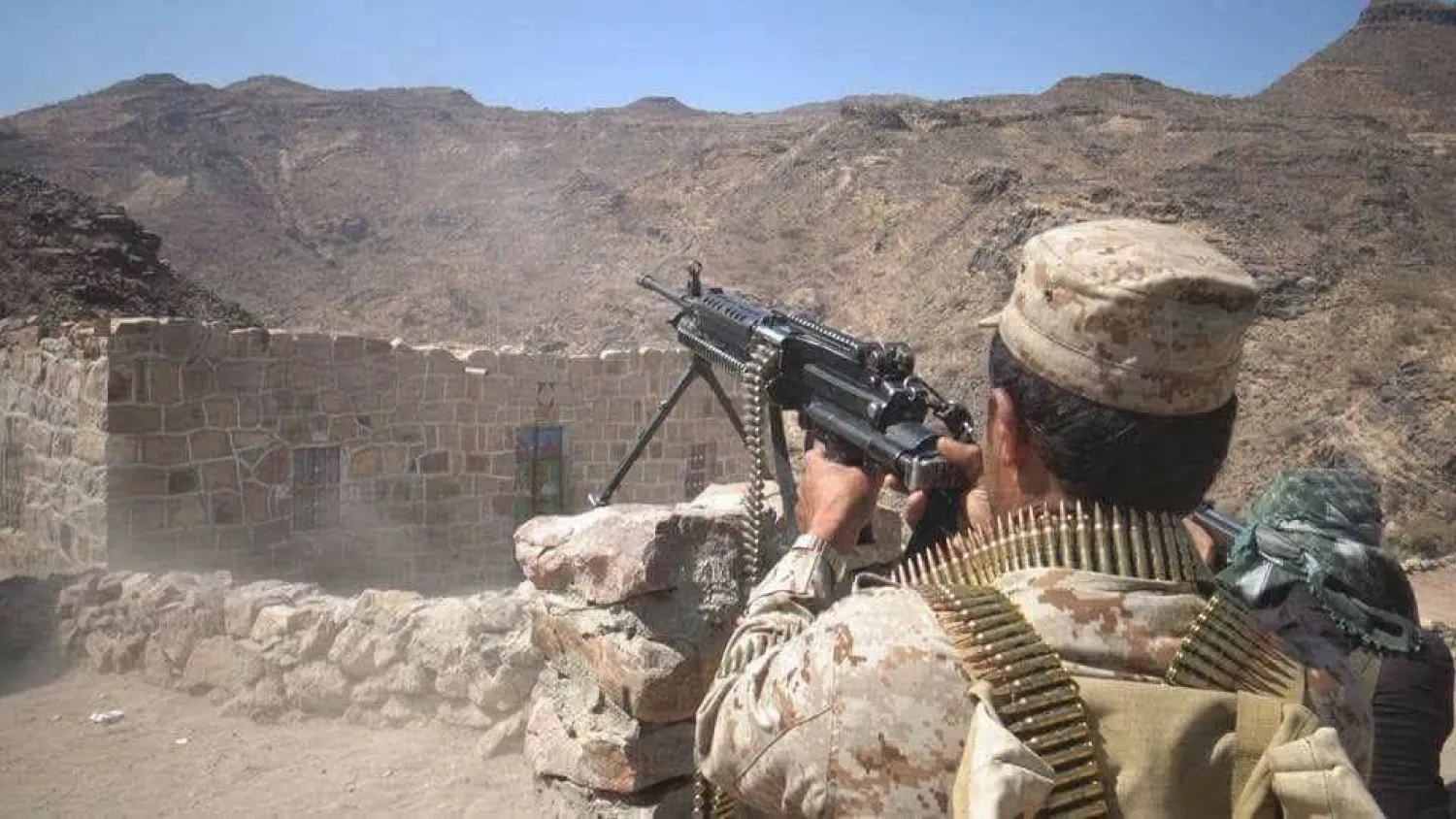
A Yemeni fighter on the front line on one of the Taiz fronts during battles against the Houthis (Military Media)
TT

Taiz Battles and Bab al-Mandab Curb Houthi Push Eastward

A Yemeni fighter on the front line on one of the Taiz fronts during battles against the Houthis (Military Media)

Yemeni government forces intensified airstrikes on Houthi positions, fortifications, and reinforcements in Taiz Governorate in southwestern Yemen on Tuesday, as fighting continued on several fronts. The forces said they had retaken positions in the south and west of the governorate, shot down two drones, and captured several members of the group near Bab al-Mandab.

The Taiz Military Axis, affiliated with the Yemeni armed forces, said warplanes carried out five airstrikes on Houthi positions, gatherings, and vehicles on the Al-Ahkoum front in Hayfan District, southeast of the governorate. It said military sources indicated that the strikes targeted reinforcements heading toward the Hayfan and Al-Subaiha fronts.

In western Taiz, fighting continued in the areas of Al-Anin, Bani Bakari, Jurdad, and Al-Kadaha amid Houthi attempts to infiltrate and launch attacks. The Taiz Military Axis announced that two drones had been shot down, one over Mount Jurdad in the southwest of the governorate and the other on the Al-Kadaha front. It said the latter was carrying a mortar shell before reaching its target.

Field sources reported that government forces had retaken positions and hilltops on the southern and western fronts in Taiz, including positions around Kahboub near Bab al-Mandab, following heavy clashes with the Houthis.

The sources said the Giants Brigades and Nation’s Shield Forces had retaken several key strategic hilltops in Kahboub after the group had seized them in recent days. Government forces also announced that they had captured seven Houthi fighters on the Al-Saqiya coast, south of Bab al-Mandab, and seized a military vehicle belonging to the group.

On the western Jurdad Bani Omar front, located between the districts of Al-Wazi'iyah and Al-Shamayatain, sources said government forces had repelled a Houthi attack and forced the attackers to withdraw.

Al-Wazi'iyah also came under airstrikes targeting Houthi positions in the areas of Al-Dharifa and Al-Mashjab, as clashes continued in several contact zones. Military sources said the strikes inflicted losses on the group and thwarted attempts to reinforce its positions and advance along the front.

On the Kahboub front overlooking Bab al-Mandab, the Southern Giants Brigades announced the capture of a Houthi commander and one of his escorts. It also said it had carried out strikes that destroyed vehicles and targeted Houthi gatherings in Kahboub and Al-Wazi'iyah.

Casualties

The battlefield developments came amid reports of heavy casualties over the past two days. Agence France-Presse, citing military sources from both sides, reported that at least 154 people had been killed in fighting across several Yemeni governorates.

Houthi-affiliated military sources said 118 people had been killed in airstrikes, clashes, and artillery shelling in Taiz, Al-Jawf, Marib, and Saada, most of them in Taiz. Government military sources, meanwhile, reported that 36 military personnel had been killed during two days of fighting, most of them on the southern and western fronts in Taiz.

Field sources also reported the death of Houthi commander Mohammed Abdullah Saad Jallafa Al-Aweer, known as Abu Malik Al-Aweer, along with several of his escorts, during clashes around Mount Jurdad in Al-Wazi'iyah District.

Fighting Spreads

The clashes are not confined to Taiz and the area around Bab al-Mandab. Shelling and fighting continued on several other fronts. In Marib, clashes continued in Harib, Al-Jubah, Al-Kassarah, and Al-Mashjah, with no change in the balance of territorial control.

In Al-Jawf, government forces announced airstrikes on Houthi positions in Rahoub and Salbah in Barat Al-Anan District, as well as positions in Al-Marashi and Al-Dhahir. Government forces also announced that they had targeted Houthi fighters and equipment in Al-Bayda and shot down a drone in Shabwa.

In a separate development, Yemen's Ministry of Human Rights condemned a missile attack on a popular market in Al-Hajf in Al-Mudharabah wa Ras Al-Arah District of Lahj Governorate, saying the attack wounded several civilians and damaged property and vehicles.

The ministry said the market was hit Monday by two ballistic missiles that landed about an hour apart. It said preliminary information regarding the timing and trajectory indicated that, according to its assessment, the missiles were launched from areas under Houthi control in Al-Sabrah District of Ibb Governorate. The ministry said it was continuing to collect information and verify the extent of the casualties and damage.

In Al-Subaiha, Chief of Staff and Acting Commander of the Nation's Shield Forces Major General Abdul Rahman Saleh Al-Lahji said the forces remained firmly positioned on the front, stressing that the area would not become a route for the Houthis to return to Aden. He called for continued fighting and steadfastness in confronting the group.

The latest developments follow clashes in recent days across the highlands between western Taiz and northern Lahj. Fighting has focused on mountainous positions in Al-Shamayatain, Jabal Habashi, Al-Wazi'iyah, and Kahboub, amid reciprocal attempts to consolidate positions and control the high ground overlooking the coastal routes and Bab al-Mandab. Government forces had previously announced that they had retaken positions and thwarted Houthi attacks and infiltration attempts on several of these fronts.


Lebanon Judge Calls in Two Hezbollah Officials over Explosives Shipment

FILED - 17 April 2026, Lebanon, Jiyeh: FILE PHOTO - A displaced Lebanese woman flashes the victory sign and displays Hezbollah and Iranian flags as they drive along the highway linking Beirut to southern Lebanon in the Jiyeh area. Photo: Marwan Naamani/dpa
TT

Lebanon Judge Calls in Two Hezbollah Officials over Explosives Shipment

FILED - 17 April 2026, Lebanon, Jiyeh: FILE PHOTO - A displaced Lebanese woman flashes the victory sign and displays Hezbollah and Iranian flags as they drive along the highway linking Beirut to southern Lebanon in the Jiyeh area. Photo: Marwan Naamani/dpa

A Lebanese judge on Tuesday ordered two Hezbollah officials to appear for questioning over their alleged involvement in a delivery of explosives seized by authorities this month, a judicial official told AFP.

Lebanese authorities had been carrying out investigations after arresting two suspected Hezbollah members accused of transporting half a tonne of explosives, which the Iran-backed group subsequently said were part of its "capabilities" to be used against Israel.

They were caught on October 8 at a security checkpoint in Dahr al-Baidar in Lebanon's east in a vehicle headed towards Beirut, with a source telling AFP that one was the son of a Hezbollah official and the other was also a group member.

The judicial official, requesting anonymity, told AFP that the judge on Tuesday ordered two Hezbollah officials to appear for questioning "after initial investigations... established their identities".

Security agencies are working to locate them and take them into custody, the official added.

Last week, Hezbollah lawmaker Hassan Fadlallah said the explosives belonged to the militant group, demanding the shipment be returned and calling for those arrested to be released, in a rare admission by the group.

US Secretary of State Marco Rubio subsequently urged Lebanon not to return the explosives.

Lebanese authorities have announced the seizure of three large shipments of explosives this month alone.

Lebanese Prime Minister Nawaf Salam has vowed that authorities "will deal with weapons outside the legal framework with the required firmness".

President Joseph Aoun on Saturday said the army and security forces were "implementing the government's decisions on extending the state's authority... and confiscating weapons and ammunition".

"Violators are referred to the judiciary, which carries out its duties fully in applying the law and the political authorities' decisions," he added.

Lebanese authorities last year committed to disarming Hezbollah after months of cross-border hostilities culminated in a 2024 war between the group and Israel.

But Hezbollah drew Lebanon into the Middle East war this year by attacking Israel, which responded with heavy strikes and a ground invasion.

In June, Lebanese and Israeli authorities signed a framework agreement which involves the disarmament of Hezbollah, a gradual Israeli withdrawal from territories it occupies, and the deployment of the Lebanese army to the area.

Hezbollah, the only militant group that refused to disarm after Lebanon's 1975-1990 civil war, has rejected surrendering its weapons and the direct negotiations with Israel.


Shabwa Deputy Governor to Asharq Al-Awsat: Houthis Supplied Terrorist Groups with Drone Technology

Shabwa Deputy Governor Fahd Al-Khulaifi (Asharq Al-Awsat)
TT

Shabwa Deputy Governor to Asharq Al-Awsat: Houthis Supplied Terrorist Groups with Drone Technology

Shabwa Deputy Governor Fahd Al-Khulaifi (Asharq Al-Awsat)

Fahd Al-Khulaifi, First Deputy Governor of Yemen's Shabwa province, warned that the Houthi group has supplied some terrorist organizations with drone technology as part of what he described as ongoing cooperation between the two sides.

His remarks came after a Houthi missile attack on Monday targeted the Martyr Ahmed Al-Sulaimani Training Center on the outskirts of Ataq, the capital of Shabwa province in southeastern Yemen.

Local authorities reported that the facility was struck by three ballistic missiles while newly recruited internal security personnel were undergoing training, leaving more than 70 people dead and over 200 wounded.

In exclusive remarks to Asharq Al-Awsat, Al-Khulaifi said Houthi attacks would not break the resilience of Shabwa's residents but would instead strengthen their determination to confront the group.

He said local authorities possess information confirming cooperation between the Houthis and terrorist organizations, including Al-Qaeda and ISIS, noting that the Houthis had enabled some of these groups to acquire drone technology.

According to Al-Khulaifi, this cooperation is evident in attacks targeting security forces, the Shabwa Defense Forces and the Nation's Shield Forces as they pass through the province en route to other governorates.

Local authorities announced that those killed would be officially recognized as having died in the line of duty, with their salaries permanently allocated to their families. They also pledged to safeguard the rights and financial entitlements of the wounded and ensure payment without delay, while mobilizing the necessary resources to provide medical care.

Al-Khulaifi said the dead and wounded were newly recruited members of the province's police and security agencies.

He noted that Shabwa Governor Awad bin Al-Wazir had revealed that local authorities possess evidence of cooperation between the Houthis and other terrorist organizations.

Al-Khulaifi added that such coordination had intensified recently and was being monitored by security agencies.

He said the Houthis and terrorist organizations were carrying out direct attacks and planting explosive devices and booby traps along roads and at locations used by security forces and the Shabwa Defense Forces.

He added that their cooperation had expanded to include the use of drones after the Houthis provided some of these organizations with the necessary technology.

Al-Khulaifi stressed that such terrorist acts would not undermine the determination of Shabwa's residents to confront the Houthis.

He called on the Arab Coalition to support the front lines with advanced weapons capable of countering Houthi military capabilities, particularly drones, and to provide ground-based air defense systems to intercept ballistic missiles.

Shabwa's local authorities held the Iran-backed Houthi group fully responsible for the attack and the resulting casualties, describing the targeting of recruits during training as an extremely serious military escalation.

They also called for urgent measures to protect military and security facilities and their personnel.

Meanwhile, Yemeni Presidential Leadership Council Chairman Rashad al-Alimi was briefed on developments following the attack during a telephone call with Shabwa Governor Awad bin Al-Wazir.

Al-Alimi instructed the relevant authorities to provide necessary medical treatment to the wounded, care for the families of those killed, complete procedures to settle their entitlements and ensure payment of their salaries, and take the necessary measures to respond firmly to the sources of the attack.

He said the targeting of recruits reflected what he described as the Houthis' tendency to resort to attacks whenever they faced pressure or setbacks in plans backed by the Iranian regime.

Al-Alimi stressed that such attacks would not deter the state from fulfilling its responsibilities to protect citizens and restore national institutions.

He also vowed that the victims' deaths would not go unanswered, emphasizing that caring for their families and honoring their sacrifices was a national responsibility.


Drone Strike in Disputed Sudan-South Sudan Area Kills Dozens, Minister Says

A person wounded in a drone strike on a market in the disputed Abyei region along the border between South Sudan and Sudan is carried to Ameth Bek hospital, October 20, 2026. (Reuters/Medecins Sans Frontieres/Handout)
TT

Drone Strike in Disputed Sudan-South Sudan Area Kills Dozens, Minister Says

A person wounded in a drone strike on a market in the disputed Abyei region along the border between South Sudan and Sudan is carried to Ameth Bek hospital, October 20, 2026. (Reuters/Medecins Sans Frontieres/Handout)

At least 73 people were killed when drones struck a market in the disputed Abyei region along the border of South Sudan and Sudan, the caretaker information minister for the jointly administered region said on Tuesday, accusing Sudan's army of carrying out the attack.

The minister did not provide evidence for his claim of who was responsible for Monday's attack.

Abyei is an oil-rich area that is jointly administered by South Sudan and Sudan, which have both staked claims to it. It experiences frequent bouts of ‌violence, with clashes ‌usually involving rival ethnic groups or armed militias.

"Around ‌73 ⁠people have been ⁠killed and 19 have been wounded ... a number of drones were shot yesterday by the Sudanese armed forces," Yohana Akol Ngor, the caretaker minister of information of the Abyei region, told Reuters on Tuesday.

Last year, at least six Bangladeshi peacekeepers were killed and eight wounded in a drone attack by separatist armed ⁠groups on a UN base in Abyei, Bangladesh's ‌armed forces said.

South Sudan's foreign ‌ministry said in a statement late Monday that drones struck a market ‌located north of Abyei town, but did not specify the ‌number of civilian casualties resulting from the attack.

The ministry said it had summoned the Sudanese ambassador to convey the government's "strong protest and deep concern regarding the attack and its implications for the security of civilians and ‌the stability of the Abyei Area."

The medical charity Médecins Sans Frontières (MSF) said in a statement that ⁠it was ⁠treating more than 20 wounded people at the nearby Ameth Bek Hospital.

"So far we received over 20 patients, including several critical cases. Patients with burns were also admitted. We are providing surgical services and wound dressing, along with other emergency care," said Christian Lindauer, MSF medical activities manager at Ameth Bek Hospital.

Sudan has been gripped by war since April 2023 between the Sudanese Armed Forces and the paramilitary Rapid Support Forces. The conflict has devastated large parts of the country and created what the United Nations has described as the world's worst humanitarian crisis.