Aoun Rejects Any Settlement at Lebanon’s Expense as Salam Rallies Int’l Support

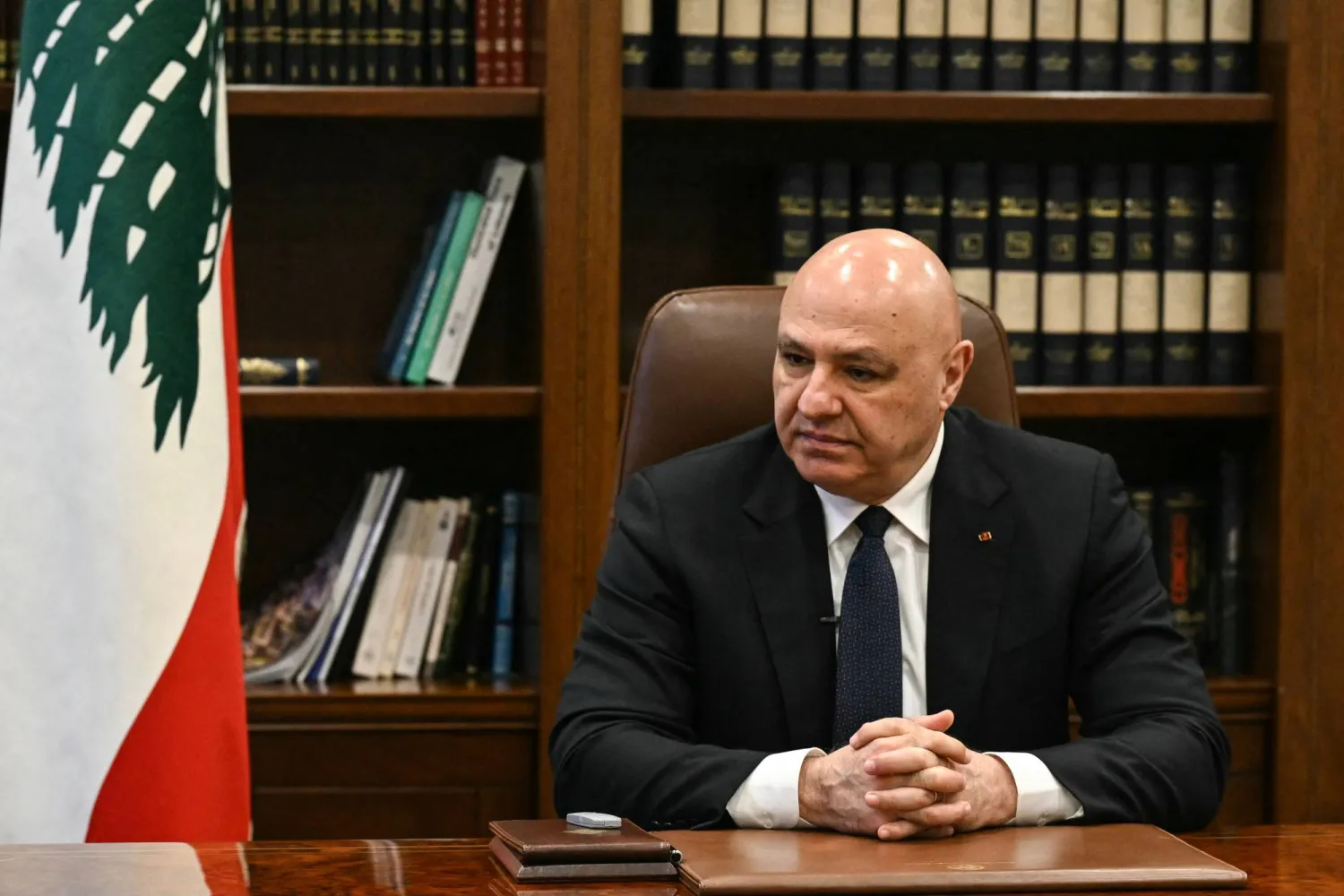
Lebanese President Joseph Aoun speaks during an interview with AFP at the Presidential Palace in Baabda on September 15, 2026. (Photo by JOSEPH EID / AFP)
TT

Aoun Rejects Any Settlement at Lebanon’s Expense as Salam Rallies Int’l Support

Lebanese President Joseph Aoun speaks during an interview with AFP at the Presidential Palace in Baabda on September 15, 2026. (Photo by JOSEPH EID / AFP)

Lebanese President Joseph Aoun has stressed the need to strengthen national unity in the face of the challenges confronting Lebanon, saying any political settlement must not come at the expense of the country and its national interests.

Aoun warned on Tuesday against “seeking support from abroad against one another at home in ways that serve Lebanon’s enemies.”

“Let us instead draw strength from one another in dealing with the outside world,” he said.

Aoun stressed that Lebanon cannot be built by a single group, sect, or political party, calling for efforts to overcome divisions and enhance dialogue and communication among Lebanese citizens as the gateway to building trust and ensuring stability.

He said Lebanon can recover whenever its people place the national interest above all other considerations, urging greater engagement between generations and a move away from grudges and divisions.

Salam Mobilizes Support in New York

In New York, Prime Minister Nawaf Salam held a series of meetings on the sidelines of the United Nations General Assembly, stressing Lebanon’s priorities in discussions with UN Secretary-General Antonio Guterres, Jordan’s King Abdullah II, Turkish President Recep Tayyip Erdogan, Finnish President Alexander Stubb, Qatari Prime Minister and Foreign Minister Sheikh Mohammed bin Abdulrahman Al Thani, Iraqi Prime Minister Ali al-Zaidi, Bahraini Foreign Minister Abdullatif bin Rashid Al-Zayani, and US Senator Jeanne Shaheen.

During these meetings, Salam stressed the need for Israel to fully withdraw from Lebanese territory and cease its attacks, strengthen the capabilities of the Lebanese Army, and ensure a continued international presence in southern Lebanon following the end of UNIFIL’s mandate.
He also emphasized extending state authority across the country and ensuring that weapons remain solely under state control.

Salam sought support for Lebanon’s recovery, reconstruction, and rehabilitation efforts, as well as for the continuation of government reforms and the expansion of cooperation and investment, particularly in energy, transportation, and regional connectivity.

Meeting with the UN Secretary-General

In his meeting with Guterres, Salam stressed the importance of maintaining a UN-backed international presence in southern Lebanon after the conclusion of UNIFIL’s mission, arguing that such a presence would support stability and help extend state authority.

He also discussed the humanitarian situation, noting that approximately 329,000 people remain displaced, and highlighted the need to shift from emergency response measures toward supporting returns, recovery efforts, and the restoration of essential services.

Regional Consultations

With King Abdullah II of Jordan, discussions focused on supporting Lebanon and its institutions, particularly the Lebanese Army, continuing coordination to reduce tensions, and mobilizing international support for arrangements that would prevent a security vacuum in the south.

In talks with Erdogan, Salam discussed strengthening Lebanese-Turkish relations and expanding cooperation in trade, investment, energy, and infrastructure, in addition to electricity and railway connectivity projects and support for recovery and reconstruction in southern Lebanon.

Salam to the Lebanese Diaspora: Difficult Decisions and Reforms

Addressing members of the Lebanese community in New York, Salam said that despite the difficult circumstances, the government had not abandoned its course. Instead, it had taken “difficult decisions” and launched a serious reform agenda aimed at changing the country's trajectory and building a state in which Lebanese citizens can regain confidence.

On the issue of weapons, Salam stressed that the government remains committed to implementing its decisions so that the state alone exercises authority across Lebanon, holds exclusive control over decisions of war and peace, and entrusts responsibility for citizens’ security to the Lebanese Army and legitimate security institutions.

He linked these efforts to achieving an Israeli withdrawal, securing the return of residents to southern Lebanon, and launching a broader recovery and reconstruction process, emphasizing that stability is an essential prerequisite for economic revival and investment.


UN Experts Urge Israel to Protect West Bank Olive Farmers

Palestinian volunteers douse an olive tree set on fire by Israeli settlers, near the village of Turmus Ayya, north of Ramallah, in the Israeli-occupied West Bank on October 16, 2026.  Ahmad Gharabli, AFP
Palestinian volunteers douse an olive tree set on fire by Israeli settlers, near the village of Turmus Ayya, north of Ramallah, in the Israeli-occupied West Bank on October 16, 2026. Ahmad Gharabli, AFP
TT

UN Experts Urge Israel to Protect West Bank Olive Farmers

Palestinian volunteers douse an olive tree set on fire by Israeli settlers, near the village of Turmus Ayya, north of Ramallah, in the Israeli-occupied West Bank on October 16, 2026.  Ahmad Gharabli, AFP
Palestinian volunteers douse an olive tree set on fire by Israeli settlers, near the village of Turmus Ayya, north of Ramallah, in the Israeli-occupied West Bank on October 16, 2026. Ahmad Gharabli, AFP

UN rights experts on Monday called on Israel to protect Palestinian farmers in the West Bank as settler attacks worsen with the annual olive harvest.

"Palestinian farmers must be protected and able to access their land safely. Yet, year after year, the violence, destruction and restrictions intensify," the experts said in a statement.

"The olive harvest should be a time when farmers can enjoy, in safety and dignity, the food and livelihoods their nature and land provide, not another season of fear, loss, violence and destruction."

The experts urged Israel to ensure that its forces protect Palestinian farmers from settler attacks and refrain from interference with their access to land. They also urged the international community to "exercise maximum pressure to protect Palestinian civilians", reported AFP.

Israel has occupied the West Bank since 1967. About 500,000 Israelis live in the West Bank, alongside three million Palestinians.

Violence is surging in the territory ahead of Israel's bitterly fought October 27 elections. The vote coincides with Palestinians' annual olive harvest which has been repeatedly disrupted by Israeli settlers as Prime Minister Benjamin Netanyahu seeks to shore up his pro-settlement right-wing base.

According to the UN humanitarian agency OCHA, 178 settler attacks related to the 2025 olive harvest were recorded in the West Bank, affecting 88 Palestinian communities.

More than 6,000 trees and saplings were "vandalised", it said -- nearly double the number in 2024 and the highest figure in six years.

"The olive harvest is an essential source of food, income and livelihood for thousands of Palestinian families," the UN experts said.

"Olive trees take years to mature and can sustain families for generations. Their destruction deprives families of far more than a single harvest: it undermines local food systems, cultural practices and ways of life, as well as the right to food and the food sovereignty of Palestinian communities."

The seven signatories to the statement include Sofia Monsalve Suarez, special rapporteur on the right to food; and Francesca Albanese, special rapporteur on human rights in the occupied Palestinian territories.

The special rapporteurs are independent experts mandated by the Human Rights Council. They do not speak for the United Nations itself.


UK Urges Firms Not to Take Part in E1 Settlement Tender or Risk Sanctions

Israeli settlers (foreground) harvesting olives confront a Palestinian family outside the settlement of Alei Zahav, near the Palestinian town of Kafr al-Dik in the Israeli-occupied West Bank, on October 13, 2026. (AFP)
TT

UK Urges Firms Not to Take Part in E1 Settlement Tender or Risk Sanctions

Israeli settlers (foreground) harvesting olives confront a Palestinian family outside the settlement of Alei Zahav, near the Palestinian town of Kafr al-Dik in the Israeli-occupied West Bank, on October 13, 2026. (AFP)

British foreign minister Ed Miliband on Monday urged companies and individuals not to proceed with bids for the E1 West Bank settlement project on Monday, warning those involved in the ‌construction of ‌illegal settlements could face ‌sanctions.

"We ⁠urge businesses and ⁠individuals not to proceed with bids for E1 construction tenders," Miliband said in a statement. "They should be ⁠aware of legal ‌and ‌reputational consequences, including the risk ‌of involving themselves in ‌serious breaches of international law."

The E1 project would bisect the Israeli-occupied West Bank and ‌cut it off from East Jerusalem, fragmenting ⁠the ⁠land Palestinians hope will form the heart of a state.

Many Western states and campaign groups have opposed the project over concerns that it could undermine a future peace deal with the Palestinians.


Syrian State Media: Armed Groups Ban UN Delegation from Entering Sweida

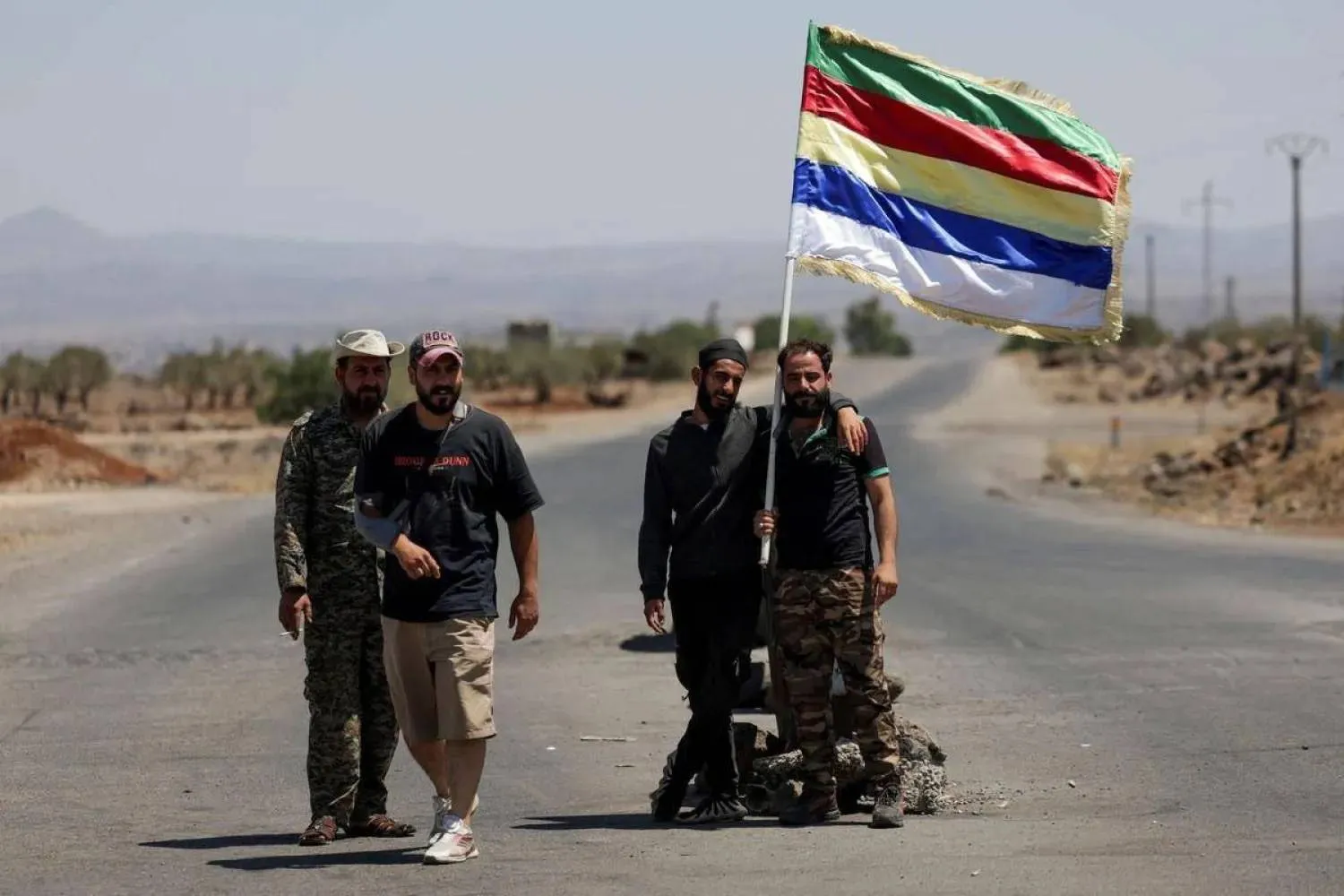
Members of the National Guard affiliated with Sheikh Hikmat al-Hijri in Sweida (File photo: Sweida 24). 
TT

Syrian State Media: Armed Groups Ban UN Delegation from Entering Sweida

Members of the National Guard affiliated with Sheikh Hikmat al-Hijri in Sweida (File photo: Sweida 24). 

Groups described by Syrian state media as operating outside the law prevented a joint UN humanitarian delegation from entering the southern Syrian city of Sweida on Sunday, citing a lack of coordination with them, according to Syria’s Al-Ikhbariya television channel.

The delegation included representatives of the UN Office for the Coordination of Humanitarian Affairs (OCHA) and international organizations. Its visit had been coordinated with the Sweida branch of the Syrian Arab Red Crescent, whose team was expected to accompany the delegation on field visits to Sweida city, Shahba and the village of Ara.

Al-Ikhbariya reported that the groups stopped the delegation at the Umm al-Zeitoun checkpoint for two to three hours before informing its members that entry was prohibited.

The delegation had earlier passed through the Al-Matouna checkpoint, operated by the Sweida Security Directorate.

The broadcaster also recalled that groups affiliated with Druze spiritual leader Sheikh Hikmat al-Hijri had blocked commercial trucks carrying essential goods and fuel from entering Sweida province on September 10.

According to Al-Ikhbariya’s correspondent at the time, the restrictions on commercial convoys coincided with the groups preventing approximately 12,000 students from reaching examination centers to sit special make-up exams for students in Sweida.