


Board of Peace Proposes $2.45 Billion Blueprint to Begin Gaza Reconstruction

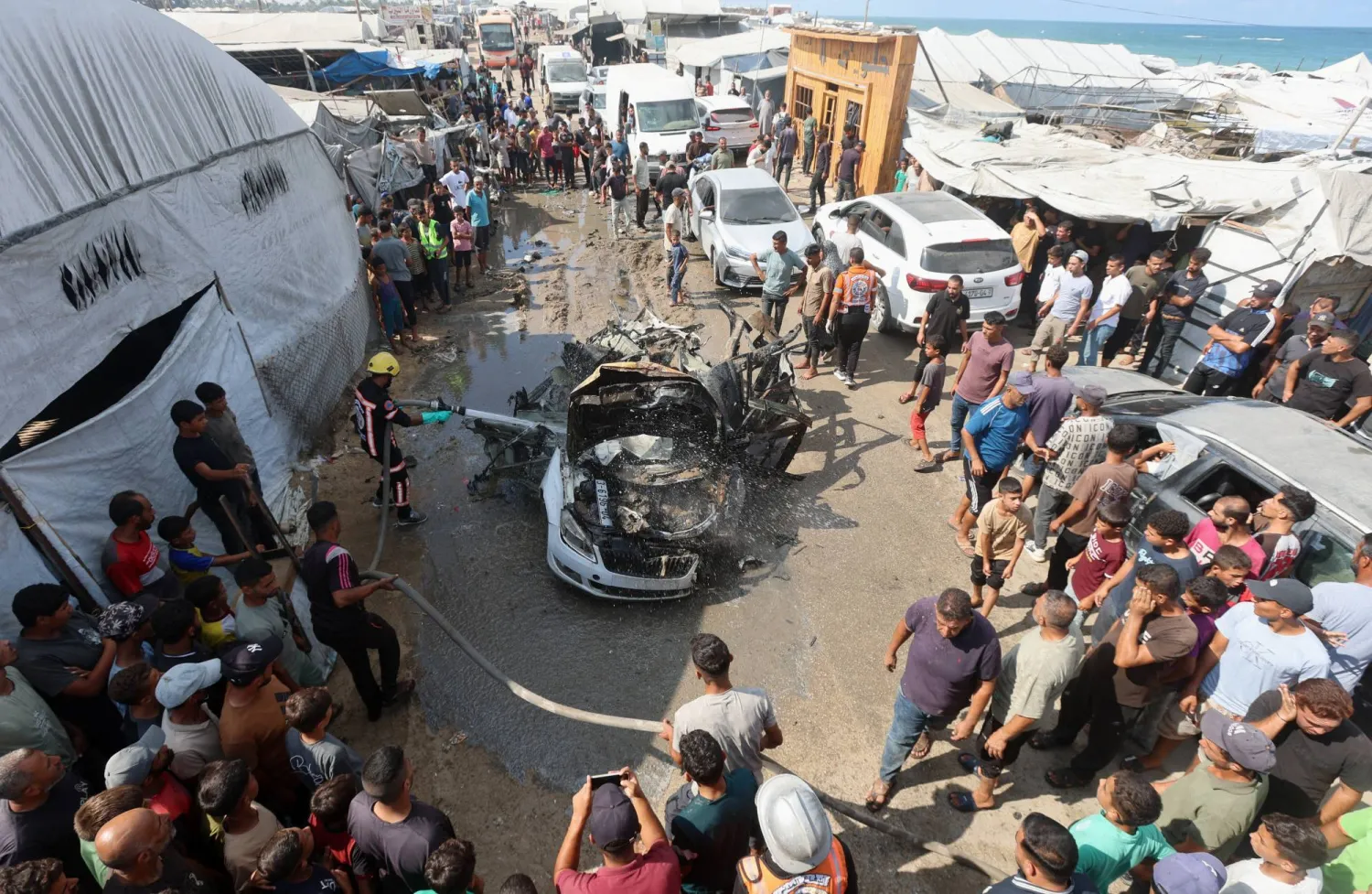
Palestinian firefighters extinguish a fire on a vehicle hit by an Israeli airstrike in Khan Younis, in the southern Gaza Strip, September 23, 2026. REUTERS/Ramadan Abed
TT

Board of Peace Proposes $2.45 Billion Blueprint to Begin Gaza Reconstruction

Palestinian firefighters extinguish a fire on a vehicle hit by an Israeli airstrike in Khan Younis, in the southern Gaza Strip, September 23, 2026. REUTERS/Ramadan Abed

The US-backed Board of Peace is proposing a six-month, $2.45 billion plan to begin reconstruction and governance in Gaza as President Donald Trump’s ceasefire plan struggles to stay afloat.

At a meeting of the group’s board in New York on the sidelines of the UN General Assembly on Wednesday, the governors unveiled a 66-project blueprint to get things started while acknowledging enormous hurdles that must still be overcome.

The projects include ambitious infrastructure, education and health initiatives that are designed to support Trump’s 20-point plan to end the Israel-Hamas war, The Associated Press reported.

“The need is immense,” the board said, noting that full reconstruction from the physical damage across Gaza will cost roughly $35.2 billion over the medium term and another $71.4 billion in the next 10 years.

The proposal is largely aimed at potential donors who will be asked to foot the bill for reconstruction of the war-devastated territory.

The ceasefire, which took effect on Oct. 10, was meant to clear the way for a broader process to rebuild Gaza under the guidance of the Board of Peace.

The plan included additional Israeli military withdrawals from Gaza, the disarmament of Hamas, the arrival of an international peacekeeping force and a new apolitical Palestinian government to administer the territory’s day-to-day affairs. It also envisioned an ambitious program for rebuilding war-ravaged Gaza.

But the US-backed plan has largely stalled. While the ceasefire halted the heaviest fighting and humanitarian conditions have improved, the Israeli military has expanded its control of Gaza and now occupies some 60% of the territory.

Hamas has not given up its weapons. The international military force and new government still have not entered Gaza, and reconstruction has not begun.

The vast majority of Palestinians continue to live in tent camps or ruins of their former homes.

The board’s high representative, Nikolay Mladenov, has said progress hinges largely on Hamas disarming — a step the group has refused to take. But he also has pressed Israel to scale back its military operation.

“I want to be very clear that we are not bound by a calendar,” he said. “We want to make sure that this works.”

Key questions that the board faces are not only laying out plans for reconstruction but also a timeline for the deployment of the international force meant to provide security in the territory and a new government, plans to disarm Hamas, and bringing in badly needed building materials.

US Gen. Jasper Jeffers, commander of the international stabilization force planned for Gaza, outlined a five-step approach to dealing with the thorny issue of demilitarizing Hamas. It begins with the first wave of the multinational unit being deployed with troops from Kosovo and Morocco, to be followed by additional personnel from Albania and Kazakhstan.

Their task will be to demilitarize the territory and decommission all of Hamas’ military infrastructure.

The goal, he said, is to gradually turn security control over to the interim government, after which Israel will be expected to withdraw its forces.



Abdelatty to Asharq Al-Awsat: Egypt Is in Contact with Russia and Ukraine to Reduce Tensions

 Egyptian Minister of Foreign Affairs, Dr. Badr Abdelatty speaks at a Congressional Gold Medal in honor of Anwar Sadat, former President of Egypt, at the US Capitol in Washington, US, DC, November 18, 2026. (Reuters)
Egyptian Minister of Foreign Affairs, Dr. Badr Abdelatty speaks at a Congressional Gold Medal in honor of Anwar Sadat, former President of Egypt, at the US Capitol in Washington, US, DC, November 18, 2026. (Reuters)
TT

Abdelatty to Asharq Al-Awsat: Egypt Is in Contact with Russia and Ukraine to Reduce Tensions

 Egyptian Minister of Foreign Affairs, Dr. Badr Abdelatty speaks at a Congressional Gold Medal in honor of Anwar Sadat, former President of Egypt, at the US Capitol in Washington, US, DC, November 18, 2026. (Reuters)
Egyptian Minister of Foreign Affairs, Dr. Badr Abdelatty speaks at a Congressional Gold Medal in honor of Anwar Sadat, former President of Egypt, at the US Capitol in Washington, US, DC, November 18, 2026. (Reuters)

Egypt has stepped in to mediate between Ukraine and Russia, with Kyiv expressing gratitude for what it described as "Cairo's active role" toward a ceasefire.

Egyptian Foreign Minister Dr. Badr Abdelatty told Asharq Al-Awsat on Saturday that, under the directives of President Abdel Fattah al-Sisi, Egypt is communicating with Ukraine and Russia to ensure freedom of navigation and de-escalation in the Black Sea, given its impact on freedom of navigation and wheat shipments.

He stressed that efforts in this regard are ongoing, hoping that they will yield results soon.

During a press briefing with Egyptian media on Saturday, Abdelatty noted that the international community appreciates Egyptian leadership and diplomacy, pointing out that Cairo is engaged across all regional and international files based on its policy of strategic balance.

He added that as the world's largest grain importer, Egypt is pushing for freedom of navigation through all maritime corridors, Hormuz, Bab al-Mandeb, and the Black Sea, especially as this directly affects its national interests.

On Friday, Ukrainian Foreign Minister Andrii Sybiha stated that Ukraine is ready for a ceasefire and expressed gratitude to India, Türkiye, and Egypt for playing an active and vital role in easing tensions in the Black Sea region and advancing mediation efforts.

Kyiv is currently awaiting a response from Russia, he added.

The Black Sea region has seen an escalation in Russian and Ukrainian attacks, with strikes expanding to hit ports, commercial vessels, and energy and grain export facilities.

Former Egyptian Assistant Foreign Minister Ambassador Mohamed Hegazy viewed Ukrainian praise for Egypt's role as a reflection of confidence in Cairo's diplomacy and its capacity to bolster international de-escalation efforts.

He told Asharq Al-Awsat that Egypt operates from a vision rooted in the belief that dialogue and diplomacy remain the most effective means of preventing conflicts from widening, particularly in the Black Sea region, which carries strategic weight for European and global security, as well as international trade, energy, food, and supply chains.

He added that Egypt's role is built on a foundation of trust and credibility, alongside a foreign policy anchored in respecting state sovereignty, steering clear of confrontational alignments, and encouraging political solutions that account for all parties' interests and pave the way for sustainable settlements.

This is not the first time Kyiv has highlighted Cairo's role; Ukrainian President Volodymyr Zelenskyy previously pointed to proposals submitted by Egypt, Türkiye, and India on September 23, during meetings on the sidelines of the UN General Assembly in New York, aimed at reaching a maritime truce to ensure the resumption of safe navigation in the Black Sea.


France, UK and Six Other Countries Call for Palestinian Elections in Early 2027

An elderly Palestinian man walks along a street in the West Bank village of Abu Falah, north of Ramallah, 20 November 2026. (EPA)
TT

France, UK and Six Other Countries Call for Palestinian Elections in Early 2027

An elderly Palestinian man walks along a street in the West Bank village of Abu Falah, north of Ramallah, 20 November 2026. (EPA)

France, the UK, Australia, Canada and four other countries on Saturday issued a joint statement calling for postponed Palestinian legislative elections to take place in the first three months of 2027.

The vote was "essential" for a "democratic renewal" in the Palestinian territories and "is inseparable from the preservation of the two State solution, which we remain steadfastly committed to", they said.

The other countries behind the joint statement were Belgium, Luxembourg, Norway and Poland.


‘Millions Starving’ in Yemen’s Houthi-Held North, NGO Head Warns

Secretary-General of the Norwegian Refugee Council (NRC) Jan Egeland, speaks during an interview with Agence-France Presse (AFP), in Sanaa on November 27, 2026. (AFP)
TT

‘Millions Starving’ in Yemen’s Houthi-Held North, NGO Head Warns

Secretary-General of the Norwegian Refugee Council (NRC) Jan Egeland, speaks during an interview with Agence-France Presse (AFP), in Sanaa on November 27, 2026. (AFP)

Millions of Yemenis in areas under Houthi control are suffering from hunger as a result of restrictions on humanitarian organizations and their lack of funding, Norwegian Refugee Council head Jan Egeland told AFP.

In an interview on Friday in Sanaa, the Yemeni capital controlled by the Iran-backed group, Egeland spoke of a "big difference" between the government-controlled south, where numerous international organizations are active, and the north, where "we are so few".

But "the needs are all over. And we are all underfunded as humanitarians in Yemen".

"Well over 20 million people" in the north "are lacking the aid they need to have a minimum (standard) of living," he said. "Millions and millions are starving and have desperate needs."

"I have never ever in my many years as a humanitarian worker seen so few humanitarian groups faced with so desperate needs among so many millions of people as in northern Yemen."

"Millions and millions got food every single month until the UN pause in operations in the north after their aid workers were detained," Egeland said.

At the end of last month, the United Nations announced the death of employee Mohammed Al-Shami, who had been detained by Houthi militia since 2024.

UN spokesman Farhan Haq said last month that 71 UN employees were still being held by the Houthis.

- Desperate situation -

Egeland highlighted the difficult political dynamics that humanitarian groups need to navigate, including sanctions on the Houthis.

"Sanctions from some of the donor countries meant that some organizations left because they were afraid to be punished for the sanctions," he said. "Others lost aid completely overnight because they were reliant on the United States and Germany and others who cut their aid" budgets.

And still other organizations "felt that the humanitarian space was not there. There was too much interference, and their aid workers were detained".

He called on the international community to do more to facilitate a return of the UN's agencies.

"Without the UN, we cannot reach everybody in the north. Only the World Food Program has the capacity to feed everybody."

But despite all the obstacles, Egeland stressed that the main issue remains a lack of funds, not access.

- 'Neglected crisis' -

He said the UN's 2026 appeal for basic assistance is only 20 percent funded and its appeal for emergency shelter has reached just 13 percent, calling the gap "catastrophic".

Yemen's frozen civil conflict reignited in July amid the regional Middle East war and has displaced more than 340,000 people in recent months, according to the International Organization for Migration.

Egeland said he would head to government-controlled Taiz, which has been suffering from a worsening food crisis for weeks due to a Houthi siege on the city.

"Both in the north and in the south, I saw people who are without shelter against the elements," he said, citing people living under leaves and branches in Abyan in the south.

"It's much worse now than I have seen it at any point in my years visiting Yemen," he said. "It is a forgotten and neglected crisis already."

Egeland expects the number of deaths resulting from acute malnutrition in Yemen to rise within six months.

"When children are as malnourished as they are now, they die from diseases. And when they drink polluted water, they get diarrhea and they die. Others get cholera and die."