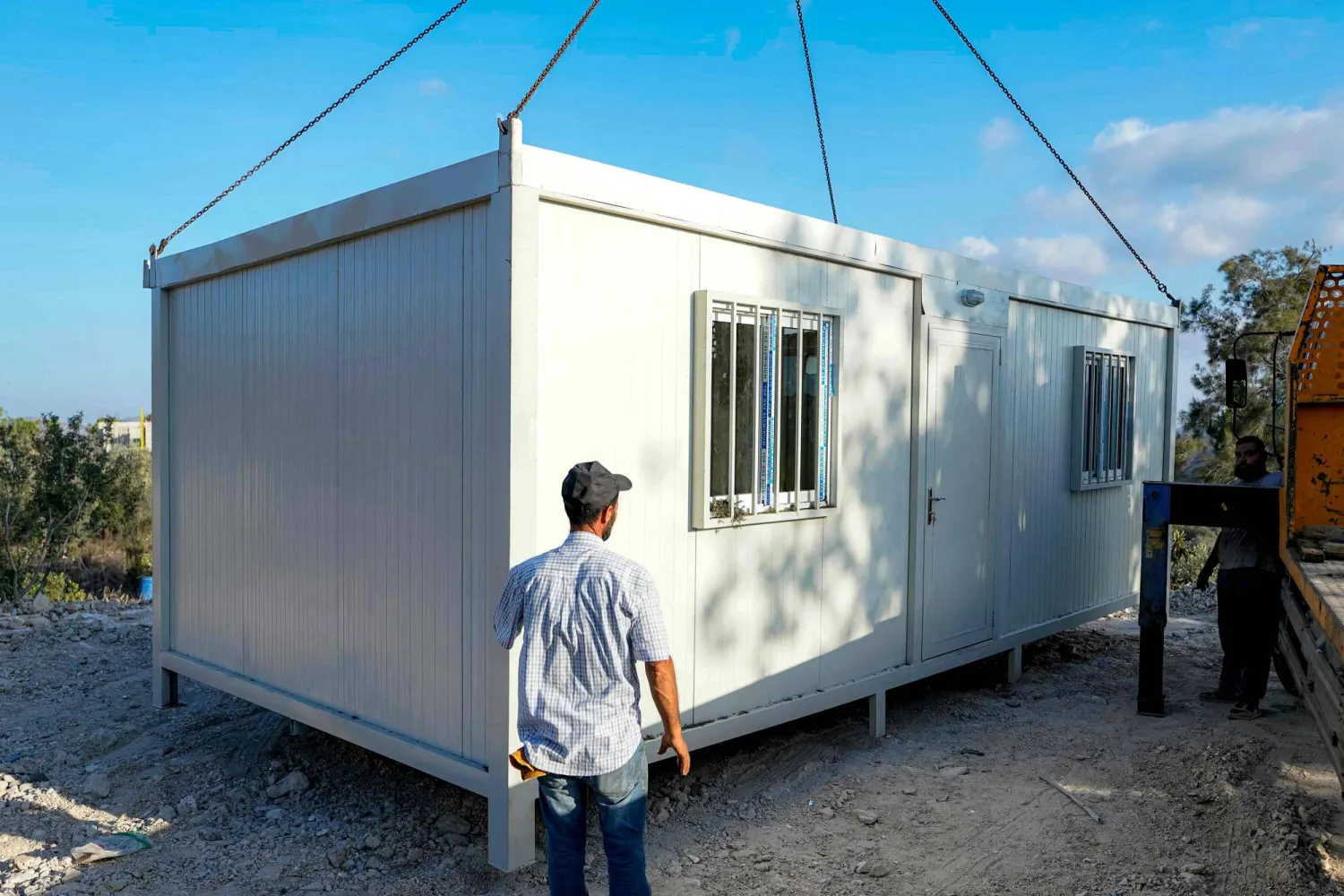
Prefabricated Homes Arrive in Destroyed South Lebanon Town

Workers set up a prefabricated house to provide housing for families whose homes have been destroyed in the fighting between Hezbollah and Israel, in the village of Zawtar al-Gharbiyeh (Western Zawtar) in southern Lebanon, on September 21, 2026. (Photo by Ammar Ammar / AFP)
TT

Prefabricated Homes Arrive in Destroyed South Lebanon Town

Workers set up a prefabricated house to provide housing for families whose homes have been destroyed in the fighting between Hezbollah and Israel, in the village of Zawtar al-Gharbiyeh (Western Zawtar) in southern Lebanon, on September 21, 2026. (Photo by Ammar Ammar / AFP)

Nearly two months after the Lebanese army entered the town of Zawtar al-Gharbiyeh in southern Lebanon, temporary housing units have started reaching families unable to live in their homes.

The army began deploying in Zawtar al-Gharbiyeh end of July after Israeli forces withdrew from the area, marking the first test of a US-brokered plan agreed by Lebanon and Israel in direct talks.

The plan foresees the Lebanese army confiscating weapons from Hezbollah ⁠ in designated areas and Israeli troops withdrawing in phases so that Lebanese troops can deploy. Zawtar al-Gharbiyeh is one of several towns or villages covered by the initial pilot program.

On Tuesday, the Council for the South began handing over the first batch of prefabricated homes to property owners whose plots had been cleared of rubble and prepared to receive the units.

This comes in coordination with the Military Coordination Group for Lebanon.

 

Workers set up a prefabricated house to provide housing for families whose homes have been destroyed in the fighting between Hezbollah and Israel, in the village of Zawtar al-Gharbiyeh (Western Zawtar) in southern Lebanon, on September 21, 2026. (Photo by Ammar Ammar / AFP)

On September 9, authorities announced that around 70 percent of the town’s residents had been able to return to inspect their properties, while only 16 percent, estimated at about 60 families out of 450, had been able to resettle. Officials estimated that 85 percent of homes had been completely destroyed and 15 percent partially damaged.

A source at the Higher Relief Commission told Asharq Al-Awsat that the prefabricated homes in Zawtar are part of a broader effort to support residents’ return and that solutions will vary according to the extent of destruction and local needs.

“We are now in the first phase, and while solutions in the villages covered by this stage may be similar or serve as models, they will not be identical because the scale of destruction differs from one area to another. The farther south we go, the more widespread the devastation becomes, making it impossible to apply a single solution to every town.”

The source explained that the response would rely on “a combination of solutions,” with prefabricated homes being one of them, adding that efforts are underway to secure available units locally as well as additional supplies from donors or foreign sources.

“We had the option of obtaining as many prefabricated homes as the local market could provide, while arranging for additional quantities from donor countries and external sources, allowing us to prepare for the first phase. In later stages, the need will certainly be greater.”

The source noted that Lebanese officials had explored opportunities for aid and grants during overseas visits, including to Türkiye, saying: “The cost of a prefabricated home in the local market is not cheap. We know this type of housing is only part of the solution, so we must secure it either through available resources or through grants and assistance.”

He added that while prefabricated homes may currently be a key solution in Zawtar, demand for them could be even greater in other areas during later phases.

“Unfortunately, our capabilities do not allow us to provide enough prefabricated homes for everyone in need. We are talking about roughly 300,000 housing units that are either completely destroyed or damaged to a degree that makes them uninhabitable. This is an enormous number. Therefore, prefabricated housing is one solution, not the only one.”

He stressed that the initiative marks the beginning of a broader process aimed at enabling residents to return and reasserting the presence of the state in the south, followed by restoring government agencies and institutions.

“It is not enough to ask people to return simply because homes are livable or because we have provided prefabricated housing if public institutions remain absent. If there is no municipal office, civil defense center, police station, or clinic, how can a normal return take place? The return of residents must go hand in hand with the return of state institutions, with prefabricated housing serving as one of the tools that help make this possible.”

Zawtar al-Gharbiyeh Mayor Abed Ezzeddine told Asharq Al-Awsat that introducing prefabricated homes addresses the “exceptional situation” of families who remain displaced. He explained that the municipality had requested 15 units.

“We have a number of families that are still displaced, some of whom can no longer afford rent. Other families are staying in buildings that must be vacated as schools reopen. We therefore needed to provide temporary shelter until their circumstances improve, especially with winter approaching.”

“There are also other families demanding to return to the town, which means we will likely need more than 15 homes,” he added.

“People want to return to Zawtar, but they need somewhere to stay while they work to rebuild their lives.”

“Many people come every day, sit in the town squares or on the ruins of their homes, and then return in the evening to the places where they are currently displaced. We therefore need to find a solution to this problem.”

He noted that displaced residents are spread across villages around Sidon, Iqlim al-Kharroub, and the Zahrani coast, where transportation costs and everyday living expenses add to their burdens amid limited employment opportunities and rising fuel costs. He confirmed that coordination is taking place directly with the Council for the South.
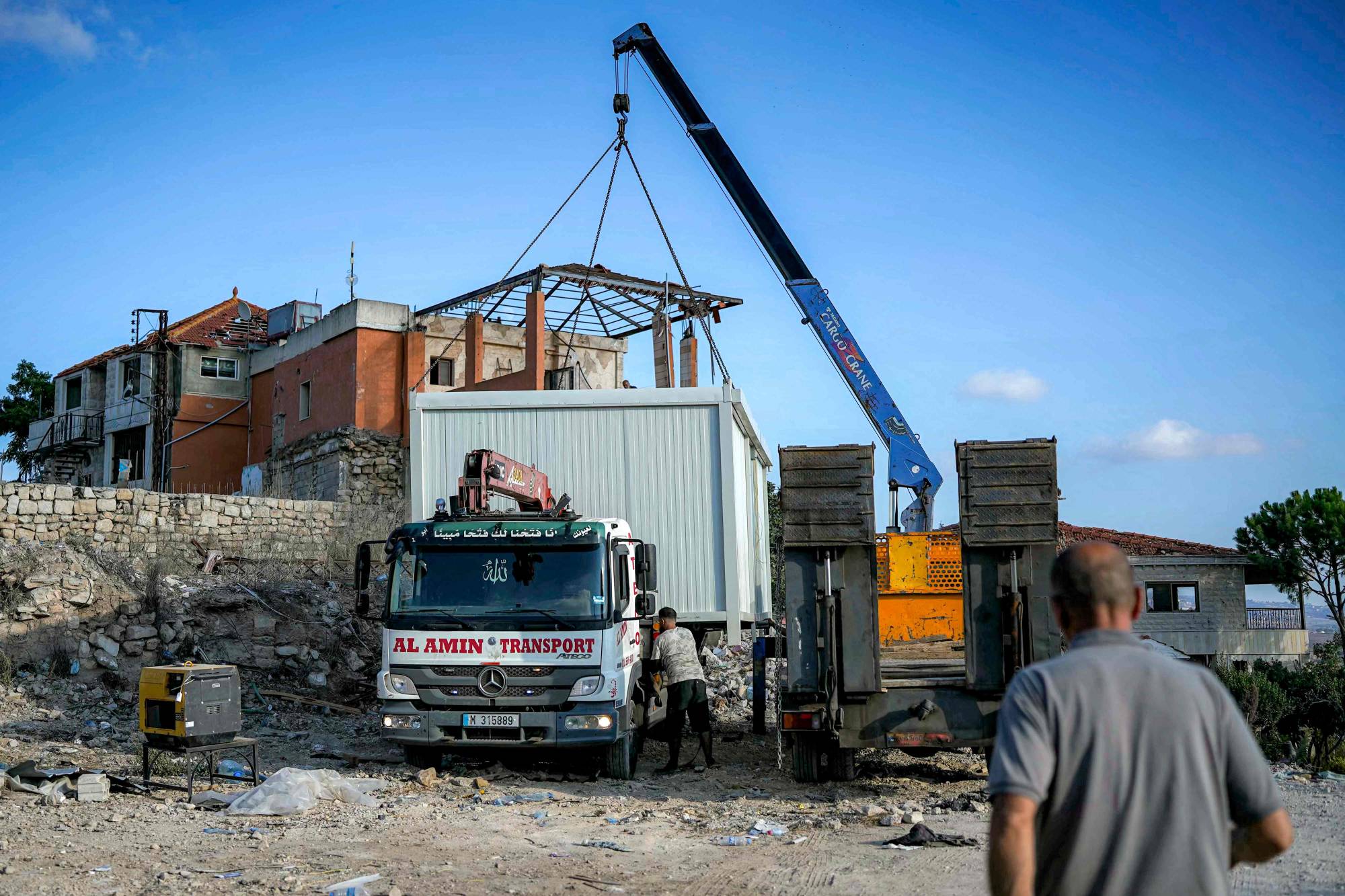
 

Workers set up a prefabricated house to provide housing for families whose homes have been destroyed in the fighting between Hezbollah and Israel, in the village of Zawtar al-Gharbiyeh (Western Zawtar) in southern Lebanon, on September 21, 2026. (Photo by Ammar Ammar / AFP)

Ezzeddine pointed out that “we in Zawtar al-Gharbiyeh live in a state of anxiety. The security situation remains unstable, especially because Zawtar al-Sharqiyeh is very close to us, and the near-daily explosions frighten people ... Every so often we hear another explosion, and homes are destroyed.”

“There are children, women, and elderly people in the town, so it is impossible to say that conditions are stable. People want to return, settle down, and find peace, but the security situation remains difficult.”

He hoped there would be stability in the south “because people are exhausted and simply want to live in peace.”


Jordan Says Security Officer Killed in Amman in Stabbing Attack

Jordan's capital, Amman (AFP)
TT

Jordan Says Security Officer Killed in Amman in Stabbing Attack

Jordan's capital, Amman (AFP)

Jordanian authorities said a security officer was stabbed to death in the country's capital Amman on Thursday, calling it a "terrorist attack".

"The Public Security Directorate mourned the martyrdom of Corporal Jawad Ali Khalaf Al-Salaytah, who was killed in a cowardly terrorist attack," the directorate said in a statement.

Another officer was injured in the incident, it added.

Authorities said the attack took place in front of the Sri Lankan embassy, where the victim was stabbed with a "sharp object".

The officer was rushed to hospital but later died from his injuries, the directorate said.

A nearby police patrol responded immediately and arrested the attacker, it added.

The second officer wounded in the incident sustained injuries to their face as he tried to intervene and is in a stable condition.

Security agencies were investigating, the directorate said.


Egypt, US Sign Strategic Objective Agreement to Expand Cooperation

Egypt and the US seek greater cooperation across multiple sectors (Egyptian Foreign Ministry). 
TT

Egypt, US Sign Strategic Objective Agreement to Expand Cooperation

Egypt and the US seek greater cooperation across multiple sectors (Egyptian Foreign Ministry). 

Egypt and the United States signed a Strategic Objective Framework Agreement on Enhancing Mutual Prosperity on Wednesday, aimed at expanding cooperation across several sectors, according to the Egyptian Foreign Ministry.

Egyptian Foreign Minister Badr Abdelatty attended the signing ceremony alongside the ministers of finance, supply and internal trade, and higher education and scientific research.

The agreement was signed by Egypt’s Deputy Foreign Minister for International Cooperation, Dr. Samar El-Ahdal, and US Chargé d’Affaires in Cairo Robert Silverman.

Foreign Ministry spokesman Ambassador Nader Zaki said the framework agreement aims to strengthen cooperation with the United States to achieve tangible economic growth in Egypt.

He explained that its objectives include expanding cooperation in key sectors and adopting US institutional and technological innovations to improve the efficiency of Egypt’s water, energy and infrastructure systems.

The agreement also seeks to modernize education, healthcare and governance, develop the skills of Egyptian professionals and create more jobs, particularly in areas of shared strategic interest such as water management, artificial intelligence and energy.

Another objective is to strengthen Egypt’s food security through science-based agriculture.

The signing comes amid repeated statements by both sides emphasizing the strategic nature of relations between Cairo and Washington and their longstanding ties.

Former US Ambassador David Satterfield identified three main reasons behind Washington’s strategic view of Egypt: preserving the Egyptian-Israeli peace treaty, ensuring access to and transit through the Suez Canal, and maintaining stability within Egypt itself.

Satterfield told Asharq Al-Awsat that the peace treaty “remains, even in light of the Abraham Accords, the cornerstone and fundamental pillar of stability and peace in the broader Middle East.”

He explained that the United States considers its engagement with and support for Egypt vital to preserving the treaty.

“Egypt’s geographical location gives it particular importance to the United States because of the Suez Canal,” he added.

A Congressional Research Service report updated on February 25, 2026, supports this assessment, linking Egypt’s importance to US national security to its geographical position, population and diplomatic influence.

The report notes that facilitating the passage of US naval vessels through the Suez Canal provides Washington with a significant advantage when it needs to deploy forces rapidly to the Gulf and Indian Ocean.

US interests, however, extend beyond the canal and the peace treaty.

Satterfield warned that instability in Egypt, whether driven by economic or political factors or both, “would threaten not only US interests but those of the broader Middle East.”

In his assessment, Egypt’s stability is therefore a strategic interest in its own right, rather than merely a desired outcome of bilateral cooperation.

Ben Fishman, a researcher at the Washington Institute for Near East Policy and former director for North Africa at the US National Security Council, agreed.

He told Asharq Al-Awsat that the United States maintains a longstanding strategic relationship and strong military partnership with Egypt, while the peace agreement with Israel “remains a pillar of regional stability.”

The two countries’ interests also converge in Gaza. Washington needs a regional partner to help negotiate and implement security arrangements, while Cairo requires US cooperation to support a resolution to a crisis affecting its borders and security.

The Congressional Research Service notes that Egypt played a key role, alongside other partners, in mediating the October 2025 Gaza ceasefire and hosted the Sharm el-Sheikh summit in support of the agreement.

Despite the importance of their relationship, Cairo and Washington do not agree on every issue.

Fishman explained that US and Egyptian interests converge in some conflicts and diverge in others, which is natural in a relationship based on mutual interests.

Satterfield echoed that assessment, stressing that such differences do not undermine the strategic nature of bilateral ties.

“Disagreements also exist between the United States and NATO countries, but they do not diminish the fact that both sides view the relationship as strategic,” he said. “That is the nature of international relations.”

In a related development, Abdelatty discussed the latest regional developments with Massad Boulos, senior adviser to the US president for Arab and African affairs, during a telephone call on Wednesday.

According to the Egyptian Foreign Ministry spokesman, the discussion addressed intensive efforts to promote de-escalation.

Abdelatty stressed “the importance of all parties showing the necessary flexibility to reduce tensions and allow a return to the political track, rather than moving toward a resumption of military operations, whose grave dangers to the region and the world President Sisi has warned against.”

The call also covered “the need to maintain full support for efforts to unify the Libyan government in a way that achieves the security and stability sought by the Libyan people.”

The two officials also discussed the situation in Sudan, emphasizing the importance of ending the ongoing war and launching a Sudanese-owned political process.


Lebanon: Four Former Army Generals Questioned as Defendants in Beirut Port Blast Probe

Families of victims of the 2020 Beirut port explosion and ambassadors from several countries commemorate the sixth anniversary of the blast (File photo: AFP). 
TT

Lebanon: Four Former Army Generals Questioned as Defendants in Beirut Port Blast Probe

Families of victims of the 2020 Beirut port explosion and ambassadors from several countries commemorate the sixth anniversary of the blast (File photo: AFP). 

The investigation into the Beirut port explosion took a new turn on Wednesday as judicial investigator Judge Tarek Bitar questioned four former Lebanese Army generals as defendants, expanding the scope of legal proceedings ahead of an indictment expected before the end of the year.

The hearing also marked the first attendance of a representative of the Public Prosecutor’s Office at the Court of Cassation, Judge Mohammad Saab.

Those questioned during the lengthy session were former Lebanese Army Chief of Staff Maj. Gen. Walid Salman, former Deputy Chief of Staff for Equipment Brig. Gen. Manuel Karjian, former head of the Ammunition Department Brig. Gen. Georges Moussa, and former director of the Equipment Directorate Brig. Gen. Munir Abou Zeid.

Their defense lawyers, lawyers representing the civil claimants and Cassation Advocate General Judge Mohammad Saab attended the hearing.

A judicial source told Asharq Al-Awsat that the officers had been summoned based on a substantive submission prepared by Saab, in which he brought allegations against them over suspicions that they had prior knowledge of the presence of ammonium nitrate at Beirut port.

The source explained that the questioning focused on “the suspicions outlined in the submission, in preparation for further investigation and a determination of the judicial position regarding each defendant, without the allegations necessarily establishing responsibility.”

Judicial Cooperation

Saab’s attendance marked the first time a representative of the Public Prosecutor’s Office at the Court of Cassation had participated in an investigative hearing before Bitar in the case.

It also signaled cooperation between the judicial investigator and the prosecutor’s office, which had previously boycotted Bitar and suspended cooperation with him when Judge Ghassan Oueidat headed the office.

The questioning ended without any decision on whether the four officers would be detained or released, leaving their legal status unresolved.

“Bitar did not issue an arrest warrant against any of them, nor did he decide to release them or require them to sign a residence undertaking, leaving the matter unresolved,” the judicial source explained.

The source did not disclose the content of the officers’ statements or their responses to the allegations.

Previously Questioned Defendants to Be Summoned Again

Bitar’s next steps will extend beyond the four former officers.

According to the same judicial source, the investigator is preparing to summon all those he previously questioned without issuing decisions concerning their cases.

They include former Prime Minister Hassan Diab, former Interior Minister Nohad Machnouk, former General Security Director-General Maj. Gen. Abbas Ibrahim and former State Security Director-General Maj. Gen. Tony Saliba, as well as judges and senior officials.

The move will bring previously deferred decisions back before Bitar as he continues investigating the allegations against the four officers.

The upcoming summonses will involve individuals whose procedural status remains unresolved, making the next round a crucial step in determining the measures to be taken before the indictment is finalized.

Those facing allegations will remain in a state of uncertainty over the judicial measures that await them.

Indictment Expected Before Year-End

Meanwhile, the Public Prosecutor’s Office at the Court of Cassation will prepare a supplementary substantive submission concerning the four officers and forward it to Bitar as soon as possible, according to the judicial source.

The supplementary submission will be added to the case file Bitar is reviewing as he prepares his indictment, taking into account the latest questioning sessions and the statements obtained.

The source stressed that Bitar “is committed to issuing the indictment before the end of this year,” adding that he would soon devote his attention to reviewing the case file and drafting the indictment.