


Yemen: Taiz Fronts Drain Houthis, Target Reinforcements

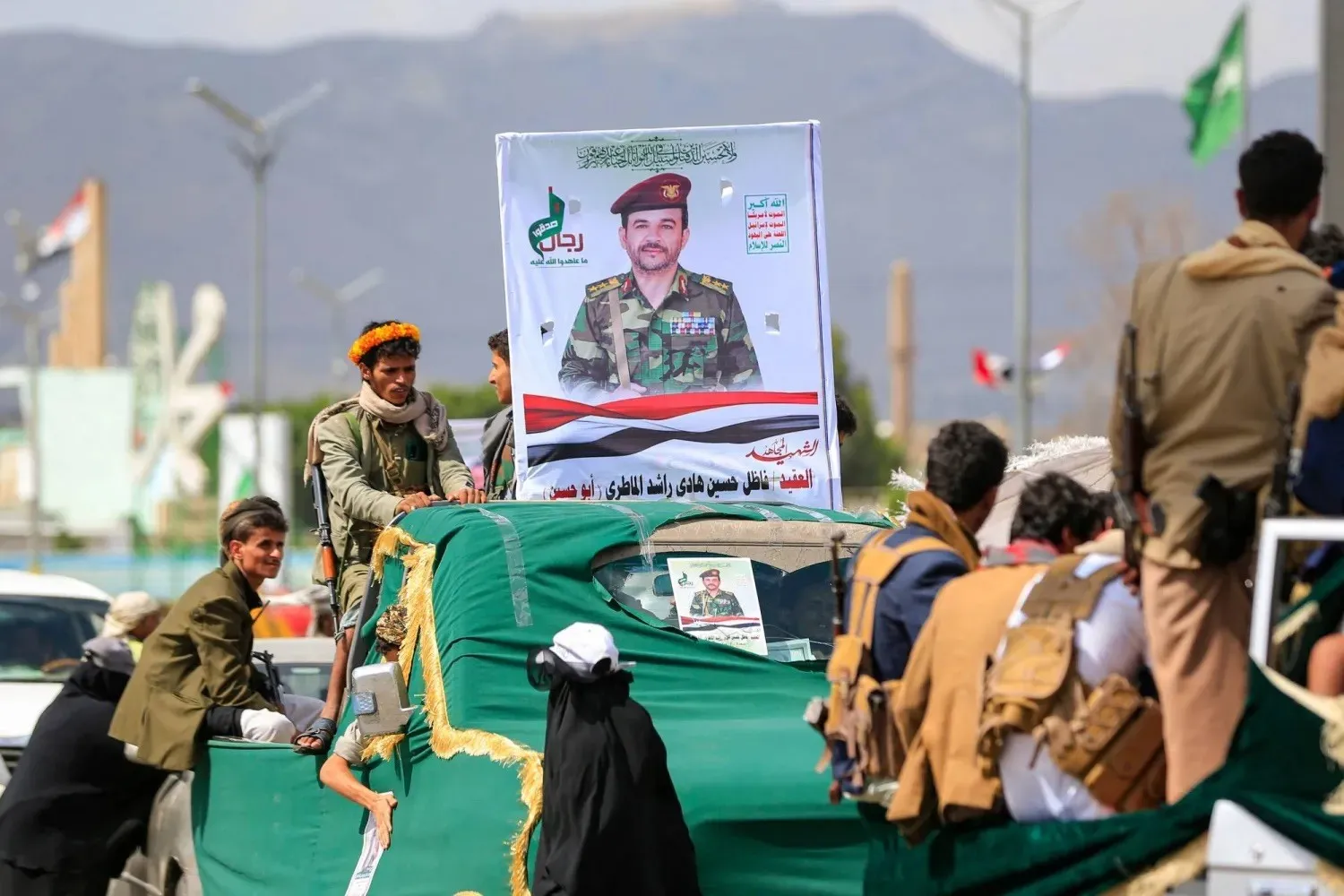
The Houthis suffer heavy losses during attacks on Yemeni government forces (AFP)
TT

Yemen: Taiz Fronts Drain Houthis, Target Reinforcements

The Houthis suffer heavy losses during attacks on Yemeni government forces (AFP)

Yemeni government forces have intensified air and artillery strikes against the Houthis in Taiz governorate as fighting continues along the province’s western, southern and eastern fronts, with no major change in territorial control reported in recent hours, according to military sources and government media.

Government warplanes on Sunday targeted Houthi positions, gatherings and reinforcements across Taiz. Forces involved in the fighting said they had thwarted Houthi infiltration attempts on several fronts, while strikes extended to other positions in Lahj near Bab al-Mandab.

Military and local sources reported that airstrikes hit Houthi positions and gatherings east of Taiz city after the group brought in personnel and military reinforcements. The raids also targeted a Houthi camp and vehicles at Mawiyah Junction, positions on the Al-Akboush front to the southeast, and a reinforcement convoy on 60th Street north of Taiz.

Government forces had earlier announced strikes on a supply convoy on 60th Street, reinforcements in the Hanna area of Al-Wazi’iyah district west of the governorate, and positions and weapons, ammunition and missile depots at the Mawiyah and Al-Dhikra junctions to the east. A Houthi gathering in Al-Suwayda in Hayfan district to the south was also targeted.

Military sources said the raids destroyed vehicles and killed and wounded Houthi fighters, including field commanders, but provided no independently verifiable figures for the losses.

Government forces also used drones to target Houthi positions, vehicles and gatherings on several fronts, indicating an intensified use of airstrikes to counter the group’s military movements and reinforcements.

Infiltration Attempts

On the ground, the Taiz Military Axis command reported that government forces thwarted a Houthi infiltration attempt on the Al-Ahtoub front in Jabal Habashi district west of Taiz and targeted Houthi fighters as they tried to approach government positions in the Hazran area.

Government forces also struck a Houthi vehicle with a mortar round on the Al-Kaddahah front and targeted gatherings on the Al-Aqroudh front southeast of the city.

The developments came as the Taiz, Lahj and Bab al-Mandab fronts remained on high alert, with attacks and counterattacks continuing around high ground and forward positions, particularly along the Jabal Numan, Kahbub, Al-Alaqma and Rasin axes.

Available battlefield information showed no signs of a new Houthi advance. Fighting remained concentrated in forward areas and on the high ground surrounding Jabal Numan, while the Houthis continued attempts to retake parts of positions they had lost along that axis.

At Kahbub, on the road leading to Bab al-Mandab, the Southern Giants Brigades said they targeted Houthi gatherings and vehicles and destroyed an armored vehicle, killing those aboard. Fighting continued on the Al-Wazi’iyah and Al-Mudaraba fronts.

Fighting Expands

The pattern of strikes over the past two days shows the fighting extending from front lines to supply positions, gathering points, camps and weapons depots as Yemeni government forces seek to limit the Houthis’ ability to send fresh reinforcements to the Taiz and Lahj fronts.

Targets have included Mawiyah and Al-Dhikra junctions east of Taiz, Al-Hawban, 60th Street north of the city, Hayfan to the south and Al-Wazi’iyah to the west, as well as positions in neighboring Ibb governorate.

The fighting is therefore no longer confined to direct clashes over high ground, with Houthi supply lines and military movements repeatedly targeted by airstrikes.

The Houthis, meanwhile, continued attempts to pressure several fronts, particularly the western axes, which are important because of their proximity to the road leading to coastal areas and Bab al-Mandab, where they are seeking to secure their gains.

The intensified military operations come amid indications of rising Houthi casualties. The group acknowledged the death of Majd al-Din Hamid al-Hamzi, whom military sources said was head of operations for the Third Missile Brigade, along with several of his escorts following fighting on the western coast fronts.

Yemeni monitoring data indicated that Houthi media outlets and affiliated platforms announced funerals for 422 members of the group in September, including officers and military commanders.

Sources that compiled the figures said the number did not represent the Houthis’ total losses because the group does not regularly announce all its dead. Some funerals are delayed, while others are buried without media coverage, and bodies remaining in hospitals or combat zones are not included in the tally.

The sources reported that 60 Houthi fighters were buried last Friday alone after being killed on various fronts. Losses were particularly concentrated on the Taiz and Lahj fronts, according to local reports.

The fighting was also accompanied by reports of fighters’ bodies remaining in some combat areas, prompting local appeals for the Red Cross and Red Crescent to retrieve them amid fears of humanitarian and environmental consequences.



Dutch FM Regrets Israel's Decision to Revoke Diplomats' Accreditation

Dutch Minister of Foreign Affairs Tom Berendsen arrives for a Council of Ministers meeting at the Ministry of General Affairs in The Hague, the Netherlands, 18 September 2026.  EPA/KOEN VAN WEEL
Dutch Minister of Foreign Affairs Tom Berendsen arrives for a Council of Ministers meeting at the Ministry of General Affairs in The Hague, the Netherlands, 18 September 2026. EPA/KOEN VAN WEEL
TT

Dutch FM Regrets Israel's Decision to Revoke Diplomats' Accreditation

Dutch Minister of Foreign Affairs Tom Berendsen arrives for a Council of Ministers meeting at the Ministry of General Affairs in The Hague, the Netherlands, 18 September 2026.  EPA/KOEN VAN WEEL
Dutch Minister of Foreign Affairs Tom Berendsen arrives for a Council of Ministers meeting at the Ministry of General Affairs in The Hague, the Netherlands, 18 September 2026. EPA/KOEN VAN WEEL

The Netherlands said Monday it regretted Israel's decision to revoke the diplomatic accreditation of Dutch officials based in the West Bank over the country's sanctions on goods from Israeli settlements.

"I deeply regret this unnecessary decision," Foreign Minister Tom Berendsen said, adding that the decision by The Hague to suspend imports from the occupied territories in the West Bank was "not directed against Israel.”

Israel earlier this month ordered the closure of the British Consulate in East Jerusalem, which is Britain's representative with the Palestinian Authority, after London announced similar sanctions banning the import of goods from settlements.

Israeli Foreign Minister Gideon Saar said on X that Dutch diplomats operating in Ramallah ⁠must return their ⁠Israeli-issued diplomatic documentation within seven days, when their diplomatic privileges and immunities are due to expire.

"Any country that acts in a hostile and unilateral manner against Israel will lose influence and relevance in the region," Saar said.


Strikes Hit Sudan Cities as Army Chief Defiant after US Visa Snub

Army chief Abdel FattahAl-Burhan greets a youth gathering at "Khartoum Stadium" (Sovereignty Council Media)
TT

Strikes Hit Sudan Cities as Army Chief Defiant after US Visa Snub

Army chief Abdel FattahAl-Burhan greets a youth gathering at "Khartoum Stadium" (Sovereignty Council Media)

Two Sudanese cities were targeted by strikes on Sunday, witnesses told AFP, a day after army chief Abdel Fattah al-Burhan vowed to press ahead with the years-long war against a rival paramilitary force despite a US visa snub and mounting pressure for a ceasefire.

Sudan has been at war since April 2023 when a power struggle between Burhan and his former deputy, commander of the Rapid Support Forces (RSF) Mohamed Hamdan Daglo, escalated into a conflict that has killed tens of thousands of people and displaced millions.

Witnesses told AFP on Sunday that a drone strike hit a major fuel depot near the army-held city of Wad Madani in central Sudan, while two explosions rocked Nyala, the capital of South Darfur state and the RSF's main stronghold in the west of the country.

The strike near Wad Madani was the first reported attack on the capital of Al-Jazira state since the military recaptured it from the RSF last year.

"A fire broke out at the depot, and I could see the flames from about three kilometers away," one witness told AFP.

Another said he saw "a drone strike the fuel tanks" at the Umm Alaila fuel depot, which supplies several states in central Sudan.

In Nyala, a witness said early Sunday he "heard a plane in the sky, and a short while later the two explosions occurred".

A second witness told AFP that "this morning we heard two loud explosions" from central Nyala.

Another said smoke "was rising from central Nyala and RSF forces surrounded the area and closed the roads around it".

The strikes come after the US denied a visa for the country's de facto leader to attend the United Nations General Assembly earlier this week.

But Burhan struck a defiant tone on Saturday at a youth event in capital Khartoum.

"Our goal is to eliminate this militia no matter how long it takes," he said, adding Sudan would not submit to "blackmail".

"We do not want a visa from any country. We will stay here and die with you in this country."

A diplomatic source told AFP the US visa snub was linked to US efforts to secure a three-month truce between the army and the RSF.

Khartoum has rejected the proposal, arguing that any truce would allow the paramilitary force to regroup.


Attention Shifts to Lebanon’s Iqlim al-Tuffah amid Israeli Military Moves

Israeli heavy machinery bulldozes houses in al-Mansouri, as seen from Hinniyeh, southern Lebanon, September 19, 2026. (Reuters)
TT

Attention Shifts to Lebanon’s Iqlim al-Tuffah amid Israeli Military Moves

Israeli heavy machinery bulldozes houses in al-Mansouri, as seen from Hinniyeh, southern Lebanon, September 19, 2026. (Reuters)

Military operations have escalated over the past few hours amid Israeli discussions regarding a transition to a "new phase" of occupation in southern Lebanon. Attack helicopters and tanks have been redeployed alongside airstrikes, artillery fire, and heavy weaponry sweeps.

Amid ongoing airstrikes, demolition operations, and movements on the ground, a critical question is being raised in Lebanon: Is the Israeli escalation limited to intensifying military pressure, or is it paving the way for a shift in the nature of operations and occupation in the South?

While the new date for the Lebanese-Israeli negotiations has not yet been set, the head of the Lebanese negotiating delegation, Simon Karam, is expected to visit the Vatican, where he will meet with Secretary of State Cardinal Pietro Parolin and Foreign Minister Paul Richard Gallagher to discuss the negotiation file and the role the Vatican could play in supporting this path, informed sources told Asharq Al-Awsat.

Lebanese President Joseph Aoun was in Rome recently where he discussed the negotiations.

On the ground, Israeli attacks continued in the South on Sunday where an Apache helicopter struck a commercial center on the Shokin-Mayfadoun road in the Nabatieh region, while heavy machine-gun sweeps targeted the towns of Beit Yahoun, Serbine, and Wadi Zibqeen.

An ambulance crew survived an airstrike that targeted a building while personnel were in the area conducting a field inspection following a previous raid, resulting in damage to shops and residential apartments in the targeted building.

An Israeli Merkava tank also targeted the town of Hadatha with four shells, before Israeli forces advanced toward a center in the town and set fire to the location. The Israeli army also demolished a number of houses in the town of al-Mansouri on Sunday.

The Israeli army announced that it attacked Hezbollah targets in southern Lebanon, stating that the strikes came in response to the launch of an explosive-laden drone toward its forces during the past night.

Retired general and military expert Hassan Jouni said the recent Israeli operations could either be part of routine maneuvers or aimed at finalizing operations in the al-Mansouri area.

This comes as the Israeli army announced it is nearing the completion of its phase focused on destroying Hezbollah’s infrastructure in the region.

Consequently, the central question following the conclusion of this phase focuses on what Israel's next move will be, Jouni told Asharq Al-Awsat.

"According to Israeli sources and official positions, discussions are underway regarding a redeployment of the army into positions currently under preparation,” he added.

This would consolidate the Israeli military presence and its defensive positions in the buffer zone and along the borders of the Yellow Line, he said.

However, Israeli operations, particularly Saturday's targeting of the Jabal al-Rihan region and its surroundings, Jabal Safi, and Sejod, are troubling indicators regarding the potential launch of a military offensive in the Iqlim al-Tuffah region, which lies geographically north of Ali al-Taher, added Jouni.

He explained that "Iqlim al-Tuffah is historically considered one of the last areas in southern Lebanon to house Hezbollah logistics bases. This raises the question of whether Israel has decided to continue operations and expand into this area, and whether Saturday’s actions will pave the way for an escalation or if the army was consolidating its defensive positions.”