
Trump Hails the US Military’s Exit from Iraq After Its 12-Year Mission

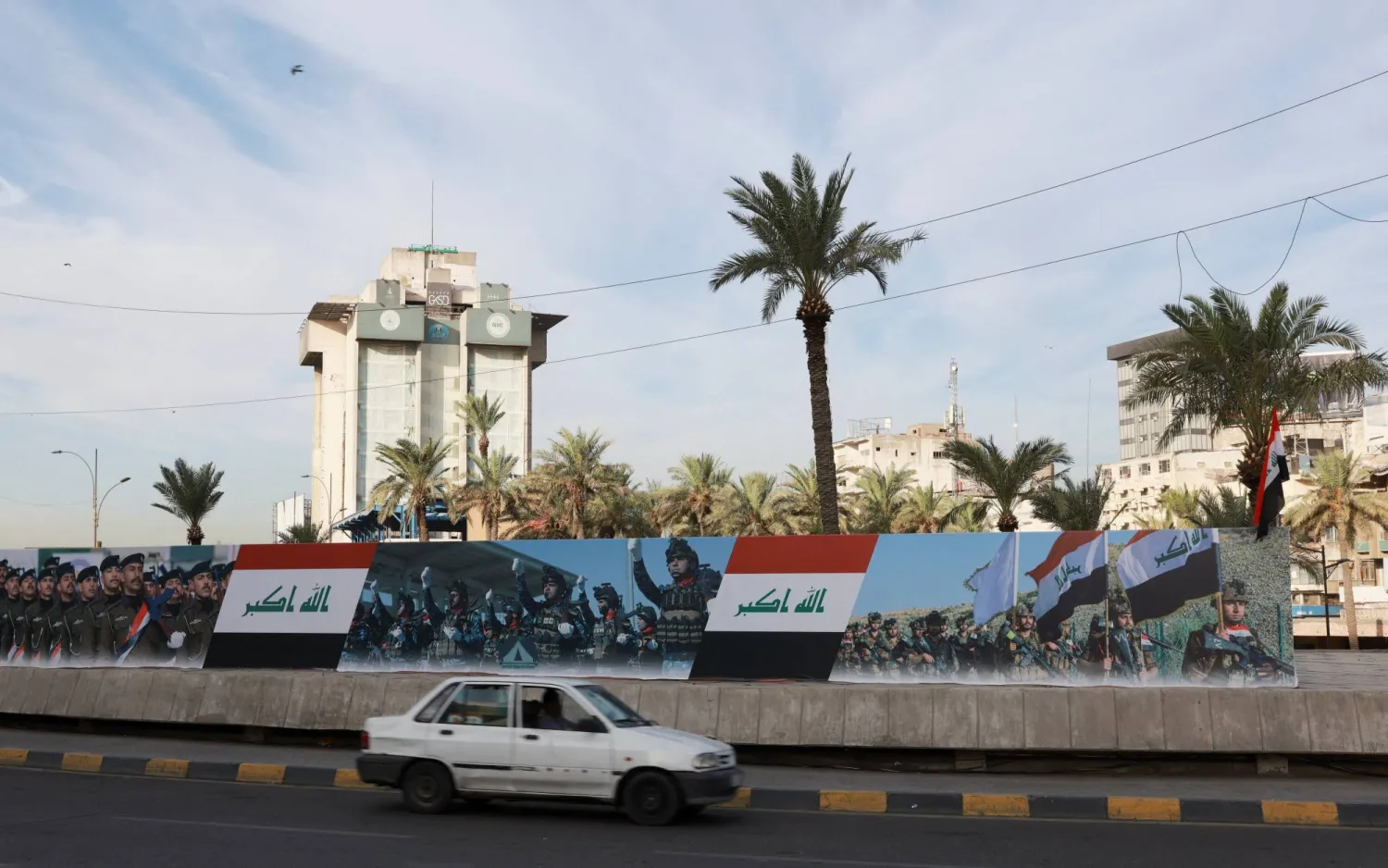
A car moves past a sign depicting Iraqi flags and images of Iraqi security forces on Sovereignty Day, marking the withdrawal of US-led coalition forces from Iraq, thereby ending more than two decades of military presence there, in Baghdad, Iraq, September 30, 2026. REUTERS/Ahmed Saad
TT

Trump Hails the US Military’s Exit from Iraq After Its 12-Year Mission

A car moves past a sign depicting Iraqi flags and images of Iraqi security forces on Sovereignty Day, marking the withdrawal of US-led coalition forces from Iraq, thereby ending more than two decades of military presence there, in Baghdad, Iraq, September 30, 2026. REUTERS/Ahmed Saad

The US military announced Wednesday that it completed the withdrawal of all American troops from Iraq, ending a 12-year mission to fight the ISIS group and prompting President Donald Trump to hail the conclusion of "a very expensive excursion into Hell.” 

The last US troops left an air base in northern Iraq under a deal between Baghdad and Washington. 

Trump, in a social media post, described the withdrawal by a Sept. 30 deadline as “orderly." Appearing soon after at a White House event celebrating Hispanics, he spoke at length about the withdrawal and said, “It’s been a long time with very bad decision making that got us involved in this quagmire in the first place. It was a quagmire. For many, many years it lasted. But soon that part of history will be over.” 

He said the shift was a victory for the US, Iraq and a sign of victory over the ISIS group. 

The withdrawal, agreed on two years ago, comes against the backdrop of the ongoing war between the United States and Iran that has also sometimes spilled over into Iraq, with Iran-backed factions firing on US troops and the US striking the groups' strongholds. 

Trump’s comments came as his own decision earlier this year to launch the war with Iran has been compared to the Iraq war for its undefined mission as it nears its seventh month. 

Appearing at the White House, Trump made that comparison, arguing both that his one-day military action in Venezuela earlier this year to capture now former President Nicolás Maduro and the Iran war compared favorably, taking far less time and with fewer deaths of US troops. 

In recent years, Washington has sought to shift its focus from the Middle East toward Asia, but that shift has been inconsistent, with the Pentagon alternating between reducing its Middle East presence and then finding itself engaging in new conflicts, including the ongoing war in Iran. 

Baghdad touted the end of the US mission as a sign of the country's increasing strength and sovereignty. 

The withdrawal was also celebrated by Iran-backed groups but raised concerns among some other Iraqis, particularly in the Kurdish region, where many fear a resurgence of the ISIS group, as well as more attacks by Iran-linked groups, possibly emboldened by the departure of US forces. 

Meanwhile, questions loom around the future of the Iraqi armed factions, which the Baghdad government has sought to disarm, with little success so far. 

A new phase in Iraq after decades of US involvement  

Pentagon spokesperson Sean Parnell said in a statement that US troops and equipment had completed an “orderly departure” from the air base in Irbil, in northern Iraq's semi-autonomous Kurdish region. 

“This milestone reflects the success of a 12-year campaign that defeated ISIS as an organized military threat in Iraq and across the region,” he said. “It also marks a transition from a wartime coalition mission to an Iraqi-led security effort supported by a more normal bilateral security relationship.” 

He added that the US military “will continue to provide targeted training and intelligence support to our Iraqi partners.” 

Iraqi Prime Minister Ali al-Zaidi presided over the handover ceremony and described the US withdrawal as the beginning of a “new phase, one defined by Iraq’s sovereignty, the strength of its institutions, the readiness of its forces, the unity of its decision-making, and balanced partnerships with its friends.” 

He said Iraqi security forces will continue the fight against ISIS and the government will ensure that non-state groups no longer hold weapons. 

Trump in his remarks on Wednesday lavished praise on al-Zaidi, calling him “outstanding,” a “fantastic guy, friend of mine,” and someone who “will hopefully be able to handle things very well.”  

He also appeared to try to take credit for al-Zaidi's leadership, saying that the Iraqi leader was “running for election” and “wasn’t given even a chance and I endorsed him and politicked for him a little bit, and he ended up winning in a virtual landslide.” 

Al-Zaidi was not on the ballot but was selected as prime minister when Iraq’s dominant parliamentary bloc nominated him after weeks of internal debate among its member parties and Trump publicly announcing his opposition to the coalition's previous choice. 

US troops invaded Iraq in 2003 to topple Saddam Hussein. They departed in 2011, but three years later, Iraqi authorities invited a smaller US-led mission to fight ISIS, which had rampaged across Iraq and Syria, seizing large swaths of territory. 

With the extremist group reduced to scattered sleeper cells, Washington and Baghdad agreed in 2024 to wind the mission down. 

US troops pulled out of bases in most areas of Iraq last year but maintained a small presence of hundreds of troops in the semi-autonomous northern Kurdish region. Bases there have regularly come under attack since the US and Israel launched their war against Iran on Feb. 28. Iran-backed Iraqi factions also have coordinated with Yemen’s Houthi militants to attack Saudi Arabia. 

The future of factions remains unclear  

The Iraqi government initially linked the Sept. 30 deadline for US withdrawal to the disarmament of non-state armed groups by that date. 

While a handful of less-influential factions have agreed to turn over their weapons, powerful groups close to Iran rejected the prospect or set conditions for disarming that the government would be unlikely to meet. 

Al-Zaidi has since walked back the deadline. He told The New York Times earlier this month that the deadline for faction disarmament has been pushed to June 2027. 

The effects of the US withdrawal may not be immediately visible, particularly since the US military presence had already been scaled down. But officials in Iraq's Kurdish region have expressed anxiety about the departure and particularly about the removal of US air defense systems. 

The Kurdish regional government's Peshmerga Ministry said the Kurdish region had faced more than 1,000 drone and ballistic-missile attacks during the recent US-Iran conflict. 

“The departure of the United States from the Kurdistan Region under these complex regional circumstances, without the provision of a defense system, is a matter of concern,” the statement said. 

Iran-allied groups in Iraq, meanwhile, have celebrated the US withdrawal. 

“The expulsion of the occupation forces, defeated, from the land of Iraq is the beginning of full sovereignty,” Abu Mujahid al-Assaf, a security official with the powerful Kataib Hezbollah, said in a statement. 

He added a warning to al-Zaidi and his government not to carry out American plans, threatening that “any government that does not work for the benefit of the people will be overthrown by all means.” 

Kataib Hezbollah leader Ahmad al-Hamidawi took a somewhat more conciliatory tone, calling on the group's fighters to halt their military activities “with the exception of targeting hostile aircraft violating the country’s airspace.” 

The Islamic Resistance in Iraq, an umbrella group of Iran-backed armed factions, said in a statement that negotiations with the government over the regulation of weapons have not resulted in an agreement and that it was “not bound by any timeline or agreement” announced by the government or political entity. The group said it is open to “any dialogue that guarantees Iraq’s sovereignty and dignity.” 


Bashir Moved to Khartoum Hospital amid Reports He Will Be Flown Abroad

Sudan's ex-president Omar al-Bashir leaves the office of the anti-corruption prosecutor in Khartoum, Sudan, June 16, 2019. (Reuters)
TT

Bashir Moved to Khartoum Hospital amid Reports He Will Be Flown Abroad

Sudan's ex-president Omar al-Bashir leaves the office of the anti-corruption prosecutor in Khartoum, Sudan, June 16, 2019. (Reuters)

Sudanese former President Omar al-Bashir, 80, has been transferred from the northern city of Merowe to a hospital in the capital Khartoum for continued treatment and tests after he developed symptoms of an “unknown” medical case.

His lawyer, Mohamed El-Hassan El-Amin told Asharq Al-Awsat on Wednesday that his client was transferred to Khartoum two weeks ago for routine medical examinations, confirming that "there is no change in his health status."

However, he noted the emergence of certain symptoms of "unknown cause," which may require travel abroad to undergo testing using advanced medical equipment.

El-Amin declined to provide further details about Bashir’s condition.

However, he noted that the former president suffers from recurrent low blood pressure and infections, adding: "This is all we can disclose at this stage."

On reports about the Sudanese authorities approving Bashir's travel abroad, El-Amin stated: "There is no official decision so far."

However, he revealed that certain government officials expressed no objection.

"This request was raised more than a year ago, but no progress has been made in its implementation," he added.

Bashir's lawyer Mohamed El-Hassan El-Amin. (Asharq Al-Awsat)

El-Amin confirmed that the same official authorities facilitated the travel of the former Vice President, Bakri Hassan Saleh, to the Turkish capital, Ankara, for medical treatment, revealing for the first time his presence outside the country.

The International Criminal Court has accused Bashir of committing war crimes and crimes against humanity in the Darfur region during his rule. He was also convicted on charges of corruption and illicit financing and faced other trials before the outbreak of the war in April 2023. At that time, he was held at a military base in Omdurman, prior to his transfer to Merowe in northern Sudan.

Sudanese media reports had said that the former president's health had deteriorated significantly over the past few days, necessitating his transfer to Khartoum.

However, high-level sources refuted to Asharq Al-Awsat claims regarding the deterioration of his health, saying that recent measures aim to pave the way for his travel abroad in anticipation of domestic political shifts or regional developments.

The sources said Islamists are seeking to preempt potential rapid shifts in the political landscape that could place the authorities, led by the President of the Sovereignty Council, Abdel Fattah al-Burhan, in extreme embarrassment before the International Criminal Court if Bashir remains in the country.

According to the sources, who preferred to remain anonymous, prominent Islamist leaders in the ousted National Congress Party had previously made contacts to arrange Bashir's transfer abroad, after obtaining approval to host him.

The sources added that the ousted president had previously been offered a transfer to Eritrea but refused, despite Eritrean President Isaias Afwerki having expressed his willingness to host him.


Hezbollah Denies Any Link to Cell Dismantled in Syria

A man waves Hezbollah flag at the Tahrir Square in Baghdad on September 26, 2026, to mark the second anniversary of killing of Hezbollah's former chief Hassan Nasrallah, in a major strike by Israel on Beirut's southern suburbs in Lebanon. (AFP)
TT

Hezbollah Denies Any Link to Cell Dismantled in Syria

A man waves Hezbollah flag at the Tahrir Square in Baghdad on September 26, 2026, to mark the second anniversary of killing of Hezbollah's former chief Hassan Nasrallah, in a major strike by Israel on Beirut's southern suburbs in Lebanon. (AFP)

Hezbollah denied on Wednesday any connection to a cell that Syrian authorities said they had dismantled in the country's south and which they accused of being affiliated with the Lebanese group.

A statement from the Iran-backed movement's media office said it "categorically denies any relationship or connection between Hezbollah and the alleged cell" and emphasized that "it has no presence whatsoever on Syrian territory and has no involvement in any security or military activity there".

On Tuesday, Syria said intelligence services and security forces "thwarted a sabotage plot in the Yarmuk basin in Daraa (province) and arrested a Hezbollah-affiliated cell composed of three individuals".

Authorities said the cell attempted "to prepare rocket launch platforms with the aim of carrying out attacks to destabilize security and stability", without specifying the target.

The Yarmuk basin area, where state media has previously reported Israeli incursions and shelling, borders the Israeli-occupied Syrian Golan Heights, as well as Jordan.

Earlier on Tuesday, Israeli Prime Minister Benjamin Netanyahu had said there were "indications" that Israel's enemies could try to attack ahead of elections scheduled for late October.

Syria's new authorities, who ousted longtime ruler Bashar al-Assad in 2024, are hostile to Hezbollah, which is a sworn enemy of Israel and fought on Assad's side during the Syrian civil war.

Authorities have previously said they dismantled several Hezbollah-linked cells preparing attacks in Syria, accusations the group has denied.

In Wednesday's statement, Hezbollah accused Israel of seeking to disrupt ties between Lebanon and Syria.

It called on Syrian authorities "to identify the real beneficiary of escalating tensions between the two countries, namely the Israeli enemy".

Last month, Hezbollah's chief Naim Qassem said he had no objection to meeting openly with Syria's leadership.

In June, responding to a question about whether he would sit at the table with Hezbollah, Syrian President Ahmad al-Sharaa said that "if this serves Lebanon's interests and safeguards Syria's interests, why not".


US Removes Syria from Arms Export Ban

A large Syrian flag flutters above Tishreen Park in Damascus on June 4, 2025. (AFP)
TT

US Removes Syria from Arms Export Ban

A large Syrian flag flutters above Tishreen Park in Damascus on June 4, 2025. (AFP)

The Trump administration is removing Syria from a list of countries that are not allowed to purchase or import US weaponry, a step that is part of a monthslong process of easing sanctions on the new government in Damascus and its leaders.

In a notice published Wednesday in the Federal Register, the State Department said it was amending its International Traffic in Arms Regulations, or ITAR, so that Syria no longer was among the nations subject to a policy of denial for licenses and other approvals needed for the sale of US weapons and munitions.

The change effective Thursday means that arms sales requests from Syria will now be considered on a case-by-case basis.

President Donald Trump acted last year to ease economic sanctions on Syria that had been in place for decades during now-ousted President Bashar al-Assad’s rule. In August, Secretary of State Marco Rubio rescinded Syria’s designation as a state sponsor of terrorism, helping paving the way for the latest step in drawing closer to the current government.

The State Department has also announced plans to reopen the US Embassy in Damascus. It has been closed for 14 years.

With Syria’s removal from the ITAR blacklist, only seven countries remain subject to the policy of denial for licenses for US arms exports: Belarus, China, Cuba, Iran, Myanmar, North Korea and Venezuela.

Syria’s interim President Ahmad al-Sharaa overthrew the Assad government nearly two years ago and has embarked on a policy of change that has impressed the Trump administration. His moves have led to hopes of eventual stability in a country that was wracked by civil war and the ISIS insurgency that engulfed northeast and western Iraq for years.

Wednesday’s withdrawal of US forces from Iraq may mean that the Syrian government plays a greater role in preventing an ISIS resurgence.