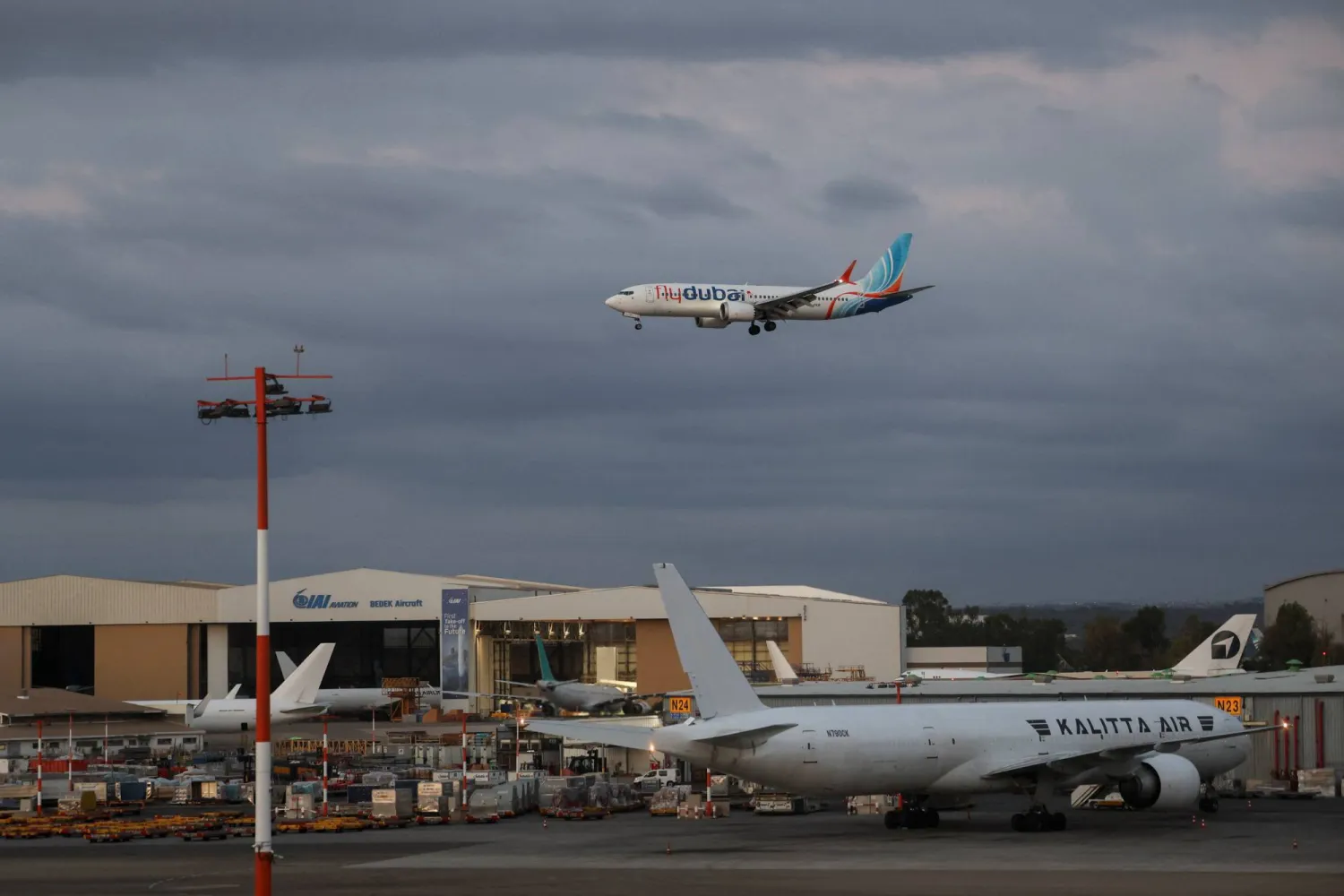
What to Know about the Terrifying FlyDubai Flight Bound for Israel

A plane, carrying passengers who were on the FlyDubai aircraft bound for Israel from the United Arab Emirates, which was diverted to Saudi Arabia following an emergency signal, arrives at the Ben Gurion International Airport, in Lod, near Tel Aviv, Israel, September 30, 2026. REUTERS/Ammar Awad
TT

What to Know about the Terrifying FlyDubai Flight Bound for Israel

A plane, carrying passengers who were on the FlyDubai aircraft bound for Israel from the United Arab Emirates, which was diverted to Saudi Arabia following an emergency signal, arrives at the Ben Gurion International Airport, in Lod, near Tel Aviv, Israel, September 30, 2026. REUTERS/Ammar Awad

One pilot stabbed another and attempted to crash a flight from the United Arab Emirates to Israel.

Passengers, many of them Israelis, feared for their lives as the FlyDubai aircraft lost half its altitude in about a minute.

As Israel scrambled fighter jets out of concern for a possible hijacking, a passenger and crew member burst into the cockpit to subdue the attacker, enabling other crew members to gain control of the aircraft, which landed safely in Saudi Arabia.

It was not clear what motivated Wednesday's attack.

The terrifying flight occurred just days before the anniversary of the Oct. 7, 2023, attack on Israel that launched the war in Gaza. It has rekindled anxieties about airline security and focused attention on an unsettling question: Are pilots a significant threat to the flying public's safety?

Here’s what we know — and don’t know — about what happened on FlyDubai flight FZ1073:

A fight, an alert and a rapid descent

The distress call came at 8:44 a.m. local time, about two and a half hours after the flight with about 170 passengers left Dubai and headed to Tel Aviv.

The captain and first officer had been fighting in the cockpit after one stabbed the other and tried to crash the aircraft, according to Israeli Prime Minister Benjamin Netanyahu.

The aircraft swiftly lost altitude — dropping from 33,000 feet to 17,000 feet (around 10,000 meters to 5,100 meters) in the span of about a minute. It then circled close to the Jordanian border before landing in Tabuk, Saudi Arabia, about an hour later.

Aviation experts said they were surprised that the plane did not crash after a descent so extreme that most of the rudder was ripped off the tail.

Both pilots suffered injuries that required hospital treatment, according to a statement from Tabuk's Prince Sultan bin Abdulaziz International Airport.

A plane carrying passengers from the flight landed Wednesday evening in Israel.

Passengers and crew wrest control

A passenger and a crew member managed to enter the cockpit, enabling other crew members to fly the plane to a safe landing, according to Netanyahu, who cited a passenger he had spoken to.

The cockpit door on all aircraft is locked during flight for security reasons — a measure that became the industry standard after the Sept. 11, 2001 attacks, in which hijackers broke into the cockpits of four domestic flights in the United States.

Netanyahu said on X that the pilot who had been stabbed opened the cockpit door, which "enabled passengers and crew to overpower the attacker — preventing a catastrophic midair disaster.”

What security checks do pilots undergo? One question surrounding this incident is how anyone on the aircraft — especially a pilot — was able to get a knife onboard. It's unclear how big the knife was that was used in the attack or if it was a knife.

In an interview with Fox News Channel’s Sean Hannity that aired Wednesday night, Netanyahu said the attacker might have hit the captain with an axe. Airlines are generally required to carry crash axes in the cockpit for use in an emergency to break open a window to escape or break open a panel to access a fire.

Pilots undergo rigorous screening, including passing through metal detectors, at checkpoints at all airports. It's also standard for airlines to vet their pilots' background for criminal and employment history, their physical and mental health, as well as having them undergo intelligence and security screening.

Israel has some of the most stringent airline security measures worldwide. Passengers on Israel-bound flights regularly are taken aside for questioning and baggage searches after passing through normal airport security.

There have been extremely rare occasions when airline security protocols fail. In 2015, the co-pilot of Germanwings Flight 9525 locked the captain out of the cockpit and deliberately set the plane on a collision course with a mountainside, killing all 150 people aboard.

Cockpit struggles have been blamed in past crashes

On Oct. 31, 1999, EgyptAir Flight 990 went down off the Massachusetts island of Nantucket killing 217 aboard, and investigators at the time said the evidence pointed to it being intentionally crashed into the ocean by its co-pilot after a struggle in the cockpit.

In its final report adopted in 2002, the National Transportation Safety Board said the co-pilot was heard on the cockpit voice recorder saying “I rely on God” as the plane was going down, while the captain repeatedly urged him to “pull up with me.”

The evidence led the NTSB to conclude that the crash was not the result of a mechanical failure but was “the result of pilot inputs, including opposing pilot inputs where the relief first officer was commanding nose-down and the captain was commanding nose-up movement.”


Israeli Political Shake-Up Clouds Lebanon Talks, Eisenkot May Take Tougher Line

US State Department Chief of Staff Daniel Holler speaks as Israeli Ambassador to the US Yechiel Leiter and Lebanese Ambassador to the US Nada Hamadeh, accompanied by US Ambassador to Lebanon Michel Issa, attend a meeting between Israeli and Lebanese delegations hosted by the United States, after the Trump administration said Israel and Lebanon agreed to implement a ceasefire to end hostilities, at the State Department in Washington, DC, US, June 3, 2026. (Reuters)
TT

Israeli Political Shake-Up Clouds Lebanon Talks, Eisenkot May Take Tougher Line

US State Department Chief of Staff Daniel Holler speaks as Israeli Ambassador to the US Yechiel Leiter and Lebanese Ambassador to the US Nada Hamadeh, accompanied by US Ambassador to Lebanon Michel Issa, attend a meeting between Israeli and Lebanese delegations hosted by the United States, after the Trump administration said Israel and Lebanon agreed to implement a ceasefire to end hostilities, at the State Department in Washington, DC, US, June 3, 2026. (Reuters)

Political upheaval in Israel has cast fresh uncertainty over negotiations with Lebanon, raising questions about whether Prime Minister-designate Gadi Eisenkot will change Israel's approach or commit to the security conditions set by Benjamin Netanyahu.

Lebanon is waiting for Israel's next government to take shape before setting a date to resume talks. But political assessments suggest a change in leadership is unlikely to soften Israel's stance and could see Eisenkot take an even tougher line.

The uncertainty highlights a divide between diplomatic calculations over when talks might resume and political assessments of where they are headed.

The last round of negotiations in Tampa, Florida, ended without a date for further talks, while disputes persist over implementing the trilateral framework agreement, Israel's withdrawal from Lebanese territory and Hezbollah's disarmament.

Lebanon awaits Israeli govt

A Lebanese ministerial source told Asharq Al-Awsat that talks with Israel remain on hold pending clarity over the country's next government, despite continued contacts with Washington.

"The Americans were the ones who called for negotiations," the source said, referring to the last meeting in Tampa.

The source said all sides recognized that elections in Israel and the United States could divert attention from the talks or shift political priorities. Lebanon is now watching whether Eisenkot can form a government, with his position on negotiations still unclear.

If Eisenkot fails to form a coalition, Lebanon could find itself negotiating again with Netanyahu, whose government would remain in a caretaker capacity, adding further political complications.

Asked about contacts with Washington, the source said: "There is always communication, but there has been no answer on this issue."

The uncertainty follows Israeli President Isaac Herzog's decision on Nov. 8 to task Eisenkot, leader of the Yashar party, with forming a government after he secured recommendations from 67 Knesset members, against 46 for Netanyahu.

Despite securing the most endorsements, Eisenkot faces divisions among his backers over the makeup of a governing coalition, particularly the participation of Arab parties and potential arrangements with religious parties.

He has 28 days to form a government, with a possible 14-day extension. Netanyahu and his cabinet retain their powers until a transfer of authority.

Talks will continue

Former Lebanese lawmaker Fares Souaid offered a different assessment, saying Israel's change in leadership would neither alter its strategic course nor halt negotiations with Lebanon.

He said the talks would continue and inevitably lead to new arrangements between the two countries, though not necessarily a peace agreement.

Souaid told Asharq Al-Awsat that the regional "earthquake" had shifted Israel from watching and waiting to seeking "a long-term insurance policy from neighboring countries."

"This will not change from one government to another or from one prime minister to another," he said.

But peace would require a major Arab initiative, he added

Souaid linked the future of Lebanese-Israeli relations to broader regional shifts, saying discussions over a new regional order could pave the way for comprehensive settlements benefiting countries that have paid a heavy price for decades of Arab-Israeli conflict.

"Everyone is talking about a new Middle East," he said.

Souaid said confrontations stretching from the Strait of Hormuz and Bab al-Mandeb to the Ali al-Taher ridge in southern Lebanon were part of a single conflict unlikely to end through separate or phased settlements.

"This is one battle," he said, predicting it would end not in stages but through a broad regional conference in which all sides would find their place in the new regional order.

Souaid also dismissed the prospect of a fundamental shift in Israel's negotiating approach under Eisenkot, saying his military background could make him at least as uncompromising as Netanyahu.

"He is no less hard-line than Netanyahu," Souaid said.

Eisenkot could adopt an even tougher negotiating stance, driven by security and military considerations, as well as domestic political pressures, he added.


Houthis Threaten to Shut Sanaa Schools to Enforce Military Mobilization

The Houthis are accused of is seeking to recruit more fighters from among students. (Local media)
TT

Houthis Threaten to Shut Sanaa Schools to Enforce Military Mobilization

The Houthis are accused of is seeking to recruit more fighters from among students. (Local media)

The Houthis are threatening dozens of private schools in Yemen's capital, Sanaa, with fines and closure for refusing to pull students and teachers out of classrooms for rallies promoting the militia's military escalation in Taiz and other battlefronts and glorifying its leader, Abdul-Malik al-Houthi.

School sources told Asharq Al-Awsat that the Houthis had ordered private schools in Sanaa and its outskirts to hold at least three student marches and rallies a week, both on school grounds and in nearby streets, cutting into classroom hours and turning schools into platforms for political propaganda and military mobilization.

Since seizing control of Sanaa, the Houthis have revised school curricula and introduced sectarian and mobilization activities, drawing warnings from human rights groups and the United Nations over the ideological indoctrination and military recruitment of children.

School administrators in the Safiya, Sabeen, Azal, Wehda and Tahrir districts have resisted the orders under pressure from parents threatening to withdraw their children over disrupted lessons and activities unrelated to education.

The education ministry in the Houthis' unrecognized government responded by threatening a range of penalties.

The threats come as the militia steps up mobilization activities in public schools under its control, coinciding with a military escalation in several provinces in recent weeks and amid accusations that it is seeking to recruit more fighters from among students.

The Houthis have turned annual school license renewals into a pressure tactic to force administrators to comply, sparking widespread anger among educators and communities who see the measures as a blatant violation of children's right to education and a direct threat to their future.

Education professionals told Asharq Al-Awsat they were increasingly alarmed by mobilization events imposed on schools, with students forced to participate daily.

One parent in Sanaa, speaking on condition of anonymity, expressed concern after the school administration told families their children were required to attend mobilization rallies.

"We can barely afford tuition and transportation, and now they want to turn our children into tools for their activities," the parent said. "We fear this could eventually go beyond marches and lead to our children being sent to the frontlines."

A teacher in the Azal district said the rallies were eating into school schedules and taking time away from core subjects.

Teachers who refuse to mobilize students or make them chant Houthi slogans face threats of disciplinary action and penalties, the teacher said.

Private schools in Sanaa have seen enrollment rise during years of war as families fled deteriorating public education and teacher strikes. But those schools now face Houthi financial levies and ideological scrutiny.

A private school principal in Tahrir, central Sanaa, condemned the use of license renewals to pressure administrators into implementing mobilization programs.

Schools are caught between Houthi threats of closure and parents threatening to withdraw their children over disrupted lessons, putting the education of hundreds of students at risk, he said.

The mounting pressure threatens to deepen an unprecedented collapse in education across Houthi-controlled areas, where tens of thousands of teachers have gone unpaid for years and face worsening living conditions.

The Houthis have refused to pay salaries to about 170,000 teachers and education employees in areas under their control since 2016, despite collecting billions of Yemeni rials in taxes and annual fees imposed on educational institutions.


Bilal Erdogan: Developments in Syria Will Restore Shared Ties Between Beirut, Tripoli and Turkish Cities

Bilal Erdogan, the son of Turkish President Recep Tayyip Erdogan, center, waves to his Lebanese supporters outside a mosque after Friday prayers in Tripoli, northern Lebanon, Friday, Nov. 13, 2026. (AP)
TT

Bilal Erdogan: Developments in Syria Will Restore Shared Ties Between Beirut, Tripoli and Turkish Cities

Bilal Erdogan, the son of Turkish President Recep Tayyip Erdogan, center, waves to his Lebanese supporters outside a mosque after Friday prayers in Tripoli, northern Lebanon, Friday, Nov. 13, 2026. (AP)

Bilal Erdogan, son of Turkish President Recep Tayyip Erdogan, called on Friday for greater regional unity to confront attacks on Gaza, the West Bank, southern Lebanon and Syria, voicing hope that recent developments in Syria would revive historic trade and economic ties between Lebanese, Syrian and Turkish cities.

Erdogan, President of the Board of Trustees of the Knowledge Dissemination Foundation, made the remarks in the northern city of Tripoli on the second day of his visit to Lebanon, where he was welcomed by political and religious figures and locals.

Speaking after prayers at the Grand Mansouri Mosque, his first stop in the city, Bilal Erdogan said he had brought a message from his father to the Lebanese people, aimed at strengthening relations and bonds of brotherhood between the two countries.

He also voiced hope for an end to war and conflict in Lebanon, paving the way for stability, recovery and prosperity similar to the development Türkiye had experienced over the past 24 years.

"God willing, this visit will help end the war in Lebanon and bring prosperity and recovery, as happened in Türkiye over the past 24 years," Bilal Erdogan said.

Turning to Syria, said recent developments could help restore the historic ties and shared economic interests linking cities across Lebanon, Syria and Türkiye.

"God willing, with the recent developments in Syria, the bonds of shared destiny between Beirut, Tripoli, Antakya, Damascus, Gaziantep and Istanbul will be restored, as they were in the past," he said.

"The people of these cities will once again engage in trade, cooperation, partnership and brotherhood."

He stressed the need to revive cooperation between Tripoli and cities in Syria and Türkiye, strengthening economic and social ties and reconnecting communities across the region.

Addressing Israeli attacks, Bilal Erdogan said regional unity and solidarity could deter further assaults and prevent wars from continuing.

He cited what he described as genocide in Gaza, violations against villages and homes in the West Bank, destruction in southern Lebanon and attacks in Syria.

“Those demolishing homes and seizing land in Gaza, the West Bank, Syria and southern Lebanon would not dare continue if the region's peoples stood united,” he said.

Bilal Erdogan toured Tripoli's old markets, the Mevlevi lodge, citadel and several Ottoman-era mosques.

He is due to visit Kouachra in the northern Akkar region on Saturday to meet residents of Turkmen descent before traveling to Beirut for talks with Prime Minister Nawaf Salam, who will host a luncheon in his honor to conclude the visit.

He kicked off his Lebanon visit on Thursday with meetings with President Joseph Aoun, Parliament Speaker Nabih Berri, former Progressive Socialist Party leader Walid Jumblatt, Lebanon's Grand Mufti Sheikh Abdel Latif Derian and Greek Orthodox Metropolitan of Beirut Elias Audeh.