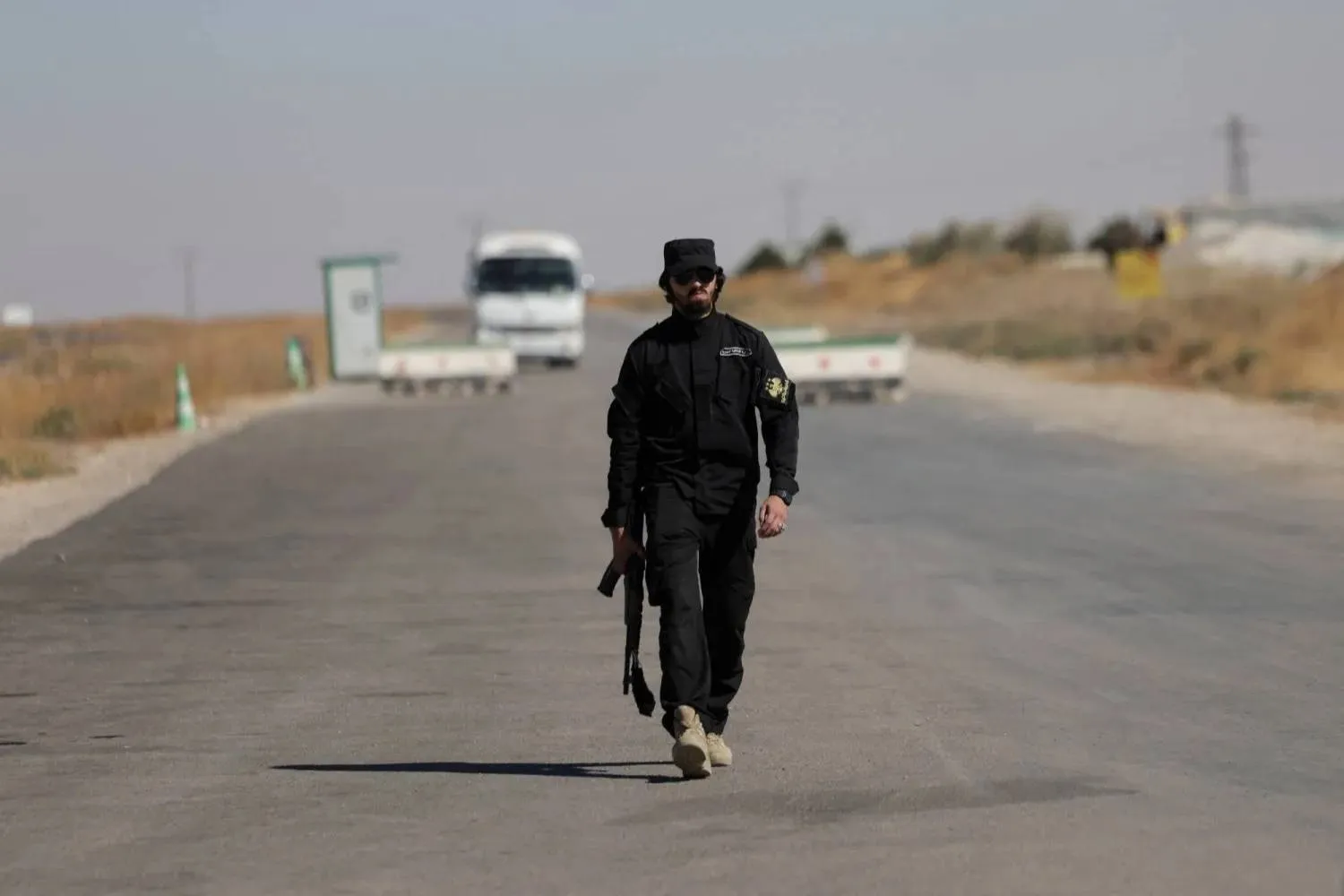

A series of security incidents across Syria in recent days raised concerns over attempts to undermine the authorities and spread instability as Damascus struggles to restore security and revive its economy.
The latest incident involved an attack on a bus carrying electricity company employees on the Masyaf Bridge in Homs, leaving several people dead and wounded.
It coincided with an explosion on a gas pipeline supplying the Tishreen thermal power plant in the Damascus countryside, knocking three power generation stations out of service and affecting drinking water networks.
Two days earlier, an explosion struck a gas pipeline in eastern Syria, while an assassination attempt targeted a Defense Ministry officer in al-Sanamayn, in Daraa province.
Unlike previous incidents, which occurred at relatively long intervals, the latest episodes unfolded within days of one another.
Their timing is particularly sensitive as Syrian authorities face mounting economic pressure while seeking to restore stability, attract reconstruction investment and transform the country into a strategic energy corridor linking Arab states to Türkiye and Europe, amid disruptions to shipping through the Strait of Hormuz caused by the US-Iran confrontation.
A Syrian security source declined to comment on the situation. Asharq Al-Awsat spoke to two security and military experts about who might benefit from weakening the authorities and spreading chaos.
Who Stands to Benefit?
Syrian strategic security and military expert Ismat al-Absi described the incidents as a deliberate pattern of sabotage rather than isolated events.
Their occurrence within a single week was neither coincidental nor random, he told Asharq Al-Awsat, describing them as a systematic campaign targeting vital infrastructure and portraying the state as incapable of protecting citizens’ most basic rights.
He suggested the primary objective was psychological: convincing Syrians that nowhere in the country was safe and that the new authorities had yet to establish effective control beyond major urban centers.
Al-Absi identified ISIS sleeper cells as potential beneficiaries, arguing that exposing government security failures could help the group rebuild its clandestine network and recruit new members.
Remnants of the former regime and their financial and military networks also had an interest in perpetuating instability, he argued, citing their knowledge of vital installations, familiarity with former security procedures and financial resources accumulated through years of corruption.
He said such networks could establish small armed cells, sabotage infrastructure and assassinate officers involved in the political transition or pursuing Assad-linked networks.
Al-Absi also identified Israel as having an interest in keeping Syria militarily weak and divided, while Iran, despite losing its former influence, retained influential networks, particularly along the Syrian coast.
Arms and drug traffickers were another potential beneficiary, he added, as weak security allowed cross-border smuggling routes through Türkiye, Iraq, Jordan and Lebanon to remain profitable.
Rather than a single perpetrator, he described an intersection of interests that stood to gain directly from instability.
Five Simultaneous Priorities
Al-Absi proposed five parallel measures, stressing that security solutions could not be separated from political, economic and institutional reforms.
The first was completing the process of bringing all weapons under state control. The second involved building an effective intelligence apparatus free of corruption, addressing what he described as fragmentation and poor coordination among existing agencies.
Third, he called for tackling the economic crisis fueling violence, citing unemployment exceeding 40 percent in some provinces and incomes below the poverty line.
He proposed reviving small and medium-sized businesses in marginalized areas, creating temporary jobs through public works programs and ensuring basic services reached rural communities where economic and cultural deprivation contributed to the spread of radical ideas.
His fourth priority was inclusive national dialogue. According to al-Absi, Syria’s communities viewed the transition through different fears: Druze concerns over central domination, Alawite memories of the March 2025 coastal violence, Sunni demands for safeguards against renewed authoritarian rule and Kurdish aspirations to preserve administrative gains in the northeast.
He advocated an elected constituent assembly representing all communities to draft a new constitution, alongside genuine administrative decentralization and clearly defined provincial financial powers.
Al-Absi believes that the fifth path lies in maintaining transparent communication with the public. Official silence surrounding explosions and assassinations fueled conspiracy theories and fear, he argued.
Citing the Sept. 21 explosion at an ammunition depot in al-Eis, south of Aleppo, he urged authorities to disclose whether poor storage was responsible or explain measures taken if internal security breaches were suspected. He also called for professional state media focused on providing information rather than propaganda.
Syria had a historic opportunity to rebuild, he argued, but needed swift, measurable decisions and tangible results within months rather than years, stressing that legitimacy was earned through actions, not slogans.
Swift, Precise Response Needed
Syrian political and security researcher Diaa Qaddour agreed that the country’s multiple security challenges required urgent action.
“When these challenges converge, the situation becomes more complicated, requiring a more precise and faster response,” he told Asharq Al-Awsat.
Qaddour cautioned that the recent incidents might or might not be connected.
He pointed to Syria’s sensitive circumstances following its removal from sanctions and terrorism lists, alongside threats from ISIS and strained relations with Lebanon’s Hezbollah and Iranian militias in Iraq.
The proliferation of weapons and opposition to the country’s political changes further complicated the domestic security landscape, he added.
Although these factors appeared separate, Qaddour argued that collectively they served one overarching objective: weakening the government and frustrating its efforts to establish security and stability.