

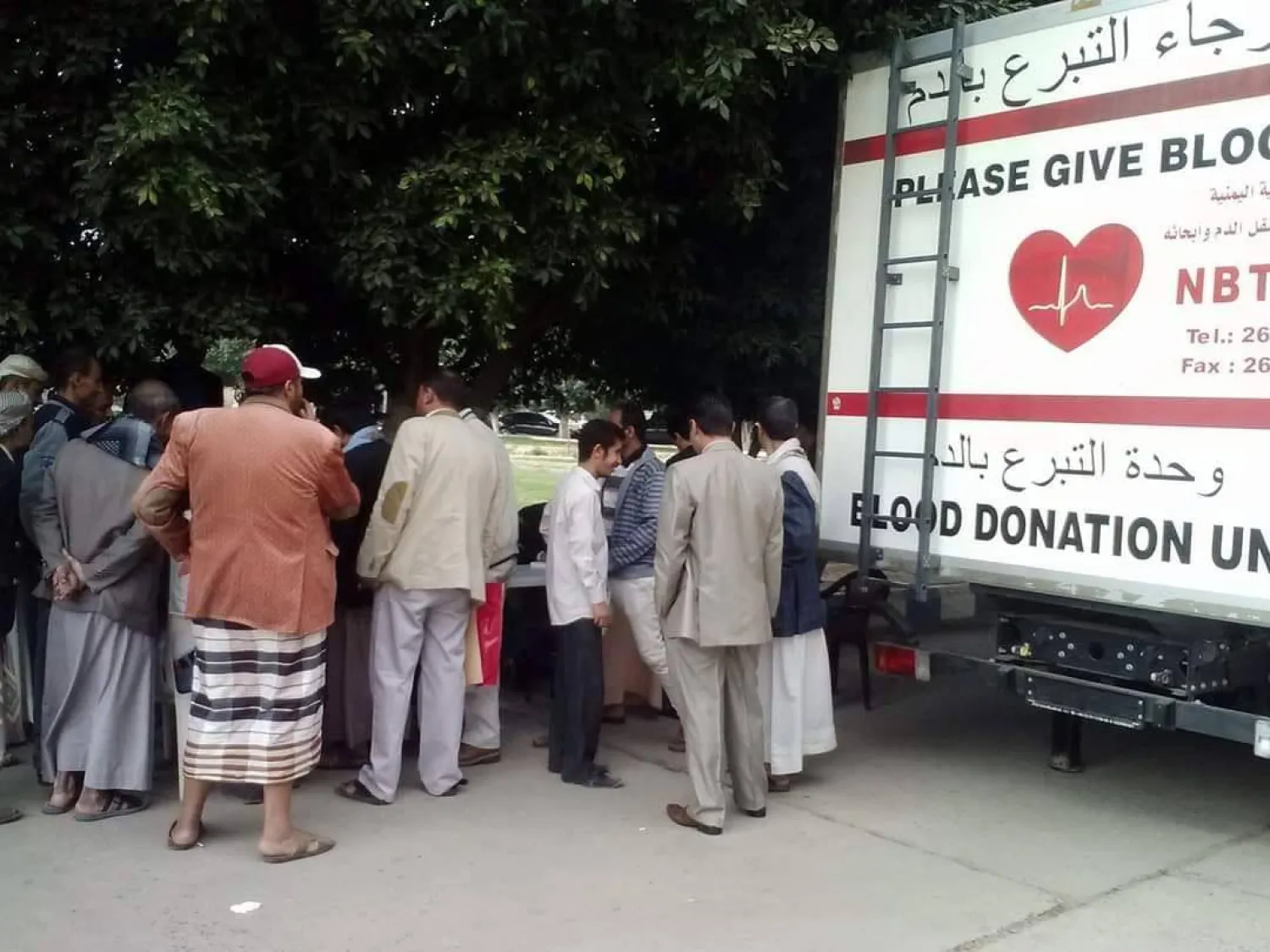

Yemen's Houthis Mobilize Blood Banks as Casualties Mount

Houthis mobilize blood donations for hospitals packed with their wounded fighters (X)
TT

Yemen's Houthis Mobilize Blood Banks as Casualties Mount

Houthis mobilize blood donations for hospitals packed with their wounded fighters (X)

The Houthi group has sent blood donation vehicles into streets, neighborhoods and squares across Sanaa and four Yemeni provinces over the past two days, urgently appealing for donors amid signs of rising numbers of wounded fighters following recent military developments.

Vehicles and trucks belonging to the so-called “National Blood Transfusion and Research Center” were deployed across the seized Yemeni capital and the provinces of Dhamar, Ibb, Al-Mahwit and Hodeidah in an intensive drive to mobilize residents to donate blood.

The vehicles toured densely populated areas, broadcasting appeals through loudspeakers.

Local sources told Asharq Al-Awsat that the group had ordered medical workers, neighborhood officials and community leaders in the targeted provinces to mobilize residents and direct them to donation centers as fighting spread across several fronts.

The sources said Houthi-controlled health facilities were on high alert, with demand rising for various blood types. Hospitals were receiving growing numbers of wounded Houthi fighters, according to local accounts.
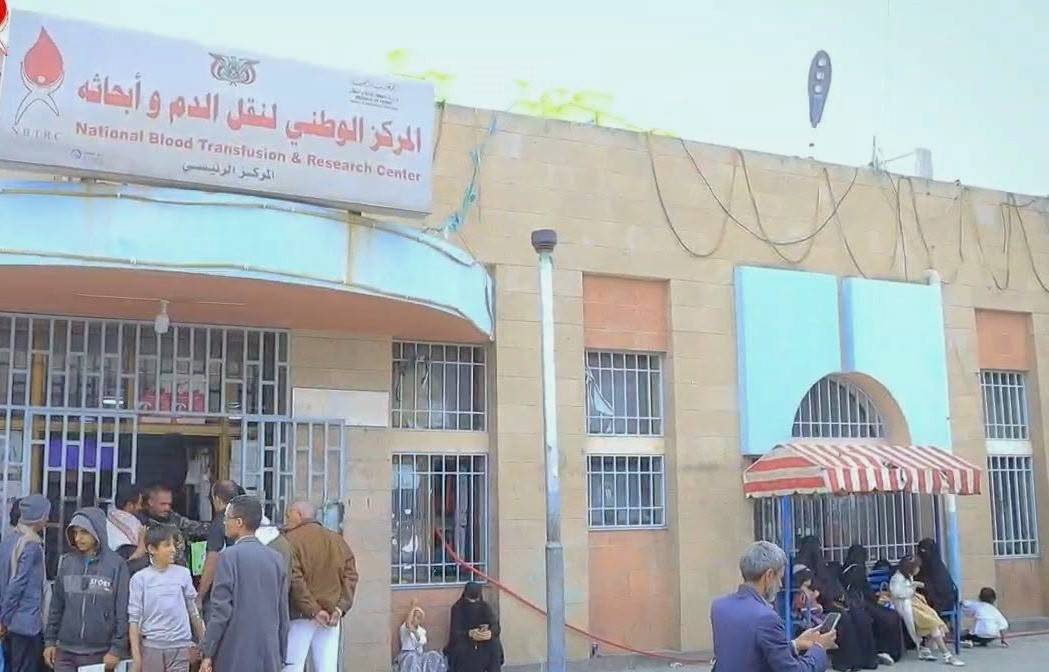
The Houthi-controlled National Blood Transfusion and Research Center in Sanaa (Facebook)

Residents in Sanaa and elsewhere described the heavy deployment of donation vehicles over the past two days as striking, citing repeated loudspeaker appeals urging people to visit donation points.

They linked the campaigns to recent battlefield developments and questioned the scale of injuries behind the group’s decision to expand the drive to more areas.

High alert, mounting losses

“Houthi appeals this time are more urgent than in previous campaigns,” said Qassem, a Sanaa resident.

“No one refuses to donate blood to save a human life, but the question is: Why do they keep sending people to the front lines, then ask residents to provide blood to treat the consequences of those battles?”

In Ibb, 193 kilometers south of Sanaa, resident Majdi said the intensified appeals “do not come out of nowhere.” The group was using various methods to mobilize residents, he said, without disclosing the scale of losses driving the surge in demand for blood.

“People are struggling with poverty, rising prices and deteriorating services, and now they are also being asked to bear the consequences of war and provide blood for the wounded,” he said.

In Dhamar, 100 kilometers south of Sanaa, sources and residents reported that blood donation vehicles from the center’s local branch were operating in several city neighborhoods, alongside urgent appeals for donors.

They said growing numbers of wounded Houthi fighters continued to arrive at hospitals, particularly Dhamar General Hospital, putting further pressure on health facilities.

In Al-Mahwit and Hodeidah in the west, local sources said turnout was initially very low. The group then expanded the campaigns to government institutions and private establishments, urging employees and workers to donate.
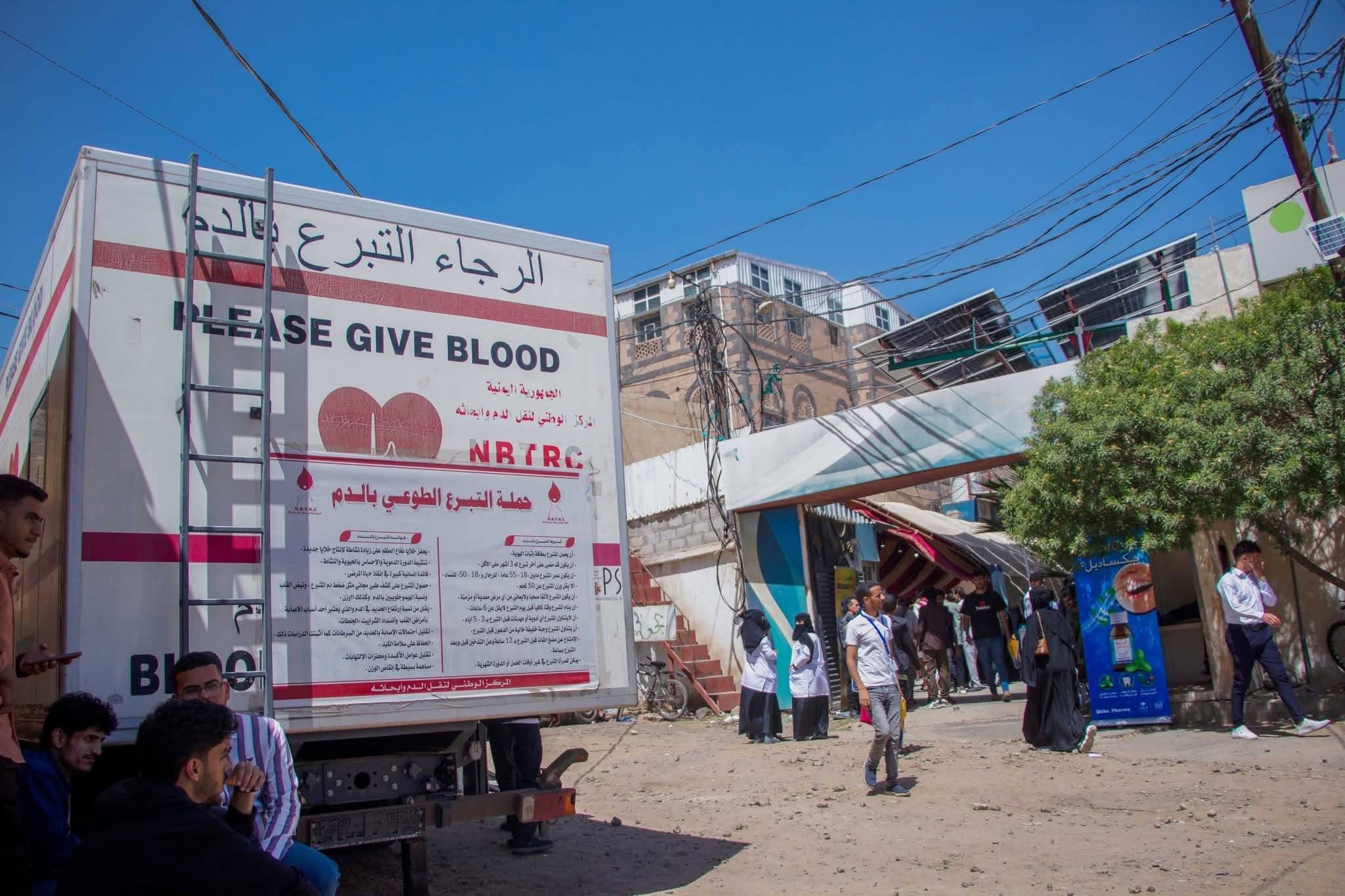
Houthi vehicles used loudspeakers to urge residents to donate blood (Facebook)

The sources described the campaigns as part of a wider state of high alert. Their timing, alongside military developments, reinforced residents’ belief that large numbers of wounded fighters urgently needed blood.

Residents in Houthi-controlled areas, meanwhile, face deteriorating health services and shortages of medicines and medical supplies.

They are calling for treatment services that meet civilians’ needs, rather than further burdens on facilities already stretched by limited resources.



Netanyahu Dismisses Claims That Israel Is Blocking Supplies to Gaza

A Palestinian child sits beside a pool of rainwater at a camp for displaced people in Deir al-Balah in the central Gaza Strip, Saturday, Nov. 7, 2026. (AP)
TT

Netanyahu Dismisses Claims That Israel Is Blocking Supplies to Gaza

A Palestinian child sits beside a pool of rainwater at a camp for displaced people in Deir al-Balah in the central Gaza Strip, Saturday, Nov. 7, 2026. (AP)

Netanyahu said Israel was not to blame for the worsening conditions for Palestinians in Gaza’s tent camps that have been hit with severe winter floods.

His remarks came after the US-created Board of Peace — established under US President Donald Trump's plan to end the Israel-Hamas war and oversee Gaza’s recovery — said Monday that Israel's delaying of the entry of winter supplies into Gaza had “exacerbated the consequences of a foreseeable humanitarian challenge.”

Torrential rain has battered the war-torn enclave in recent days, damaging tens of thousands of makeshift tents. Four people, including three children, were killed on Sunday when a large sandstone slab collapsed onto tents during the rains.

Netanyahu said the Palestinian group Hamas is to blame because it continues to refuse to disarm, a condition of the deal announced by Trump, and seizes humanitarian aid in order to use it for military purposes.

“Hamas alone is responsible for the suffering of the people of Gaza, and it is now cynically exploiting that suffering to shift blame onto Israel once again,” he said Tuesday.

British Foreign Secretary Ed Miliband said the situation in Gaza was “intolerable” and demanded Israel end “arbitrary restrictions” on aid.

In Washington, Sen. Brian Schatz of Hawaii, the top Democrat on the Senate's foreign spending subcommittee, called for Israel to immediately allow winter gear into Gaza.

“There are a lot of challenges when it comes to Israel and Palestine that are complicated, and fraught, and contentious,” Schatz said on the Senate floor on Tuesday. “But we should all be able to agree that repairing torn tents and helping people to dry out, and providing warmth to freezing children is a basic human obligation.”


Representatives of 3 Countries Receive Families of ISIS Fighters from Syria’s Roj Camp

Women and their children at the Roj camp in Syria. (AFP file)
TT

Representatives of 3 Countries Receive Families of ISIS Fighters from Syria’s Roj Camp

Women and their children at the Roj camp in Syria. (AFP file)

Representatives of Sudan, Somalia and Indonesia have received another group of their nationals from the Roj camp in Syria’s northeastern Hasakah province, the country’s last remaining camp housing families of ISIS fighters.

The handover took place three days ago during a visit by the foreign representatives, accompanied by Syrian government officials and members of the Internal Security Forces, according to a local activist.

The repeated visits by government security delegations suggest that Damascus is preparing to take over administration of the facility from the dissolved Kurdish Syrian Democratic Forces (SDF), the activist said.

Ibrahim al-Halabi, a resident of Hasakah, told Asharq Al-Awsat that the delegation met women living at the site who described their circumstances.

Located in the far northeast of Hasakah province, Roj houses around 2,200 women and children in 750 tents. Its residents hold various foreign and Arab nationalities, including Turkish, Russian, British, French, German, Australian, Indonesian, Sudanese, Somali and Tunisian citizenship. It became Syria’s last remaining camp for families of ISIS fighters following the closure of al-Hol, also in the Hasakah countryside.

Several groups of Sudanese, Somali and Indonesian nationals have already been repatriated since 2022.

According to Halabi, the latest handover included 12 Indonesian women and their children, 30 Somali women and between three and nine Sudanese women.

Dual citizenship complicates repatriation

Halabi explained that Sudanese and Somali nationals repatriated in previous operations held only one nationality. Others, however, have dual citizenship, including Sudanese-British and Somali-British nationals, complicating efforts to arrange their return.

Some women have refused to be handed over to Sudanese authorities, demanding instead that they be transferred to the British government. As a result, Sudanese and Somali women holding dual nationality have yet to be repatriated, Halabi noted.

He added that Syrian government Internal Security Forces had entered Roj several times recently, during which residents from Australia, Sudan, Somalia, Indonesia and Trinidad and Tobago were transferred out.

The latest visit brought considerable relief to residents.

Halabi also viewed the visits as a sign that Damascus would assume responsibility for managing the facility. However, he expected security arrangements to remain under the supervision of former SDF personnel integrated into the government’s Internal Security Forces under the January 2026 agreement between Damascus and the Kurdish-led force.

Roj's future

In February, the Syrian government took control of al-Hol, previously the country’s largest detention camp for families of ISIS fighters, after wresting it from the SDF, which had administered both facilities.

Al-Hol, described as the world’s most dangerous camp, had housed tens of thousands of families of various nationalities.

Following its takeover, Damascus began evacuating foreign residents and transferring them to another camp in the northern Aleppo province.

With al-Hol closed, Roj emerged as the most prominent remaining facility housing women and widows of ISIS members from different countries.

However, activists in northern Syria say it remains unclear when the camp will close or where its residents will be transferred afterward.


Iraq Reopens One Border Crossing with Iran, Closes Another as It Pursues Mediation

Iraqi Prime Minister Ali al-Zaidi. (INA)
TT

Iraq Reopens One Border Crossing with Iran, Closes Another as It Pursues Mediation

Iraqi Prime Minister Ali al-Zaidi. (INA)

Iraqi Foreign Minister Fuad Hussein confirmed Tuesday that Prime Minister Ali al-Zaidi’s secret visit to Iran was aimed at bringing Tehran and Washington closer together, as Baghdad reopened one border crossing with Iran and announced the temporary closure of another.

Speaking to the Iraqi News Agency (INA) on the sidelines of the Paris Peace Forum, Hussein described the visit as “an attempt to bring the Iranian and American positions closer together, alongside other efforts.”

He stressed Iraq’s interest in easing tensions, citing the economic impact of the closure of the Strait of Hormuz and casualties from the US war on Iran.

“We have strong relations with our neighbor Iran, as well as excellent relations with the United States,” Hussein said. “That is why Iraq can play this role, although other countries are also doing so.”

Request for time

A senior Iraqi government official told Asharq Al-Awsat that al-Zaidi had conveyed an American message to Tehran outlining a possible formula for resolving the conflict between the two countries.

The Iranian side, however, requested more time to respond, according to the official.

A source familiar with the visit confirmed to Iran’s Fars News Agency that al-Zaidi had traveled to Tehran last Friday for several hours and met Mohammad Bagher Ghalibaf, Iran’s parliament speaker and head of its negotiating delegation.

The agency reported that talks focused exclusively on Baghdad’s efforts to end the war.

Despite repeated official statements presenting the visit as a mediation effort, a source close to Iraq’s Coordination Framework suggested it might instead have been motivated by domestic concerns.

“Al-Zaidi’s recent policies, particularly the ban on Iranian flights and the closure of some border crossings, have caused considerable harm to Iran,” the source told Asharq Al-Awsat.

The visit may therefore have been intended to explain Baghdad’s position on those measures and avoid angering Tehran, it added.

It pointed to the recent public confrontation between al-Zaidi and Kataib Hezbollah, warning that tensions could lead to a direct clash. Given its influence and close ties with some armed factions, Tehran could help ease the dispute.

Regional role

Ihssan Shmary, an academic and head of the Political Thinking Center, believes al-Zaidi’s visit was primarily part of his efforts to establish a regional diplomatic role through an initiative he had previously presented to US President Donald Trump.

Speaking to Asharq Al-Awsat, Shmary said that the trip coincided with extensive Arab and regional efforts to reduce tensions and prevent renewed fighting between Washington and Tehran.

He described the trip as an attempt to break the deadlock between the two countries and secure a foreign policy achievement for Iraq.

Nevertheless, he questioned Baghdad’s ability to bring Washington and Tehran to the negotiating table.

“Iraq may be very far from being able to play the role of a country that brings the US and Iran together at a table of understanding,” he cautioned.

Al-Sheeb reopens, Mandali closes

In a separate development, Omar al-Waeli, head of Iraq’s Border Ports Authority, announced Tuesday the reopening of the al-Sheeb crossing with Iran, which had been closed since October 21.

Authorities also decided to temporarily close the Mandali crossing in the Diyala province beginning Friday.

Al-Waeli explained that al-Sheeb would resume operations following completion of the required technical procedures, while Mandali’s closure would allow similar technical requirements to be addressed.

The decisions followed earlier remarks by Foreign Minister Hussein revealing that the US Treasury Department had formally requested Baghdad to close all its border crossings with Iran except two.

Ban on Iranian flights remains in place

Meanwhile, Iran’s Football Federation announced Tuesday that Iraq had refused permission for a direct flight carrying the Iranian national team to land at Basra airport.

The team was scheduled to participate in a friendly tournament alongside Iraq, Lebanon and Palestine.

Iran’s Mehr News Agency quoted the federation as blaming obstacles imposed by the Iraqi government, particularly its refusal to authorize a direct flight to Basra.

As a result, the players traveled to the Iranian city of Abadan, from where they would continue to Basra by road.

An Iraqi Transport Ministry official told Asharq Al-Awsat that Iranian aircraft were permitted to land only at Najaf airport.

The Iranian side had chosen to fly the team to Abadan because it was closer to the stadium in Basra, the official explained.

He confirmed that Iraq remained committed to its ban on Iranian flights landing at Iraqi airports, with Najaf as the sole exception, to avoid US Treasury sanctions.