139 Migrants, Including Children, Die After Boat Capsizes off Djibouti

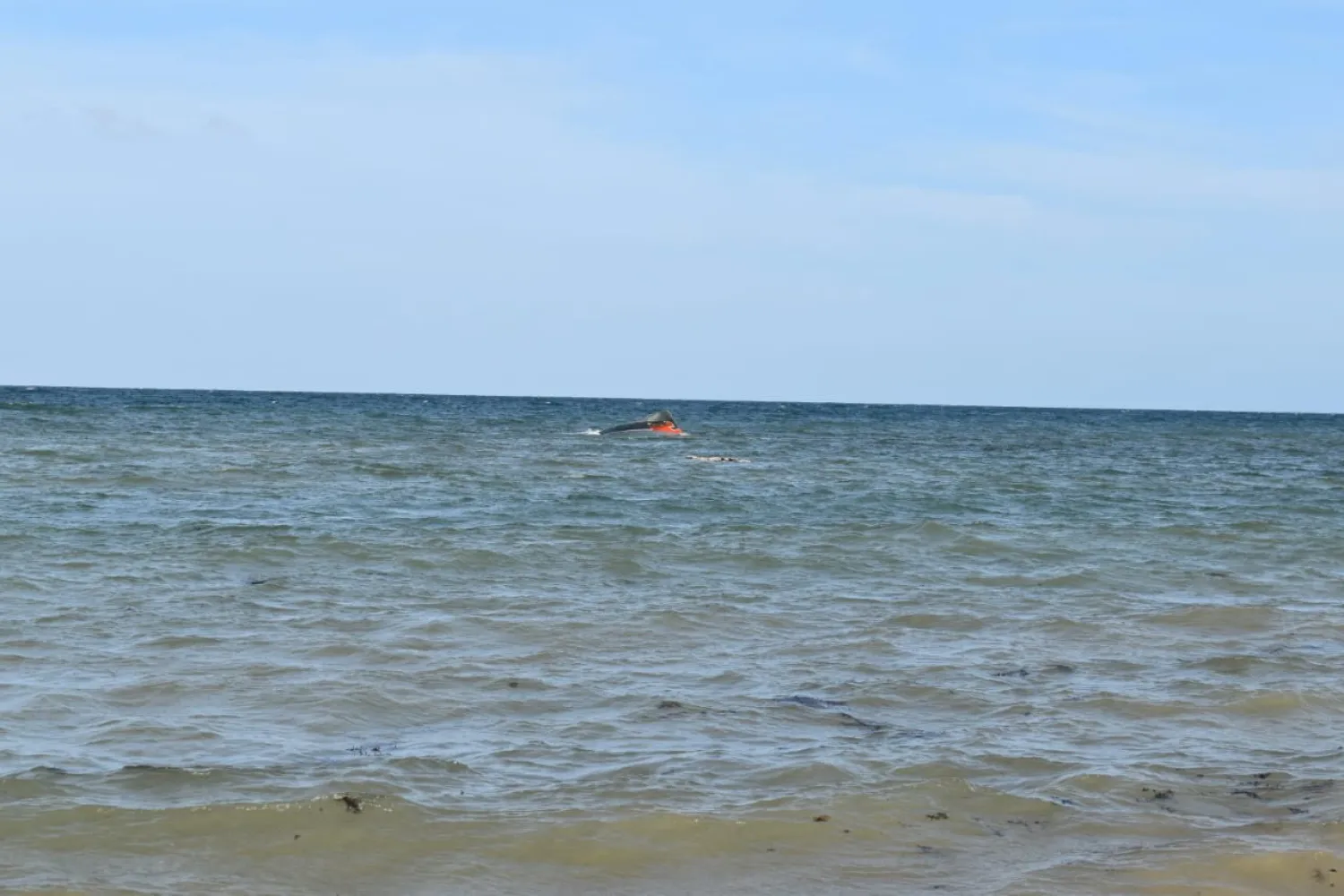
 A portion of the vessel floats after it capsized while carrying about 305 people from Djibouti to Yemen. (Kennedy Omondi Okoth/International Organization for Migration/Handout via Reuters)
A portion of the vessel floats after it capsized while carrying about 305 people from Djibouti to Yemen. (Kennedy Omondi Okoth/International Organization for Migration/Handout via Reuters)
TT

139 Migrants, Including Children, Die After Boat Capsizes off Djibouti

 A portion of the vessel floats after it capsized while carrying about 305 people from Djibouti to Yemen. (Kennedy Omondi Okoth/International Organization for Migration/Handout via Reuters)
A portion of the vessel floats after it capsized while carrying about 305 people from Djibouti to Yemen. (Kennedy Omondi Okoth/International Organization for Migration/Handout via Reuters)

At least 139 people, including children, have died after a boat carrying more than 300 migrants capsized off the coast of Djibouti in east Africa, the International Organization for Migration said Sunday.

That number only includes those buried by authorities in Djibouti. Others have been buried by the migrants themselves, but they won't be added to the official count until authorities can verify the bodies, Alexandre Coissac, IOM Chief of Mission in Djibouti, told the AP via the phone.

“What is terrible is that they were buried with no names, in a common grave, like in a war situation,” Coissac said. “They all have a mother, a father, and we may never learn what happened.”

Coissac said the migrants boarded the ship in the evening of Oct. 8 and that it sank very soon after, close to the shore, “mainly because it was overcrowded.”

“The local authorities did their best,” Coissac said, “but they were overwhelmed with all the bodies that kept coming at once towards the shore.”

He said authorities were bringing the surviving migrants to the IOM rescue center in Obock where they received medical assistance after swallowing sea water, and psychological support.

“They're all in a state of shock,” Coissac, who visited the area of the shipwreck Saturday, said. “I tried to talk to some of them but it's very difficult.”

Some of the migrants in the IOM center are already aware that their family members died during the shipwreck. Others were given access to phones to call loved ones back home to notify them they are alive.

At least 84 people remained missing in one of the deadliest shipwrecks yet on the popular but perilous crossing from the Horn of Africa to the Arabian Peninsula, where many migrants seek work in Gulf nations.

The boat was traveling from Djibouti to Yemen when it capsized on Thursday night or Friday morning, according to the IOM. More than 80 people survived, all of them Ethiopian nationals, it said.

The Geneva-based UN migration agency said the vessel had 305 people on board and warned that the death toll could still rise.

Personal items likely belonging to the migrants, including shoes, were seen on a beach in a video shared by IOM. Rescue work continued as fears grew for the missing.

Tens of thousands of migrants from the Horn of Africa travel every year through Djibouti and across the Bab al-Mandeb Strait towards Gulf countries in search of safety and economic opportunities, the IOM said in its statement.

That movement has continued despite newly escalating fighting in Yemen, on the other side of the strait.

“This is a devastating loss of life,” said Coissac. “This tragedy is a stark reminder of the dangers faced by migrants along this migration corridor as they seek economic opportunities.”

In recent weeks, at least 2,000 Yemenis have received aid in Djibouti as the fighting has escalated in Yemen between the legitimate government and Iranian-backed Houthi militia.

That's the opposite direction from the movement of the migrants who died in the shipwreck and the typical migration patterns of recent years: The tens of thousands who cross from eastern Africa toward Yemen each year have typically been looking for work in the Gulf.

Over 900 migrants died or went missing along the route last year, according to IOM’s Missing Migrants Project.

“No one gets into a boat like that unless they believe there is no other safe way,” IOM Director-General Amy Pope said. “We cannot keep treating these deaths as normal. Safe and legal pathways save lives. I am asking governments and donors to act before the next boat goes down.” 


Syria Destroys 400 Mn Captagon Pills in Major Drug Haul

Syrian authorities burn seized narcotics, including captagon pills, on Sunday, Nov. 22, 2026. (SANA)
TT

Syria Destroys 400 Mn Captagon Pills in Major Drug Haul

Syrian authorities burn seized narcotics, including captagon pills, on Sunday, Nov. 22, 2026. (SANA)

Syrian authorities on Sunday announced the destruction of large quantities of narcotics, including 400 million captagon pills seized by security forces in multiple operations.

"Large quantities of narcotic and psychotropic substances seized during various security operations were destroyed in batches," the drug enforcement department announced in a statement carried by state news agency SANA.

It added that the quantities destroyed included "400 million captagon pills, 12.2 tons of hashish, in addition to 2.3 tons of cannabis plants, six kilograms of heroin, as well as 5.4 million narcotic pills".

"Tools and equipment used in smuggling, concealment, transport, and manufacture, including chemical substances," were also destroyed.

Synthetic stimulant captagon became Syria's largest export after the civil war began in 2011, flooding the region and becoming a key source of illicit funding for now ousted Syrian president Bashar al-Assad.

Syria's new authorities who took power in December 2024 have been working to combat the captagon trade.

Khaled Eid, the head of the drug enforcement department, announced in June that authorities "carried out 1,550 operations to seize and foil" drug smuggling attempts since Assad's fall, according to SANA.

He said authorities dismantled 90 international smuggling networks, shut down 17 captagon manufacturing plants, and seized 697 million captagon pills and 15 tons of hashish during those operations.


Burhan Downplays RSF Advances in Blue Nile, Vows to Fight On

Burhan offers his condolences to the relatives of Khatmiyya leader Mohamed Osman al-Mirghani. (Sudan's Transitional Sovereignty Council)
TT

Burhan Downplays RSF Advances in Blue Nile, Vows to Fight On

Burhan offers his condolences to the relatives of Khatmiyya leader Mohamed Osman al-Mirghani. (Sudan's Transitional Sovereignty Council)

Sudan’s army chief Abdel Fattah al-Burhan downplayed advances by the Rapid Support Forces (RSF) and their allies in the Blue Nile region, urging residents not to fear an attack on the regional capital and vowing to fight until what he called the rebellion is defeated.

His remarks came hours after the RSF-aligned Tasis alliance claimed control of five areas in Geissan, a day after announcing the capture of the Bau locality headquarters.

Speaking in Khartoum on Friday evening while offering condolences over the death of Khatmiyya Sufi leader Mohamed Osman al-Mirghani, Burhan sought to reassure residents of Ad-Damazin, the Blue Nile capital.

“Don’t be afraid,” he said, citing the army’s expulsion of RSF fighters from Khartoum as evidence of its ability to prevail.

“They were sitting in the very house where I am speaking,” he added. “Wherever they enter, they will find themselves in a tunnel, in a trap they cannot escape.”

Burhan said that the war remained a priority, acknowledging that much of the state’s resources were being directed toward military operations.

“The army is defending Sudan, its citizens and their right to exist. We will fight until we win, and we will win,” he declared.

The Tasis alliance, comprising the RSF and its ally, the Sudan People’s Liberation Movement-North (SPLM-N) faction led by Abdelaziz al-Hilu, announced on Friday that its forces had captured several towns in Geissan, nearly 40 kilometers southeast of Ad-Damazin.

The alliance had claimed control of the Bau locality headquarters the previous day, while conflicting accounts emerged from the warring sides over other towns.

Blue Nile’s regional government stressed that the army still held the initiative and was working to restore security in the southern part of the region.

Burhan also praised the Democratic Unionist Party, led by Mirghani, for supporting the army throughout the war through its members and political positions, describing it as a partner alongside other parties and organizations backing the military and Sudanese people.

While acknowledging what he described as hardships in daily living conditions, he attributed much of the economic pressure to an “economic war” waged by countries he accused of instigating the conflict on April 15, 2023.

He also criticized reports about famine and fuel shortages, describing them as attempts to discourage Sudanese citizens and undermine morale.

Famine warnings

Despite Burhan’s dismissal of the reports, international humanitarian organizations have repeatedly warned of worsening food insecurity in parts of Darfur and Kordofan.

The Integrated Food Security Phase Classification (IPC) identified famine conditions in El Fasher and Kadugli and warned of further deterioration driven by fighting, displacement, drought and insufficient humanitarian funding.

According to a World Health Organization alert issued on October 12, IPC analysis covering February through May 2026 found that around 19.5 million people in Sudan faced acute food insecurity at crisis level or worse, including around 135,000 in the catastrophic category.

The World Food Program (WFP) has documented restrictions on the movement of goods, particularly in areas affected by fighting and displacement.

It attributed rising food prices to disrupted supplies and the depreciation of the Sudanese pound.


Israel Uncovers More Gaza Tunnels After Years of Devastating War

Israeli soldiers inside a tunnel in the Gaza Strip (Reuters). 
TT

Israel Uncovers More Gaza Tunnels After Years of Devastating War

Israeli soldiers inside a tunnel in the Gaza Strip (Reuters). 

Years of a devastating war have failed to dismantle Hamas’ vast tunnel network in Gaza, with Israel continuing to uncover underground passages even in areas under its military control.

Recent Israeli announcements have detailed new discoveries on both sides of the Yellow Line, established under the October 10, 2025, ceasefire agreement. The boundary initially left Israel controlling about 50% of Gaza, a share that has since expanded to more than 65%.

The latest operation, described as the first of its kind since the ceasefire, targeted a Hamas tunnel west of the Yellow Line and Salah al-Din Road, near the southern side of the Netzarim Corridor toward central Gaza.

Israeli forces have also reported destroying several tunnels within areas they control, underscoring the complexity of an underground network that has proved more extensive and resilient than anticipated.

Origins of the Tunnel Network

Hamas first used a tunnel in a military operation on September 26, 2001, a year after the outbreak of the Second Intifada.

The group detonated explosives inside a tunnel approximately 150 meters long beneath a military tower at the Termit outpost in Rafah, southern Gaza, killing and wounding several Israeli soldiers.

Israel initially paid limited attention to the tactic, quickly sealing and destroying the tunnel using rudimentary methods rather than the advanced technology employed today.

Hamas subsequently repeated the approach in other operations, including one in 2006 in which Israeli soldier Gilad Shalit was captured.

After taking control of Gaza, Hamas devoted considerable resources to developing tunnels for defensive and offensive operations, as well as smuggling weapons and military equipment.

Commercial tunnels also proliferated along the Rafah border after Israel imposed a sweeping blockade on the territory.

During the 51-day Gaza war in 2014, Hamas surprised Israeli forces with a series of cross-border tunnel operations, allowing its fighters to attack Israeli troops at close range.

The attacks heightened fears among residents of Israeli communities surrounding Gaza and prompted demands for stronger defenses against underground infiltration.

Israel subsequently built a technologically advanced border barrier equipped with aboveground and underground detection and protection systems.

However, during the October 7, 2023, attack, Hamas breached the new barrier using explosives designed to destroy sections of it and aerial means, including paragliders.

Tunnels, meanwhile, remained primarily defensive structures and facilities for command and control, although Hamas field commanders were later forced to abandon some of them after they came under attack.

Israeli Assessments

Israeli Southern Command officers have recently acknowledged that Hamas’ military arsenal, particularly its tunnel network, has not been completely eliminated.

They have also indicated that further measures are needed to address the future of the group’s weapons.

Amichai Mitelman, of the civil engineering department at Ariel University, estimated in a report published recently by Israel’s Maariv newspaper that a substantial portion of Hamas’ tunnels remains intact. He cautioned that no single method could destroy the entire network.

According to Mitelman, estimates of the total length of Gaza’s tunnels before the October 7 attack ranged from 500 to 1,000 kilometers.

Some tunnels were between 30 and 40 meters deep, with branching passages of varying widths, he explained.

Efforts to destroy the network by flooding tunnels with seawater or detonating large quantities of explosives have failed to eliminate it completely.

Filling tunnels with concrete has recently proved more effective, he said, although the method is costly and labor-intensive.

The Qassam Engineers

The underground network has remained a major challenge for Israel throughout the war, which has continued at a limited level despite the ceasefire.

Israel has demanded the complete destruction of Hamas’ tunnels under the ceasefire agreement, subject to monitoring by Israel, the United States and mediating countries.

The fate of Hamas’ other weapons, including rockets, has also become a central issue.

During operations to recover Israeli hostages, particularly the remains of those killed, it emerged that some had been buried in small tunnels and branches that Israeli forces had failed to detect.

Some of these passages remained intact within tunnel systems the military had believed it had destroyed.

Videos released by Hamas’ armed wing, the Izz al-Din al-Qassam Brigades, featuring commanders and fighters killed during the war, have also shed light on the construction of the tunnels and the development of the group’s rocket arsenal.

The footage suggests that much of the work relied on local expertise and manual labor rather than exclusively on weapons smuggled from Iran or elsewhere, as is often assumed.

This has also prompted Israeli demands to dismantle Hamas’ weapons-manufacturing workshops.

The videos indicate that many of those responsible for tunnel construction and rocket development, known within the group as the “Qassam engineers,” did not hold formal engineering qualifications.

While a small number had engineering degrees, most had studied other subjects, and some had no academic qualifications.

Many were construction workers or technicians whose practical skills enabled them to oversee the development of the underground network over many years. They supervised excavation teams largely composed of younger Qassam recruits.

The so-called engineers assessed soil conditions, identified areas of structural strength and weakness, and determined tunnel routes before excavation began.

Hamas sources told Asharq Al-Awsat that tunnel construction and preparation followed what they described as professional engineering practices, using various types of equipment operated by skilled technicians.

The sources credited these workers with playing a central role in developing what Hamas considers a strategic military asset.

They acknowledged that construction had faced serious difficulties over the years, with numerous workers killed during excavation and others suffering paralysis or other injuries following soil collapses and unexpected incidents.

Security challenges also complicated the work, including alleged Israeli attempts to recruit informants from among faction members, tunnel workers and others to identify underground locations.

Other Hamas sources said the group’s rocket industry similarly relied on domestic development. According to these accounts, engineers from Gaza received training and studied relevant subjects at universities and other institutions before returning to train additional personnel, expanding the number of people capable of manufacturing and developing weapons.

The sources maintained that explosives were also manufactured and adapted locally to meet operational requirements, including those used to destroy sections of Israel’s border barrier during the October 7 attack.

They credited the engineers with adapting weapons to changing battlefield conditions.

The same approach, they added, extended to other locally developed weapons, including the Yassin 105 anti-armor projectile, which Hamas used extensively against Israeli forces during the war.