


Tunisian Journalists Fear Jail Again as Freedoms Erode

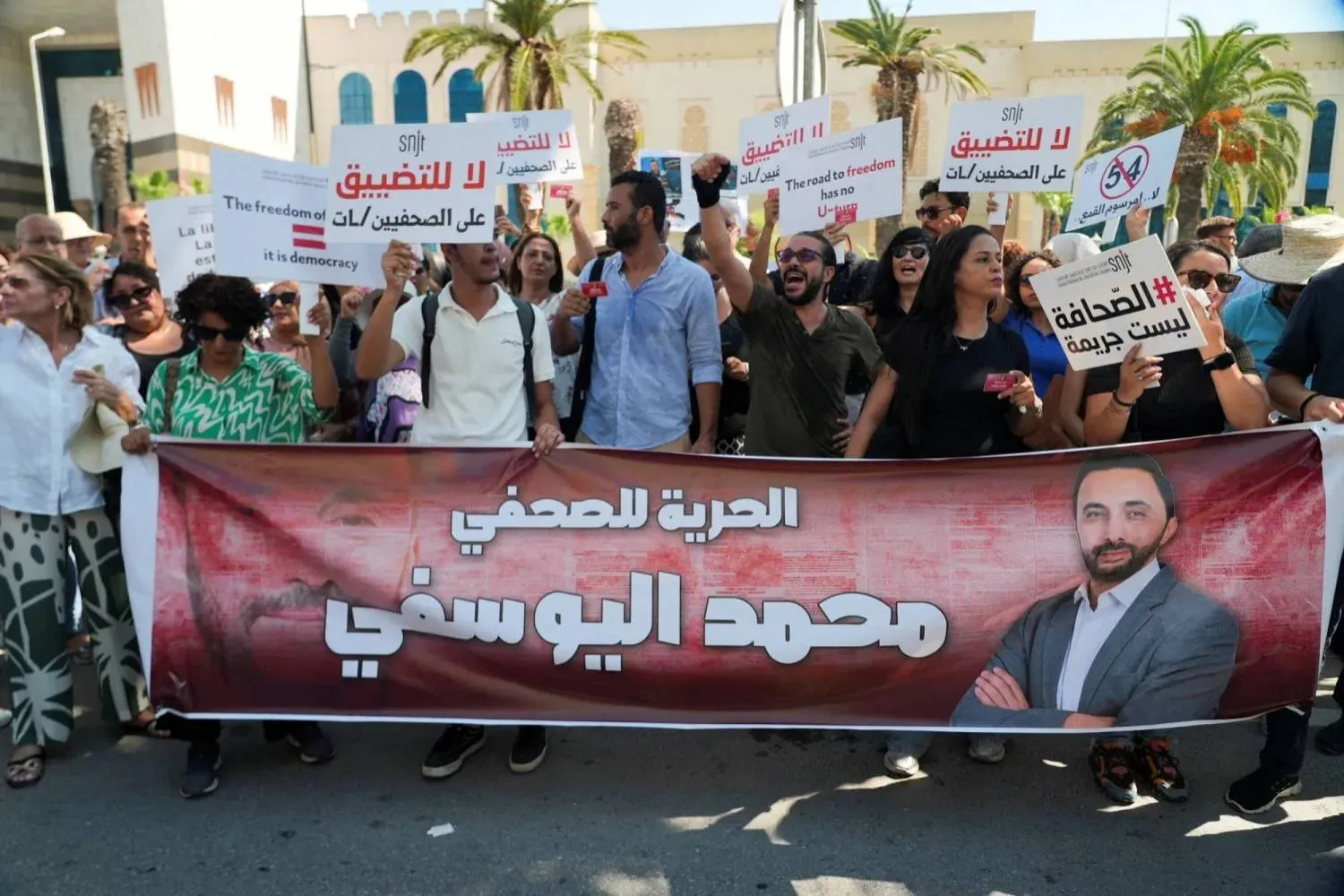
Tunisian journalists participate in a rally called by the Tunisian journalists' union to demand the release of journalist Mohamed Yousfi, a vocal critic of President Kais Saied, in Tunis, Tunisia. September 8, 2026. REUTERS/ Jihed Abidellaoui
TT

Tunisian Journalists Fear Jail Again as Freedoms Erode

Tunisian journalists participate in a rally called by the Tunisian journalists' union to demand the release of journalist Mohamed Yousfi, a vocal critic of President Kais Saied, in Tunis, Tunisia. September 8, 2026. REUTERS/ Jihed Abidellaoui

In the garden of the independent outlet ‘Nawaat,’ about half a dozen journalists sit smoking, trading jokes and discussing investigations they plan to publish on subjects ranging from the quality of drinking water to conditions of prisons.

They know that any of the stories ⁠could lead to prosecution.

A Hard Test

Journalists in Tunisia who enjoyed a burst of press freedom after the 2011 Arab Spring are once again looking over their shoulders in the knowledge their work may land them in prison.

The 2011 overthrow of Zine El-Abidine Ben Ali unshackled Tunisia's media, but a decade later President Kais Saied's seizure of sweeping powers began eroding those gains.

Some 20 journalists face criminal charges over their reporting or social media posts, with four already imprisoned, according to Zied Dabbar, head of the National Syndicate of Tunisian Journalists, who called the situation unprecedented.

In return, Saied has said he is not a dictator and that journalists are free to criticize authorities and frequently do.

Authorities say prosecutions are impartial judicial matters and that no one is above the law.
The Tunisian prime minister's press office did not respond to Reuters’ requests for comment.

Now, independent media face a full-on crackdown, rights groups say, and Tunisia has tumbled more than 50 places in the past five years to 137th in Reporters Without Borders' press freedom index.

Shifting Minefield

“We are living in a grey area, as if we were in a shifting minefield, and we pay the price every day,” said Aymen Rezgui, editor-in-chief of Nawaat, reflecting on how at least limits were clear pre-2011 versus current uncertainty.

Rezgui said Nawaat regularly receives threats — anonymously or from government supporters on social media branding him a traitor — over reporting on issues ranging from prisons to power cuts and water shortages.

The outlet has also faced judicial restrictions, including a government order suspending activities for a month last year.

Journalists in Jail, Others Choose Exile

Many other journalists report similar pressures.

Last month, Mohamed Yousfi, editor-in-chief of independent news website Al-Qatiba, was arrested on his way to a private radio station for a live program. A judge has charged him with illicit enrichment, which he says is a fabrication.

Other jailed journalists and media figures include prominent broadcasters Mourad Zeghidi and Borhen Bsaies, who were first convicted of spreading false news and insulting the president, and later of tax evasion. ⁠They deny the charges and say they have been framed.

For some, leaving Tunisia has become the only option to avoid a similar fate, despite the personal cost.

In December 2025, Khaoula Boukrim, founder of independent website Tumedia and a prominent critic of the president, left for France fearing imminent arrest.

Months later, she was sentenced in absentia to four years in prison over writings critical of the judiciary and a system of governance she described as authoritarian.

Journalist Haythem Mekki has also left Tunisia after receiving a prison sentence following public comments he made denouncing conditions in a hospital morgue.

Beyond prosecutions, journalists are frequently prevented by police from working in public and are sometimes detained for hours, the journalists' syndicate says.

Most ministries no longer have press offices, while several international correspondents have been denied accreditation, further restricting independent coverage.

Political and critical programs have disappeared from many private radio stations. State media has ⁠increasingly marginalized dissenting voices, the syndicate says, though the TAP state news agency remains a rare exception, continuing to cover protests, opposition activities and civil society initiatives.



Israel Has Detained Dozens of Syrians. Families are Desperate for Answers

Ali al-Abdullah, 20, a former detainee released from an Israeli prison, holds a child in the village of Saysoun, in Syria’s Daraa province, Monday, Nov. 2, 2026. (AP Photo/Ali Haj Suleiman)
TT

Israel Has Detained Dozens of Syrians. Families are Desperate for Answers

Ali al-Abdullah, 20, a former detainee released from an Israeli prison, holds a child in the village of Saysoun, in Syria’s Daraa province, Monday, Nov. 2, 2026. (AP Photo/Ali Haj Suleiman)

Ali al-Abdullah spent more than five months in Israeli detention centers last year after being taken from a village in southwestern Syria. He said he was beaten and placed in solitary confinement, but that no charges were ever brought against him.

Kinan Baker was detained by Israeli forces last year from a nearby Syrian village in a middle-of-the-night raid of his home. His family has not heard from him since and does not know where he is or why he is being held, The Associated Press said.

Al-Abdullah and Baker are among dozens of Syrians apprehended by Israel since its forces seized a UN-mandated buffer zone following the ouster of Bashar Assad nearly two years ago. Many were physically and verbally abused during raids and arrests and inside Israeli prisons, according to human rights groups, two former detainees and two relatives of current detainees.

Israel’s seizure of the buffer zone in December 2024 was met with resentment across Syria – especially among families living within or adjacent to the 235-square-kilometer (91-square-mile) area. The euphoria they felt following Assad’s ouster quickly evaporated as Israel introduced checkpoints and patrols in their villages and embarked on a flurry of detentions.

Families of detainees say they feel hopeless and powerless, and that their pleas to the Syrian government and the UN for information about their loved ones have fallen on deaf ears.

“We can only hold on to hope in God, and pray that he reunites us with our son,” said Huda Baker, the mother of Kinan.

The Israeli military said its presence in and around the buffer zone is needed to defend its northern border from Hezbollah, a Lebanese militant group backed by Iran that fought closely alongside Assad during Syria's 13-year civil war.

Israeli “troops question and detain individuals when there is reasonable suspicion of their involvement in terrorist activity,” the military said. It rejected allegations of abusing detainees and refused to address specific cases because detainees and their families would not provide their Syrian government ID numbers.

Israel has launched strikes and raids after seizing buffer zone Israel captured the Golan Heights from Syria during the 1967 Mideast war and later annexed it — a move not recognized by most of the international community. To prevent future conflict, a 1974 agreement established a UN-patrolled buffer zone in southern Syria adjacent to the Golan.

After seizing the buffer zone, Israel declared the 1974 agreement void.

Israel has erected military outposts and launched strikes, raids and incursions in Quneitra and Daraa provinces, which straddle the buffer zone. Its military activity has even reached the countryside southwest of Damascus, the capital.

Syria's new leader, Ahmad al-Sharaa has demanded Israel withdraw from the buffer zone, and a spokesperson for the Quneitra province, Mohammed Saeed, said Israel’s allegations of militant activity there were “baseless lies.”

The civil war that led to Assad's ouster “freed the country from occupying forces, whether they were Iranian or Hezbollah forces present in the area,” said Saeed.

Former detainees say they were abused while in Israeli custody Forty-nine Syrians have been detained since December 2024, though 16 have been released over the past year, according to Syrian government officials and UN-backed investigators who have accused Israel of human rights violations in Syria.

The Syria Justice and Accountability Center, a human rights group based in Washington, said former detainees and relatives who witnessed arrests have alleged ill-treatment or torture. In interviews with the organization, former detainees said they were held in stress positions and threatened at gunpoint, said Salma Daoudi, a researcher at SJAC.

Al-Abdullah, 20, was detained in June 2025 at an Israeli checkpoint in the village of Ain Thakar, which overlooks the buffer zone. The soldiers asked whether he or anyone in his village was affiliated with armed extremist militant groups. He said he was unaffiliated and that no such groups were present in his village.

He was then placed into handcuffs, and for the next 5 months he was shuttled between different Israeli detention centers.

While he was in solitary confinement at two different prisons, “there was no ventilation, only light," and he would only be uncuffed for a couple of minutes each day to eat.

“Sleeping was not allowed. You had to remain seated cross-legged the whole time and were not allowed to lie down. You would spend seven days like that.”

‘Five minutes’ of detention turned into 15 months Huda Baker was asleep when the Israeli military raided her family home in August 2025. She said the military threatened to blow up the house if her son Kinan, 39, did not turn himself over within five minutes.

Her son walked out, she said, at which point he was blindfolded and handcuffed. He hasn't been heard from since.

While out walking in the village of Tranje in June 2025, Wadih Baker — no relation to Kinan — came across an Israeli army patrol. He was apprehended and told he would be released after five minutes.

He was detained for roughly 15 months. “I was held at a post near the Syrian border for one day ... and then the next day they transferred me to a prison.”

Both he and al-Abdullah said they were held in Israel's Ofer Prison, near Ramallah in the occupied West Bank, and later the Sde Teiman Prison, in the Negev Desert.

Israeli and international rights groups have said that Palestinian prisoners in those facilities have faced torture and ill-treatment.

A father worries about his teenage son who was detained At least one Syrian was apprehended from the UN buffer zone before Assad was overthrown.

Saddam Saad Eldin was 16 in April 2024 when he was detained by Israeli troops while working in an olive grove.

His father, Hassan Saad Eldin, 47, said he has no information about where his son is and that Israeli troops have prevented him from accessing his farmland in the village of Jabata al-Khashab.

“They bulldozed an area of 10 to 12 dunums (2.5-3 acres) of olive groves and completely demolished a full livestock stable,” he said, pointing to a large dirt roadblock that obstructs his access.

The accusation that his village may harbor armed groups, whether Iran-backed or otherwise, baffles him.

“We are civilians — farmers and agricultural workers — with no external allegiances,” he said.

He speaks with former detainees upon their release, hoping for news about his son. A former detainee who saw Saddam told him that he hadn't been harmed. Still, he worries about his son when other former detainees discuss abuses they witnessed in prisons.


EU Explores Deeper Syria Partnership, Flags Concern over Russia Role

Flags of the European Union and its member states fly in front of the building of the European Parliament in Strasbourg, France June 30, 2017. REUTERS/Arnd Wiegmann
TT

EU Explores Deeper Syria Partnership, Flags Concern over Russia Role

Flags of the European Union and its member states fly in front of the building of the European Parliament in Strasbourg, France June 30, 2017. REUTERS/Arnd Wiegmann

The European Union is weighing a broad upgrade in ties with Syria, including security sector reform, investment and a revival of a long-frozen trade accord, according to an EU document seen by Reuters, as the bloc seeks to draw Damascus closer to Europe and counter lingering Russian influence after Bashar al-Assad's overthrow.

The discussion paper, prepared by the bloc's diplomatic service ahead of a November 16 meeting of EU foreign ministers, sketches one of Brussels' most ambitious efforts yet to normalize ties with Syria, less than two years after Assad's fall ended decades of authoritarian rule and reshaped regional alliances.

The EU's diplomatic service said that while Syria's transition is ‌moving forward, "challenges remain ‌high and accelerated progress is needed" on issues such as economic recovery, ‌national ⁠reconciliation, and the ⁠reintegration of internally displaced people and refugees.

Alongside plans to support security-sector reform, including trilateral cooperation with Jordan on the training of Syrian police recruits, the EU is seeking to step up its engagement with the country to limit "the malign influence of Russian and other foreign actors on Syria", the discussion paper said.

Russia's intervention in Syria's civil war helped keep Assad in power for years and secured Moscow's strategic foothold on the Mediterranean. Since his overthrow, however, the Kremlin has been trying to secure ⁠a new deal with the current authorities to preserve access to the ‌Tartous naval facility and Hmeimim air base, assets that ‌underpin its military reach in the region.

The EU document said Moscow's influence had diminished post-Assad but its ‌continued military presence and economic leverage remained a concern.

OPENING THE DOOR WIDER TO INVESTMENT

Syria faces ‌enormous reconstruction needs after nearly 14 years of civil war that devastated infrastructure and crippled the economy. Its new authorities have sought foreign investment to rebuild the country and revive trade after years of international isolation.

Among the most striking proposals in the EU document is a plan to revive an association agreement initialed ‌in 2008 but never concluded, a move that would create a framework for free trade, political dialogue and broader cooperation between Brussels and Damascus.

EU ⁠diplomats would seek ⁠a fresh mandate from EU member countries to negotiate revisions to the pact. The document said the existing text could provide a basis for rapidly deepening ties.

On the economic front, the EU is seeking to reintegrate Syria into Euro-Mediterranean cooperation frameworks and global trade networks, with a focus on transport, energy and digital connectivity.

The bloc is encouraging the European Investment Bank to resume engagement with Syria and helping Damascus' efforts to become a shareholder in the European Bank for Reconstruction and Development, a step towards accessing reconstruction finance.

An EU-led coordination forum scheduled for November 17 in Damascus will focus on investment and private sector engagement, laying the groundwork for a possible EU-Syria investment conference in 2027, the document said.

The proposed steps follow the resumption of the EU's 1978 cooperation agreement with Syria and the first high-level political dialogue between Brussels and Damascus in May. The EU has committed 620 million euros ($718 million) in support for Syria in 2026 and 2027, covering humanitarian assistance and socio-economic recovery.


Iraq to Send Delegation to Lebanon over ex-MP Killing

People walk next to a building, where former Iraqi MP Ahmed al-Alwani was found strangled to death, in Beirut, Lebanon, November 11, 2026. REUTERS/Mohamed Azakir
TT

Iraq to Send Delegation to Lebanon over ex-MP Killing

People walk next to a building, where former Iraqi MP Ahmed al-Alwani was found strangled to death, in Beirut, Lebanon, November 11, 2026. REUTERS/Mohamed Azakir

Iraq will send a delegation to Lebanon to support the probe into the killing of a former lawmaker in Beirut, a security official told AFP on Wednesday.

Former Sunni Iraqi politician Ahmed al-Alwani was found strangled to death in a Beirut apartment on Monday night.

"A specialized security delegation will head to Lebanon to follow developments" in the case with the Lebanese security agencies, the official said.

Another Iraqi official said that the motives for the killing remained unclear.

A Lebanese judicial official told AFP that initial findings showed that three people were involved, including two foreign nationals who fled to Syria. Their identities have yet to be determined.

A third suspect, a Lebanese national, has been detained and is being interrogated.

The source added that Alwani was lured in a "highly calculated" operation, with the suspects renting an apartment for him and taking him there directly from the airport.

Alwani was sentenced to death in Iraq in 2014 for the murder of two soldiers, but was ultimately released from prison last year.

He came from a prominent Sunni tribe in the western Anbar province, and was a prominent supporter of a 2013 Sunni-led protest movement against the Shia-dominated government.

His arrest had further inflamed anger towards the government, which many Sunnis viewed as having marginalized their community.

Alwani arrived in Beirut on November 5, his media office said in a statement posted on his Facebook page.

It added that his last call with his team took place after he reached the apartment from the airport.

Iraqi President Nizar Amede, who met Lebanese Prime Minister Nawaf Salam in Türkiye, called on Wednesday for a swift investigation to determine the circumstances surrounding the killing and identify the perpetrators.