

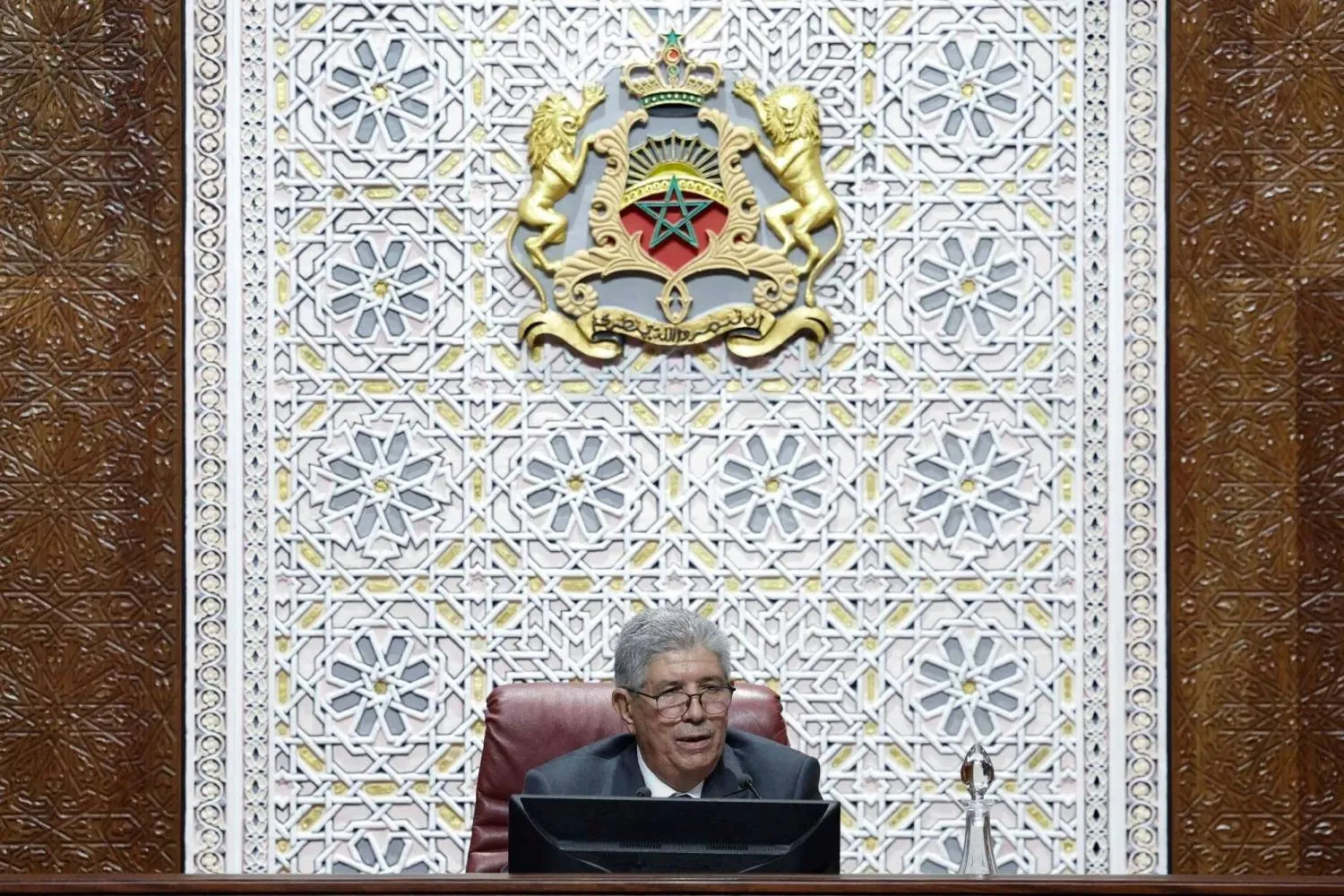

Morocco’s New Parliament Speaker: Ahmed Touizi’s Rise to the Top of the Legislature

Morocco’s new parliament speaker, Ahmed Touizi (AFP)
TT

Morocco’s New Parliament Speaker: Ahmed Touizi’s Rise to the Top of the Legislature

Morocco’s new parliament speaker, Ahmed Touizi (AFP)

Ahmed Touizi’s rise to become Morocco’s parliament speaker in October 2026 marks the opening of a new political phase after a reshaping of the country’s governing majority and opposition.

The elevation of the senior Authenticity and Modernity Party figure to lead the House of Representatives directly reflects the legislative election results and the balance of power among parties in parliament.

It also puts his long record in education, local government and regional administration under closer institutional scrutiny.

As Touizi begins his five-year term, he faces major organizational and constitutional challenges.

He must steer legislative debate with balance and manage competition between the governing majority and opposition groups at equal distance, safeguarding the rights of all sides while preserving the authority of the institution.

The parliamentary showdown and the numbers behind the vote

Touizi capped his political career by being elected parliament speaker at a plenary session on Tuesday, Oct. 13, 2026.

He secured what is regarded as the third-highest constitutional office in the state with an absolute majority of 220 votes, backed strongly by the parties in the new governing coalition.

His main rival, Idriss El Azami El Idrissi of the opposition Justice and Development Party, won 59 votes.

The ballot also carried a quieter political message. Of the 369 votes cast, 90 were blank or invalid, reflecting the scale of underlying tensions inside the legislature.

The House completed the formation of its constitutional bodies the following day. Lawmakers unanimously approved a single list with 293 votes, establishing the chamber’s bureau under the principle of proportional representation and appointing eight deputy speakers.

Mustapha Baitas of the National Rally of Independents was named first deputy speaker and Khalid Chennak of the Istiqlal Party was second deputy speaker.

They were joined by Abdellah Bouanou of the Justice and Development Party and Mohamed Ouzzine of the Popular Movement.

The restructuring also extended to the heads of the chamber’s nine permanent committees, the core engines of the legislative process.

Mohamed El Gharass of the Constitutional Union was appointed head of the Foreign Affairs Committee, Moncef Toub of the Istiqlal Party the Interior Committee, Mohamed Ghiyath of the National Rally of Independents the Justice and Legislation Committee, and Hicham El Mhajri of the Authenticity and Modernity Party the Finance Committee.

Mustapha Ibrahimi of the Justice and Development Party was named head of the Social Sectors Committee, Mohamed Al Aaraj of the Popular Movement the Productive Sectors Committee, Abdelhak Amghar of the Socialist Union of Popular Forces the Infrastructure Committee, Hassan Derham of the Party of Progress and Socialism the Education and Culture Committee, and Hanan El Masi of the Authenticity and Modernity Party the Public Finance Oversight Committee.

From the geographic margins to the top of the legislature

Touizi’s political career is closely tied to his stronghold in Al Haouz province, particularly the town of Ait Ourir near Marrakesh.

The mountainous, developing area was more than his birthplace and childhood home. It became his decisive electoral base and the platform from which he built his political influence.

That deep local connection gave him grassroots legitimacy, but it also brought persistent criticism. Local actors and opponents have argued that his record in local administration failed to deliver the hoped-for development gains in his hometown and surrounding areas.

From natural sciences teacher to politics

The new parliament speaker is 71 and was born in the 1950s, living through the major transformations of modern Morocco.

Touizi studied science before entering public service as a natural sciences teacher in Morocco’s public education system.

Throughout his career, he has repeatedly invoked his roots as an educator in his speeches. For years, that background shaped both his political rhetoric and his direct communication with ordinary citizens before he turned full-time to electoral and institutional politics.

Political pragmatism and a long journey across parties

Touizi’s partisan record shows clear political flexibility and an ability to adapt to shifts in Morocco’s party landscape and changing balances of power.

He began his political career in 1974 within organizations linked to the National Union of Popular Forces in Marrakesh, then associated with a radical leftist current.

As Morocco’s political landscape shifted, Touizi moved among several parties, including the Constitutional Union and the Popular Movement, before joining the liberal Authenticity and Modernity Party.

He rose through its ranks to become a member of its political bureau and one of the leading figures shaping its parliamentary balance.

From local government to the legislative engine room

Touizi has held a succession of local and legislative posts over several decades.

He served as president of the Ait Ourir municipal council for several consecutive terms, becoming a familiar figure in local administration.

He expanded that territorial influence when he was elected president of the Marrakesh-Tensift-Al Haouz regional council from 2011 to 2016, before Morocco adopted its current regional structure.

His career also extended to parliament. He spent years in the House of Councilors, where he served as a chamber quaestor, before moving to the House of Representatives as a lawmaker for the Al Haouz constituency.

He later headed the Authenticity and Modernity Party’s parliamentary group during the previous legislative term, gaining detailed knowledge of the inner workings of lawmaking and the balance between parliamentary blocs.

Taking the speaker’s chair and inheriting a long legacy

Touizi succeeds Rachid Talbi Alami of the National Rally of Independents as parliament speaker.

His election also places him in a long line of prominent figures who have led Morocco’s legislative institution since the early post-independence period.

They include Mehdi Ben Barka in the National Consultative Council, Abdelkrim Al Khatib, Dey Ould Sidi Baba and Ahmed Osman, who led the parliamentary institution for the longest uninterrupted period, as well as Abdelwahed Radi, Mustapha Mansouri, Karim Ghellab and Habib El Malki.



Netanyahu Dismisses Claims That Israel Is Blocking Supplies to Gaza

A Palestinian child sits beside a pool of rainwater at a camp for displaced people in Deir al-Balah in the central Gaza Strip, Saturday, Nov. 7, 2026. (AP)
TT

Netanyahu Dismisses Claims That Israel Is Blocking Supplies to Gaza

A Palestinian child sits beside a pool of rainwater at a camp for displaced people in Deir al-Balah in the central Gaza Strip, Saturday, Nov. 7, 2026. (AP)

Netanyahu said Israel was not to blame for the worsening conditions for Palestinians in Gaza’s tent camps that have been hit with severe winter floods.

His remarks came after the US-created Board of Peace — established under US President Donald Trump's plan to end the Israel-Hamas war and oversee Gaza’s recovery — said Monday that Israel's delaying of the entry of winter supplies into Gaza had “exacerbated the consequences of a foreseeable humanitarian challenge.”

Torrential rain has battered the war-torn enclave in recent days, damaging tens of thousands of makeshift tents. Four people, including three children, were killed on Sunday when a large sandstone slab collapsed onto tents during the rains.

Netanyahu said the Palestinian group Hamas is to blame because it continues to refuse to disarm, a condition of the deal announced by Trump, and seizes humanitarian aid in order to use it for military purposes.

“Hamas alone is responsible for the suffering of the people of Gaza, and it is now cynically exploiting that suffering to shift blame onto Israel once again,” he said Tuesday.

British Foreign Secretary Ed Miliband said the situation in Gaza was “intolerable” and demanded Israel end “arbitrary restrictions” on aid.

In Washington, Sen. Brian Schatz of Hawaii, the top Democrat on the Senate's foreign spending subcommittee, called for Israel to immediately allow winter gear into Gaza.

“There are a lot of challenges when it comes to Israel and Palestine that are complicated, and fraught, and contentious,” Schatz said on the Senate floor on Tuesday. “But we should all be able to agree that repairing torn tents and helping people to dry out, and providing warmth to freezing children is a basic human obligation.”


Representatives of 3 Countries Receive Families of ISIS Fighters from Syria’s Roj Camp

Women and their children at the Roj camp in Syria. (AFP file)
TT

Representatives of 3 Countries Receive Families of ISIS Fighters from Syria’s Roj Camp

Women and their children at the Roj camp in Syria. (AFP file)

Representatives of Sudan, Somalia and Indonesia have received another group of their nationals from the Roj camp in Syria’s northeastern Hasakah province, the country’s last remaining camp housing families of ISIS fighters.

The handover took place three days ago during a visit by the foreign representatives, accompanied by Syrian government officials and members of the Internal Security Forces, according to a local activist.

The repeated visits by government security delegations suggest that Damascus is preparing to take over administration of the facility from the dissolved Kurdish Syrian Democratic Forces (SDF), the activist said.

Ibrahim al-Halabi, a resident of Hasakah, told Asharq Al-Awsat that the delegation met women living at the site who described their circumstances.

Located in the far northeast of Hasakah province, Roj houses around 2,200 women and children in 750 tents. Its residents hold various foreign and Arab nationalities, including Turkish, Russian, British, French, German, Australian, Indonesian, Sudanese, Somali and Tunisian citizenship. It became Syria’s last remaining camp for families of ISIS fighters following the closure of al-Hol, also in the Hasakah countryside.

Several groups of Sudanese, Somali and Indonesian nationals have already been repatriated since 2022.

According to Halabi, the latest handover included 12 Indonesian women and their children, 30 Somali women and between three and nine Sudanese women.

Dual citizenship complicates repatriation

Halabi explained that Sudanese and Somali nationals repatriated in previous operations held only one nationality. Others, however, have dual citizenship, including Sudanese-British and Somali-British nationals, complicating efforts to arrange their return.

Some women have refused to be handed over to Sudanese authorities, demanding instead that they be transferred to the British government. As a result, Sudanese and Somali women holding dual nationality have yet to be repatriated, Halabi noted.

He added that Syrian government Internal Security Forces had entered Roj several times recently, during which residents from Australia, Sudan, Somalia, Indonesia and Trinidad and Tobago were transferred out.

The latest visit brought considerable relief to residents.

Halabi also viewed the visits as a sign that Damascus would assume responsibility for managing the facility. However, he expected security arrangements to remain under the supervision of former SDF personnel integrated into the government’s Internal Security Forces under the January 2026 agreement between Damascus and the Kurdish-led force.

Roj's future

In February, the Syrian government took control of al-Hol, previously the country’s largest detention camp for families of ISIS fighters, after wresting it from the SDF, which had administered both facilities.

Al-Hol, described as the world’s most dangerous camp, had housed tens of thousands of families of various nationalities.

Following its takeover, Damascus began evacuating foreign residents and transferring them to another camp in the northern Aleppo province.

With al-Hol closed, Roj emerged as the most prominent remaining facility housing women and widows of ISIS members from different countries.

However, activists in northern Syria say it remains unclear when the camp will close or where its residents will be transferred afterward.


Iraq Reopens One Border Crossing with Iran, Closes Another as It Pursues Mediation

Iraqi Prime Minister Ali al-Zaidi. (INA)
TT

Iraq Reopens One Border Crossing with Iran, Closes Another as It Pursues Mediation

Iraqi Prime Minister Ali al-Zaidi. (INA)

Iraqi Foreign Minister Fuad Hussein confirmed Tuesday that Prime Minister Ali al-Zaidi’s secret visit to Iran was aimed at bringing Tehran and Washington closer together, as Baghdad reopened one border crossing with Iran and announced the temporary closure of another.

Speaking to the Iraqi News Agency (INA) on the sidelines of the Paris Peace Forum, Hussein described the visit as “an attempt to bring the Iranian and American positions closer together, alongside other efforts.”

He stressed Iraq’s interest in easing tensions, citing the economic impact of the closure of the Strait of Hormuz and casualties from the US war on Iran.

“We have strong relations with our neighbor Iran, as well as excellent relations with the United States,” Hussein said. “That is why Iraq can play this role, although other countries are also doing so.”

Request for time

A senior Iraqi government official told Asharq Al-Awsat that al-Zaidi had conveyed an American message to Tehran outlining a possible formula for resolving the conflict between the two countries.

The Iranian side, however, requested more time to respond, according to the official.

A source familiar with the visit confirmed to Iran’s Fars News Agency that al-Zaidi had traveled to Tehran last Friday for several hours and met Mohammad Bagher Ghalibaf, Iran’s parliament speaker and head of its negotiating delegation.

The agency reported that talks focused exclusively on Baghdad’s efforts to end the war.

Despite repeated official statements presenting the visit as a mediation effort, a source close to Iraq’s Coordination Framework suggested it might instead have been motivated by domestic concerns.

“Al-Zaidi’s recent policies, particularly the ban on Iranian flights and the closure of some border crossings, have caused considerable harm to Iran,” the source told Asharq Al-Awsat.

The visit may therefore have been intended to explain Baghdad’s position on those measures and avoid angering Tehran, it added.

It pointed to the recent public confrontation between al-Zaidi and Kataib Hezbollah, warning that tensions could lead to a direct clash. Given its influence and close ties with some armed factions, Tehran could help ease the dispute.

Regional role

Ihssan Shmary, an academic and head of the Political Thinking Center, believes al-Zaidi’s visit was primarily part of his efforts to establish a regional diplomatic role through an initiative he had previously presented to US President Donald Trump.

Speaking to Asharq Al-Awsat, Shmary said that the trip coincided with extensive Arab and regional efforts to reduce tensions and prevent renewed fighting between Washington and Tehran.

He described the trip as an attempt to break the deadlock between the two countries and secure a foreign policy achievement for Iraq.

Nevertheless, he questioned Baghdad’s ability to bring Washington and Tehran to the negotiating table.

“Iraq may be very far from being able to play the role of a country that brings the US and Iran together at a table of understanding,” he cautioned.

Al-Sheeb reopens, Mandali closes

In a separate development, Omar al-Waeli, head of Iraq’s Border Ports Authority, announced Tuesday the reopening of the al-Sheeb crossing with Iran, which had been closed since October 21.

Authorities also decided to temporarily close the Mandali crossing in the Diyala province beginning Friday.

Al-Waeli explained that al-Sheeb would resume operations following completion of the required technical procedures, while Mandali’s closure would allow similar technical requirements to be addressed.

The decisions followed earlier remarks by Foreign Minister Hussein revealing that the US Treasury Department had formally requested Baghdad to close all its border crossings with Iran except two.

Ban on Iranian flights remains in place

Meanwhile, Iran’s Football Federation announced Tuesday that Iraq had refused permission for a direct flight carrying the Iranian national team to land at Basra airport.

The team was scheduled to participate in a friendly tournament alongside Iraq, Lebanon and Palestine.

Iran’s Mehr News Agency quoted the federation as blaming obstacles imposed by the Iraqi government, particularly its refusal to authorize a direct flight to Basra.

As a result, the players traveled to the Iranian city of Abadan, from where they would continue to Basra by road.

An Iraqi Transport Ministry official told Asharq Al-Awsat that Iranian aircraft were permitted to land only at Najaf airport.

The Iranian side had chosen to fly the team to Abadan because it was closer to the stadium in Basra, the official explained.

He confirmed that Iraq remained committed to its ban on Iranian flights landing at Iraqi airports, with Najaf as the sole exception, to avoid US Treasury sanctions.