Israel Says Commercial Goods Not Entering Gaza Over Hamas Tax Dispute

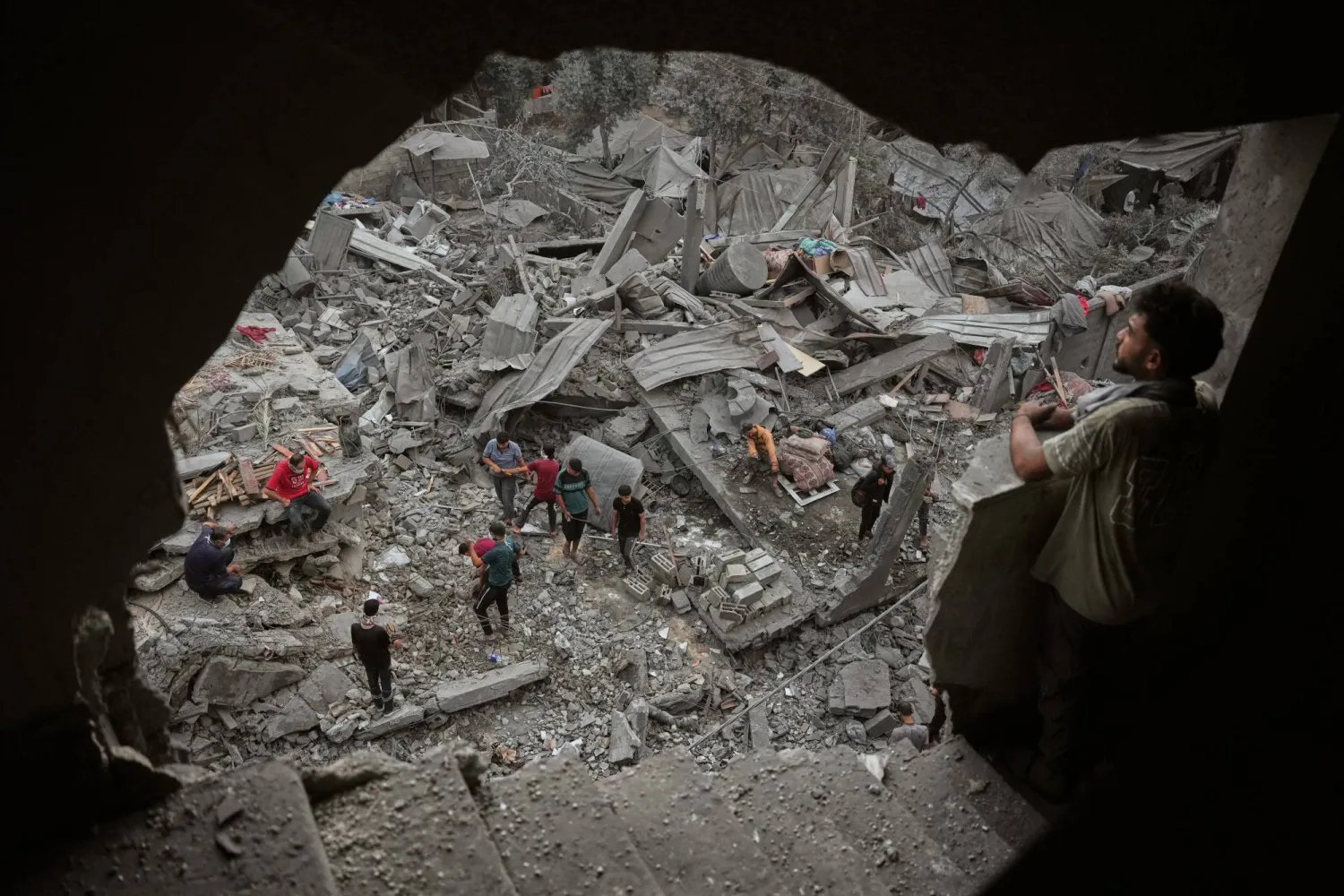
 Palestinians inspect a building destroyed in an Israeli airstrike late Saturday in Zawaida, central Gaza Strip, Sunday, Oct. 11, 2026. (AP)
Palestinians inspect a building destroyed in an Israeli airstrike late Saturday in Zawaida, central Gaza Strip, Sunday, Oct. 11, 2026. (AP)
TT

Israel Says Commercial Goods Not Entering Gaza Over Hamas Tax Dispute

 Palestinians inspect a building destroyed in an Israeli airstrike late Saturday in Zawaida, central Gaza Strip, Sunday, Oct. 11, 2026. (AP)
Palestinians inspect a building destroyed in an Israeli airstrike late Saturday in Zawaida, central Gaza Strip, Sunday, Oct. 11, 2026. (AP)

Israel on Thursday said commercial goods usually delivered into Gaza by private merchants had not entered the beleaguered territory for days because of Hamas threats and a taxation scheme, an accusation the group rejected.

Despite a fragile ceasefire observed since October 2025, the Gaza Strip remains engulfed in a severe humanitarian crisis and the alleged dispute between Hamas and merchants threatens to further cut off supplies to the territory.

Gaza, a tiny territory surrounded by Israel, Egypt and the Mediterranean Sea, has been under blockade even before Hamas's October 7, 2023 attack sparked the most recent war.

But COGAT, the Israeli defense ministry agency responsible for civilian affairs in the Palestinian territories, said it told senior international officials that merchants had suspended coordination for the entry of goods into Gaza "until further notice" because of what it described as Hamas coercion.

In a letter to international representatives involved in implementing the ceasefire, COGAT said merchants reported that Hamas demanded about 10,000 shekels ($3,200) for every truck into Gaza and that traders sell around 30 percent of goods in cash instead of bank transfers.

The agency also cited reports that Hamas security personnel had arrested the son of a merchant who refused to comply with the demands, prompting traders to suspend operations out of fear for their safety.

Hamas rejected the allegations in a letter addressed to mediators including Egypt, Qatar and Türkiye, saying it "categorically" denied imposing taxes or government fees on commercial trucks.

It said it had not collected taxes or fees on commercial activity in the past three years of war because of the humanitarian and economic conditions in Gaza.

Hamas said the 10,000-shekel figure referred to a "voluntary community initiative" by Gaza's businesspeople to put money into a "national fund" for relief projects, while the transaction requirement was to inject "cash liquidity" into the territory.

COGAT said the private sector accounted for roughly half of all trucks entering Gaza each week and warned the suspension could undermine the ceasefire agreement.

COGAT said Israel had not initiated the suspension of coordination, but the merchants.

Nickolay Mladenov, the Gaza representative of the US-backed Board of Peace tasked with implementing the ceasefire, said he had received COGAT's letter and condemned reported "threats and coercion" against merchants.

"Such practices are unacceptable and must end immediately," Mladenov wrote on X, adding that interference in supply chains increased the suffering of Gaza's civilians.

The International Organization for Migration (IOM) last week called for Israel to ease the "constraints" on the entry of critical supplies into Gaza.


Syria Launches 'Liberation Season 2026,' Marking Anniversary of 'Deterrence of Aggression' Offensive

Participants march toward the Umayyad Mosque as “Liberation Season 2026” celebrations get underway in Damascus on Friday. (AFP)
TT

Syria Launches 'Liberation Season 2026,' Marking Anniversary of 'Deterrence of Aggression' Offensive

Participants march toward the Umayyad Mosque as “Liberation Season 2026” celebrations get underway in Damascus on Friday. (AFP)

Syria kicked off its "Liberation Season 2026" celebrations on Friday with a mass sporting march through Damascus, marking the second anniversary of the offensive that set in motion the fall of Bashar al-Assad’s regime, ending an era of repression, injustice, killings and torture.

Organized by the Damascus Governorate in coordination with the Ministry of Emergency and Disaster Management, the march brought together people of all ages, cyclists, skaters and civil defense teams to commemorate the launch of the “Deterrence of Aggression” offensive.

Participants gathered at Umayyad Square in the morning, waving national flags and white banners bearing the Islamic declaration of faith: “There is no god but Allah, and Muhammad is the Messenger of Allah.”

The procession wound through the capital, passing the National Museum, Victoria Bridge, the Hejaz district, Damascus Citadel and the famed al-Hamidiyah souk before reaching the Umayyad Mosque.

Footage published by a news platform showed crowds prostrating in gratitude to God outside the mosque, amid chants of “Allahu Akbar” (God is greatest) and jubilant ululations from women and girls celebrating Liberation Day.

From ‘Deterrence of Aggression’ to Liberation

The Damascus Governorate unveiled the program for “Liberation Season 2026” on Thursday. Celebrations run from November 27, the second anniversary of the offensive’s launch, through December 8, marking the day Syria was freed from Assad’s rule in 2024.

Internal security forces were deployed extensively across Damascus to secure the march route, keep traffic flowing and ensure public safety.

Abdulrahman al-Sarouji, director of public relations at the Damascus Governorate, told the official Syrian Arab News Agency (SANA) that the authorities had organized events to reinforce the significance of the anniversary, with the march designed to engage Syrians of all ages and walks of life.

The program features sporting, cultural, social, artistic and economic activities, including discounts across the capital, events at the former fairgrounds and the welcoming of Syrian expatriates arriving from abroad.

It also includes premiere screenings at the Opera House of films commemorating the Syrian revolution and its events, alongside intellectual lectures at the National Library.

Celebrations will culminate in a main event at Umayyad Square on Liberation Day, December 8.

The anniversary also resonated in Friday sermons across several Damascus mosques, where preachers hailed the victory as “a blessing bestowed by God upon Syrians.”

They urged worshippers to safeguard that achievement by supporting the families of martyrs, comforting the wounded, helping those in need, honoring past sacrifices and contributing to reconstruction.

They also stressed the importance of cooperation, solidarity, justice and compassion, warning against division, factionalism and hatred.

‘Building It Together’

Under the slogan “We reclaimed it ... and together we will rebuild it,” the Ministry of Information’s Foreign Media Department launched an interactive digital platform to track and document Syrian National Day celebrations worldwide and highlight the participation of Syrian communities abroad.

The “Deterrence of Aggression” offensive began on November 27, 2024, under the Military Operations Command led by Hayat Tahrir al-Sham (HTS).

Rapid territorial gains by armed opposition factions, coupled with the crumbling of Assad’s forces and widespread defections, marked an unprecedented shift in the balance of control since the outbreak of the Syrian revolution.

The dramatic developments left Syrians at home and abroad anxiously following the course of the offensive. Just 12 days after it began, Assad’s regime fell.

Local news platforms reported anniversary celebrations in the town of Qabtan al-Jabal in western rural Aleppo, while a motorcade along the seafront in Tartous province marked the occasion.

Strategic military and security expert Ismat al-Absi told Asharq Al-Awsat that Liberation Day represented a defining moment in Syria’s national history.

“Liberation Day is not merely another festive occasion on the calendar. It is a founding milestone, marking the end of half a century of rule by a single family and Syria’s transition from a captive state to one that determines its own course,” he said.

Al-Absi said the offensive carried a dual significance: the collapse in just 12 days of a military apparatus built on loyalty rather than competence, and the rise of a revolutionary army that demonstrated its capacity for leadership, organization and planning.

On the regional level, Assad’s downfall reshaped the balance of power in the Levant and severed a supply line that had sustained cross-border smuggling, militias and drug trafficking, he said.

Domestically, however, its greatest significance lay in the fact that the people who had taken up arms now held the reins of the state for the first time in decades.

Those who bet on the failure of the new Syria had lost twice, Al-Absi said: first, when the state survived the regime’s collapse despite predictions of chaos, and again when Syria broke out of its isolation and forged Arab and international partnerships rather than descending into collapse.

The new leadership inherited a bankrupt, fractured country beset by challenges, yet accomplished in two years what entire governments had failed to achieve, he said, citing relative security stability, the dismantling of hundreds of terrorist cells, drug trafficking and criminal networks, and the restoration of state authority.

“Predicting failure is an arrow anyone can fire at no cost. Building a state from the rubble, however, is a test that words alone cannot meet,” Al-Absi said.

“Nevertheless, the government remains accountable for its results. Celebration does not absolve us of accountability. It should strengthen our resolve to finish the work.”

Among the achievements of the past two years, Al-Absi cited the establishment of institutions governing the new state, the launch of a political and constitutional process, the gradual consolidation of arms under state control and the dismantling of hundreds of terrorist cells and drug trafficking networks.

He also highlighted Syria’s return to the Arab and Islamic fold, the lifting of sanctions and the return of thousands of families to their homeland.

The hardest tasks, however, lie ahead, he said.

They include completing the formation of a unified national army rooted in the revolution and built to professional standards, delivering transitional justice without revenge or impunity, reviving the economy and improving living conditions.

Security and stability, he stressed, could only be measured by the well-being of the people.

He also called for the consolidation of state sovereignty across the south, Sweida and the coastal region, without exception.

“My priorities, in order, are the army, justice and the economy,” Al-Absi concluded. “A state that cannot protect, hold to account or feed its people remains incomplete, no matter how much it celebrates.”



Son of Hamas Chief Survives Israeli Strike, Hamas Says

Palestinians ride a motorcycle past destroyed buildings in Gaza City, Thursday, Nov. 26, 2026. (AP)
TT

Son of Hamas Chief Survives Israeli Strike, Hamas Says

Palestinians ride a motorcycle past destroyed buildings in Gaza City, Thursday, Nov. 26, 2026. (AP)

The son of Hamas chief Khalil al-Hayya survived an assassination attempt by the Israeli military on Friday, senior Hamas official Basem Naim said.

He told Reuters that Izzeldeen al-Hayya and his family had survived a dawn airstrike and Hamas sources said several people, including Hayya's daughter-in-law, had been wounded but there had been no deaths.

The Israeli military had ‌no immediate ‌comment.

Naim described Izzeldeen al-Hayya, ‌born ⁠in 1997, as ⁠the Hamas chief's last surviving son, with four others having been killed by Israeli forces.

The family of one of the late sons survived Friday's strike, Naim said.

Hamas said in a statement that the Israeli military had targeted ⁠a residential apartment, and linked ‌the attack to threats ‌Israeli Defense Minister Israel Katz has made against Hayya.

Hamas ‌accused Israel of seeking to undermine ‌a 2025 Gaza ceasefire agreement and said Israel bore full responsibility for the consequences of its continued attacks.

Izzeldeen is the twin brother of Hamam ‌Khalil al-Hayya, who was killed in a 2025 Israeli airstrike targeting Hamas leaders in ⁠Qatar, ⁠Naim said.

Named Hamas' overall leader in July, Hayya narrowly escaped assassination himself in the Qatar strike.

Hayya warned of possible retaliation on Thursday after Israeli attacks killed at least 10 people in Gaza.

Separately, three Palestinians were killed and two others injured on Friday in an Israeli strike on the city of Rafah, medical sources told Reuters. There was no immediate Israeli comment on the strike.


Salam Says a Proposal Is Underway to Have UN Peacekeepers Stay in Lebanon

 Lebanese Prime Minister Nawaf Salam speaks during an interview with The Associated Press in Beirut, Lebanon, Friday, Nov. 27, 2026. (AP)
Lebanese Prime Minister Nawaf Salam speaks during an interview with The Associated Press in Beirut, Lebanon, Friday, Nov. 27, 2026. (AP)
TT

Salam Says a Proposal Is Underway to Have UN Peacekeepers Stay in Lebanon

 Lebanese Prime Minister Nawaf Salam speaks during an interview with The Associated Press in Beirut, Lebanon, Friday, Nov. 27, 2026. (AP)
Lebanese Prime Minister Nawaf Salam speaks during an interview with The Associated Press in Beirut, Lebanon, Friday, Nov. 27, 2026. (AP)

Lebanon’s prime minister said Friday that a new proposal is in the works that could have the UN Security Council allow the peacekeeping force in southern Lebanon to continue working after its nearly 50-year mandate expires at the end of the year.

Prime Minister Nawaf Salam told The Associated Press that the plan would see the peacekeeping force known as UNIFIL continuing its work after Dec. 31 and as the Security Council debates what should replace it.

France is preparing to introduce a resolution, Salam said, which would allow UNIFIL to continue some of its functions — such as clearing mines, escorting humanitarian convoys, and monitoring violations — in southern Lebanon during a drawdown period after the peacekeepers' mandate ends.

US officials have indicated that Washington is “open to considering” such an arrangement, he said.

“This would not resolve the problem of so-called post-UNIFIL, but it will give us some extra time to agree on a new architecture in southern Lebanon,” Salam said in an exclusive interview with the AP at the government palace in Beirut.

No plan in place for what comes next

The UN Security Council voted last year to terminate UNIFIL’s mandate at the end of 2026, bowing to demands from the United States and its close ally Israel, which argued that the force had failed to stop Hezbollah's buildup in southern Lebanon.

UNIFIL officials say they were never charged with disarming Hezbollah and that the force helped to preserve calm in the border region for 17 years before Hamas’ 2023 attack on southern Israel ignited a regional war.

The 7,500 peacekeepers currently stationed in southern Lebanon are expected to gradually withdraw over about six months after their mandate expires. The force has a year to fully end its operations.

Much of southern Lebanon, meanwhile, is occupied by Israeli forces after a war broke out in March between Israel and the Lebanese group Hezbollah, linked to the wider Iran war. Hezbollah has refused to give up its weapons, and Israel says it will not withdraw before the group is disarmed.

France has not publicly commented on the proposal that Salam cited.

However, a Western diplomat with knowledge of the matter said one option under discussion is to slow down the withdrawal process and “maintain certain UNIFIL missions” to avoid a power vacuum. The diplomat spoke on condition of anonymity to discuss the matter.

Lebanese officials have called for an extension of UNIFIL's mandate or, failing that, for a new UN-mandated force to be formed.

US officials have expressed willingness for some sort of international force to remain, but not in its current form. They have suggested that it could be a civilian force or private defense contractor.

Salam said that “any force to be deployed will have to be endorsed by the Security Council."

“I was very clear about it," he said. Any presence of forces "in the south will have to be endorsed by the Security Council."

‘In flux’

Salam said that with the wider Middle East and especially his region "in flux,” it's hard to make definitive plans.

Efforts are still underway to form a new government in Israel following last month's elections, and it remains unclear whether the US-Iran war is heading toward a new escalation or a negotiated solution. Iran is Hezbollah's main backer.

While the Lebanese government has insisted that its negotiations with Israel are separate from any US-Iran deal, Salam acknowledged that “the relation between the US and Iran directly affects the situation in Lebanon.”

“Lebanon is not an isolated island in the Mediterranean,” he said. “We are very much influenced by developments in the region. The whole region is in turmoil.”

Lebanon and Israel reached an agreement in June under which Israeli forces are supposed to gradually withdraw from Lebanon and hand over control to the Lebanese army, while Hezbollah is to be disarmed.

But implementation has stalled, as have talks between the two countries.

Salam denied that the talks have collapsed but said the “formal negotiations were put on hold” because of the Israeli elections and uncertainty around the composition of the next Israeli government.

It is unclear how an Israeli government potentially headed by opposition politician Gadi Eisenkot instead of current Prime Minister Benjamin Netanyahu would differ in its approach to Lebanon, Salam said.

Salam's firm stand on Iran and Hezbollah

The Lebanese prime minister said that his government has open lines of communication with Hezbollah and Iran but will not “allow the future of the country to be contingent on Iran’s wishes.”

Hezbollah, which has suffered a series of major blows in two recent wars with Israel, seems to be “more and more dependent on Iran" and continues to receive military and financial assistance from Tehran, Salam said.

That's despite attempts to clamp down on the group's ability to move money and weapons into the country.

Since the ouster of Syria's Iran-allied former President Bashar Assad two years ago, the flow of arms from Iran to Lebanon via Syria has slowed but not stopped.

Lebanon remains in a difficult position. Hezbollah has threatened to fight any attempt to forcibly disarm it, and the Lebanese army has so far moved cautiously.

“Definitely we are not seeking confrontation with Hezbollah," Salam said. "But we will not succumb to the intimidation of Hezbollah.”