



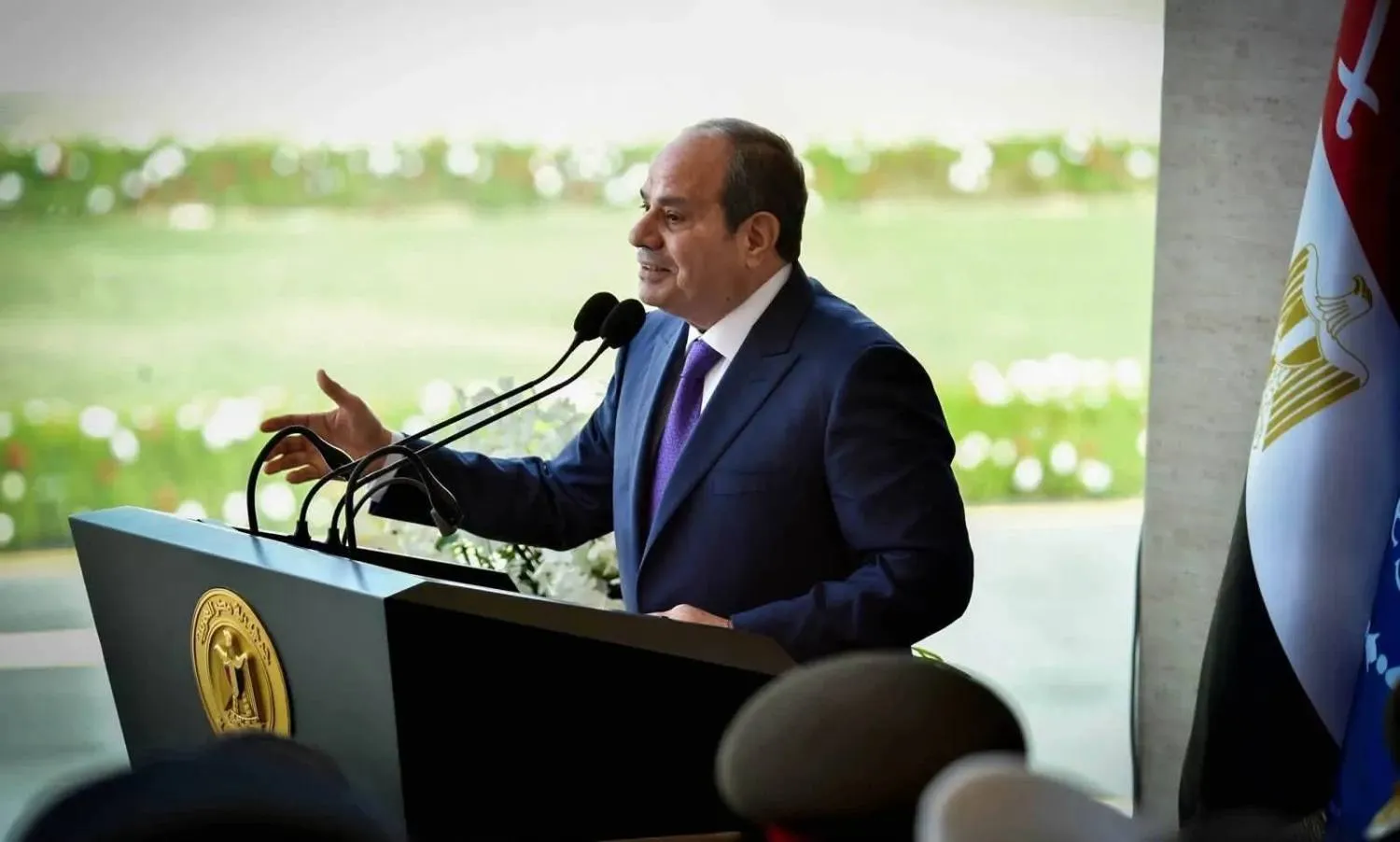

Egyptian President Abdel Fattah al-Sisi stressed that his presidency will end in 2030, calling the date a "settled matter," ruling out constitutional amendments and dismissing speculation that he is grooming a relative to succeed him.
Political and strategic affairs experts told Asharq Al-Awsat that Sisi's remarks marked a major shift and a historic precedent, potentially putting to rest speculation over constitutional changes that could distract from Egypt's development priorities.
Sisi came to power in 2014 after winning the presidential election and secured re-election in 2018 and 2023. Constitutional amendments passed in 2019 extended presidential terms from four to six years and allowed him to seek a third term, which expires in 2030.
No constitutional changes
Speaking at a graduation ceremony for Egyptian Military Academy cadets on Saturday, Sisi insisted that the constitution would remain untouched.
He said his presidency would definitively end in 2030 and that the matter was not open to debate, stressing that Egypt had an abundance of qualified citizens capable of leading the country.
Sisi also rejected speculation that he was preparing a family member or relative to succeed him, saying the Egyptian Military Academy had a role in training future leaders.
He stressed the need to safeguard the state against individuals unable to shoulder the responsibilities of leadership.
With 43 months remaining until 2030, he suggested dedicating 30 months to preparing prospective leaders.
He called for the speaker of parliament, prominent intellectuals and politicians, and the ministers of higher education and justice to develop a comprehensive framework that would pave the way for legislation governing the election of qualified candidates.
The program, he suggested, could train groups of 200, 300 or 500 participants in the workings of the state and the requirements for safeguarding it, broadening the choices available to Egyptian voters.
Sisi urged action on the proposal, emphasizing the responsibility to protect Egypt and its future and keep its flag flying high.
His remarks follow speculation on social media that the constitution could be amended in 2027 to allow him to seek another presidential term.
A historic precedent
Major General Mohamed el-Ghabari, a strategic affairs expert and former director of Egypt's National Defense College, said Sisi's declaration signaled a commitment to the constitutional transfer of power.
Speaking to Asharq Al-Awsat, he said Sisi wanted history to remember him for helping establish that principle, becoming the first Egyptian president in decades to clearly set an end date for his rule.
The remarks conveyed Sisi's belief that he had assumed office with a sense of duty and intended to hand over power with the same responsibility, while pressing ahead with development plans despite economic challenges and regional turmoil threatening stability and growth, he added.
Ghabari said Sisi was also making clear that the choice of Egypt's next leader rests with its people, warning that speculation about constitutional amendments or extending his presidency served no national interest and risked diverting attention from development and strategic planning.
He stressed that building credible political alternatives would require effective parties and institutions capable of nurturing leaders with clear platforms and the ability to present their visions to voters.
Mohamed Ezz al-Arab, head of the Arab and Regional Studies Unit at the Al-Ahram Center for Political and Strategic Studies, said Sisi appeared determined to make 2030 the endpoint of his rule.
Speaking to Asharq Al-Awsat, he said: "What's striking is not just his announcement that his presidential term will end in 2030, but his call for the speaker of parliament to work with the justice minister and political, party and academic figures on selecting and preparing centers of excellence and future leaders."
"That would represent a major shift if things proceed as intended," he added.
Ezz al-Arab said Sisi's remarks reinforced the principle that Egypt is a state of institutions, where power cannot be inherited by his sons or any other family member.


