Hezbollah’s Actions Raise Fears of Internal Escalation in Lebanon

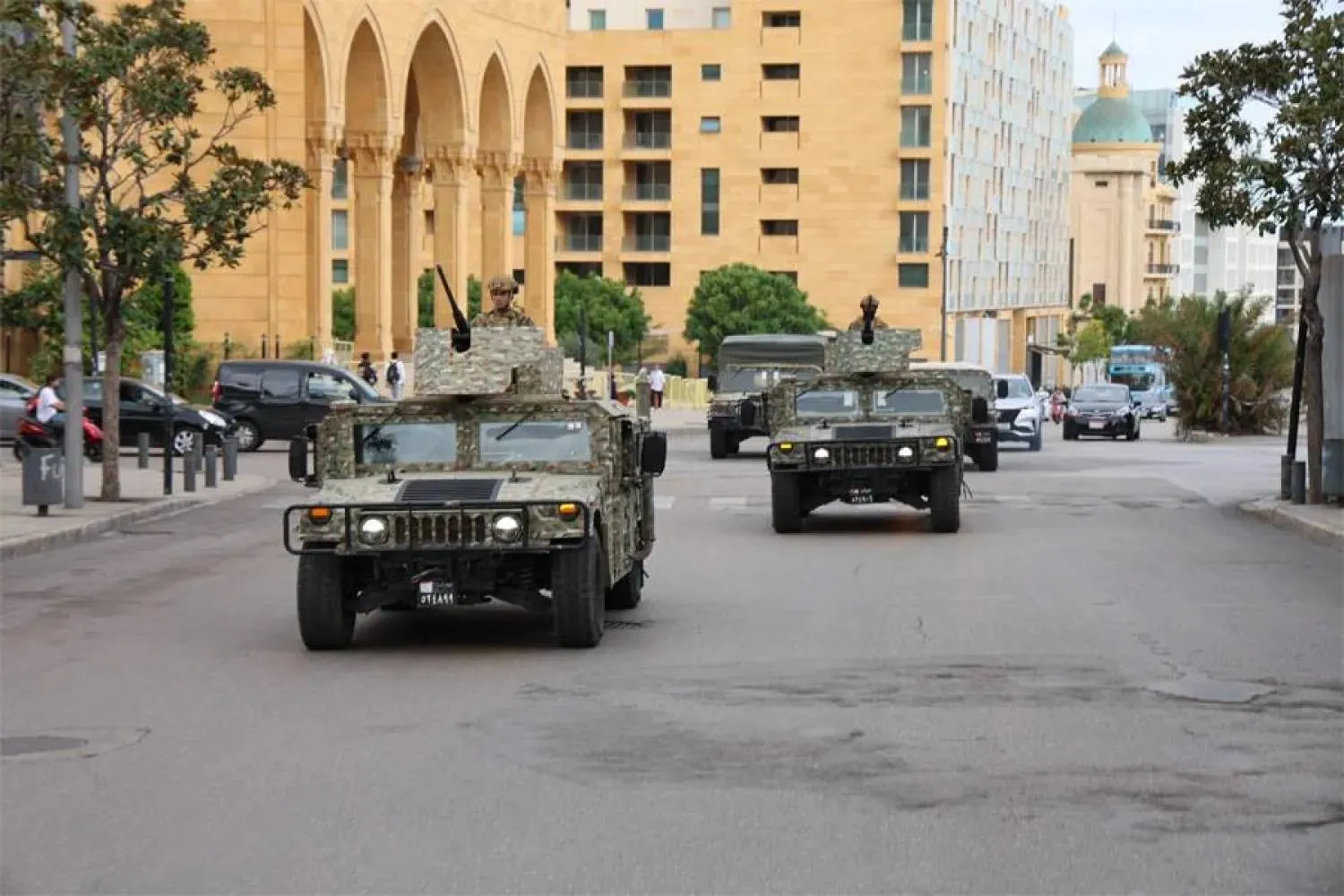
A Lebanese army patrol in Beirut. (Lebanese Army)
TT

Hezbollah’s Actions Raise Fears of Internal Escalation in Lebanon

A Lebanese army patrol in Beirut. (Lebanese Army)

Fears of renewed internal tensions are growing in Lebanon as Hezbollah steps up its confrontational rhetoric toward the authorities and its supporters take to the streets of Beirut and its southern suburbs.

Against a backdrop of regional upheaval and mounting pressure on Iran, the developments have raised questions about whether Hezbollah is seeking to challenge the government’s authority or preparing further moves at home in response to shifting regional dynamics.

Ministerial sources told Asharq Al-Awsat that while the possibility of escalation remained a concern, there was no indication that any such move was imminent. The sources insisted that security agencies would continue enforcing government decisions, regardless of Hezbollah’s objections, and ruled out concessions over recent security and judicial measures.

They described the Iran-backed group’s increasingly defiant statements, particularly over a seized explosives shipment last week, as a reaction to the authorities’ actions rather than a reason to reconsider them.

President Joseph Aoun is due to chair a meeting of security chiefs at the presidential palace Monday afternoon to review recent developments, including the explosives shipment.

Prime Minister Nawaf Salam, meanwhile, reaffirmed that lasting stability depends on extending state authority throughout Lebanon, even if gradually, through its own security forces. Decisions on war and peace, he stressed, must remain exclusively with the state and its constitutional institutions.

Salam contacted Army commander Gen. Rodolphe Haykal and Internal Security Forces chief Maj. Gen. Raed Abdallah to commend the reinforced security presence across Greater Beirut following nighttime gatherings that had unsettled residents.

He also met Justice Minister Adel Nassar and Prosecutor General Rami al-Hajj to follow up on investigations into the explosives seized at Dahr al-Baidar and subsequent incidents, including efforts to arrest those involved in possessing or transporting illegal weapons.

He stressed that all action would be governed by the law.
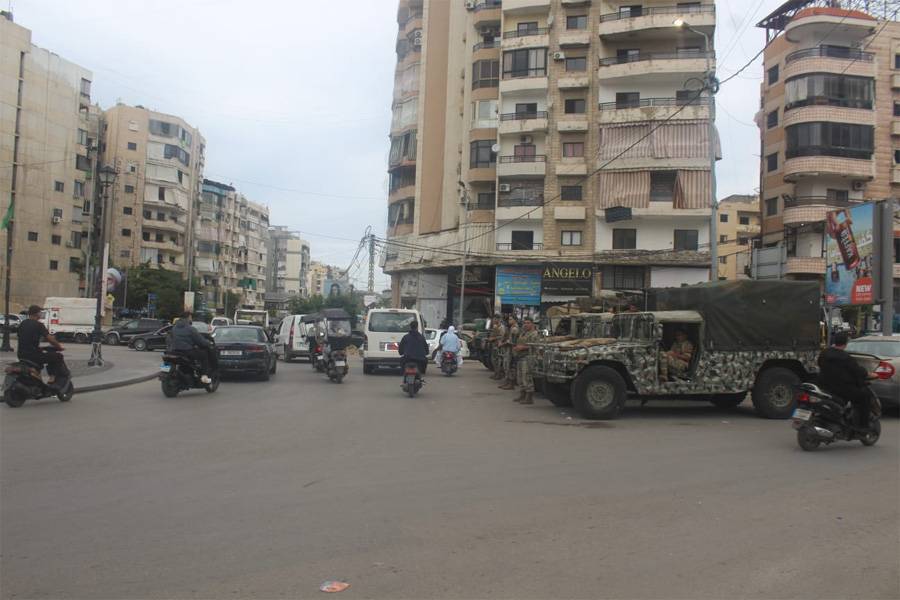
The Lebanese army deployed at an entrance to Beirut's southern suburbs. (Lebanese Army)

Government refuses to back down

The government’s determination to retain exclusive control over weapons was echoed by Foreign Minister Youssef Raggi during the 52nd meeting of foreign ministers of the Organization of Islamic Cooperation in Iraq.

Raggi recalled the August 2025 decision to impose state monopoly over arms and extend state authority across the country.

He argued that sovereignty could not coexist with competing armed forces, nor could stability be achieved while decisions affecting the country were taken outside state institutions.

The increasingly tense atmosphere has also prompted warnings from Lebanese political figures.

MP Ibrahim Mneimneh suggested that the mobilization of Hezbollah supporters could be intended to prepare the ground for action at the right circumstances.

In remarks to Asharq Al-Awsat, he argued that Hezbollah appeared to be seeking a return to the situation that prevailed before the government’s decisions on weapons monopoly, while demonstrating that those measures carried little practical weight.

He did not rule out a link to Iran’s regional calculations or the broader political and security arrangements taking shape in the region.

For Mneimneh, the decisive issue was how the state would respond to any challenge. Unless it seriously addressed weapons outside its control, he cautioned, “Lebanon would remain hostage to the same circumstances.”

He urged the authorities to begin implementing their decisions, particularly the pledge to keep Beirut free of weapons, describing it as an “essential step toward restoring state authority in the capital.”

Lebanese Forces MP Antoine Habchi, for his part, accused Hezbollah of invoking the threat of civil war to buy time.

“Any internal fighting at this stage would be disastrous for Hezbollah itself, calling for the government’s decisions to be implemented without ambiguity,” he urged.
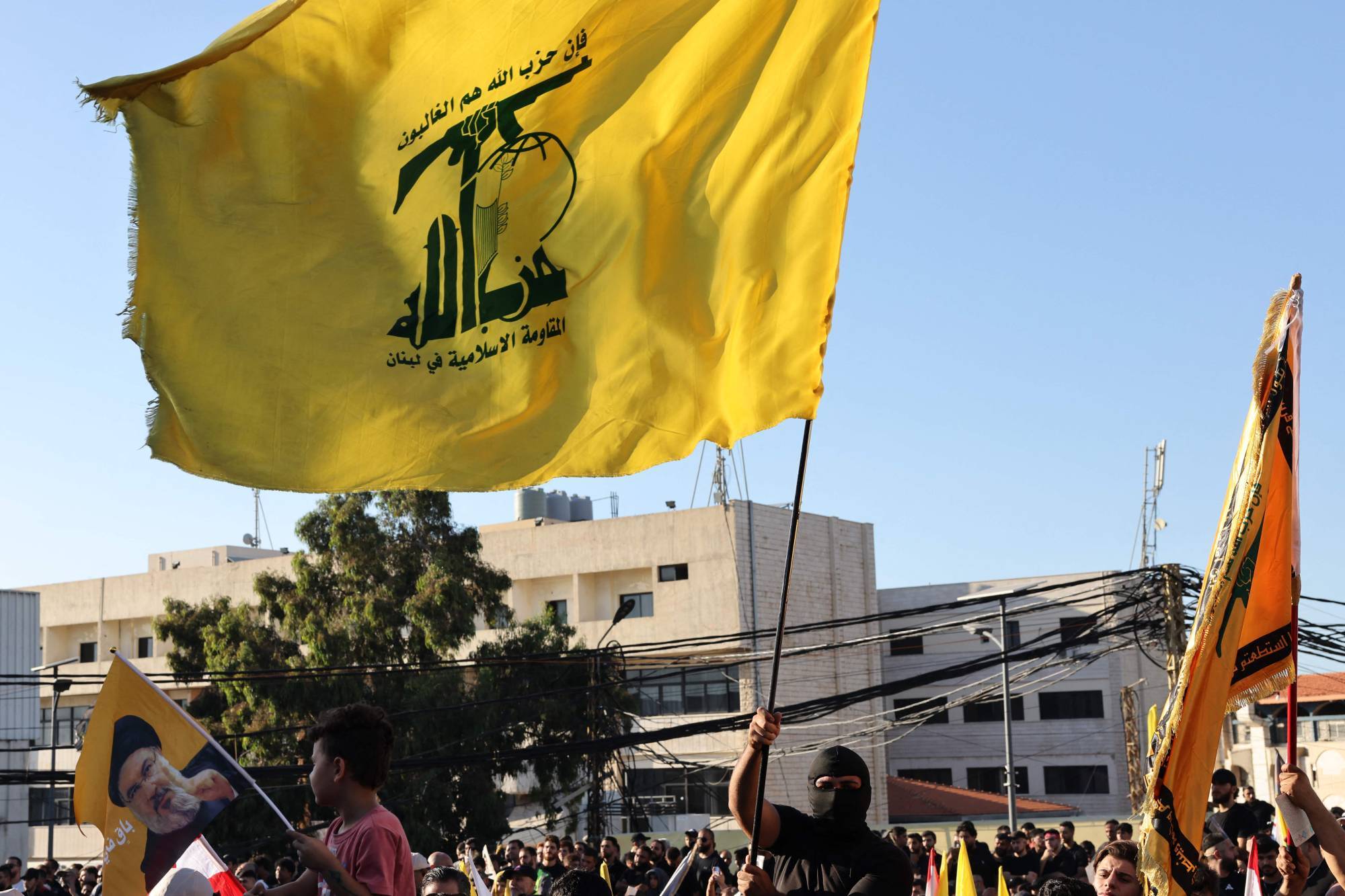
A Hezbollah supporter raises the party's flag at a demonstration in Beirut's southern suburbs. (AFP)

Tensions on the ground

The Lebanese Army has deployed heavily in Beirut for several days, particularly around the southern suburbs and their entrances, amid concerns that Hezbollah supporters could stage further demonstrations.

The deployments coincide with ongoing investigations into the explosives seized at Dahr al-Baidar and a warehouse containing expired medicines.

On Friday evening, young men on motorcycles attempted to obstruct an Internal Security Forces patrol during a raid on the warehouse near the entrance to the southern suburbs. The army intervened, allowing the patrol to seal the premises.

Although Hezbollah denied any connection to the warehouse, reports alleged that a son of its secretary-general, Naim Qassem, was a partner in the business.

MP Paula Yacoubian repeated the allegation on Al Jadeed television Sunday, saying the other partner was the candidate backed by the Shiite political alliance for Lebanon’s pharmacists’ syndicate.

Qassem’s son denied involvement, saying the case was now in the hands of the relevant security and judicial authorities.

Hezbollah nevertheless protested the raid, insisting that operations in sensitive areas follow previously agreed coordination procedures - an apparent reference to arrangements that existed before the government’s recent decisions concerning its weapons.

The confrontation followed another dispute over a truck carrying around 780 kilograms of explosives seized by authorities at a Dahr al-Baidar checkpoint. Hezbollah acknowledged ownership of both the truck and its cargo, demanding their return and the release of those detained.

Hezbollah MP Hassan Fadlallah initially declared that the group “would not tolerate measures targeting it to satisfy US demands.”

On Sunday, he shifted responsibility for the mounting tensions onto the state, accusing the authorities of pushing Lebanon toward internal confrontation under American pressure.

He questioned who stood to benefit from such a confrontation and why the government appeared determined “to provoke tensions rather than defuse them.”


Netanyahu Dismisses Claims That Israel Is Blocking Supplies to Gaza

A Palestinian child sits beside a pool of rainwater at a camp for displaced people in Deir al-Balah in the central Gaza Strip, Saturday, Nov. 7, 2026. (AP)
TT

Netanyahu Dismisses Claims That Israel Is Blocking Supplies to Gaza

A Palestinian child sits beside a pool of rainwater at a camp for displaced people in Deir al-Balah in the central Gaza Strip, Saturday, Nov. 7, 2026. (AP)

Netanyahu said Israel was not to blame for the worsening conditions for Palestinians in Gaza’s tent camps that have been hit with severe winter floods.

His remarks came after the US-created Board of Peace — established under US President Donald Trump's plan to end the Israel-Hamas war and oversee Gaza’s recovery — said Monday that Israel's delaying of the entry of winter supplies into Gaza had “exacerbated the consequences of a foreseeable humanitarian challenge.”

Torrential rain has battered the war-torn enclave in recent days, damaging tens of thousands of makeshift tents. Four people, including three children, were killed on Sunday when a large sandstone slab collapsed onto tents during the rains.

Netanyahu said the Palestinian group Hamas is to blame because it continues to refuse to disarm, a condition of the deal announced by Trump, and seizes humanitarian aid in order to use it for military purposes.

“Hamas alone is responsible for the suffering of the people of Gaza, and it is now cynically exploiting that suffering to shift blame onto Israel once again,” he said Tuesday.

British Foreign Secretary Ed Miliband said the situation in Gaza was “intolerable” and demanded Israel end “arbitrary restrictions” on aid.

In Washington, Sen. Brian Schatz of Hawaii, the top Democrat on the Senate's foreign spending subcommittee, called for Israel to immediately allow winter gear into Gaza.

“There are a lot of challenges when it comes to Israel and Palestine that are complicated, and fraught, and contentious,” Schatz said on the Senate floor on Tuesday. “But we should all be able to agree that repairing torn tents and helping people to dry out, and providing warmth to freezing children is a basic human obligation.”


Representatives of 3 Countries Receive Families of ISIS Fighters from Syria’s Roj Camp

Women and their children at the Roj camp in Syria. (AFP file)
TT

Representatives of 3 Countries Receive Families of ISIS Fighters from Syria’s Roj Camp

Women and their children at the Roj camp in Syria. (AFP file)

Representatives of Sudan, Somalia and Indonesia have received another group of their nationals from the Roj camp in Syria’s northeastern Hasakah province, the country’s last remaining camp housing families of ISIS fighters.

The handover took place three days ago during a visit by the foreign representatives, accompanied by Syrian government officials and members of the Internal Security Forces, according to a local activist.

The repeated visits by government security delegations suggest that Damascus is preparing to take over administration of the facility from the dissolved Kurdish Syrian Democratic Forces (SDF), the activist said.

Ibrahim al-Halabi, a resident of Hasakah, told Asharq Al-Awsat that the delegation met women living at the site who described their circumstances.

Located in the far northeast of Hasakah province, Roj houses around 2,200 women and children in 750 tents. Its residents hold various foreign and Arab nationalities, including Turkish, Russian, British, French, German, Australian, Indonesian, Sudanese, Somali and Tunisian citizenship. It became Syria’s last remaining camp for families of ISIS fighters following the closure of al-Hol, also in the Hasakah countryside.

Several groups of Sudanese, Somali and Indonesian nationals have already been repatriated since 2022.

According to Halabi, the latest handover included 12 Indonesian women and their children, 30 Somali women and between three and nine Sudanese women.

Dual citizenship complicates repatriation

Halabi explained that Sudanese and Somali nationals repatriated in previous operations held only one nationality. Others, however, have dual citizenship, including Sudanese-British and Somali-British nationals, complicating efforts to arrange their return.

Some women have refused to be handed over to Sudanese authorities, demanding instead that they be transferred to the British government. As a result, Sudanese and Somali women holding dual nationality have yet to be repatriated, Halabi noted.

He added that Syrian government Internal Security Forces had entered Roj several times recently, during which residents from Australia, Sudan, Somalia, Indonesia and Trinidad and Tobago were transferred out.

The latest visit brought considerable relief to residents.

Halabi also viewed the visits as a sign that Damascus would assume responsibility for managing the facility. However, he expected security arrangements to remain under the supervision of former SDF personnel integrated into the government’s Internal Security Forces under the January 2026 agreement between Damascus and the Kurdish-led force.

Roj's future

In February, the Syrian government took control of al-Hol, previously the country’s largest detention camp for families of ISIS fighters, after wresting it from the SDF, which had administered both facilities.

Al-Hol, described as the world’s most dangerous camp, had housed tens of thousands of families of various nationalities.

Following its takeover, Damascus began evacuating foreign residents and transferring them to another camp in the northern Aleppo province.

With al-Hol closed, Roj emerged as the most prominent remaining facility housing women and widows of ISIS members from different countries.

However, activists in northern Syria say it remains unclear when the camp will close or where its residents will be transferred afterward.


Iraq Reopens One Border Crossing with Iran, Closes Another as It Pursues Mediation

Iraqi Prime Minister Ali al-Zaidi. (INA)
TT

Iraq Reopens One Border Crossing with Iran, Closes Another as It Pursues Mediation

Iraqi Prime Minister Ali al-Zaidi. (INA)

Iraqi Foreign Minister Fuad Hussein confirmed Tuesday that Prime Minister Ali al-Zaidi’s secret visit to Iran was aimed at bringing Tehran and Washington closer together, as Baghdad reopened one border crossing with Iran and announced the temporary closure of another.

Speaking to the Iraqi News Agency (INA) on the sidelines of the Paris Peace Forum, Hussein described the visit as “an attempt to bring the Iranian and American positions closer together, alongside other efforts.”

He stressed Iraq’s interest in easing tensions, citing the economic impact of the closure of the Strait of Hormuz and casualties from the US war on Iran.

“We have strong relations with our neighbor Iran, as well as excellent relations with the United States,” Hussein said. “That is why Iraq can play this role, although other countries are also doing so.”

Request for time

A senior Iraqi government official told Asharq Al-Awsat that al-Zaidi had conveyed an American message to Tehran outlining a possible formula for resolving the conflict between the two countries.

The Iranian side, however, requested more time to respond, according to the official.

A source familiar with the visit confirmed to Iran’s Fars News Agency that al-Zaidi had traveled to Tehran last Friday for several hours and met Mohammad Bagher Ghalibaf, Iran’s parliament speaker and head of its negotiating delegation.

The agency reported that talks focused exclusively on Baghdad’s efforts to end the war.

Despite repeated official statements presenting the visit as a mediation effort, a source close to Iraq’s Coordination Framework suggested it might instead have been motivated by domestic concerns.

“Al-Zaidi’s recent policies, particularly the ban on Iranian flights and the closure of some border crossings, have caused considerable harm to Iran,” the source told Asharq Al-Awsat.

The visit may therefore have been intended to explain Baghdad’s position on those measures and avoid angering Tehran, it added.

It pointed to the recent public confrontation between al-Zaidi and Kataib Hezbollah, warning that tensions could lead to a direct clash. Given its influence and close ties with some armed factions, Tehran could help ease the dispute.

Regional role

Ihssan Shmary, an academic and head of the Political Thinking Center, believes al-Zaidi’s visit was primarily part of his efforts to establish a regional diplomatic role through an initiative he had previously presented to US President Donald Trump.

Speaking to Asharq Al-Awsat, Shmary said that the trip coincided with extensive Arab and regional efforts to reduce tensions and prevent renewed fighting between Washington and Tehran.

He described the trip as an attempt to break the deadlock between the two countries and secure a foreign policy achievement for Iraq.

Nevertheless, he questioned Baghdad’s ability to bring Washington and Tehran to the negotiating table.

“Iraq may be very far from being able to play the role of a country that brings the US and Iran together at a table of understanding,” he cautioned.

Al-Sheeb reopens, Mandali closes

In a separate development, Omar al-Waeli, head of Iraq’s Border Ports Authority, announced Tuesday the reopening of the al-Sheeb crossing with Iran, which had been closed since October 21.

Authorities also decided to temporarily close the Mandali crossing in the Diyala province beginning Friday.

Al-Waeli explained that al-Sheeb would resume operations following completion of the required technical procedures, while Mandali’s closure would allow similar technical requirements to be addressed.

The decisions followed earlier remarks by Foreign Minister Hussein revealing that the US Treasury Department had formally requested Baghdad to close all its border crossings with Iran except two.

Ban on Iranian flights remains in place

Meanwhile, Iran’s Football Federation announced Tuesday that Iraq had refused permission for a direct flight carrying the Iranian national team to land at Basra airport.

The team was scheduled to participate in a friendly tournament alongside Iraq, Lebanon and Palestine.

Iran’s Mehr News Agency quoted the federation as blaming obstacles imposed by the Iraqi government, particularly its refusal to authorize a direct flight to Basra.

As a result, the players traveled to the Iranian city of Abadan, from where they would continue to Basra by road.

An Iraqi Transport Ministry official told Asharq Al-Awsat that Iranian aircraft were permitted to land only at Najaf airport.

The Iranian side had chosen to fly the team to Abadan because it was closer to the stadium in Basra, the official explained.

He confirmed that Iraq remained committed to its ban on Iranian flights landing at Iraqi airports, with Najaf as the sole exception, to avoid US Treasury sanctions.