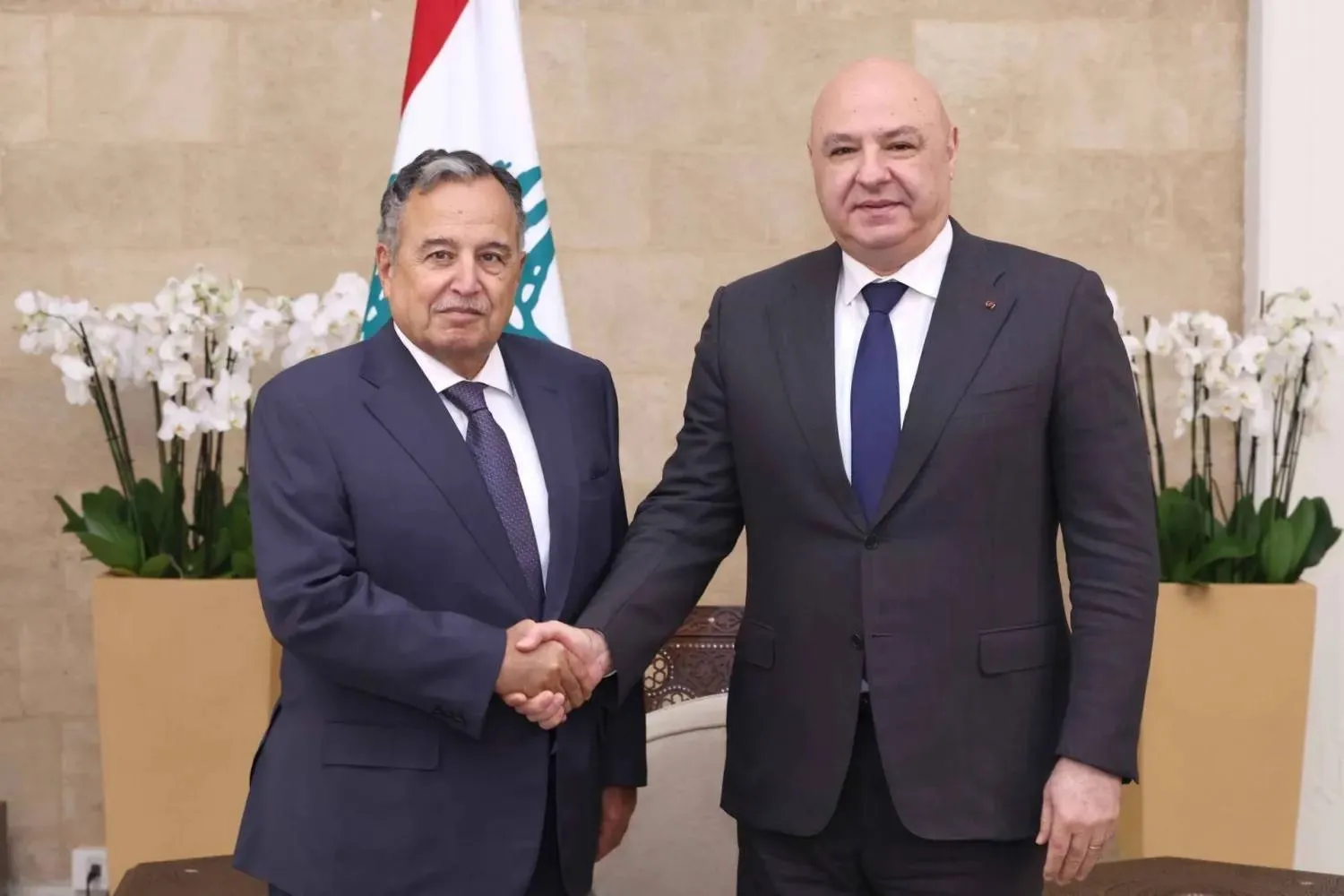
Arab League Chief Pushes for Concrete Support for Lebanon

Lebanese President Joseph Aoun welcomes Arab League Secretary-General Nabil Fahmy (Lebanese Presidency)
TT

Arab League Chief Pushes for Concrete Support for Lebanon

Lebanese President Joseph Aoun welcomes Arab League Secretary-General Nabil Fahmy (Lebanese Presidency)

Arab League Secretary-General Nabil Fahmy has called for concrete political and financial support for Lebanon, as Lebanese leaders pressed for a diplomatic solution, Israel’s withdrawal and reconstruction.

“Lebanon is among the Arab League’s priorities, and among my own priorities as its secretary-general,” he said on Monday during a visit to Beirut that included meetings with President Joseph Aoun, Parliament Speaker Nabih Berri and Prime Minister Nawaf Salam.

Meeting the Arab League chief, Aoun accused Israel of failing to comply with the agreed framework and continuing its violations in South Lebanon, saying such actions only strengthened Lebanese determination to defend their land and rights.

He reaffirmed Lebanon’s commitment to diplomacy despite its difficulties, describing it as far less costly than a devastating war.

Declaring that it was time for Lebanon to enjoy some respite, Aoun welcomed Arab efforts to help the country overcome its challenges and stressed the importance of dialogue and negotiations.

The secretary-general said his visit followed a decision by Arab foreign ministers reaffirming support for Lebanon’s sovereignty, institutions and citizens.

He called for tangible financial and practical assistance that would strengthen state institutions and directly benefit the population, pledging to intensify contacts with Arab and Western governments.

Asked about the risk of a wider regional war, Fahmy denied conveying specific warnings to Aoun but acknowledged discussing the dangers posed by multiple conflicts and the possibility of a broader escalation.

He also reaffirmed the Arab League’s support for ending Israeli occupation and preserving Lebanon’s stability, stressing that each country had the right to determine its negotiating approach when asked about US-sponsored Lebanese-Israeli talks.

In talks with Berri, the Arab League chief reviewed regional developments and continued Israeli attacks, pledging to pursue diplomatic initiatives to secure assistance for Lebanese institutions and citizens.

The two also discussed the future of the United Nations Interim Force in Lebanon (UNIFIL), whose planned departure has raised concerns over a security vacuum.

The secretary-general said the Arab League opposed ending the mission, arguing that a continued UN presence offered the strongest framework for international oversight and accountability. Any alternative, he stressed, would require Lebanese agreement and a clear international legal mandate.

Salam urged continued Arab efforts to secure Israel’s complete withdrawal from Lebanese territory and extend state authority nationwide through its own forces.

He also urged support for recovery and reconstruction to help residents remain in their communities and strengthen state institutions.

The prime minister encouraged Arab investment in infrastructure and regional connectivity projects to stimulate growth and deepen Lebanon’s integration with its Arab neighbors.

Fahmy announced plans to visit South Lebanon to assess conditions firsthand and help shape further diplomatic engagement with Arab governments and international partners.

The visit would support efforts to secure political and financial assistance for Lebanese institutions, including the army.

He said the trip would allow him to return to Cairo with a clearer assessment of Lebanon’s needs, paving the way for follow-up on Arab commitments and closer coordination of political and financial support.


Four Killed in Gaza after Sand Embankment Collapses on to Tents

A Palestinian child sits beside a pool of rainwater at a camp for displaced people in Deir al-Balah in the central Gaza Strip, Saturday, Nov. 7, 2026. (AP Photo/Abdel Kareem Hana)
TT

Four Killed in Gaza after Sand Embankment Collapses on to Tents

A Palestinian child sits beside a pool of rainwater at a camp for displaced people in Deir al-Balah in the central Gaza Strip, Saturday, Nov. 7, 2026. (AP Photo/Abdel Kareem Hana)

Torrential rain in Gaza caused a sand embankment to collapse on to tents, killing a woman and three small children in an incident that highlighted the danger facing hundreds of thousands of displaced Palestinians as the rainy winter season sets in.

Medics said heavy rain late on Sunday washed away a rocky sand bank abutting a camp for displaced families south of Deir al-Balah, in central Gaza. A woman and two of her children, aged 8 and 6, were killed. A fourth child, aged 4, was also killed, and six others were injured.

Video verified by Reuters showed residents using hammers to break large sandy rocks and others removing sand with shovels searching for people trapped underneath using flashlights.

"What can one say about the situation in Gaza? Whoever did not die from bombs and missiles is dying from buildings collapsing on them, from the collapse of sand and mountains on them," said Amal Al-Zein, 35, a relative of the victims.

Sohaib Abu Darbali, a witness, said the collapse of the embankment sounded like an explosion.

"We found that three tents were covered completely after the mountain collapsed on top of them. People were under the rubble and we couldn't see them," he told Reuters.

'THE ONLY SOLUTION IS RECONSTRUCTION'

The vast majority of Gaza's 2 million population lives in tent encampments or the ruins of bombed-out buildings, with reconstruction yet to begin following Israel's two-year military assault, launched after the 2023 Hamas attacks on southern Israel.

For many of them, this is the fourth winter during which they will need to cope with flood water overtaking their tents and soaking their belongings when it rains.

Local authorities said at least 70,000 tents had been flooded in the first hours after heavy rain began on Saturday.

The UN Office for the Coordination of Humanitarian Affairs said humanitarian partners had received appeals from more than 26,000 households reporting damage to shelters or belongings following weekend rainstorms.

A US-brokered ceasefire last year called for the eventual reconstruction of Gaza, but little progress has been made. Negotiators have failed to agree on terms for Hamas to disarm or for Israel to withdraw its troops, which control about two-thirds of the territory and from which residents have been ordered to leave.

Mahmoud Basal, spokesman for Gaza's civil defence service, said people put up their tents next to sand banks believing they could protect them.

"Tents can't protect people, neither from rain nor of the heat, the only solution is reconstruction," Basal told Reuters.

Israel says no reconstruction can happen before Hamas is disarmed.


Al-Shaibani: Syrian-Jordanian Relations at Their Strongest in Decades

 Jordanian Deputy Prime Minister and Minister of Foreign Affairs Ayman Safadi meets with Syrian Minister of Foreign Affairs and Expatriates Asaad Al-Shaibani on the sidelines of the second session of the Jordan-Syria Higher Coordination Council, a body established to institutionalize strategic cooperation between the two nations. Photo: dpa
Jordanian Deputy Prime Minister and Minister of Foreign Affairs Ayman Safadi meets with Syrian Minister of Foreign Affairs and Expatriates Asaad Al-Shaibani on the sidelines of the second session of the Jordan-Syria Higher Coordination Council, a body established to institutionalize strategic cooperation between the two nations. Photo: dpa
TT

Al-Shaibani: Syrian-Jordanian Relations at Their Strongest in Decades

 Jordanian Deputy Prime Minister and Minister of Foreign Affairs Ayman Safadi meets with Syrian Minister of Foreign Affairs and Expatriates Asaad Al-Shaibani on the sidelines of the second session of the Jordan-Syria Higher Coordination Council, a body established to institutionalize strategic cooperation between the two nations. Photo: dpa
Jordanian Deputy Prime Minister and Minister of Foreign Affairs Ayman Safadi meets with Syrian Minister of Foreign Affairs and Expatriates Asaad Al-Shaibani on the sidelines of the second session of the Jordan-Syria Higher Coordination Council, a body established to institutionalize strategic cooperation between the two nations. Photo: dpa

Jordanian Foreign Minister Ayman Safadi said Syria's security and stability were vital to Jordan and a cornerstone of regional stability.

Speaking at a joint news conference in Damascus with his Syrian counterpart Asaad al-Shaibani, Safadi said Jordan was working with Syria to build a future for a free, secure and stable Syrian state.

"We mourn the civilian victims who lost their lives in the Daraa incident and extend our sincere condolences to their families. Syrian blood is just as precious as Jordanian blood," Safadi said.

He added that a joint security committee had met and agreed on mechanisms to coordinate counterterrorism efforts.

"We are proud of what we have achieved so far and will continue strengthening cooperation between Jordan and Syria," Safadi said, pointing to the signing of 11 agreements aimed at deepening integration between the two countries.

He also reiterated Jordan's condemnation of Israeli attacks on Syrian territory.

For his part, al-Shaibani described Syrian-Jordanian relations as being "at their strongest in decades," reaffirming Damascus' commitment to strengthening ties with Amman across various sectors.

"We have agreed with Jordan to rehabilitate the international highway linking our two countries at a cost of $47 million, as well as to expand the capacity and improve the efficiency of the Nassib border crossing," he said.

"A joint security and technical committee has been established to investigate the Daraa incident and determine the circumstances surrounding it. Efforts are underway to provide redress and compensation to the innocent victims of the strikes," al-Shaibani added.


New Mass Grave Discovered South of Damascus

A photo posted on Facebook by the Tadamon Neighborhood Coordination Committee showing one of its demonstrations demanding that those responsible for the neighborhood's massacres be brought to justice.
TT

New Mass Grave Discovered South of Damascus

A photo posted on Facebook by the Tadamon Neighborhood Coordination Committee showing one of its demonstrations demanding that those responsible for the neighborhood's massacres be brought to justice.

Residents of the Tadamon neighborhood in southern Damascus discovered a new mass grave on Monday in the Al-Shuhada area, also known as Al-Sulaykha, bringing the number of mass graves found in the neighborhood to eight.

The discovery came a day after Syria's Justice Ministry referred the case of Amjad Youssef, known as the "Butcher of Tadamon," to an investigating judge ahead of his trial.

The newly discovered grave contained the remains of more than five victims, according to the Tadamon Neighborhood Coordination Committee, which said search operations were continuing with the assistance of Civil Defense teams and the National Commission for the Missing.

It is the eighth mass grave discovered in the same area.

The neighborhood coordination committee has been documenting suspected mass grave sites throughout Tadamon through video footage and eyewitness accounts.

In a video released by the committee, a local resident said children had discovered human bones at the site.

Another resident appealed to the relevant authorities to survey the entire area, recover the remains and preserve them properly, ensuring that the families of missing people have access to evidence that could help establish the fate of their loved ones.

"Every time someone starts laying the foundations for a house, they find human bones," he said.

The Interior Ministry's Counterterrorism Department referred the case of Amjad Youssef, the principal suspect in the Tadamon massacres, to the Office of the Prosecutor General for transfer to an investigating judge.

The referral is intended to initiate public prosecution proceedings against Youssef and his alleged accomplices based on the evidence and investigative findings submitted by the authorities.

In a statement issued upon receiving the case file, the Justice Ministry reaffirmed its determination to pursue accountability, prevent impunity and deliver justice to victims of crimes committed against the Syrian people, in accordance with the law and the principles of transitional justice.

The move followed the conclusion of preliminary investigations into Youssef, the main suspect in the massacres committed in 2013.

The Syrian Justice Ministry announced that the case had been referred to the Prosecutor General as a step toward bringing him to trial under the country's transitional justice process.

Syrian internal security forces arrested Youssef in April 2026 during an operation in the Hama countryside.

Youssef, a former warrant officer with Branch 227 of the Assad regime's Military Intelligence Directorate, was detained along with several members of his security unit and people close to him as part of the investigation.

The Interior Ministry subsequently released video footage of his confessions, in which he admitted to killing dozens of civilians in cold blood and burning their bodies in a pit in the Tadamon neighborhood in 2013, without having received direct orders.

Conflicting Death Tolls

Estimates of the number of victims killed in the Tadamon massacres vary considerably.

Some estimates put the death toll at 280, while testimonies from neighborhood residents suggest that several thousand people may have been killed.

The uncertainty reflects the large number of people who disappeared in the area and the discovery of numerous pits and sites containing the remains of victims of the 2013 massacres, which took place within a residential block that was under construction.

The case of Amjad Youssef, dubbed the "Butcher of Tadamon," has emerged as one of the most prominent cases pursued over the past year under Syria's transitional justice process.

It concerns one of the most horrific atrocities documented in video and audio recordings, filmed by the perpetrators themselves as a display of pride in what they portrayed as their "heroic" actions.

The Tadamon massacres are also closely connected to broader efforts to determine the fate of thousands of missing and forcibly disappeared people in Damascus during the early years of the uprising against Bashar al-Assad's regime.

Among them are the six children of Dr. Rania al-Abbasi and her husband, Dr. Abdul Rahman, who have been missing since 2013.

According to the Interior Ministry, investigations involving detainees in the Youssef case uncovered evidence indicating his involvement in the killing of the couple's six children.

In May 2026, Syria's National Commission for the Missing announced that it had reached reliable findings establishing, with a high degree of professional certainty, that the children had been killed.

The fate of their parents, however, remained unknown.

In August 2026, the commission also announced that it had established the fate of Bassam Bahra and his son, Samih Bahra, 13 years after their disappearance in Damascus.

It said the two had been killed in the Tadamon neighborhood by a group led by Youssef and his accomplice Kamel Abbas.

The Tadamon massacre first drew international attention following an investigation published by The Guardian on April 27, 2022.

The investigation exposed a massacre carried out by forces loyal to Bashar al-Assad's regime on April 16, 2013, in which approximately 41 people were killed and buried in a mass grave in the Tadamon neighborhood.

The report included video footage showing Youssef, a noncommissioned officer serving with Branch 227 of the Military Intelligence Directorate, forcing dozens of blindfolded civilians of different ages toward a large, deep pit alongside other perpetrators.

The victims were shot as they fell into the pit, after which their bodies were set on fire.

Media reports have indicated that 27 videos documenting the Tadamon massacre are held in Britain, with only one having been made public.

Abdul Moneim Zain Al-Din, described as the general coordinator of the Syrian revolution, previously cited that figure and called for the release of the remaining recordings.