Türkiye Troops to Stay in Syria, Iraq ‘Until Border Security Ensured’, Defense Minister Says

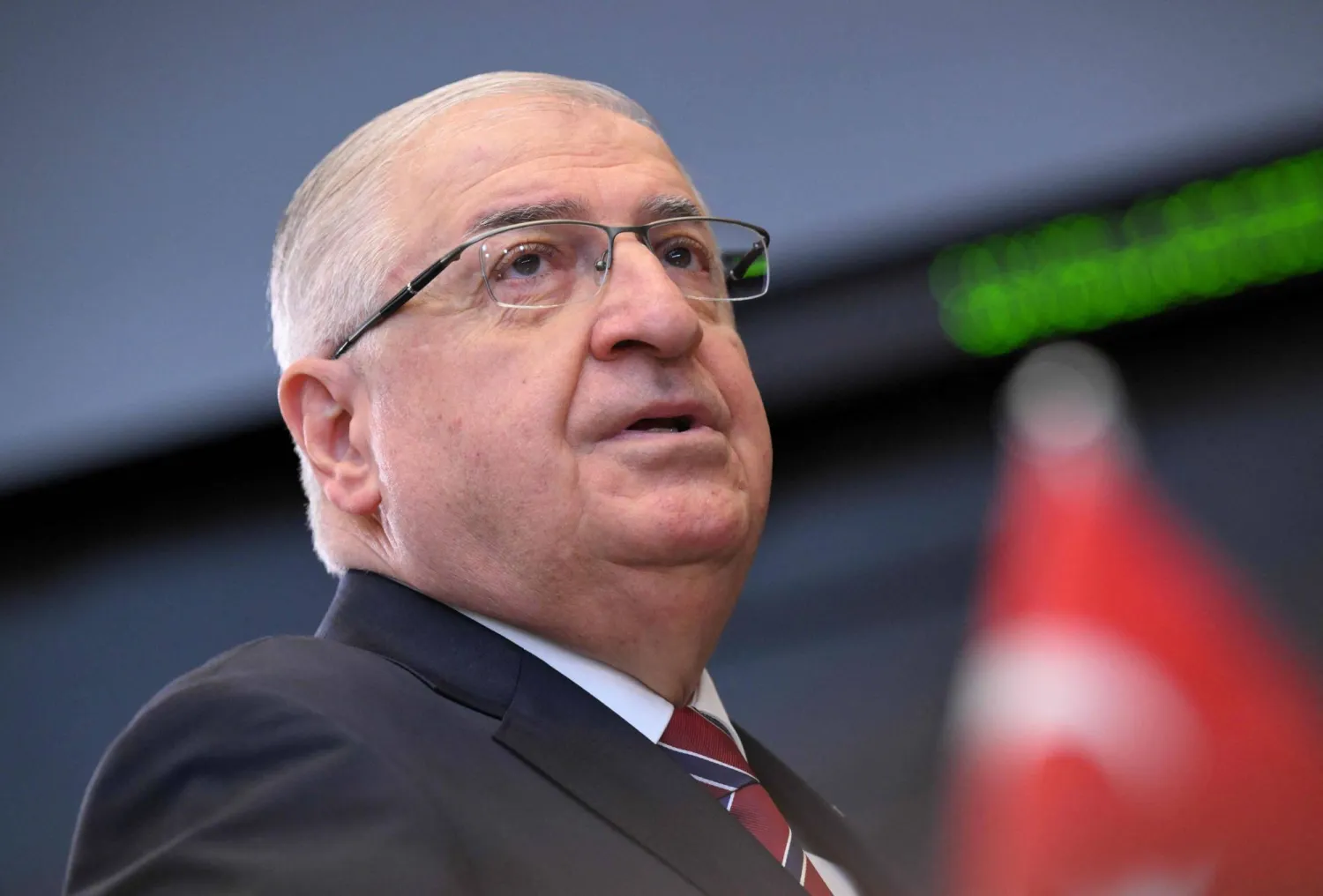
Türkiye's Defense Minister Yasar Guler attends the meeting of Ministers of Defense of the North Atlantic Council at the NATO headquarters in Brussels on February 15, 2024. (AFP)
TT

Türkiye Troops to Stay in Syria, Iraq ‘Until Border Security Ensured’, Defense Minister Says

Türkiye's Defense Minister Yasar Guler attends the meeting of Ministers of Defense of the North Atlantic Council at the NATO headquarters in Brussels on February 15, 2024. (AFP)

Türkiye will keep its own troops in Syria and Iraq until border security with its two neighbors has been fully ensured, Defense Minister Yasar Guler told AFP.

"We are maintaining our military presence in Iraq and Syria," he said in a written answer to AFP questions.

"When we assess that the necessary conditions have been met in terms of regional and border security, the status of our base areas and our presence in the region will be reconsidered."

Türkiye has for years maintained troops in northern Syria and Iraq to contain the threat along its borders posed by separatist militants from the Kurdistan Workers' Party (PKK) and from ISIS extremists.

But over the past two years, the situation has shifted with the emergence of a new Ankara-allied government in Syria following Bashar al-Assad's fall, and following Türkiye's push to draw a line under its decades-long conflict with the PKK.

Since Assad's fall, Türkiye had established "close coordination in the field of security" with the new Syrian government, with its troops working to "strengthen the capacity" of the Syrian military and "to ensure the security of our borders", the minister said.

"Once the terrorist threat in the region has been completely eliminated, border security has been ensured, and state authority has been fully and uniformly established throughout Syria without exception, the status of our forces will be reassessed," he said.

When the Assad regime fell, Türkiye had between 16,000 and 18,000 troops in northern Syria, a Turkish official said.

Since then, there has been no reliable figure for troops deployed in Syria, although a Turkish official last month said talks were under way to determine their legal status there.

But Guler refused to be drawn on any future plans.

"At this stage it would not be appropriate to make a prior assessment regarding deployment or base plans that have not been made public," he said.

"Issues related to the future posture of the Turkish armed forces in Syria will be addressed by taking into account Syria's sovereignty and territorial integrity, the mutual understanding of the two countries, the security conditions on the ground and the evolution of the terrorist threat."

- Troop numbers according to needs -

Turkish troops have also long been operational in northern Iraq, regularly conducting cross-border operations and air raids on PKK hideouts, while maintaining their own bases there -- putting a strain on ties between Ankara and Baghdad.

Troops have been based there since 2015, and today they number between 800 and 1,000, an Iraqi security source told AFP.

Without disclosing any figures, Guler said troop numbers in both Iraq and Syria were assessed in proportion to what was needed on the ground.

"It would not be accurate to assess our military presence in Iraq and Syria solely on the basis of personnel numbers. Our force structure and posture on the ground are shaped according to needs" linked to threat levels, border security and developments on the ground, he said.

As the PKK process has advanced, the Kurdish militants destroyed weapons at a symbolic ceremony last year, and this month, withdrew from four key bases in northern Iraq in a move confirmed by Turkish intelligence.

For lasting success, the PKK must "fully implement their decision to dissolve" with Türkiye "meticulously monitoring the next phases of the process" while not dropping its guard.

"The progress of the process doesn't mean security measures have been relaxed," he said, with troops continuing to "take the necessary measures" against any situation viewed as a security threat.

Like in Syria, Türkiye was also closely watching Iraq's own efforts "to disarm armed groups and bring them under state control", he said, hailing recent successes in the Sinjar region.

Iraq has set a June 30 deadline for pro-Iran factions to hand over their weapons to the state following the end of the US-led coalition's mission there.

Following the successful Sinjar push, Türkiye said last month it would "gradually" hand control to Baghdad of its Bashiqa base near the northern city of Mosul although no timeline was given.

Türkiye would continue to support Iraq and was planning "to elevate military and security cooperation between the two countries to a higher level" in the coming period, he said.


Netanyahu Dismisses Claims That Israel Is Blocking Supplies to Gaza

A Palestinian child sits beside a pool of rainwater at a camp for displaced people in Deir al-Balah in the central Gaza Strip, Saturday, Nov. 7, 2026. (AP)
TT

Netanyahu Dismisses Claims That Israel Is Blocking Supplies to Gaza

A Palestinian child sits beside a pool of rainwater at a camp for displaced people in Deir al-Balah in the central Gaza Strip, Saturday, Nov. 7, 2026. (AP)

Netanyahu said Israel was not to blame for the worsening conditions for Palestinians in Gaza’s tent camps that have been hit with severe winter floods.

His remarks came after the US-created Board of Peace — established under US President Donald Trump's plan to end the Israel-Hamas war and oversee Gaza’s recovery — said Monday that Israel's delaying of the entry of winter supplies into Gaza had “exacerbated the consequences of a foreseeable humanitarian challenge.”

Torrential rain has battered the war-torn enclave in recent days, damaging tens of thousands of makeshift tents. Four people, including three children, were killed on Sunday when a large sandstone slab collapsed onto tents during the rains.

Netanyahu said the Palestinian group Hamas is to blame because it continues to refuse to disarm, a condition of the deal announced by Trump, and seizes humanitarian aid in order to use it for military purposes.

“Hamas alone is responsible for the suffering of the people of Gaza, and it is now cynically exploiting that suffering to shift blame onto Israel once again,” he said Tuesday.

British Foreign Secretary Ed Miliband said the situation in Gaza was “intolerable” and demanded Israel end “arbitrary restrictions” on aid.

In Washington, Sen. Brian Schatz of Hawaii, the top Democrat on the Senate's foreign spending subcommittee, called for Israel to immediately allow winter gear into Gaza.

“There are a lot of challenges when it comes to Israel and Palestine that are complicated, and fraught, and contentious,” Schatz said on the Senate floor on Tuesday. “But we should all be able to agree that repairing torn tents and helping people to dry out, and providing warmth to freezing children is a basic human obligation.”


Representatives of 3 Countries Receive Families of ISIS Fighters from Syria’s Roj Camp

Women and their children at the Roj camp in Syria. (AFP file)
TT

Representatives of 3 Countries Receive Families of ISIS Fighters from Syria’s Roj Camp

Women and their children at the Roj camp in Syria. (AFP file)

Representatives of Sudan, Somalia and Indonesia have received another group of their nationals from the Roj camp in Syria’s northeastern Hasakah province, the country’s last remaining camp housing families of ISIS fighters.

The handover took place three days ago during a visit by the foreign representatives, accompanied by Syrian government officials and members of the Internal Security Forces, according to a local activist.

The repeated visits by government security delegations suggest that Damascus is preparing to take over administration of the facility from the dissolved Kurdish Syrian Democratic Forces (SDF), the activist said.

Ibrahim al-Halabi, a resident of Hasakah, told Asharq Al-Awsat that the delegation met women living at the site who described their circumstances.

Located in the far northeast of Hasakah province, Roj houses around 2,200 women and children in 750 tents. Its residents hold various foreign and Arab nationalities, including Turkish, Russian, British, French, German, Australian, Indonesian, Sudanese, Somali and Tunisian citizenship. It became Syria’s last remaining camp for families of ISIS fighters following the closure of al-Hol, also in the Hasakah countryside.

Several groups of Sudanese, Somali and Indonesian nationals have already been repatriated since 2022.

According to Halabi, the latest handover included 12 Indonesian women and their children, 30 Somali women and between three and nine Sudanese women.

Dual citizenship complicates repatriation

Halabi explained that Sudanese and Somali nationals repatriated in previous operations held only one nationality. Others, however, have dual citizenship, including Sudanese-British and Somali-British nationals, complicating efforts to arrange their return.

Some women have refused to be handed over to Sudanese authorities, demanding instead that they be transferred to the British government. As a result, Sudanese and Somali women holding dual nationality have yet to be repatriated, Halabi noted.

He added that Syrian government Internal Security Forces had entered Roj several times recently, during which residents from Australia, Sudan, Somalia, Indonesia and Trinidad and Tobago were transferred out.

The latest visit brought considerable relief to residents.

Halabi also viewed the visits as a sign that Damascus would assume responsibility for managing the facility. However, he expected security arrangements to remain under the supervision of former SDF personnel integrated into the government’s Internal Security Forces under the January 2026 agreement between Damascus and the Kurdish-led force.

Roj's future

In February, the Syrian government took control of al-Hol, previously the country’s largest detention camp for families of ISIS fighters, after wresting it from the SDF, which had administered both facilities.

Al-Hol, described as the world’s most dangerous camp, had housed tens of thousands of families of various nationalities.

Following its takeover, Damascus began evacuating foreign residents and transferring them to another camp in the northern Aleppo province.

With al-Hol closed, Roj emerged as the most prominent remaining facility housing women and widows of ISIS members from different countries.

However, activists in northern Syria say it remains unclear when the camp will close or where its residents will be transferred afterward.


Iraq Reopens One Border Crossing with Iran, Closes Another as It Pursues Mediation

Iraqi Prime Minister Ali al-Zaidi. (INA)
TT

Iraq Reopens One Border Crossing with Iran, Closes Another as It Pursues Mediation

Iraqi Prime Minister Ali al-Zaidi. (INA)

Iraqi Foreign Minister Fuad Hussein confirmed Tuesday that Prime Minister Ali al-Zaidi’s secret visit to Iran was aimed at bringing Tehran and Washington closer together, as Baghdad reopened one border crossing with Iran and announced the temporary closure of another.

Speaking to the Iraqi News Agency (INA) on the sidelines of the Paris Peace Forum, Hussein described the visit as “an attempt to bring the Iranian and American positions closer together, alongside other efforts.”

He stressed Iraq’s interest in easing tensions, citing the economic impact of the closure of the Strait of Hormuz and casualties from the US war on Iran.

“We have strong relations with our neighbor Iran, as well as excellent relations with the United States,” Hussein said. “That is why Iraq can play this role, although other countries are also doing so.”

Request for time

A senior Iraqi government official told Asharq Al-Awsat that al-Zaidi had conveyed an American message to Tehran outlining a possible formula for resolving the conflict between the two countries.

The Iranian side, however, requested more time to respond, according to the official.

A source familiar with the visit confirmed to Iran’s Fars News Agency that al-Zaidi had traveled to Tehran last Friday for several hours and met Mohammad Bagher Ghalibaf, Iran’s parliament speaker and head of its negotiating delegation.

The agency reported that talks focused exclusively on Baghdad’s efforts to end the war.

Despite repeated official statements presenting the visit as a mediation effort, a source close to Iraq’s Coordination Framework suggested it might instead have been motivated by domestic concerns.

“Al-Zaidi’s recent policies, particularly the ban on Iranian flights and the closure of some border crossings, have caused considerable harm to Iran,” the source told Asharq Al-Awsat.

The visit may therefore have been intended to explain Baghdad’s position on those measures and avoid angering Tehran, it added.

It pointed to the recent public confrontation between al-Zaidi and Kataib Hezbollah, warning that tensions could lead to a direct clash. Given its influence and close ties with some armed factions, Tehran could help ease the dispute.

Regional role

Ihssan Shmary, an academic and head of the Political Thinking Center, believes al-Zaidi’s visit was primarily part of his efforts to establish a regional diplomatic role through an initiative he had previously presented to US President Donald Trump.

Speaking to Asharq Al-Awsat, Shmary said that the trip coincided with extensive Arab and regional efforts to reduce tensions and prevent renewed fighting between Washington and Tehran.

He described the trip as an attempt to break the deadlock between the two countries and secure a foreign policy achievement for Iraq.

Nevertheless, he questioned Baghdad’s ability to bring Washington and Tehran to the negotiating table.

“Iraq may be very far from being able to play the role of a country that brings the US and Iran together at a table of understanding,” he cautioned.

Al-Sheeb reopens, Mandali closes

In a separate development, Omar al-Waeli, head of Iraq’s Border Ports Authority, announced Tuesday the reopening of the al-Sheeb crossing with Iran, which had been closed since October 21.

Authorities also decided to temporarily close the Mandali crossing in the Diyala province beginning Friday.

Al-Waeli explained that al-Sheeb would resume operations following completion of the required technical procedures, while Mandali’s closure would allow similar technical requirements to be addressed.

The decisions followed earlier remarks by Foreign Minister Hussein revealing that the US Treasury Department had formally requested Baghdad to close all its border crossings with Iran except two.

Ban on Iranian flights remains in place

Meanwhile, Iran’s Football Federation announced Tuesday that Iraq had refused permission for a direct flight carrying the Iranian national team to land at Basra airport.

The team was scheduled to participate in a friendly tournament alongside Iraq, Lebanon and Palestine.

Iran’s Mehr News Agency quoted the federation as blaming obstacles imposed by the Iraqi government, particularly its refusal to authorize a direct flight to Basra.

As a result, the players traveled to the Iranian city of Abadan, from where they would continue to Basra by road.

An Iraqi Transport Ministry official told Asharq Al-Awsat that Iranian aircraft were permitted to land only at Najaf airport.

The Iranian side had chosen to fly the team to Abadan because it was closer to the stadium in Basra, the official explained.

He confirmed that Iraq remained committed to its ban on Iranian flights landing at Iraqi airports, with Najaf as the sole exception, to avoid US Treasury sanctions.