Terrorist Attack on Church in Jordan's Karak Leaves Dozens Dead, Wounded

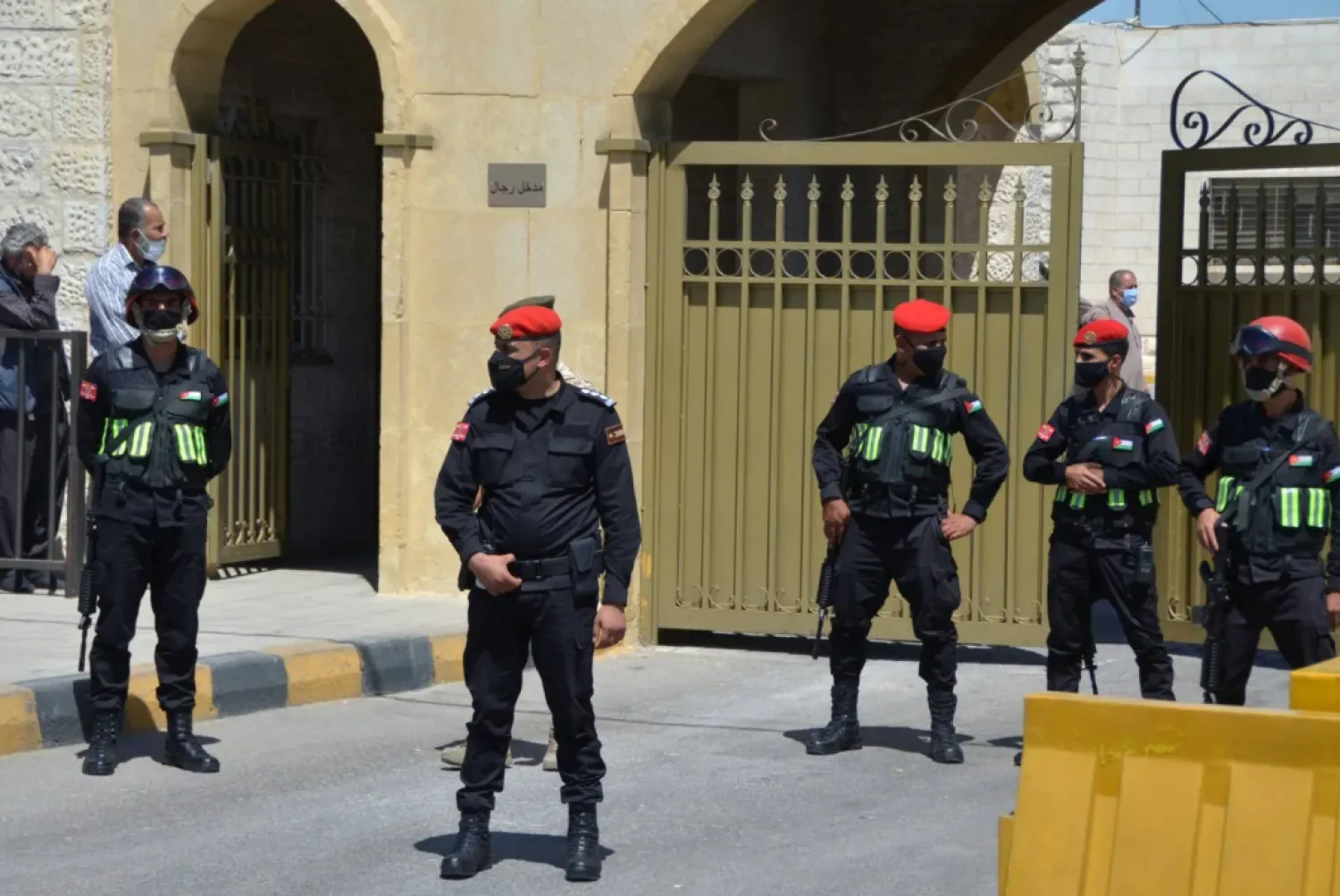
Jordanian security personnel in the capital, Amman (Reuters/File Photo)
TT

Terrorist Attack on Church in Jordan's Karak Leaves Dozens Dead, Wounded

Jordanian security personnel in the capital, Amman (Reuters/File Photo)

Jordan's King Abdullah II vowed to impose the "harshest penalties" on those responsible for an attack on a church in Karak, southern Jordan, that left dozens of people dead and wounded.

The king visited people injured in the "terrorist attack" and checked on their condition, according to the Jordan News Agency.

The Jordanian monarch stressed the need to confront the perpetrators of the terrorist attack in Karak with the harshest penalties, expressing confidence that those who believed their treacherous bullets could divide Jordanians would see their efforts fail. He reaffirmed the strength and unity of the Jordanian people.

In a post on X, the king said: "All Jordanians, from the north of the country to the south, share the same land and stand united, and no act of treachery will divide them."

King Abdullah offered condolences to the families of those killed and wished the wounded a speedy recovery.

"Every Jordanian life is precious, and we will deal with an iron fist with anyone who attacks this country," he said.

In Hamoud village in Karak Governorate, about 150 kilometers south of the capital, Amman, two gunmen opened fire indiscriminately with automatic rifles, killing several people and wounding dozens, some critically.

The village is home to the Christian Al Halasa clan, one of the largest Christian clans in the governorate.

Surveillance footage from outside the church, widely circulated online, showed the two gunmen carrying out the attack. A third armed man also appeared in the footage but apparently did not manage to fire his weapon.

Eyewitness Account

An eyewitness described to Asharq Al-Awsat the horrifying scenes experienced by people near the church.

At approximately 2:15 p.m. local time in Amman, two armed men entered and opened fire. Bloodshed quickly engulfed the area, with bodies lying outside the church before the scene of the massacre extended into the church's nave.

One eyewitness, who had been standing at the church entrance, said he initially struggled to comprehend what was happening.

He realized the gravity of the attack only when a bullet missed him and struck his cousin, who was standing beside him, in the chest. His cousin died in his arms.

The witness described being overwhelmed by shock and confusion as his cousin died in his arms while his mother remained inside the church.

Realizing that death surrounded the building, he rushed through gunfire coming from every direction in an attempt to rescue his mother, even if it meant sacrificing his own life.

"The shooting went on for a long time, and no one managed to stop the two gunmen," he said.

The scenes described by the eyewitness were documented in dozens of videos circulated on social media.

The attack was unprecedented in Jordan, targeting members of the Christian community in Karak, a governorate known for its tradition of coexistence between Muslims and Christians.

Who Were the Attackers?

Jordanian Interior Minister Mazin Al Farrayeh subsequently declared that the country was confronting "a terrorist operation carried out by a group of extremists who committed a horrific act."

Public Security Director Maj. Gen. Obaidallah Maaytah later announced that the death toll had risen to seven, with 27 people wounded.

The church had been receiving mourners attending a funeral service for a member of the clan and was crowded with people paying their respects.

The gathering made it easier for the attackers to inflict a large number of casualties among villagers who traditionally come together for such occasions.

Sources told Asharq Al-Awsat that the two attackers, who fled the scene, were residents of Karak Governorate and adherents of extremist takfiri ideology.

They were reportedly aware of the location and timing of the funeral service, indicating that the attack had been premeditated.

The sources confirmed that the identities of the two attackers had been established and that security forces were continuing to search for them and other suspects believed to be involved in a terrorist cell.

They added that entrances and exits to the governorate had been secured to prevent the suspects from escaping.

Maj. Gen. Maaytah confirmed that authorities possessed information about the perpetrators of the terrorist attack but said it was premature to disclose the suspects' names.

He also declined to set a deadline for their arrest.

"We cannot specify a timeframe for concluding the operation because it depends on the nature of the situation," he said.

This is not the first time Karak has experienced a terrorist attack.

Residents still recall the events at Karak Castle in December 2016, when security forces pursued ISIS members who subsequently barricaded themselves inside the historic fortress, where weapons had been concealed.

During that incident, hostages were held inside the castle, and the operation lasted more than 15 hours.

According to the account, 14 people, including security personnel, civilians and a foreign tourist, were killed, while many others near the castle were wounded. All four militants involved in the attack were also killed.


Bilal Erdogan: Developments in Syria Will Restore Shared Ties Between Beirut, Tripoli and Turkish Cities

Bilal Erdogan, the son of Turkish President Recep Tayyip Erdogan, center, waves to his Lebanese supporters outside a mosque after Friday prayers in Tripoli, northern Lebanon, Friday, Nov. 13, 2026. (AP)
TT

Bilal Erdogan: Developments in Syria Will Restore Shared Ties Between Beirut, Tripoli and Turkish Cities

Bilal Erdogan, the son of Turkish President Recep Tayyip Erdogan, center, waves to his Lebanese supporters outside a mosque after Friday prayers in Tripoli, northern Lebanon, Friday, Nov. 13, 2026. (AP)

Bilal Erdogan, son of Turkish President Recep Tayyip Erdogan, called on Friday for greater regional unity to confront attacks on Gaza, the West Bank, southern Lebanon and Syria, voicing hope that recent developments in Syria would revive historic trade and economic ties between Lebanese, Syrian and Turkish cities.

Erdogan, President of the Board of Trustees of the Knowledge Dissemination Foundation, made the remarks in the northern city of Tripoli on the second day of his visit to Lebanon, where he was welcomed by political and religious figures and locals.

Speaking after prayers at the Grand Mansouri Mosque, his first stop in the city, Bilal Erdogan said he had brought a message from his father to the Lebanese people, aimed at strengthening relations and bonds of brotherhood between the two countries.

He also voiced hope for an end to war and conflict in Lebanon, paving the way for stability, recovery and prosperity similar to the development Türkiye had experienced over the past 24 years.

"God willing, this visit will help end the war in Lebanon and bring prosperity and recovery, as happened in Türkiye over the past 24 years," Bilal Erdogan said.

Turning to Syria, said recent developments could help restore the historic ties and shared economic interests linking cities across Lebanon, Syria and Türkiye.

"God willing, with the recent developments in Syria, the bonds of shared destiny between Beirut, Tripoli, Antakya, Damascus, Gaziantep and Istanbul will be restored, as they were in the past," he said.

"The people of these cities will once again engage in trade, cooperation, partnership and brotherhood."

He stressed the need to revive cooperation between Tripoli and cities in Syria and Türkiye, strengthening economic and social ties and reconnecting communities across the region.

Addressing Israeli attacks, Bilal Erdogan said regional unity and solidarity could deter further assaults and prevent wars from continuing.

He cited what he described as genocide in Gaza, violations against villages and homes in the West Bank, destruction in southern Lebanon and attacks in Syria.

“Those demolishing homes and seizing land in Gaza, the West Bank, Syria and southern Lebanon would not dare continue if the region's peoples stood united,” he said.

Bilal Erdogan toured Tripoli's old markets, the Mevlevi lodge, citadel and several Ottoman-era mosques.

He is due to visit Kouachra in the northern Akkar region on Saturday to meet residents of Turkmen descent before traveling to Beirut for talks with Prime Minister Nawaf Salam, who will host a luncheon in his honor to conclude the visit.

He kicked off his Lebanon visit on Thursday with meetings with President Joseph Aoun, Parliament Speaker Nabih Berri, former Progressive Socialist Party leader Walid Jumblatt, Lebanon's Grand Mufti Sheikh Abdel Latif Derian and Greek Orthodox Metropolitan of Beirut Elias Audeh.


UN Rights Chief Demands Houthis Return Body of Yemeni Staff Member

UN High Commissioner for Human Rights Volker Turk delivers a statement at the United Nations Offices in Geneva, on September 16, 2025. (AFP)
TT

UN Rights Chief Demands Houthis Return Body of Yemeni Staff Member

UN High Commissioner for Human Rights Volker Turk delivers a statement at the United Nations Offices in Geneva, on September 16, 2025. (AFP)

The UN's ‌human rights chief on Friday demanded the return of the body of a Yemeni staff member of his office who died of unknown causes weeks ago after being held in Houthi custody for more than two years.

Mohammad el-Shami's family learned of his death on October 30, more than a month after it occurred, but ‌they have received no ‌explanation of the cause ‌or ⁠circumstances. El-Shami ⁠had been held by the Houthi militia since June 6, 2024.

"Our colleague must be laid to rest in a dignified manner, in accordance with the wishes of his family – which was denied contact with him ⁠for two years while he ‌was in detention," ‌said United Nations High Commissioner for Human Rights Volker ‌Turk.

His family said the Houthis had ‌agreed in principle to an investigation in a statement earlier this week. "Do not allow Mohamed to die twice: once when he was taken from ‌his family and disappeared, and again when the truth about his ⁠fate ⁠is allowed to disappear from the world."

There was no immediate comment from the Houthis, who have previously alleged those detained were part of a spy network working for the United States and Israel.

More than 70 UN employees and dozens of humanitarian workers remain in detention in Yemen. A video circulating this week appeared to show one of them "confessing", Turk's office said, voicing fears that the group may be subject to torture or ill-treatment.


Palestinian Teen Reunites with Family After Month in Israeli Jail

The mother of Ezzedine al-Lahalia, a 15-year-old Palestinian teenager, kisses him as they reunite in the village of Al-Jib in the Israeli-occupied West Bank, late on November 12, 2026, after his release from an Israeli prison where he had spent a month in detention. (AFP)
TT

Palestinian Teen Reunites with Family After Month in Israeli Jail

The mother of Ezzedine al-Lahalia, a 15-year-old Palestinian teenager, kisses him as they reunite in the village of Al-Jib in the Israeli-occupied West Bank, late on November 12, 2026, after his release from an Israeli prison where he had spent a month in detention. (AFP)

Looking tiny in his adult-size grey prison jumpsuit, 15-year-old Palestinian Ezzedine al-Lahalia appeared stunned as his mother embraced him after a month in an Israeli jail.

His first request was a child's wish for his favorite food: stuffed cabbage and shawarma.

The teenager, who had been charged with throwing stones, was reunited with his family Thursday night in an emotional scene witnessed by an AFP photographer.

Ezzedine's mother held back tears as she kissed his cheeks, while the older men released alongside him greeted their wives and children.

Then Israeli troops fired tear gas, interrupting the families' reunions.

Lahalia, from the West Bank city of Sair, reunited with his family in the village of Al-Jib near Jerusalem, where Israeli authorities typically release Palestinian prisoners on Thursdays.

"After the Israelis brought the prisoners out, after we had received them, they fired tear gas," Ezzedine's mother, Rania Jaradat told AFP, adding that the scene was reminiscent of when soldiers took the boy from the family home on October 14, 2026.

"They were afraid that the families would assemble near the gate and celebrate," she said.

After Lahalia's release, she said, "the first thing he asked for was stuffed cabbage and shawarma". She happily complied.

He was released after the family paid 5,000-shekels (around $1,500) in bail.

As the eldest of five, his absence was particularly felt by his younger siblings.

"They're happy that I've returned, but they were very distressed while I wasn't with them," Ezzedine told AFP.

According to the Addameer Prisoner Support and Human Rights Association, 9,300 Palestinians are currently held in Israeli jails, including 350 minors.

Earlier this week, the military said it had shot a 14-year-old in a group of boys it suspected of throwing stones at a passing car in the north of the West Bank.

The Israeli human rights group B'Tselem noted an increase in deaths of Palestinians after the easing of open-fire rules in 2022 for stone throwers.