


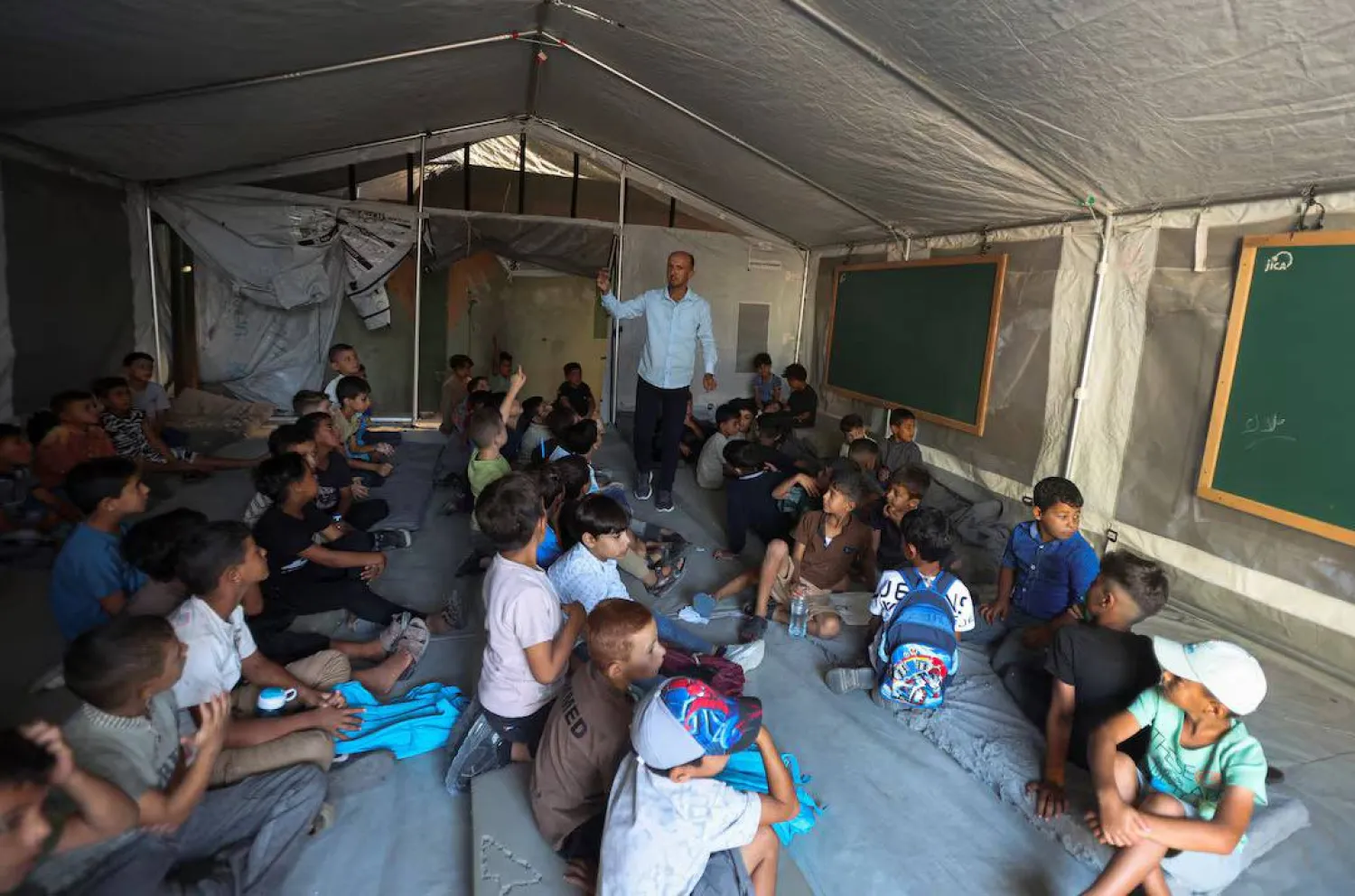

Julia Dicum, Director of Education at the United Nations Relief and Works Agency for Palestine Refugees (UNRWA), has warned that Gaza's education system could take up to seven years to recover, according to research projections, following years of disruption and military operations that have deprived children of a normal school life.
"When we opened the school year in September this year, we met children who should have been in third grade but were entering a school building for the first time," Dicum told Asharq Al-Awsat in an exclusive interview.
Some children in the final years of primary school have received no more than one full academic year of in-person education because of disruptions caused by the COVID-19 pandemic and the past three years of war.
Their learning gaps have been compounded by "the psychological trauma of loss and living under constant fear of bombardment and uncertainty," Dicum said.
Years of Accumulated Learning Gaps
Research conducted by the University of Cambridge, the Centre for Lebanese Studies and UNRWA projected that cumulative disruptions could leave children as much as five years behind in their educational progress.
That estimate was made more than a year ago, and Dicum believes the extent of the learning loss is likely to be even greater now.
As educational disruptions continue, she warned: "The longer this disruption continues, the wider the learning gaps become, and the greater the risk that children will drop out of education permanently."
Maintaining children's connection to structured, recognized education is therefore among UNRWA's highest priorities, alongside establishing the resources, capacity and conditions needed for a transition to safe and sustainable formal schooling.
A Return Far From the Normal School Day
At the start of the 2026-2027 academic year, more than 200,000 children in Gaza remained without access to structured learning, according to estimates provided by Dicum.
Meanwhile, the Education Cluster reported in September 2026 that 495,680 learners were attending 687 learning spaces operated by humanitarian response partners.
The Education Cluster is a coordination mechanism for humanitarian organizations working in education in Gaza, helping organize responses to emergency learning needs.
However, access to a learning space does not mean a return to a normal school day.
Many children who have resumed learning receive far fewer instructional hours than usual, amid overcrowding, shortages of school supplies and damaged buildings or temporary facilities lacking adequate water, sanitation and hygiene services.
Displacement and the dangers posed by explosive remnants of war add to these challenges.
"Gaza is still far from a return to regular, full-time schooling for all girls and boys," Dicum said.
Restrictions on the entry of educational supplies and construction materials also hinder debris removal, repairs and reconstruction, preventing a return to normal educational activities.
Under these circumstances, instruction has been reduced to four core subjects: Arabic, English, mathematics and science, alongside expanded mental health and psychosocial support services.
Universities and technical and vocational education and training institutions have also suffered extensive damage and are offering modified forms of learning.
Unaccredited Programs Threaten Educational Progression
The Palestinian Authority's Ministry of Education and Higher Education has approved programs using educational materials aligned with the Palestinian curriculum, including UNRWA's distance-learning program.
However, many other initiatives provide informal, unaccredited learning experiences.
Dicum warned that these programs would not enable the current generation to access higher education on a broad scale.
"The challenge is no longer simply to return children to some form of learning, but to restore quality, sustainable and accredited education that allows children to learn, progress and acquire the skills that will give them a future built on recovery and hope," she said.
From Emergency Shelters to Learning Spaces
UNRWA's educational response began in October 2023 with mental health and psychosocial support services for children in its emergency shelters.
In early 2024, the agency developed flexible self-learning materials in core subjects, aligned with United Nations values and standards.
It then began establishing temporary learning spaces in the summer of that year.
By late 2024, UNRWA had launched an accredited distance-learning program, seeking wherever possible to reconnect students with the teachers and classmates they had been assigned to in August 2023.
By the end of September 2026, the agency was operating approximately 84 temporary learning spaces across Gaza, reaching nearly 100,000 learners.
It was also providing structured distance education to around 280,000 students in grades one through nine, according to figures supplied by Dicum.
For comparison, UNRWA educated approximately 300,000 students in grades one through nine during the 2022-2023 academic year.
That represented half of all students enrolled in grades one through 12 across Gaza, with the other half attending Palestinian Authority schools and a small number of private schools.
Current in-person instruction takes place in tents and some classrooms inside UNRWA schools.
Families have helped prepare these spaces for learning, sometimes moving their belongings aside each day so teachers can conduct lessons.
Dicum said cooperation between Gaza's communities and UNRWA has developed to the point where "the local community returned three school buildings to UNRWA for use in full-time education during 2026."
"This reflects the importance Gaza's communities attach to education and the contribution they are making to restoring it," she added.
Efforts to resume education have also extended to technical and vocational training for Palestine refugee youth aged 16 to 18.
The initial focus was on helping students who had enrolled at the beginning of the 2023-2024 academic year complete their training and obtain their qualifications through blended and online learning.
In September 2026, UNRWA enrolled students in two-year courses and began planning shorter vocational programs, particularly in skills that could contribute to recovery.
Dicum noted that this type of training is not usually part of an emergency response.
Making Up for Lost Learning Starts With Each Child's Level
Returning to learning offers an opportunity to prevent educational gaps from widening further.
However, making up for years of disrupted schooling requires identifying what each child can actually do and providing support appropriate to their current level.
"Educational recovery is possible, but there is no quick way to make up for years of disrupted education," Dicum said.
The process begins with reading, writing and numeracy, assessing individual learning levels, providing adapted educational materials and ensuring continued support from teachers.
Recovery also depends on the broader conditions in which children live and attempt to study, as well as their ability to receive sufficient and regular instructional time.
Dicum outlined the immediate priority: "What matters now is preventing further learning loss and giving children a reliable pathway back to sustainable, quality education."
Funding and the Continuity of Learning Opportunities
UNRWA currently faces a major challenge in the form of its financial crisis, which could hamper its ability to maintain and expand its educational response.
Sustaining existing programs and preparing for a return to formal schooling when conditions permit require consistent resources that allow for long-term planning.
Dicum concluded by emphasizing that "sustainable, regular and predictable funding" is essential to preserving learning opportunities and supporting the return to safe, adequately resourced formal education.


