Emboldened Israeli Settlers Lead a Surge of Attacks on Palestinians’ Olive Harvest

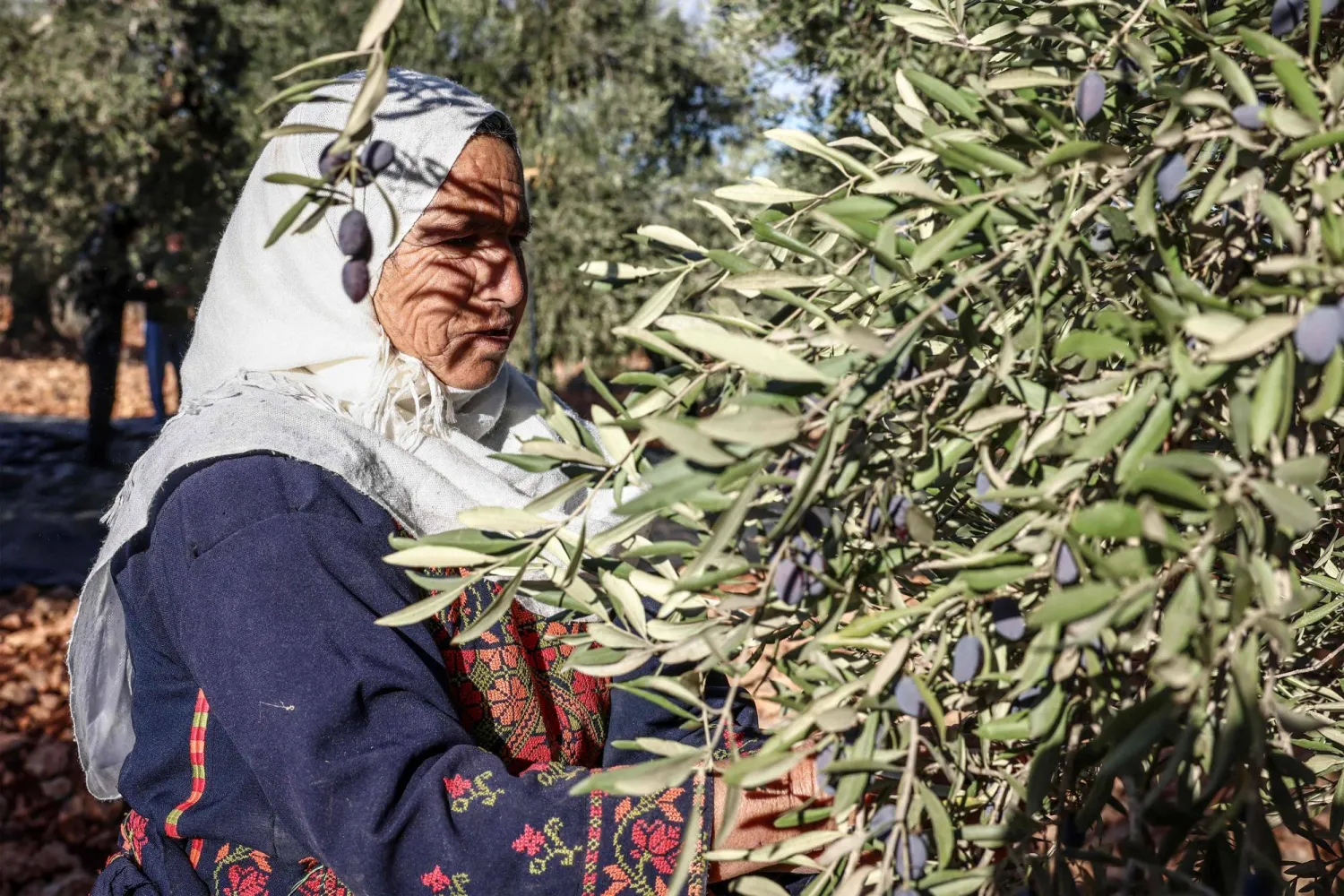
A Palestinian woman picks olives during the harvest season in a Palestinian-owned olive grove in the village of Turmus Ayya, northeast of Ramallah in the Israeli-occupied West Bank, on October 20, 2026. (AFP)
TT

Emboldened Israeli Settlers Lead a Surge of Attacks on Palestinians’ Olive Harvest

A Palestinian woman picks olives during the harvest season in a Palestinian-owned olive grove in the village of Turmus Ayya, northeast of Ramallah in the Israeli-occupied West Bank, on October 20, 2026. (AFP)

Attacks by Jewish settlers have surged this year during the Palestinians’ annual olive harvest in the occupied West Bank.

Scenes of Palestinians, journalists and diplomats beaten by masked men spotlight how settlers have been establishing themselves deeper in Palestinian communities, emboldened by Prime Minister Benjamin Netanyahu ’s government. At least four Palestinians have been killed this season, whether by settlers or Israeli soldiers.

The violence has brought new international criticism at a time when Netanyahu faces a razor-thin race in next Tuesday's legislative elections. But the prime minister is doubling down. After a West Bank shooting attack blamed on Palestinian gunmen that killed two Israeli soldiers on Friday, Netanyahu praised settlers as “heroic” and vowed to “destroy the terror infrastructure and establish more and more settlements.”

Here’s a look at the olive harvest and the tensions around it:
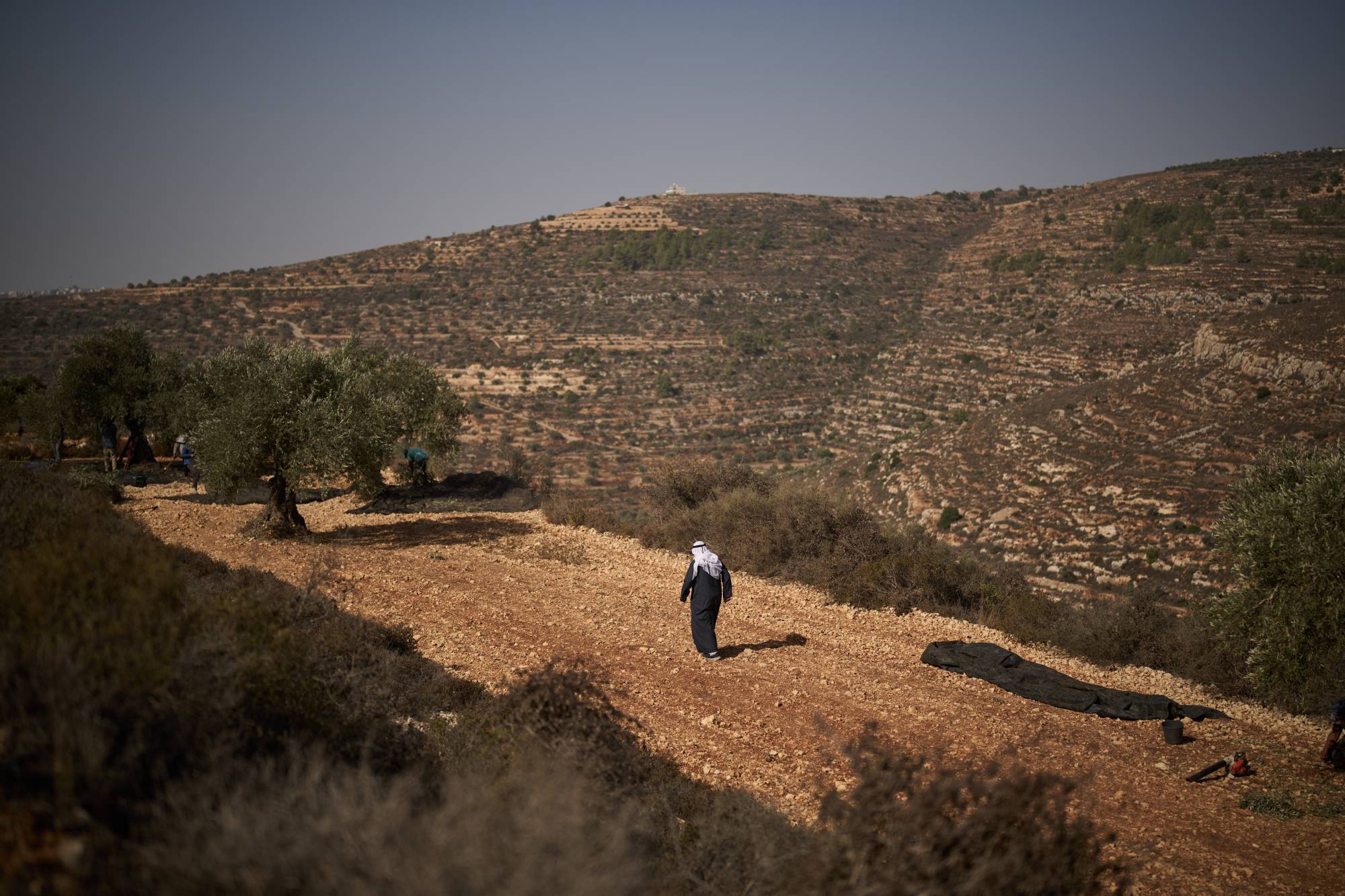
Palestinian Kamal Haloum walks in an olive grove during the olive harvest in the West Bank village of Al-Mazraa al-Sharqiya, Friday, Oct. 23, 2026. (AP)

Palestinians’ ties to the land are challenged

Olive groves across the West Bank represent both heritage and needed income. The harvest traditionally has been a joyous occasion for Palestinians to gather and be thankful for another year.

“In the past, harvesters would enjoy a month of singing and fixing tea and coffee in their groves. Now the journey is full of pain and risk,” said Abbas Milhem of the Palestinian Farmers’ Union.

But the harvest has become a time of friction as Palestinians spread out and, simply by picking olives, assert their ties to the land that many Israeli settlers say should belong to Israel instead.

Olive trees have been destroyed and olives stolen in over 325 incidents of settler violence this harvest season, which began in late September, Israeli rights group Yesh Din says. Over 130 of those incidents involved physical assaults on harvesters.

Yesh Din and the farmers’ union call this harvest the most violent in recent history.

One Palestinian, Abel Atif Bazaari, said last week outside the village of Burqa near Nablus that olives are more than just a crop. He ran his fingers along a branch. “Protected, respected. I think in all religions, olives are respected,” he said. “This is the identity of the Palestinians.”

His cousin, a security guard, was killed when responding to an attack on the family's land this season. Bazaari was hurt. A bandage covered his temple near his blackened left eye. They have paused the harvest, he said. The land has been in the family for over a century.
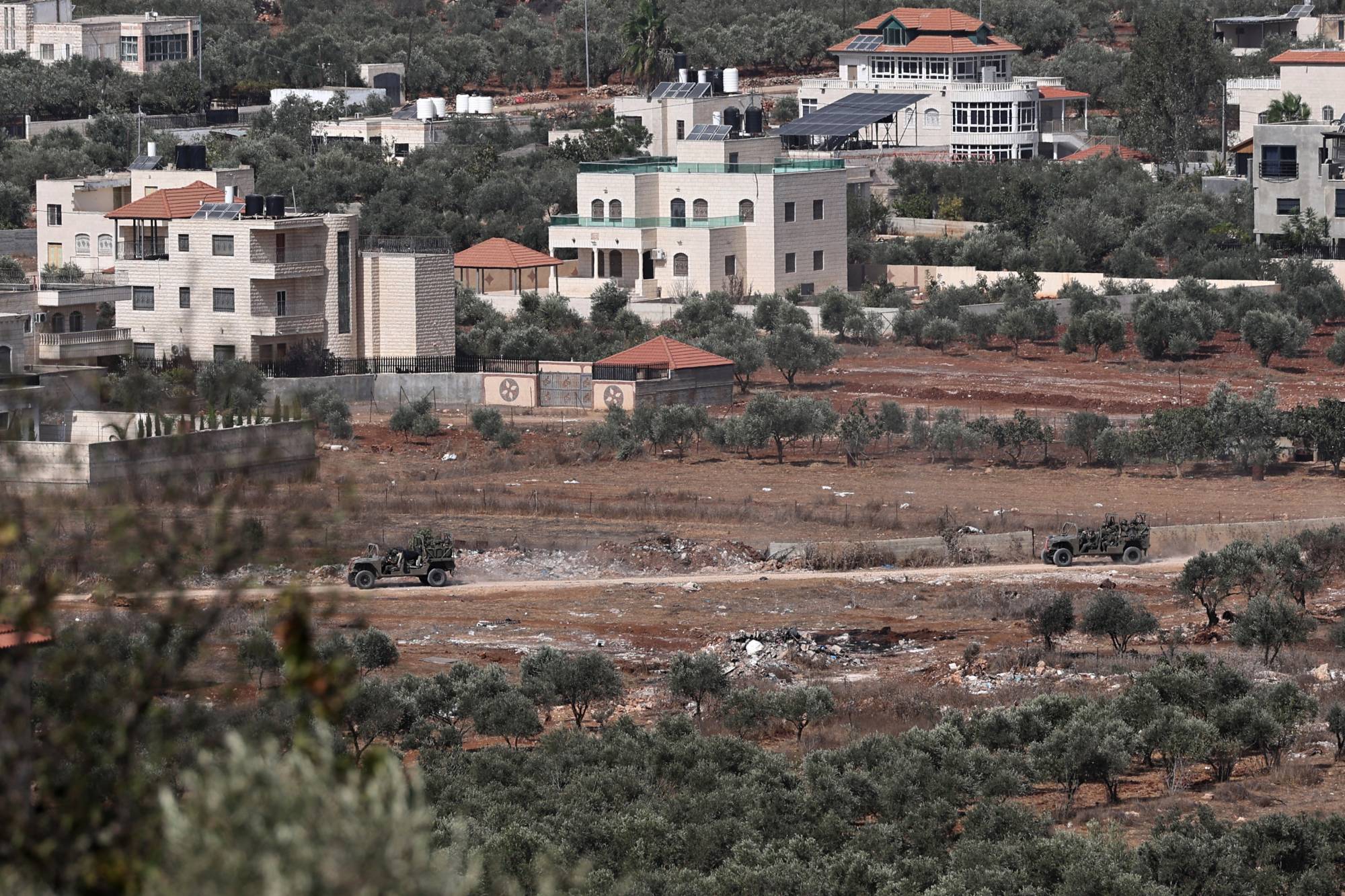
Israeli military vehicles patrol an area during the olive harvest in the town of Turmus Ayya, in the West Bank, 23 October 2026. (EPA)

West Bank outposts have surged under Netanyahu

Since 2023, Israeli settlers have erected more than 180 new outposts in the West Bank, most of them close to Palestinian communities and often on their farmland, according to Peace Now, a watchdog group. Settlers from those outposts have largely been behind intensifying attacks on Palestinians since the war in Gaza began with the Hamas-led assault on Israel on Oct. 7, 2023.

On Wednesday, a joint statement by activists and rabbis from the United States, Israel and the West Bank called the attacks on the harvest and Palestinian farmers part of “ethnic cleansing” in the territory. Israel has denied allegations, previously made by Britain as well, of ethnic cleansing.

The outposts — often made up of a few mobile homes — are not authorized, but the military rarely takes action against them. Palestinians trying to fend off the settlers have been accused of throwing rocks or chunks of concrete.

Netanyahu’s government relies on the support of far-right parties and has dramatically expanded settlements as a way to strengthen Israel’s grip on the West Bank and prevent any potential Palestinian state. Far-right Finance Minister Bezalel Smotrich, a settler leader who is in charge of settlement policy, has sought to steer funding to unauthorized outposts.

Most of the international community views all settlements as illegal and an obstacle to peace. “The clear goal is to drive communities off their land,” UN Secretary-General Antonio Guterres said Thursday of settler attacks.
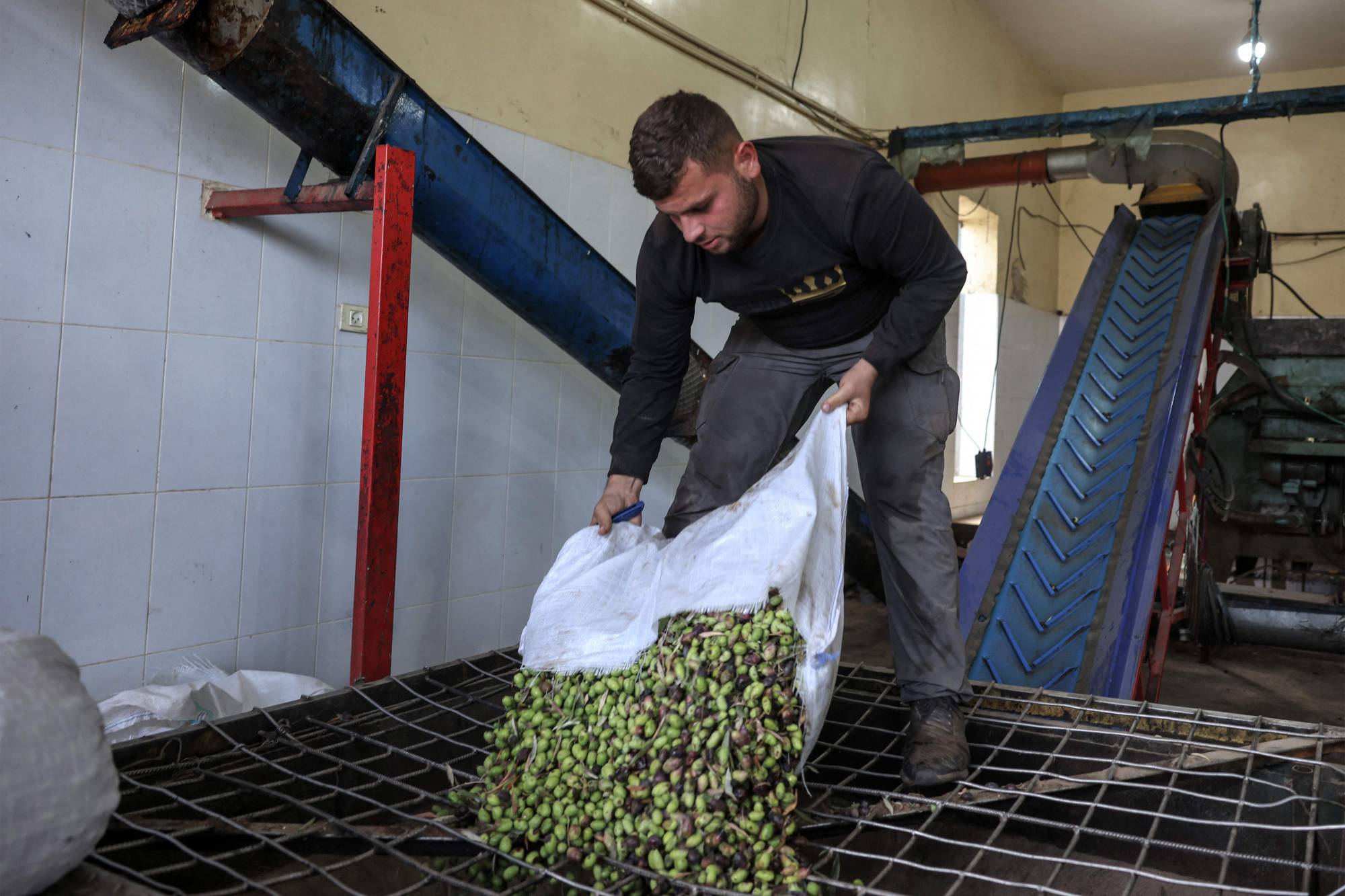
A Palestinian worker unloads freshly harvested olives for processing at an olive press in Turmus Ayya, northeast of Ramallah in the Israeli-occupied West Bank, on October 20, 2026. (AFP)

Outsiders visit in solidarity and are attacked

The olive harvest draws activists, diplomats, rabbis, journalists and others who seek to show solidarity with Palestinians and document attacks and intimidation.

Sometimes they are attacked, too.

A photographer for The Washington Post, Heidi Levine, is recovering after settlers last Friday beat her so badly that several vertebrae were broken and a finger was nearly detached. The following day, masked settlers wielding metal bars attacked a French mayor among a group of diplomats from France, Belgium and Poland at another harvest.

On Wednesday, a US congressional candidate from New York, Brad Lander, was among a group of American rabbis and others detained by Israeli troops at a harvest before being released hours later.

Rights groups say settlers are rarely punished, though several were arrested after last week’s high-profile attacks. Police said most were later released as investigations continue.

It’s becoming harder for Palestinians to reach their land. Peace Now says they have been required to coordinate with Israel’s military to access more of their privately owned farmland than previously. The West Bank is a patchwork of areas under varying levels of Palestinian civil and Israeli military control.

Some of those who coordinate with the military are still attacked, Milhem with the farmers’ union said. He estimated that roughly 110,000 Palestinian families depend on privately owned groves for income that reaches into the millions of dollars in all.

“Palestinian farmers do not — and should not — need permits to harvest their own olive fields,” Lander said Thursday on X, adding that Wednesday’s visit was meant to “call attention to the horrors of the occupation.”
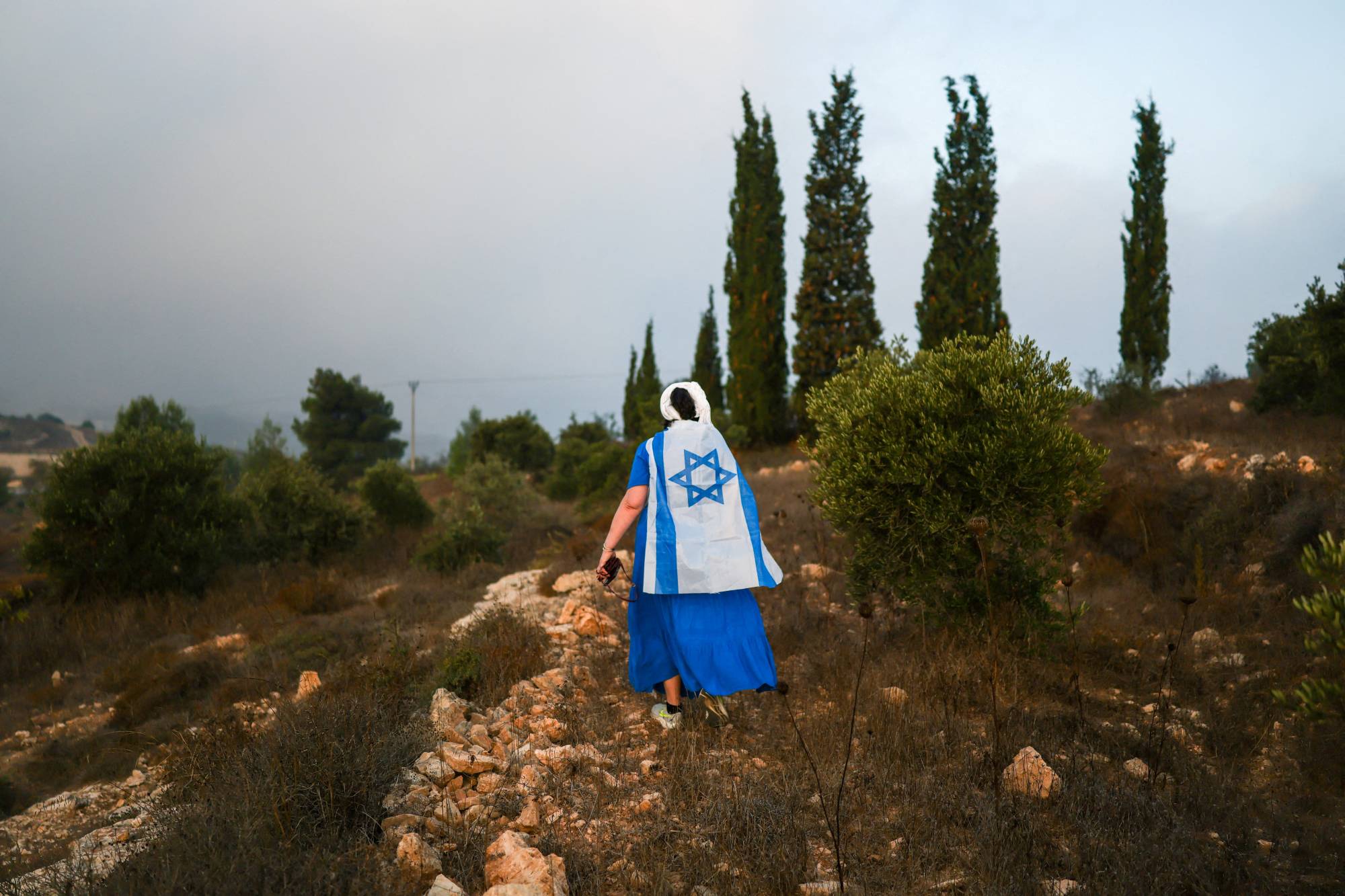
A Jewish settler walks towards olive trees owned by Palestinians due to be harvested, near the Israeli settlement Neve Daniel, in the Israeli-occupied West Bank, October 12, 2026. (Reuters)

‘Handful of criminals’

Settler attacks on Palestinians rarely bring an outcry in Israel, but some Israeli senior politicians and officials have spoken out after Levine was beaten.

Netanyahu’s main rival in the elections, Gadi Eisenkot, said on X that “a handful of criminals is burning up the last shreds of legitimacy left to the state of Israel.” Eisenkot has backed settlement building in the West Bank but says he would shut down the unauthorized outposts.

Levine told the AP that Israeli President Isaac Herzog told her “he’s ashamed for what happened: ‘These people are a stain on Israeli society.’” Herzog has denounced settler attacks against Palestinians in the past.

Netanyahu, meanwhile, has questioned the circumstances around some attacks on the olive harvest and alleged a “coordinated campaign to smear Israel” following the weekend attack on diplomats.

He has blamed overall attacks in the West Bank on a small number of troublemakers.


US Reaffirms Support for Libya’s Unity, Promotion of ‘Transparency and Accountability’

Massad Boulos, advisor to the US President on African and Middle Eastern Affairs, meets a high-level economic delegation from Libya’s Government of National Unity (GNU) in Washington, DC (Boulos’ account on X)
TT

US Reaffirms Support for Libya’s Unity, Promotion of ‘Transparency and Accountability’

Massad Boulos, advisor to the US President on African and Middle Eastern Affairs, meets a high-level economic delegation from Libya’s Government of National Unity (GNU) in Washington, DC (Boulos’ account on X)

Washington has defended its political initiative in Libya, stating that it aims to accelerate the process of reunifying the divided country, while reaffirming its “commitment to working with Libyan partners to promote economic stability, support transparent and accountable institutions, and ensure that Libya’s resources bring lasting benefits to the Libyan people.”

On Thursday, Massad Boulos, advisor to the US President on African and Middle Eastern Affairs, met with a high-level economic delegation from Libya’s Government of National Unity (GNU) in Washington, DC, to launch a bilateral strategic partnership and discuss Libya's economic and political stabilization.

Boulos said he discussed with the delegation strengthening US-Libya economic cooperation, supporting the development of Libya’s energy sector, and building on recent progress toward greater economic and institutional integration.

In a post on X, he said the United States remains committed to working with Libyan partners to strengthen economic stability, support transparent and accountable institutions, and ensure Libya’s resources deliver lasting benefits for the Libyan people.

“Under President Trump’s leadership, our unification initiative and efforts offer a path towards a unified Libya, open for business, and finally realizing its extraordinary potential,” he wrote.

Later, the State Department said in a statement that Boulos participated in a roundtable discussion hosted at the US Department of Energy to explore opportunities for cooperation between Washington and Tripoli in the energy and trade sectors.

Boulos commended the efforts of the Libyan-US Trade and Investment Council, the host organization, as well as US Department of Energy Undersecretary Kyle Haustveit and the Libyan delegation, for the “fruitful discussion.”

“We are opening doors for American businesses, driving investment and job creation, and creating opportunities for our countries,” he said.

Boulos added that “building a strong and integrated Libyan economy is a fundamental pillar for achieving the broader goal of establishing stability, unity, and prosperity in the country.”

The US initiative rests on unifying the government and the sovereign institutions, so as to stabilize the oil sector and encourage foreign investment, while opening channels of cooperation between the military and security leaderships of eastern and western Libya.

It proposes a power-sharing arrangement that retains Tripoli-based Prime Minister Abdul Hamid Dbeibeh as head of government alongside Saddam Haftar as head of a reformed Presidential Council.


Tunisia: Five-Year Prison Sentence for Prominent Activist Sihem Bensedrine

Tunisian rights activist Sihem Bensedrine
TT

Tunisia: Five-Year Prison Sentence for Prominent Activist Sihem Bensedrine

Tunisian rights activist Sihem Bensedrine

The Court of First Instance of Tunis has sentenced rights activist Sihem Bensedrine to five years in prison on charges of administrative corruption during her tenure as head of a transitional justice commission, according to local agencies and AFP.

Bensedrine was charged under two articles of Tunisia’s Penal Code, relating to the “abuse of office by a public official to cause material harm to the administration” during her tenure as head of the Truth and Dignity Commission (2014–2018), according to Fathi Rebii, Bensedrine's defense team.

Tunisia's Truth and Dignity Commission is an independent body established in 2013 to investigate state-sponsored human rights abuses and financial corruption committed under the mandates of presidents Habib Bourguiba (1957-1987) and Zine El Abidine Ben Ali (1987-2011).

The commission also acted as an arbitrator in cases it heard, and the ruling issued relates to a settlement agreement reached with a businessman.

In the same case, former commission member Khaled Krichi was also sentenced to four years in prison, while ex-minister Mabrouk Korchid received six years, according to Rebii.

Bensedrine was arrested in August 2024 and detained for over six months but has since remained free pending appeals in the cases against her.

Last June, the criminal chamber specialized in financial corruption cases at the Tunis Court of First Instance sentenced Bensedrine to 25 years in prison in cases involving “abuses and violations” in the work of the Truth and Dignity Commission, as well as a settlement agreement reached with businessman Slim Chiboub.

Bensedrine and Khaled Krichi, who had been sentenced to 10 years in prison, appealed the rulings.

In a statement issued on Friday, the organization Lawyers Without Borders in Tunisia condemned the ruling, stating that “instead of combating impunity for perpetrators of gross human rights violations, the judiciary is being exploited to target the body tasked with exposing these violations.”


Sudan's Tasis Alliance Seizes Blue Nile’s Strategic Bau District

Members of Sudan's Rapid Support Forces (RSF) in Blue Nile state (File photo: AP)
TT

Sudan's Tasis Alliance Seizes Blue Nile’s Strategic Bau District

Members of Sudan's Rapid Support Forces (RSF) in Blue Nile state (File photo: AP)

Forces from Sudan's Tasis alliance, which includes the Rapid Support Forces (RSF) and the Sudan People's Liberation Movement-North (SPLM-N), said they had captured the strategic Bau locality in southeastern Blue Nile state after hours of fighting with the army and its allies.

The alliance's forces pushed forward rapidly early Friday, seizing Khor Mak, Sinja Nabaq, Al-Taqa, Madina 10 and Madina 11, bringing the fighting closer to Damazin, the regional capital.

Bau lies about 70 kilometers southwest of Ed Damazin and is the birthplace of Malik Agar, deputy chairman of Sudan's Sovereignty Council and leader of an SPLM-N faction allied with the army.

Tasis said it had inflicted heavy losses on army troops and allied forces, capturing large quantities of weapons, ammunition and military equipment.

In a statement, the alliance said its fighters had seized 27 combat vehicles and six armored vehicles, destroyed or burned more than 70 others and killed hundreds of army personnel. It also claimed to have captured numerous soldiers, including a senior officer.

Bau's position along several strategic routes could allow the alliance to push further toward Damazin, Blue Nile's political, military and administrative hub.

Videos posted Friday by Tasis fighters showed RSF and SPLM-N personnel inside Bau town.

The Sudanese army has not officially commented on the fighting.

Last Sunday, the army sent combat units to its Fourth Infantry Division headquarters to reinforce frontline positions in Blue Nile and halt advances by the RSF and forces loyal to Joseph Tuka.

But Bau Commissioner Abdel Ghani Daqis Khalifa disputed the alliance's claim of full control, saying RSF fighters had entered the area but had not seized the entire locality.

Khalifa accused South Sudan and Ethiopia of direct involvement in destabilizing Blue Nile.

He told Asharq Al-Awsat that army troops and allied forces had repelled a Tasis assault on Dairang, inflicting heavy losses on the attackers.

He said RSF fighters were positioned in Maqja, an area the army had withdrawn from for tactical military reasons.

Fighting shifted Friday morning to Madina 11, east of Bau town near Qeissan locality, he said.

More than 6,000 families had fled Bau and surrounding areas to Al-Shaheed Effendi, a town in the far south of Damazin, according to preliminary figures cited by Khalifa.

He said most administrative areas in Bau remained stable and that he was continuing to carry out his duties from within the locality.

In early August, the RSF and the SPLM-N faction led by Abdelaziz Adam al-Hilu seized the strategic towns of Kurmuk and Qeissan along the Ethiopian border, turning Blue Nile into one of Sudan's most active war fronts.

Calls to protect civilians

The Civil Society Initiative, a local group, voiced grave concern over the rapid military escalation and the advance of fighting toward Ed Damazin.

In a statement posted on Facebook, it urged the warring parties to protect civilians, open safe humanitarian corridors to evacuate people trapped in combat zones and allow aid to reach those in need without obstruction.

The group said the attacking RSF forces bore responsibility for protecting civilians and called on them to take precautions to shield residents from military operations and avoid actions that could endanger lives or property.

Blue Nile borders Ethiopia and South Sudan.

Tasis forces had earlier seized the strategic Sali area in Kurmuk locality, widening their presence across the region.