Shock and Grief in a Jordanian Village after Church Attack

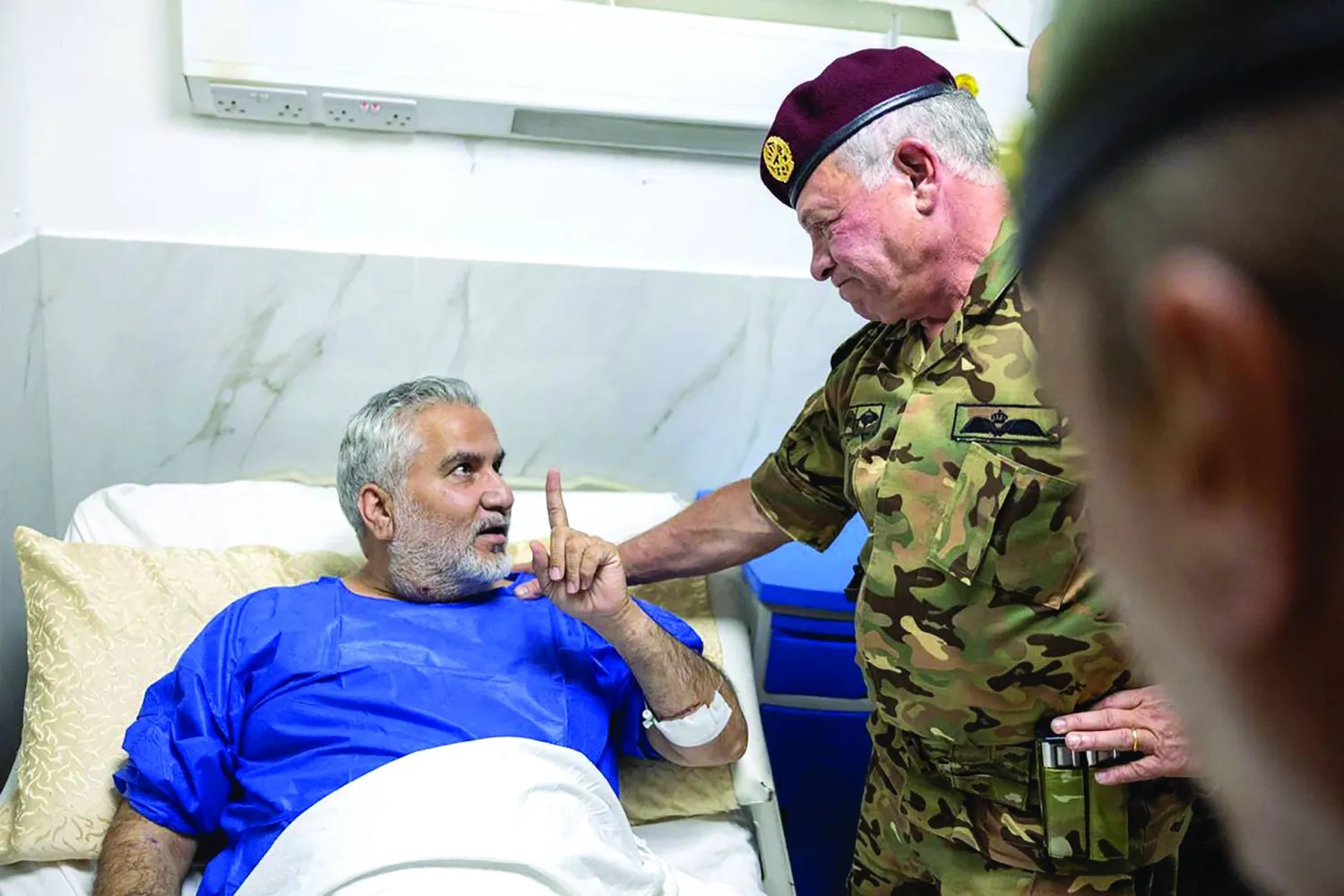
This handout picture released by the Jordanian Royal Palace on October 23, 2026, shows Jordan's King Abdullah II (R) visiting Prince Ali Military Hospital in Karak to check on those who were injured in the attack on a Greek Orthodox church in the village of Hammoud in Karak governorate. (Photo by Jordanian Royal Hashemite Court (RHC) / AFP)
TT

Shock and Grief in a Jordanian Village after Church Attack

This handout picture released by the Jordanian Royal Palace on October 23, 2026, shows Jordan's King Abdullah II (R) visiting Prince Ali Military Hospital in Karak to check on those who were injured in the attack on a Greek Orthodox church in the village of Hammoud in Karak governorate. (Photo by Jordanian Royal Hashemite Court (RHC) / AFP)

Workers were cleaning the last traces of blood from St George's Church in Jordan's Hammoud the day after a deadly attack, when visitors arrived to express their solidarity amid an atmosphere of shock and grief.

At noon on Saturday, the bells of the Greek Orthodox church in Jordan's Karak Governorate, south of Amman, rang in unison alongside churches across Jordan, mourning the victims of the unprecedented attack against Christians in the kingdom, which left nine dead and 25 wounded according to the latest toll from the authorities.

Sayel al-Khaitan, a doctor who was inside the church when the attack, which took place during a funeral, began, described what happened as a tragedy.

"It is a criminal, dark, spiteful, Daesh-style attack", he said, referring to the ISIS group, saying it targeted Jordanian society as a whole.

He described coming under heavy gunfire, saying, "It was likely that we would have fallen as martyrs in the massive attack, but, by a miracle, we survived".

Jordan's Interior Minister Mazen Al-Faraya said the attackers were extremists.

They are still on the run.

- 'Hunting people' -

Bullet holes marred the church's walls and wooden pews, with windows shattered and glass shards gathered into a pile outside.

Security forces have been deployed at the entrances and exits of the church in the small, predominantly Christian village.

Christians make up about three percent of the Muslim-majority kingdom.

On Saturday, preparations were underway for the victims' funerals the following day and church officials have dug a mass grave, which will become a memorial.

Father Yohanna Hamati told AFP about 170 to 200 people taking part in the funeral of a woman from his parish when the volley of bullets began outside shortly after 2 pm.

He said the mourners "at first did not grasp what was happening".

But as people fled into the church, "we began to realize there was an attack".

"They were hunting people," he said. "Nothing like it has ever happened, neither to a church nor to a mosque."

He said some of the wounded mourners were Muslim, adding "we make no distinction between Muslim and Christian" and stressing that what happened "does not reflect Jordanian morals".

In the village's guest hall, condolences were pouring in from clerics, military officials, the Vatican ambassador to Jordan and local dignitaries.

In the provincial capital Karak, dozens of people visited Prince Ali Military Hospital, where most of the wounded were taken, to donate blood or express solidarity.

Youth activist Murooj Al-Nuwaysa, wearing a pink hijab, said she came with about 25 young men and women, carrying a bouquet of flowers with a card reading, "Our loss is one".

- 'Shock and pain' -

Nuwaysa says she was at the hospital on Friday visiting a patient at the time of the attack.

"I didn't have my phone with me, and I didn't know what was happening."

"Ambulances were arriving in large numbers... It was very strange. Then there was the sight of the blood and the people... We later heard there had been an attack on a church," she said.

She said the youth delegation's visit on Saturday was an expression of "solidarity and our feeling of shock and pain."

"Our friends, colleagues and relatives, Muslims and Christians, live together and share each other's occasions. It is a huge shock."

Jordan's King Abdullah II visited the injured in the hospital, dressed in military fatigues and carrying a pistol on his hip.

"We will show them," he vowed to the victims.

Outside the hospital, Majed Jaafar, dressed in traditional Arab robes and the red-and-white Jordanian keffiyeh, said with a mix of sadness and anger: "We cried for them. Christians are cousins, neighbors and relatives. There is nothing between us but love."

"This is the first time something like this has happened in Jordan," he said.

Wisam al-Burqan, one of the villagers, said he arrived at the site of the attack minutes after the assailants fled.

"These people are not a danger to Christians alone... they are a danger to society as a whole," he said, demanding the government "strike with an iron fist, uproot them and show them no mercy".


Syria to Launch Vaccination Drive Against Polio

A health official administers oral polio vaccine drops to a child during a vaccination campaign launched by the Syrian Ministry of Health in Deir Ezzor, Nov. 15, 2026. (SANA)
TT

Syria to Launch Vaccination Drive Against Polio

A health official administers oral polio vaccine drops to a child during a vaccination campaign launched by the Syrian Ministry of Health in Deir Ezzor, Nov. 15, 2026. (SANA)

Syria's health ministry is preparing a vast vaccination campaign, with UN backing, to protect children in the eastern province of Deir Ezzor against polio, following the detection of three cases.

Polio, which mainly affects children under five, is an infectious disease. One in 200 infections leads to irreversible paralysis, and among those paralyzed, five to 10 percent die.

Thanks to immunization efforts, the disease has mostly been eradicated globally.

"The ministry is preparing to launch a comprehensive vaccination campaign against polio targeting more than 371,000 children under five in the province of Deir Ezzor," said Yasser al-Farouh, who heads the ministry's department for communicable and noncommunicable illnesses.

The campaign is expected to begin on November 30, he said, according to state news agency SANA.

It follows the detection of three cases of polio, with authorities putting the risk of an epidemic outbreak as "high".

Syria has emerged from a long civil war that has put great strain on the health system.

"Disruptions to health services and difficulties accessing routine immunization have left gaps in protection in some communities," the UN children's agency, UNICEF, said in a joint statement with the World Health Organization and the Syrian health ministry.

The number of polio cases around the world has decreased by over 99 percent since 1988, according to the WHO, from an estimated 350,000 in more than 125 endemic countries, to two endemic countries.

"As long as a single child remains infected, children in all countries are at risk of contracting polio. Failure to eradicate polio from these last remaining strongholds could result in a global resurgence of the disease," the WHO said.

There was a brief resurgence of polio in 2013 in Syria and in Iraq in 2014, but an 18-month vaccination campaign brought case numbers back down to zero.


Is Egypt Rethinking its Strategy in Libya?

Egyptian President Abdel Fattah el-Sisi welcomes Libya’s Government of National Unity Prime Minister Abdul Hamid Dbeibeh in Cairo on Thursday (Egyptian Presidency)
TT

Is Egypt Rethinking its Strategy in Libya?

Egyptian President Abdel Fattah el-Sisi welcomes Libya’s Government of National Unity Prime Minister Abdul Hamid Dbeibeh in Cairo on Thursday (Egyptian Presidency)

Egypt’s growing rapprochement with Libya’s interim Government of National Unity (GNU), led by Abdul Hamid Dbeibeh, has raised questions about whether Cairo is reassessing its longstanding priorities in a country divided by years of institutional rivalry.

After years of closer ties with the eastern-based Libyan National Army (LNA), commanded by Field Marshal Khalifa Haftar, Egypt has intensified contacts with Tripoli. The outreach culminated in President Abdel Fattah el-Sisi’s talks with Dbeibeh, their second meeting in recent months.

Thursday’s meeting followed separate visits to Tripoli by Egyptian Foreign Minister Badr Abdelatty and intelligence chief Hassan Rashad, at a time when political, security and economic challenges remain intertwined and disputes over institutional legitimacy continue to obstruct efforts to establish a unified government.

Yet Egyptian and Libyan diplomats interviewed by Asharq Al-Awsat cautioned against interpreting Cairo’s outreach as a shift from one camp to another.

Egypt has not abandoned its close ties with eastern Libya, they argued, while the security and geographic interests underpinning its relationship with the LNA leadership remain unchanged by renewed engagement with Tripoli.

Parallel Channels of Communication

Former Egyptian Assistant Foreign Minister Ezzat Saad traced Cairo’s approach to a broader policy that took shape in 2020, when Egypt adopted the Berlin Declaration as a comprehensive international framework for addressing the Libyan crisis.

The declaration encompasses political, military, security and economic tracks, as well as the arms embargo, human rights and international humanitarian law.

Saad explained that the framework, whose outcomes were endorsed by the UN Security Council, brings the various dimensions of Libya’s crisis under a single approach aimed at achieving a comprehensive settlement and unifying state institutions.

Egypt has maintained coordination with Libyan parties in recent years without developing formal alliances, he added, while keeping communication channels open with both eastern and western Libya.

Analysts therefore view Cairo’s continued engagement across the political divide less as a retreat from previous understandings than as an effort to preserve parallel channels of communication and avoid concentrating Egyptian influence within a single Libyan camp.

Eastern Libya’s Strategic Importance

Cairo’s rapprochement with the GNU has nevertheless prompted concern among politicians and activists in eastern Libya, particularly amid disagreements over a maritime boundary agreement with Türkiye.

Libya’s House of Representatives approved the agreement in October, but Egypt has rejected it.

Former Libyan diplomat Mohamed al-Jazwi, who previously served as consul in Cyprus, dismissed the prospect of a fundamental shift in Cairo’s priorities.

“Eastern Libya represents strategic depth for Egyptian national security,” he told Asharq Al-Awsat, arguing that relations with the LNA rest on considerations extending beyond current political disagreements, which he described as a passing cloud.

Those considerations date back to battles against extremist organizations in Benghazi and Derna, when developments in eastern Libya’s counterterrorism campaign were closely linked to security along Egypt’s western border.

From this perspective, the LNA’s role in combating terrorism carries regional significance beyond eastern Libya itself.

Al-Jazwi pointed to Rashad’s November 13 meeting in Cairo with Saddam Haftar, the LNA’s deputy commander-in-chief, as further evidence of continued cooperation.

The discussions addressed unifying political authority, advancing joint projects and holding permanent elections. The LNA portrayed the meeting as part of efforts to establish a unified, stable state and strengthen political and security stability.

A Broader Partnership

Former Libyan ambassador to Ukraine Adel Issa offered a different perspective, viewing Egypt’s outreach as an opportunity to reshape its role through closer engagement with all components of the Libyan state.

Rather than aligning itself with one faction or treating Libya’s internal divisions as permanent political calculations, Cairo could pursue a broader partnership, he argued.

Under this approach, Egypt’s interests would be better served by treating Libya as a single entity, helping bridge differences and overcome divisions while preserving institutional unity and promoting stability in both countries.

Libya remains divided politically and militarily between rival administrations: Dbeibeh’s GNU in the west and a parliament-appointed government led by Osama Hammad in the east, which is backed by the LNA.

Analysts believe the agenda of Thursday’s Sisi-Dbeibeh meeting offered practical indications of the broader engagement advocated by Issa.

Beyond reaffirming Libya’s security, unity and territorial integrity, the talks focused on expanding trade and investment, particularly in energy, natural gas, oil and reconstruction.


Israel Says Struck Hezbollah Weapons Site in East Lebanon

Smoke rises following an Israeli strike in the southern village of Kfar Tebnit, Lebanon, Thursday, Nov. 19, 2026. (AP)
TT

Israel Says Struck Hezbollah Weapons Site in East Lebanon

Smoke rises following an Israeli strike in the southern village of Kfar Tebnit, Lebanon, Thursday, Nov. 19, 2026. (AP)

The Israeli military said it struck a previous Hezbollah missile production and storage site in eastern Lebanon on Thursday, marking the second attack in the region this week.

"A short while ago, the Israeli Air Force conducted a strike, guided by precise intelligence, in the Janta area in the Bekaa region of Lebanon, targeting a site that was previously used by the Hezbollah terrorist organization for missile production and the storage of weapons," the military said in a statement.

"The site was struck by the army several times during the war. The army identified that Hezbollah terrorists had arrived at the site recently and struck the site's entrances in order to prevent its restoration," it added.

Lebanon's official National News Agency reported that "enemy aircraft launched five airstrikes" in eastern Lebanon.

On Monday, the Israeli military had carried out a bombing in the same region, saying it "struck a weapons shipment transferred from Syria to Lebanon, intended for the Hezbollah terrorist organization".

"The military will not allow the Hezbollah terrorist organization to restore its capabilities and harm Israeli civilians and soldiers," the army said Thursday.

Hezbollah has been weakened by two successive wars with Israel since 2023, most recently after it drew Lebanon into the Middle East conflict in March this year with rocket fire at Israel, which responded with airstrikes and a ground invasion.

Hezbollah lawmakers have nonetheless maintained that the group is rebuilding its military capacities.

Hostilities in Lebanon have declined since June after a US-Iran understanding over the broader regional war, and a US-sponsored Israel-Lebanon framework agreement.

The framework involves the disarmament of Hezbollah, a gradual Israeli troop withdrawal from south Lebanon, and the deployment of the Lebanese army to the area.

But implementation has stalled and Hezbollah has refused to surrender its weapons.

Israel's army still carries out strikes in south Lebanon, where its forces are operating in a self-declared occupied "security zone" running around 10 kilometers (six miles) deep along the border.