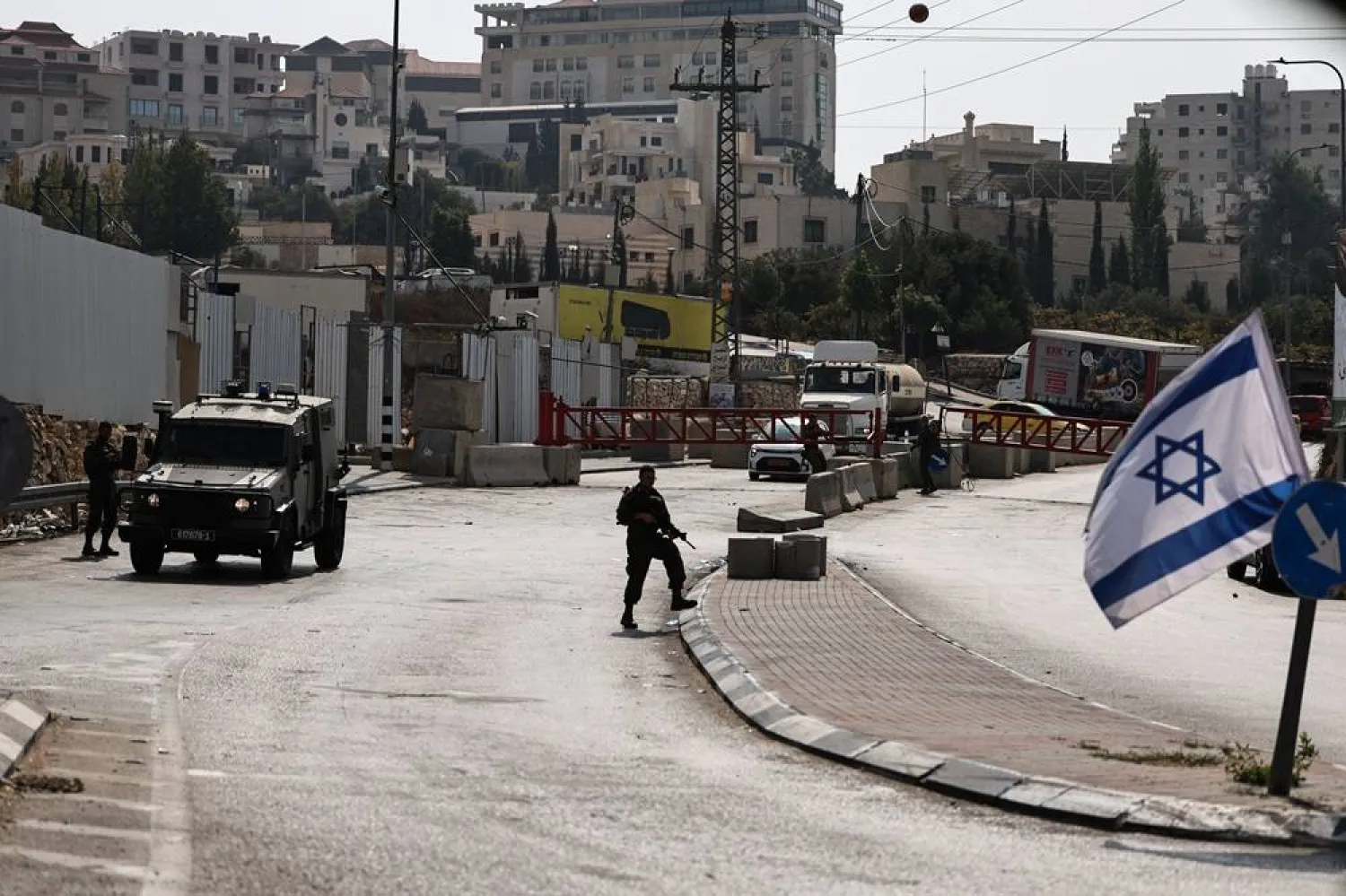
UN Raises ‘Ethnic Cleansing’ Concerns Over Israel’s Operation in Hebron

Israeli soldiers stand guard at a closed military gate at an entrance to the West Bank city of Hebron, 25 October 2026, as the military enforced a closure on the city and surrounding villages for a third consecutive day. (EPA)
TT

UN Raises ‘Ethnic Cleansing’ Concerns Over Israel’s Operation in Hebron

Israeli soldiers stand guard at a closed military gate at an entrance to the West Bank city of Hebron, 25 October 2026, as the military enforced a closure on the city and surrounding villages for a third consecutive day. (EPA)

Israeli military operation in the occupied West Bank city of Hebron, launched after a deadly attack by Palestinian gunmen, raises serious concerns of "ethnic cleansing", the United Nations warned Monday. 

The municipality in Hebron, the Palestinian territory's largest city, said in a statement that 3,189 people had been forced from their homes by the ongoing operation. 

It followed Friday's attack in which two Palestinian gunmen killed two soldiers at a checkpoint near the city, just days before Tuesday's Israeli elections. The gunmen were killed in a shootout. 

Israeli troops entered the Hebron neighborhood of Ein Deir Baha, where the two assailants lived, and ordered residents to pack up and leave. 

Israel's "aggressive operation" has already resulted in the forcible displacement of thousands of Palestinians, "demolished homes and commercial property, and deprived residents of the ability to move freely", UN rights chief Volker Turk said in a statement. 

"The sweeping steps taken raise grave concerns of unnecessary and disproportionate use of force -- which must end." 

He said the lockdown was confining many to their homes and immediate neighborhoods. 

"Declarations by senior Israeli government officials indicate that the measures implemented are punitive in nature and designed to instill fear. This is unacceptable," said Turk. 

"Those who have been displaced must be allowed to return home. Israel must ensure compensation and reparation for unlawful evictions and demolitions, and associated displacement. 

"Collective punishment is a grave violation of international law. Threats to empty and erase entire neighborhoods also raise serious concerns of ethnic cleansing." 

Speaking earlier in Cairo, UN Secretary-General Antonio Guterres said he was deeply alarmed by Israeli actions in the West Bank. 

"Evictions are unrelenting with Palestinians driven from their lands. Settler violence is surging," he said. 

"We are seeing an increasingly coercive environment, with the specter of ethnic cleansing looming ever larger. This must end." 

Guterres said there could be no durable peace in the Middle East "without the realization of the legitimate rights of the Palestinian people to self-determination". 


Report: Hezbollah Readies for New Regional War with Funds from Iran

17 April 2026, Lebanon, Jiyyeh: A displaced Lebanese woman flashes the victory sign and displays Hezbollah and Iranian flags as they drive along the highway linking Beirut to southern Lebanon in the Jiyyeh area. (dpa)
TT

Report: Hezbollah Readies for New Regional War with Funds from Iran

17 April 2026, Lebanon, Jiyyeh: A displaced Lebanese woman flashes the victory sign and displays Hezbollah and Iranian flags as they drive along the highway linking Beirut to southern Lebanon in the Jiyyeh area. (dpa)

Lebanese armed group Hezbollah has spent three months preparing for a possible resumption of hostilities with Israel, after receiving an infusion of cash from Iran, according to Lebanese security personnel briefed on its activities.

The group, founded by Iran's Revolutionary Guards in 1982, has been dealt severe blows in two wars with Israel since 2024, with thousands of fighters and many of its leaders killed, and much of its arsenal destroyed.

Invading Israeli forces now occupy its heartland of villages in southern Lebanon, and political pressure has built up in Beirut for its disarmament.

It nevertheless remains committed to fighting Israel and has used a lull in hostilities since June to rearm, with a focus on procuring explosives and producing drones that can be flown into Israeli positions, two Lebanese security sources told ‌Reuters.

One of the ‌sources, and another close to Hezbollah, said the group had received tens of ‌millions ⁠of dollars from ⁠Iran to help boost its military capabilities. That is in addition to around $200 million that the group received from Tehran to aid displaced families in its Shiite heartlands, which Reuters reported earlier this month.

The group has been restoring command-and-control structures that broke down in key battles, according to one of those sources and three other security officials familiar with the group's operations.

In response to questions from Reuters, Hezbollah's media office said Israel's occupation of Lebanese land made any resistance to it a legitimate right. It rejected the suggestion that its command-and-control systems had broken down.

Israel's military declined to comment. Iran's permanent mission to the ⁠United Nations in Geneva did not immediately respond to Reuters questions.

A US State Department ‌spokesman said Washington would keep strangling Hezbollah's finances through sanctions and other measures. ‌A US Treasury spokesperson said Iran was running out of money and ways to move money.

HEZBOLLAH ON ALERT

Hezbollah's effort comes ‌amid continued tensions in the wider Middle Eastern conflict ignited by the US-Israeli attack on Iran in February.

Hezbollah opened ‌fire in support of Iran on March 2, triggering an Israeli offensive that killed more than 4,000 people and uprooted a quarter of Lebanon's population, mostly members of Hezbollah's Shiite constituency.

Hostilities largely abated over the summer as an interim Iran-US deal included a Lebanon ceasefire and Washington mediated talks between Lebanon and Israel. Full-scale hostilities have not resumed in Lebanon despite the collapse of the ‌US-Iranian deal, though Israel continues deadly strikes in the south.

Hezbollah is on alert for a possible US-Iran escalation, potentially reigniting the Lebanon front.

The sources told Reuters the group ⁠had not yet managed ⁠to fully prepare its stockpiles or fighting force.

Hezbollah is still restocking, acknowledging this month that explosives seized by Lebanese authorities belonged to it and were intended for use against Israel. A Hezbollah official and a Lebanese security source told Reuters they were specifically for its explosive drones.

ISRAEL'S REMOTE WARFARE PROVED A CHALLENGE, SOURCES SAY

The group will also need to repair command-and-control capabilities after losses on key fronts, including the flashpoint town of Bint Jbeil and the strategic Ali al-Taher ridge, according to one of the Lebanese sources and three security officials.

They said Hezbollah's tactic of operating in small units and rationing the use of anti-tank rockets left some units isolated on those fronts, struggling to confront Israel's remotely operated systems including weaponized drones and armed remote-controlled vehicles.

The Israeli military told Reuters it uses remotely-operated systems to monitor southern Lebanon and reduce troops' threat exposure.

Hezbollah has not explicitly said whether it would take part in the eruption of fresh hostilities, but its media office said it was wary of giving Israeli leaders any justification to escalate in Lebanon, particularly as the group was concerned about its constituents being displaced once more.


‘No Fuel to Keep Babies Warm’: Shortages Push Hospitals in Yemen’s Taiz to Brink

A nurse attends to a newborn baby inside an incubator at a hospital in the southwestern city of Taiz, Yemen, October 23, 2026. (Reuters)
TT

‘No Fuel to Keep Babies Warm’: Shortages Push Hospitals in Yemen’s Taiz to Brink

A nurse attends to a newborn baby inside an incubator at a hospital in the southwestern city of Taiz, Yemen, October 23, 2026. (Reuters)

Fuel shortages in Yemen's besieged city of Taiz have forced one hospital to cut the number of incubators it can operate from 40 to 10, putting newborn babies at risk as weeks of fighting choke off vital supplies and deepen a humanitarian crisis affecting hundreds of thousands of people.

"There's no oxygen, there's no fuel to run the incubators, to keep the babies warm," said Nada Ahmed, a nurse in the neonatal unit of the Yemeni-Swedish Hospital for Maternity and Childhood.

Nawal Najeeb, a supervisor in the neonatal unit, warned the facility could be forced to halt operations if fuel supplies do not arrive.

"It will be a catastrophe for the babies, a catastrophe of deaths ‌and disabilities."

Taiz has ‌been largely isolated since October 3, with fighting preventing humanitarian supplies ‌from ⁠entering and civilians from ⁠leaving, following an escalation in clashes between the legitimate government and the Iran-aligned Houthi group.

FUEL PRICES SURGE

Key supply routes, including the Taiz-Aden corridor, have been blocked by Houthi forces, worsening shortages of water, food and fuel. The city hosts nearly half of the 250,000 people displaced by the latest fighting, according to the United Nations.

In Taiz city, 42 health facilities are reporting acute shortages of fuel, oxygen, medicines and medical supplies, WHO spokesperson Christian Lindmeier said.

Fuel prices have surged to 2,000 Yemeni rials per liter, driver Abdullah ⁠al-Radfani told Reuters.

Oxfam Yemen's policy, advocacy and media manager, Fatma Jaffar Shotah, ‌described one dialysis patient who has to spend two nights ‌at a healthcare center rather than traveling home between sessions because regular journeys have become unaffordable, the cost ‌rising from half a dollar to around $10.

"Fuel shortage inside the city is having catastrophic impacts ‌on people's lives," she said.

The strain is being felt beyond Taiz. Aid group Médecins Sans Frontières (MSF) said fuel shortages were causing power outages at hospitals and primary healthcare centers in the southern governorates of Aden and Lahj, affecting operating theatres and intensive care units.

HUNGER AND MALNUTRITION

UN agencies and aid groups also warned of worsening ‌hunger and malnutrition. The World Food Program says that more than 800,000 people have been cut off from food assistance in Taiz and surrounding ⁠areas.

UNICEF spokesperson Ricardo Pires ⁠said 52,000 of the 168,000 children screened in Taiz so far this year are acutely malnourished, including more than 11,500 suffering from severe acute malnutrition.

Although UNICEF has put in place nearly 8,000 cartons of life-saving therapeutic food, enough to sustain treatment services for around three months, Pires warned that worsening insecurity and movement restrictions could hamper future deliveries and prevent families from reaching treatment centers.

MSF said growing displacement was aggravating child malnutrition in southern Yemen, an area which has already faced a long-standing hunger crisis, as families flee fighting in the north and along the west coast.

Between September 15 and October 22, MSF screened 299 children under 5 at its mobile clinics in Aden and Lahj. Forty-four children, or 14.7%, were suffering from moderate acute malnutrition, while 28 children, or 9.4%, were severely malnourished and in need of hospital care.

"In each location we go, on a daily basis, we see at least one or two children who are in severe acute malnutrition," said MSF's mobile health activity manager, Sara Ghanem.


Deadly Blast in Car on Syria Highway

Syrian security forces in Aleppo in January. (Reuters)
TT

Deadly Blast in Car on Syria Highway

Syrian security forces in Aleppo in January. (Reuters)

An unidentified explosion in a vehicle on Syria's Damascus-Homs highway on Monday caused casualties, state media reported, while a government source told AFP that three people were killed.

State news agency SANA said that "an explosion took place inside a car on the Damascus-Homs road in the Al-Qastal area", adding that emergency workers removed "the bodies of victims", while authorities launched an investigation.

A government source told AFP on condition of anonymity that three people were killed.