Yellen Warns US Default Would Threaten Global Economy, Undermine Its Leadership 

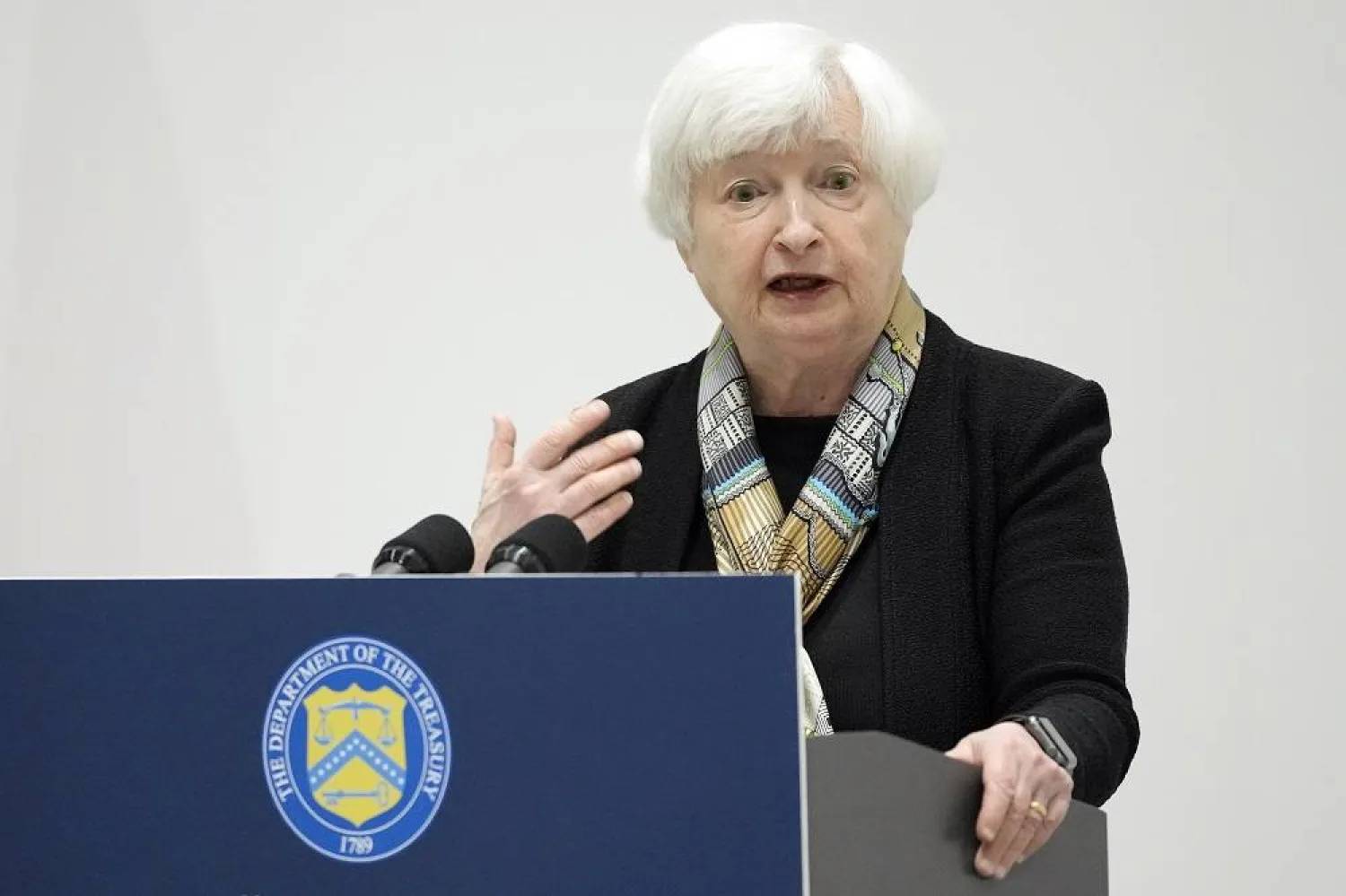
US Treasury Secretary Janet Yellen takes questions from journalists during a press conference, at the G7 meeting of Finance Ministers and Central Bank Governors, at Toki Messe in Niigata, Japan, Thursday, May 11, 2023. (AP)
TT

Yellen Warns US Default Would Threaten Global Economy, Undermine Its Leadership 

US Treasury Secretary Janet Yellen takes questions from journalists during a press conference, at the G7 meeting of Finance Ministers and Central Bank Governors, at Toki Messe in Niigata, Japan, Thursday, May 11, 2023. (AP)

US Treasury Secretary Janet Yellen on Thursday urged Congress to raise the $31.4 trillion federal debt limit and avert an unprecedented default that would trigger a global economic downturn and risk undermining US global economic leadership.

Yellen issued the latest in a series of increasingly stark warnings in remarks prepared for a press conference ahead of a meeting in Japan with her counterparts from the Group of Seven (G7) rich nations, as well as India, Indonesia and Brazil.

"A default would threaten the gains that we've worked so hard to make over the past few years in our pandemic recovery. And it would spark a global downturn that would set us back much further," she said. "It would also risk undermining US global economic leadership and raise questions about our ability to defend our national security interests."

US President Joe Biden on Wednesday said failure by Congress to act before Treasury runs out of money to pay the government's bills -- something that could happen as early as June 1 -- risked throwing the US economy into a recession.

Yellen said Republican brinkmanship on the issue amounted to a "crisis of our own making" and that just the threat of a default could lead to a downgrade of the US government's credit rating, as occurred during a debt ceiling fight in 2011.

It could drive interest rates higher on mortgages, auto payments and credit cards, Yellen said, noting that rates were already spiking on debt due around June 1.

The US economy would suffer a "substantial" hit if Treasury was no longer able to issue debt, not to mention the impact on financial markets and institutions and consumer confidence, she said, calling the prospect "unthinkable."

"All of these analyses show that we would fall into -- if this lasted for any meaningful period of time -- a very substantial downturn," she said.

Biden, a Democrat, insists that Congress has a constitutional duty to raise the debt ceiling, which reflects previously spent federal money, without conditions. But Republicans who control the House of Representatives have tied any increase in the debt limit to sweeping budget cuts.

The US president this week said he might have to skip travelling to Hiroshima to meet with G7 leaders next week, depending on developments in the debt ceiling standoff. Biden is due to meet with top Democratic and Republican congressional leaders again on Friday after an initial meeting on Tuesday.

Unlike most developed countries, the US sets a ceiling on how much it can borrow. Because the government spends more than it takes in, lawmakers must periodically raise that cap.

Yellen also mapped out her priorities for the G7 meeting, including individual and joint action to strengthen the global economy and bring down inflation, redoubling a commitment to help Ukraine defend itself against Russia's invasion, and longer-term efforts to boost economic resilience.

Despite the downside risks, Yellen said the global economy remained in a better place than many had predicted six months ago, with most G7 countries having seen a drop in annual headline inflation and improved growth forecasts.

The United States had taken action to strengthen confidence in its banking system after the failure of three regional banks, Yellen said, as well as enacting legislation to invest in infrastructure, alternative energy and semiconductor chips.

It was also critical to help developing countries, she said, adding that G7 members would coordinate their efforts to push for "timely and comprehensive" debt treatments for countries in debt distress. Yellen has repeatedly accused China - the world's largest sovereign creditor - of dragging its heels on moving forward with such arrangements.

Yellen said she would also work with her G7 counterparts to build greater economic resilience in the longer term by boosting domestic production of critical goods and helping developing countries expand their stake in global supply chains.

That meant helping those countries move away from "solely extractive industries into activities that provide greater support for the domestic economy and employment", she said.

Yellen said the work would build on the $600 billion in investments underway through the G7 Partnership for Global Infrastructure and Investment, which aims to mobilize private capital for infrastructure projects in developing countries.

The G7 -- which groups the US, Japan, Germany, Britain, France, Italy and Canada, along with the European Union -- would also keep working to mitigate geostrategic risks and counter economic coercion by China, Yellen said.


Iraq Oil Output Exceeds 5 million bpd

Majnoon oil field near the Iraqi city of Basra (Reuters)
TT

Iraq Oil Output Exceeds 5 million bpd

Majnoon oil field near the Iraqi city of Basra (Reuters)

Iraq produces more than 5 million barrels of oil per day (bpd), Oil Minister Basim Mohammed told state news agency INA on Saturday.

According to Reuters, Iraq is pushing for a higher OPEC production quota as the economic fallout from the Iran war and new investment by oil majors increase pressure on Baghdad to boost output, potentially putting it at odds with the producer group.

The conflict has hit Iraq particularly hard, forcing major export cuts and depriving the state of oil revenue, which accounted for 88% of government income last year.


IMF: Any Slowdown in AI-driven Growth Would be Factor for Central Banks

IMF Managing Director Kristalina Georgieva speaks during the Annual Meetings Plenary at the Annual Meetings of the International Monetary Fund (IMF) and the World Bank Group (WBG) at the Queen Sirikit National Convention Center (QSNCC) in Bangkok on October 16, 2026. (Photo by Lillian SUWANRUMPHA / AFP)
TT

IMF: Any Slowdown in AI-driven Growth Would be Factor for Central Banks

IMF Managing Director Kristalina Georgieva speaks during the Annual Meetings Plenary at the Annual Meetings of the International Monetary Fund (IMF) and the World Bank Group (WBG) at the Queen Sirikit National Convention Center (QSNCC) in Bangkok on October 16, 2026. (Photo by Lillian SUWANRUMPHA / AFP)

Central bankers around the world would need to consider any slowdown in AI-driven growth as they assess steps in their fight against inflation, International Monetary Fund Managing Director Kristalina Georgieva said on Friday.

Georgieva said concerns about dependence on the AI investment boom and high valuations were impacting markets around the world.

"Things are going up and down, and this is likely to continue," she told an audience at IMF headquarters in Washington, adding that the volatility would complicate the job of central banks at a time when risks to price stability had been growing.

A steep rout in technology stocks on Thursday rippled through markets on fears that ⁠the Democrats' victory ⁠in the US midterm elections would increase regulatory scrutiny of AI and slow the data center build-out, sending investors to the safety of bonds.

The political jitters are hitting an AI trade already on shaky footing due to worry about return on massive spending on AI-related infrastructure, with the meltdown spurring margin calls and spooking retail investors and hedge ⁠funds alike.

Georgieva said the AI investment boom was lifting growth in some countries, helping to offset a negative oil-supply shock triggered by the war in the Middle East, but it was also adding to inflationary pressures and financial stability concerns.

The IMF last month flagged significant growth and financial stability risks from a potential ending of the AI investment boom, among other factors, including a prolonged Middle East war. At the time, it warned that a steep drop in AI investment could lead to a sharp fall in asset prices, ultimately cutting global GDP ⁠by 1.1% ⁠by 2028, including a 1.8% drop in US output.

Georgieva did not repeat the downside forecast on Friday, but acknowledged the recent market volatility.

"Should there be a slowdown in the AI-driven growth impulse, it would need to be factored in as central banks assess the necessary steps in the fight against stubborn inflation," she said.

Democrats are planning to unleash a flood of new legislation targeting artificial intelligence systems and data-center development when they take control of the US Congress in January, Reuters reported on Friday, citing congressional aides and advocates.

That would mark a sharp shift from the Republican-led Congress, where lawmakers largely focused on promoting AI development and declined to pass legislation restricting the technology.


World Food Prices Dip in October, but Remain Higher Than a Year Ago

A worker carries loaves of bread for sale at a bakery in the capital city of Cairo, Egypt November 4, 2026. (Reuters)
TT

World Food Prices Dip in October, but Remain Higher Than a Year Ago

A worker carries loaves of bread for sale at a bakery in the capital city of Cairo, Egypt November 4, 2026. (Reuters)

World food prices edged lower in October as weaker import demand contributed to monthly declines in cereal, dairy and meat prices, but were still nearly 6% higher than a year earlier, the United Nations' Food and Agriculture Organization said on Friday.

The FAO Food Price Index, which tracks monthly changes in international prices for a basket of food commodities, ‌averaged 133.9 points ‌in October, down from a revised ‌135.6 ⁠in September.

The index ⁠was 5.9% higher than a year earlier, but remained 16.4% below its March 2022 peak.

FAO's cereal price index fell 4.5% from September and was 12.6% lower than a year ago, as wheat and maize quotations declined. Wheat prices eased on weak import demand ⁠and improved production prospects, especially in Argentina.

"Expectations of ‌easing constraints on Black ‌Sea export flows added to the downward pressure on prices, ‌although continued disruptions to Black Sea logistics limited the decline," ‌FAO said in a statement.

Maize prices also eased after reaching a three-year high in September, pressured by the US harvest, expectations of ample supplies in South America and renewed ‌prospects of easing tensions in the Black Sea region.

Vegetable oil prices edged up 0.3%, ⁠as ⁠higher soybean and sunflower oil prices more than offset a fall in rapeseed oil prices.

Sugar prices rose 6.6%, their fourth straight monthly increase, to the highest level since December 2024, after rainfall disrupted harvesting in Brazil. They were now 28.8% above a year ago.

The dairy index fell 1.1%, as lower butter and cheese prices linked to ample supplies and subdued demand outweighed gains in milk powder.

The meat index declined 1.2%, while still slightly above its year-earlier level, as ovine and bovine meat prices fell.