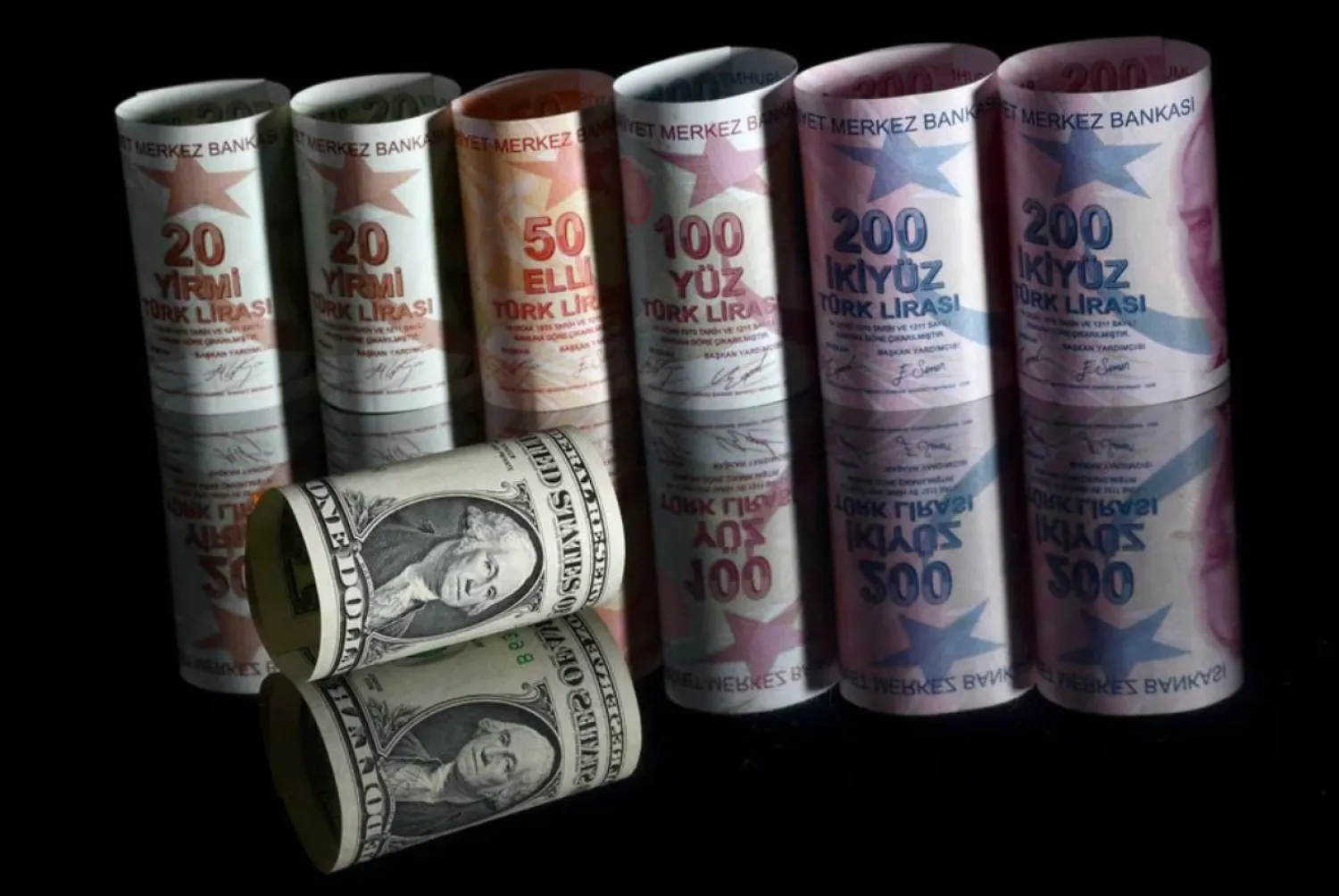
Turkish Lira Nears Record Low of 20 vs Dollar Ahead of Election Runoff

A U.S. one dollar banknote is seen next to Turkish lira banknotes in this illustration taken in Istanbul, Türkiye November 23, 2021. REUTERS/Murad Sezer/Illustration/File Photo
TT

Turkish Lira Nears Record Low of 20 vs Dollar Ahead of Election Runoff

A U.S. one dollar banknote is seen next to Turkish lira banknotes in this illustration taken in Istanbul, Türkiye November 23, 2021. REUTERS/Murad Sezer/Illustration/File Photo

The Turkish lira weakened to a record low just off 20 against the dollar on Friday ahead of this weekend's presidential election runoff which will decide whether President Tayyip Erdogan extends his rule into a third decade.

At 0413 GMT, the lira stood at 19.9845 against the dollar, off a record low of 19.9950 in early trade, Reuters reported.

Türkiye's sovereign dollar bonds and equities have plunged, while the cost of insuring exposure to Turkish debt has spiked since the first round of the presidential election on May 14.

Erdogan was well ahead of his main rival Kemal Kilicdaroglu in that vote and fell just short of the more than 50% support he needed to avoid going to Sunday's runoff.


Gold Slips as Higher Oil, US Inflation Data Bolster Fed Hike Bets

Ingots of 99.99 percent pure gold are placed in a workroom at the Novosibirsk precious metals refining and manufacturing plant in the Siberian city of Novosibirsk, Russia, September 15, 2023. (Reuters)
TT

Gold Slips as Higher Oil, US Inflation Data Bolster Fed Hike Bets

Ingots of 99.99 percent pure gold are placed in a workroom at the Novosibirsk precious metals refining and manufacturing plant in the Siberian city of Novosibirsk, Russia, September 15, 2023. (Reuters)

Gold prices slipped on Friday as higher oil prices and robust US inflation data strengthened the case for another Federal Reserve interest rate hike later this year.

Spot gold was down 0.5% at $4,000.54 per ounce by 0511 GMT, while US gold futures for ‌December delivery dropped ‌0.5% to $4,010.10. Bullion was on track ‌for ⁠a second consecutive monthly decline.

"Gold's ⁠slide is asking serious questions of technical support around the $4,000 level. Dip buying has previously limited declines, but it remains to be seen whether value buying will come to gold's rescue," said Tim Waterer, chief market analyst at KCM Trade.

"There were enough bullish indicators in the US ⁠macro data this week to keep the Fed ‌on track for a potential ‌December hike, which combined with oil at present levels means ‌that gold continues to lose out from an inflation perspective."

US ‌inflation accelerated in September as consumers paid more for gasoline and other goods, supporting economists' expectations of an interest rate increase in December.

Higher interest rates increase the opportunity cost of holding non-yielding ‌bullion, making gold less attractive to investors.

Traders are pricing in about a 75% chance ⁠of a ⁠rate hike in December, according to the CME's FedWatch Tool.

Oil prices rose on Friday and were set for a fourth monthly gain, as an attack on a tanker in the Strait of Hormuz highlighted supply risks stemming from the US-Israeli war on Iran.

Elsewhere, annual core inflation in Japan's capital well exceeded the central bank's 2% target in October, data showed on Friday, highlighting mounting price pressure.

Spot silver slid 1.6% to $51.53 per ounce, platinum dropped 1.9% to $1,459.75 and palladium fell 1.4% to $992.37. All three metals were headed for weekly and monthly declines.


IMF Says Engaging with Iraq on Preparing New Bailout Program

Central Bank of Iraq (INA)
TT

IMF Says Engaging with Iraq on Preparing New Bailout Program

Central Bank of Iraq (INA)

The International Monetary Fund on Thursday said it was engaging with Iraqi authorities as it prepares a new bailout program for the country, whose economy has been battered by the war on Iran.

The US-Israel war on Iran, launched in late February, plunged the region into conflict and saw Tehran's retaliatory action virtually block the Strait of Hormuz, a key energy supply route.

Iraq's economy is heavily dependent on its energy exports, which almost entirely rely on transport through the strait.

Before the war, the country was already facing acute fiscal constraints, and the IMF this month forecast its economy would contract by 16 percent this year.

"Our plan now is to engage with the authorities to understand better their priorities, how they want to address their vulnerabilities, and then to move ahead on how we can best support them with a program," said IMF spokesperson Julie Kozack at a regular press briefing in Washington.

Kozack cited the country's severe financing constraints from before the outbreak of the war, and said its very narrow non-oil revenue base was also putting pressure on the fiscal balance.

The last of Iraq's three most recent programs with the IMF ended in 2019.

It has a total of around $428 million in interest payments due to the Fund by 2030, according to IMF data.

IMF Chief Kristalina Georgieva first disclosed that Iraq had approached the Fund for a new program at the Fund's annual meetings in Bangkok earlier this month.

At those meetings, Georgieva lauded the resilience of global economic growth in the face of wars in Iran and Ukraine, but warned that outcomes were highly uneven with more vulnerable economies battered hard by the conflicts.


Iraq's Central Bank: Exchange Rate Gap Narrows to 9%, No New Currency Being Printed

Iraq's Central Bank Governor chairs a meeting on Thursday (Iraqi News Agency)
TT

Iraq's Central Bank: Exchange Rate Gap Narrows to 9%, No New Currency Being Printed

Iraq's Central Bank Governor chairs a meeting on Thursday (Iraqi News Agency)

Iraq's Central Bank Governor Nizar Nasser Hussein announced Thursday that the gap between the dinar's official exchange rate and its parallel-market rate had narrowed to 9%, down from approximately 24%, while denying reports that new banknotes were being printed.

Hussein made the remarks during a visit by the Iraqi Parliament's Investment and Development Committee to the central bank to discuss the repercussions of changes to the dollar exchange rate, their impact on economic and investment activity, and the challenges facing investors and local companies, according to a parliamentary statement carried by the Iraqi News Agency (INA).

The governor confirmed that no currency printing was underway, describing reports to the contrary as inaccurate. He also noted that the gap between the official and parallel-market exchange rates had fallen to 9%, as Iraq faces mounting financial and economic pressures stemming from the war involving Iran and disruptions to oil exports.

In early October, the Central Bank of Iraq raised the dollar's selling rate to the public to 1,520 dinars, from approximately 1,320 dinars previously, a move that devalued the dinar by around 15% against the dollar amid pressure on oil revenues and foreign currency inflows.

Iraq's public finances depend heavily on oil revenues, making export disruptions and declining foreign currency inflows major sources of pressure on the state budget and foreign exchange market.

During the meeting, the central bank outlined measures taken to support the economy, including assistance to state-owned and private banks in providing citizens with concessional loans ranging from 5 million to 15 million Iraqi dinars.

For its part, the Investment and Development Committee stressed the need to limit the impact of exchange rate changes on investment project costs, raw material prices and contractual obligations, as well as their repercussions for market stability and citizens' purchasing power.

The committee called for stronger coordination between the central bank, government agencies and the banking sector, streamlined bank financing procedures, and the removal of obstacles facing investors to ensure projects can continue without imposing additional burdens on businesses and citizens.

The developments come as Iraqi authorities seek to contain the economic fallout from the war amid mounting pressure on oil exports and public finances.

Iraq had requested financial support from the International Monetary Fund, which projected that the country's economy would contract by 16% this year, according to estimates cited in the report.