


Saudi Arabia Grants Licenses for Establishment of 4 Economic Zones

Minister of Investment Eng. Khaled Al-Falih addresses the Saudi Special Economic Zones Investment Forum on Monday. (Asharq Al-Awsat)
TT

Saudi Arabia Grants Licenses for Establishment of 4 Economic Zones

Minister of Investment Eng. Khaled Al-Falih addresses the Saudi Special Economic Zones Investment Forum on Monday. (Asharq Al-Awsat)

The Saudi government is seeking to develop special economic zones based on modern and innovative designs, with the aim to attract foreign direct investments and shape the future of regional and global markets.

Ministers, officials, and local and international experts attended the launch of the Saudi Special Economic Zones Investment Forum on Monday, which saw the announcement of new investment deals exceeding 27 billion riyals ($7.2 billion).

Hosted by the Economic Cities and Special Zones Authority (ECZA), in partnership with the Saudi Program for Attracting Regional Headquarters of International Companies, the forum witnessed extensive sessions that highlighted Saudi Arabia’s position as a future investment destination and the importance of special economic zones in diversifying the country’s sources of income.

During the event, licenses for the establishment of four Special Economic Zones (SEZs) were awarded to the King Abdullah Economic City’ (KAEC) SEZ, Ras Al-Khair SEZ , Jazan SEZ, and Cloud Computing SEZ.

Eng. Khaled Al-Falih, Minister of Investment, said the Saudi government concluded in 2022 deals for the private sector worth 285 billion riyals ($76 billion) in various fields, including cars, information and communication technology, agriculture and space, as well as petrochemicals, mining and renewable energy.

He revealed that the investment sector in Saudi Arabia grew by 31 percent during 2022, to exceed one trillion riyals ($266.6 billion), for the first time in the history of the Kingdom.

The minister underlined that the social, economic and commercial indicators have proven the extent of investor confidence in the Saudi infrastructure. He added that the new special economic zones were designed based on a futuristic and innovative outlook, with a focus on attracting foreign direct investment and maximizing opportunities for major industries.

Minister of Finance Mohammed Al-Jadaan stated that the economic zones help achieve sustainable development and contribute to attracting investments and generating job opportunities.

He added that the economic cities would benefit from Saudi Arabia’s strategic location to establish new clusters of companies across the main growth sectors, which would contribute in shaping the future of regional and global markets.

According to Al-Jadaan, the special zones target specific investors in certain sectors to reduce competition between the primary economy and the special economic cities.

Bandar AlKhorayef, Minister of Industry and Mineral Resources, said the private economic zones in Saudi Arabia would greatly benefit the local economy, as they are an important component of economic diversification.

He stressed that the zones would serve re-export products and help create a large commercial movement in the next stage.

AlKhorayef revealed that the private economic zones focus on various industries related to ship manufacturing, mining and renewable energy industries, to promote investments that help expand services and create added value.

Meanwhile, Nabil Khoja, Secretary General of ECZA, told Asharq Al-Awsat that the volume of investments in the special economic zones in the coming period would top 116 billion riyals ($30.9 billion), given the efforts made to achieve the targets set to support the foundations of the Saudi economy.

Khoja predicted an influx of more investments in the coming phase, noting that each economic zone was characterized by qualitative industries and provided a package of incentives and enablers.

The forum discussed the opportunities offered by the special economic zones and the promising growth potential they provide to investors around the world.

Talks also touched on key topics that dealt with Saudi Arabia’s strengths, including the supportive and competitive regulatory environment, the strategic geographical location that boosts the country’s position as a vital center for supply chains and logistics services, and the advanced digital infrastructure capable of supporting ICT companies and the global cloud computing system.

The forum reviewed the latest developments in the Saudi program that focuses on attracting regional headquarters of international companies.

Some of the most important advantages offered by the special economic zones in Saudi Arabia include competitive tax rates and exemption from customs duties on imports, production inputs, machinery and raw materials.
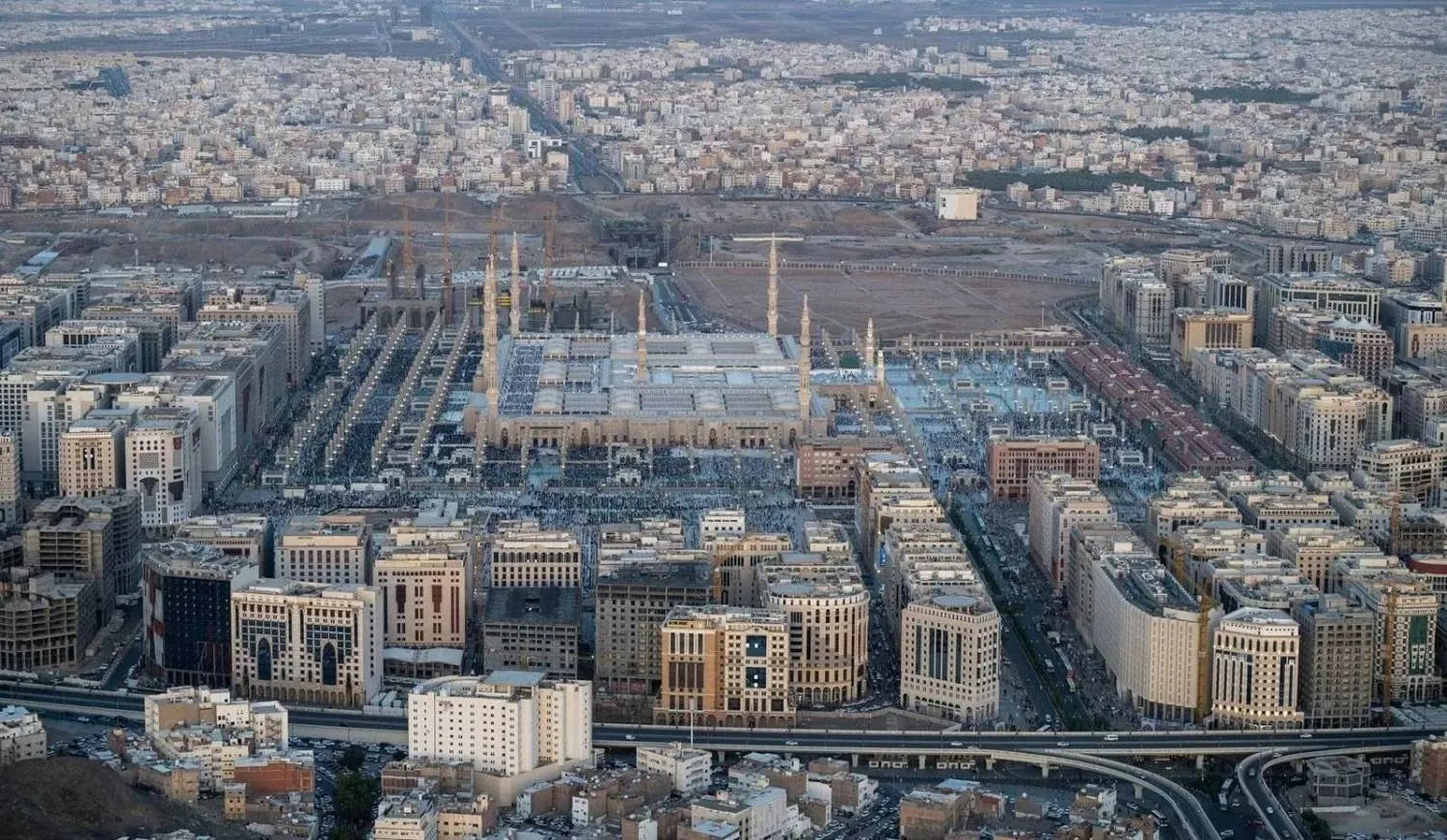



Madinah Sees Tourism Surge Ahead of Ramadan, Spending Tops $13.9 Billion

A cluster of buildings and hotels surrounding the Prophet’s Mosque (SPA). 
TT

Madinah Sees Tourism Surge Ahead of Ramadan, Spending Tops $13.9 Billion

A cluster of buildings and hotels surrounding the Prophet’s Mosque (SPA). 

Saudi Arabia’s Minister of Tourism, Ahmed Al-Khateeb, has toured hospitality facilities and visitor services in Madinah as part of the “Spirit of Ramadan” inspection tour, which also included Jeddah and Makkah.

New data show visitor numbers exceeded 21 million over the past year, a 12 percent increase from 2024, while total tourism spending reached SAR 52 billion (about $13.9 billion), up 22 percent.

The visit focused on assessing the sector’s readiness for the Ramadan season, evaluating service quality, and supporting ongoing and upcoming tourism projects.

Madinah posted strong tourism performance in 2025, driven by higher visitor inflows and expanded hospitality capacity, reinforcing its position as a leading religious destination within Saudi Arabia’s tourism landscape.

Demand growth has been matched by a sharp rise in supply. Licensed hospitality facilities increased to 610, up 35 percent, while the number of licensed rooms surpassed 76,000, a 24 percent gain, strengthening the city’s ability to accommodate during peak seasons such as Ramadan and Hajj.

Travel and tourism offices also grew to more than 240, reflecting a 29 percent expansion in supporting services.

Al-Khateeb said the entry of international hospitality brands and new projects over the past five years underscores both sectoral growth and rising investor confidence in the Kingdom’s tourism ecosystem.

“The landscape today is different. The sector is growing steadily, supported by a system that empowers investors and facilitates their journey, with a promising future ahead,” he said.

To expand hotel capacity, the minister inaugurated the Radisson Hotel Madinah, a project worth more than SAR 39 million (around $10 million) and financed by the Tourism Development Fund.

The 2025 performance signals a shift from traditional seasonal growth toward more sustainable expansion built on diversified offerings, improved service quality, and a stronger contribution to the local economy.


Airbus Planning Record Commercial Aircraft Deliveries in 2026

An Airbus A350-1000 at the Singapore Airshow on February 4. The company said Thursday it aims to deliver a record number of aircraft this year. Roslan RAHMAN / AFP/File
TT

Airbus Planning Record Commercial Aircraft Deliveries in 2026

An Airbus A350-1000 at the Singapore Airshow on February 4. The company said Thursday it aims to deliver a record number of aircraft this year. Roslan RAHMAN / AFP/File

Plane maker Airbus aims to deliver a record number of commercial aircraft this year, the company said Thursday, capitalizing on "strong demand" and a jump in profit in 2025.

"2025 was a landmark year, characterized by very strong demand for our products and services across all businesses," CEO Guillaume Faury said in a press release announcing annual results.

The European manufacturer said it received 1,000 orders for commercial planes in 2025, with net orders of 889 after taking cancellations into account, and 793 delivered.

Last year, its overall profit jumped 23 percent to 5.2 billion euros ($6.1 billion).

The company said it is targeting "around 870 commercial aircraft deliveries" this year.

"As the basis for its 2026 guidance, the Company assumes no additional disruptions to global trade or the world economy, air traffic, the supply chain, its internal operations, and its ability to deliver products and services," it said in its outlook.

Both Airbus and its rival Boeing have struggled to return to pre-pandemic production levels after their entire network of suppliers was disrupted, even as airlines are eager to modernize their fleets with more fuel-efficient aircraft and expand to meet an expected increase in passenger numbers over the coming decades.


Saudi Arabia's Humain Invests $3 Bn in Musk's xAI

The logo of the Saudi company Humain. Asharq Al-Awsat
TT

Saudi Arabia's Humain Invests $3 Bn in Musk's xAI

The logo of the Saudi company Humain. Asharq Al-Awsat

Saudi Arabia's artificial intelligence firm Humain said Wednesday it had invested $3 billion in US billionaire Elon Musk's xAI.

The investment made Humain a "significant minority shareholder,” the company said in a statement.

It added that its xAI holdings would be "converted into SpaceX shares" after the rocket company announced it was taking over the AI start-up earlier this month as Musk pushes to unify his many business interests.

CEO Tareq Amin said the latest investment “reflects Humain’s conviction in transformational AI and our ability to deploy meaningful capital behind exceptional opportunities where long-term vision, technical excellence, and execution converge, xAI’s trajectory, further strengthened by its acquisition by SpaceX, one of the largest technology mergers on record, represents the kind of high-impact platform we seek to support with significant capital.”

Musk's xAI had previously announced in November it was teaming up with Humain to build a 500-megawatt data center in Saudi Arabia.

The Saudi firm also inked a new deal with Nvidia.