Kuwaiti Oil Minister: Kuwait, Saudi Arabia Have 'Exclusive Rights' in Durra Gas Fieldhttps://english.aawsat.com/business/4426266-kuwaiti-oil-minister-kuwait-saudi-arabia-have-exclusive-rights-durra-gas-field
Kuwaiti Oil Minister: Kuwait, Saudi Arabia Have 'Exclusive Rights' in Durra Gas Field
The Durra gas field. Asharq Al-Awsat
Kuwait and Saudi Arabia have "exclusive rights" in the Durra gas field in the Arabian Gulf, Kuwait Oil Minister Saad Al Barrak said on Sunday, and he called on Iran to validate its claim to the field by demarcating its own maritime borders first.
Iran has previously said it has a stake in the field and called a Saudi-Kuwaiti agreement signed last year to develop it "illegal".
"Until this moment, this is an exclusive right of Kuwait and Saudi Arabia in the Durra field, and whoever has a claim must start demarcating the borders. And if it has a right, it will take it according to the rules of international law," Al Barrak said in an interview with Saudi state-run Al Ekhbariya television.
"The other side has claims that are not based on a clear demarcation of the maritime borders," he added, referring to Iran.
There is no room for negotiations with Iran over Durra until it demarcates its own maritime borders in accordance with international laws, the minister said.
The minister insisted Kuwait and Saudi Arabia are “one team” when it comes to the gas field, which will be developed “for the benefit of both countries.”
Policy Resilience and Transport Lifelines: Saudi Arabia’s Shield Against the Hormuz Crisishttps://english.aawsat.com/business/5254372-policy-resilience-and-transport-lifelines-saudi-arabia%E2%80%99s-shield-against-hormuz
Policy Resilience and Transport Lifelines: Saudi Arabia’s Shield Against the Hormuz Crisis
Saudi Arabia's capital Riyadh (SPA)
As the world grapples with unprecedented turbulence fueled by the US-Israeli-Iranian confrontation, and as global supply chains reel from the closure of the Strait of Hormuz, the Saudi economy has emerged as an exceptional model of resilience. This stability is no coincidence; rather, it is the fruit of proactive policies and early investments in diversifying transport arteries and logistics. This strategic integration has allowed the Kingdom to transform its geography from a point of dependency on threatened waterways into an impregnable economic fortress. Through land, sea, and air routes that have become "alternative lifelines," the Kingdom has not only ensured the flow of energy but also secured the region’s needs for food and medicine, cementing its status as a vital logistical hub amidst the surging waves of conflict.
Economic experts believe that the efficacy of Saudi economic policies, coupled with the cultivation of inherent strengths and diverse transport and export options, has contributed significantly to the economy's ability to withstand the repercussions of the ongoing regional conflict.
Policy Efficacy and Strategic Strength
In this context, Fadl bin Saad Al-Buainain, a member of the Shura Council and economic consultant, affirmed that the Saudi economy is characterized by strength, durability, and sustainability. He noted its capacity to adapt to emergency shifts by leveraging its fundamental assets, thereby mitigating the impact of the current crisis despite its high risks.
Al-Buainain emphasized that the sheer depth and scale of the Saudi economy allow it to absorb sudden shocks and even convert them into opportunities to address any emerging shortages. He pointed out that the strategic vision for the oil sector and "qualitative hedging" to ensure supply security have created critical alternatives for oil exports following the closure of the Strait of Hormuz.
According to Al-Buainain, the sustainability of exports has bolstered the reliability of Saudi Aramco and maintained government revenues, while maximizing gains from high oil prices to compensate for any reduction in exported volumes.
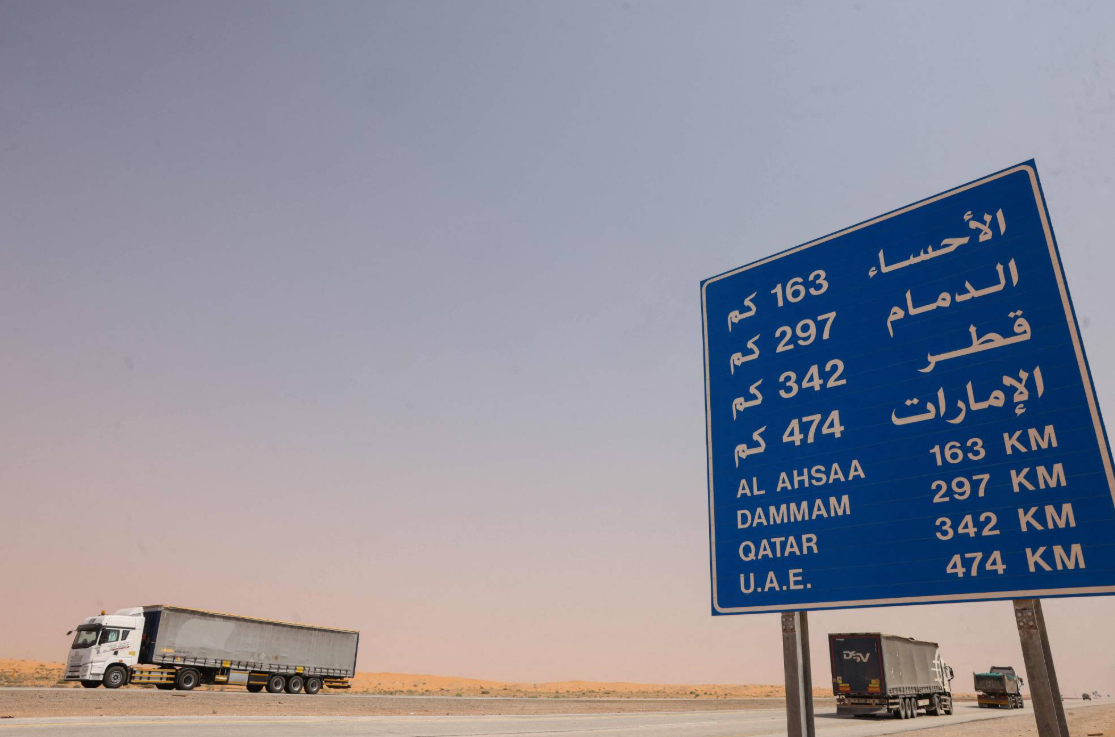
Trucks on the highway between Riyadh and Al-Ahsa, about 200 kilometers east of the Saudi capital (AFP)
The Pivotal Role of "Vision 2030"
Al-Buainain underscored the fundamental role of reforms stemming from Saudi Vision 2030 in enhancing economic diversification and strategic hedging across financial and oil sectors. He noted that prudent management, directly overseen by Crown Prince Mohammed bin Salman, served as the first line of defense against the crisis.
He cited S&P Global Ratings' affirmation of the Kingdom’s "A+" credit rating with a "Stable" outlook as the "strongest neutral evidence of economic durability and efficiency." He also highlighted the defensive aspect, stating: "The readiness of the military sectors was the most critical factor in protecting oil installations and achieving economic security," noting that the Kingdom’s Red Sea coastline has been vital in sustaining trade lines and protecting regional commerce.
A Logistical Platform and Humanitarian Responsibility
According to Al-Buainain, the Kingdom has transformed into a global logistics platform, opening its airports and ports as alternatives for neighboring countries. This has guaranteed the sustainability of food and medicine supply chains, providing much-needed stability to Gulf markets. In the energy sector, Saudi Arabia continued to meet customer demands and even offered additional barrels on the spot market, utilizing the East-West Pipeline and overseas storage reserves.
"In the transport and logistics sector, the Kingdom successfully managed the situation of stranded individuals, returning them to their home countries and ensuring the operation of Gulf airlines by opening alternative airports," Al-Buainain added.
He further revealed a massive humanitarian and logistical role played by Saudi ports in the Eastern Province, which provided food, medicine, and fuel to approximately 3,200 stranded ships and 40,000 sailors in the Arabian Gulf following Iranian threats to maritime safety. He stressed that "the Kingdom's humanitarian efforts do not waver, even under the darkest circumstances and in the face of barbaric acts that violate international law."
Stability in the Face of Crisis
For his part, Engineer Abdullah Al-Mobty, Chairman of the Abha Chamber and former Head of the Federation of Saudi Chambers, told Asharq Al-Awsat that the nature of the Saudi economy has made it resilient against the fallout of the US-Israeli-Iranian confrontation. He noted that the Kingdom has shown remarkable stability throughout historical crises thanks to a "clear vision set by the leadership to strengthen the economy through wise methodologies and plans."
Al-Mobty attributed this resilience to Riyadh’s role as a "reliable strategic depth," maintaining the best possible economic position even during a war of this magnitude. He noted that Saudi Arabia views proactive planning and foresight as an integral part of its commitment to the nation and its citizens' interests.
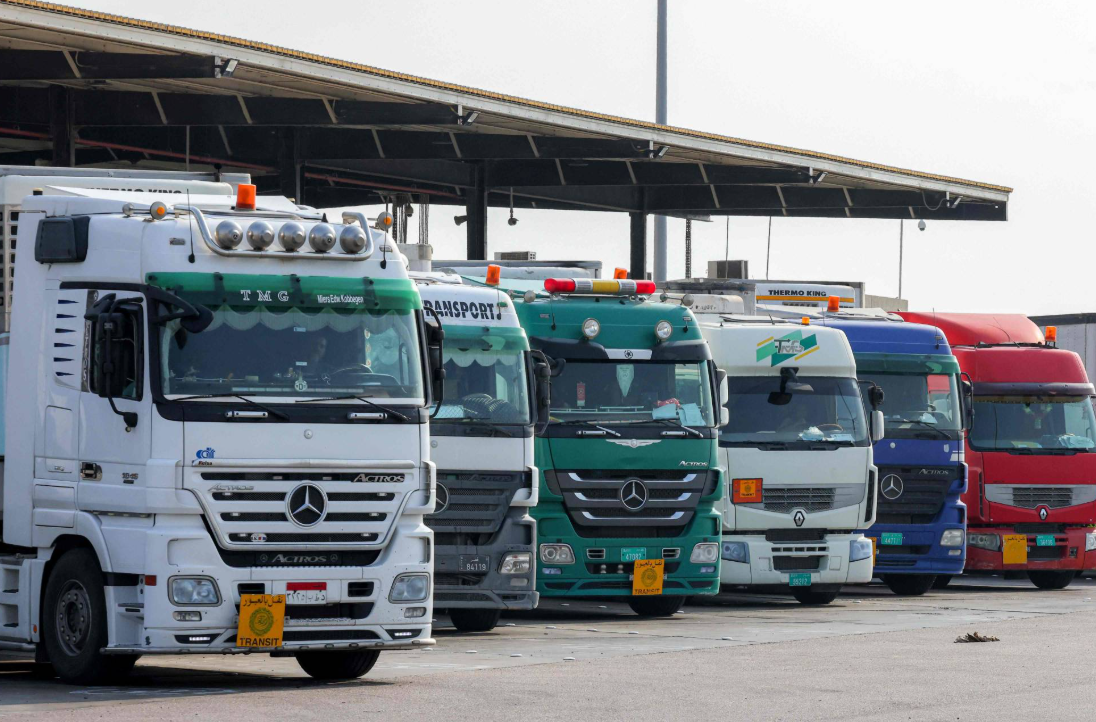
Trucks loaded with goods wait to cross into Qatar at the Salwa border crossing in eastern Saudi Arabia (AFP)
Land Transport Solutions
Al-Mobty emphasized that the Kingdom has never been an advocate of war; instead, its vision focused on creating strategic alternatives. He pointed to the Kingdom's ability to bypass the Strait of Hormuz by pumping crude via the Red Sea and securing the delivery of essential supplies to Gulf states through existing infrastructure.
"One of the immediate results we witnessed was the efficiency of the Saudi land transport sector," Al-Mobty stated. "It responded instantly and with massive capacity to cover the needs of the UAE and neighboring countries, both in passenger transport and securing supply chains. This proved the Kingdom’s success in turning its geographical location into an economic fortress for the region."
The Capacity to Absorb Shocks
Abdullah bin Zaid Al-Mulihi, CEO of Saudi Techno Excellence Company, stressed that the effectiveness of the Kingdom's plans in managing economic, trade, and investment sectors has granted it an exceptional ability to face the massive challenges currently paralyzing global and regional economies.
Al-Mulihi explained to Asharq Al-Awsat that Saudi economic policies are designed with high flexibility to absorb crises, citing the Kingdom's historical resilience during the 2008 global financial crisis. He noted that policies promoting diversification and advanced infrastructure, including land and sea ports, have optimized the Kingdom's unique geography.
"The multiplicity of transport and export options is what achieved this strategic resilience," Al-Mulihi said. He added that the Saudi land transport sector has become the "driving engine" of the region's economy, experiencing a strong boom as it secures the movement of goods and people, particularly to the UAE, reinforcing the sector as a primary pillar in confronting the current crisis.
Oil Prices Ease and Stocks Jump after Trump Says Iran is Talking with the US, Despite Iran's Denialshttps://english.aawsat.com/business/5254354-oil-prices-ease-and-stocks-jump-after-trump-says-iran-talking-us-despite-irans
epa12841568 People walk on the shore of the Gulf of Finland with the St. Petersburg Oil Terminal in the background on a sunny day in St. Petersburg, Russia, 22 March 2026. Temperatures in St. Petersburg, Russia's second largest city, reached eleven degrees Celsius. EPA/ANATOLY MALTSEV
Oil Prices Ease and Stocks Jump after Trump Says Iran is Talking with the US, Despite Iran's Denials
epa12841568 People walk on the shore of the Gulf of Finland with the St. Petersburg Oil Terminal in the background on a sunny day in St. Petersburg, Russia, 22 March 2026. Temperatures in St. Petersburg, Russia's second largest city, reached eleven degrees Celsius. EPA/ANATOLY MALTSEV
Relief is ripping through financial markets Monday after President Donald Trump said the United States has talked with Iran about a possible end to their war. Oil prices are easing, and stock prices are jumping on Wall Street following severe losses elsewhere in the world before Trump’s announcement.
The price for a barrel of Brent crude fell 8% to $103.23, down from nearly $120 last week, after Trump said on his social media network that the United States and Iran held productive talks the last two days “regarding a complete and total resolution of our hostilities in the Middle East.”
The S&P 500 leaped 1.3% toward its best day since well before the war began following the step down in tensions, even though Iran denied there were any negotiations, The AP news reported.
Over the weekend, Trump had threatened to obliterate Iran’s power plants if it doesn’t open up the Strait of Hormuz within 48 hours. The strait has become a sore point for Trump because its near-closure by Iran has prevented oil tankers from leaving the Arabian Gulf to supply customers around the world.
Trump said Monday that he is postponing attacks on Iranian power plants for five days to allow talks to continue. Still, caution remains, and the optimism in financial markets was measured. Shortly after Trump’s announcement — hours before his original deadline was set to expire — Iranian state television declared that the American leader had backed down “following Iran’s firm warning.” And a state-owned newspaper said Iran’s Foreign Ministry denied that any negotiations have taken place with the US.
The price of Brent crude fell as low as $96 immediately after Trump’s announcement of the postponement, but it quickly recovered a chunk of that loss. Benchmark US crude had a similar reaction, immediately falling toward $84 per barrel before paring its loss and reaching $90.85.
Financial markets have gone through vicious swings up and down since the war began because of uncertainty about how long it may last. The fear is that the war could keep so much oil and natural gas from the Arabian Gulf off global markets that it sends a debilitating wave of inflation crashing through the global economy.
That in turn could keep the Federal Reserve and other central banks from resuming their cuts to interest rates, which would give the global economy and prices for investments a boost.
Still, the overriding reaction in financial markets on Monday was one of relief. The Dow Jones Industrial Average was up 654 points, or 1.4%, as of 9:35 a.m. Eastern time, and the Nasdaq composite was 1.6% higher.
In Europe, stock indexes immediately flipped from losses to gains following Trump’s announcement and then held onto them. France’s CAC 40 jumped 1.3%, and Germany’s DAX returned 1.8%.
That compares with sharp drops for Asian stock indexes, which finished trading before Trump made his announcement. South Korea’s Kospi careened 6.5% lower, Japan’s Nikkei 225 dropped 3.5% and Hong Kong’s Hang Seng fell 3.5%.
Treasury yields also eased in the bond market following Trump’s announcement. But like oil prices, they nevertheless remain well above where they were before the war began.
The yield on the 10-year Treasury fell to 4.38% from 4.39% late Friday. But it remains solidly above its 3.97% level from just before the war.
EU-Mercosur Trade Deal to Apply Provisionally from May 1https://english.aawsat.com/business/5254318-eu-mercosur-trade-deal-apply-provisionally-may-1
FILE PHOTO: EU flags flutter in front of European Central Bank (ECB) headquarters in Frankfurt, Germany July 18, 2024. REUTERS/Jana Rodenbusch/File Photo/File Photo
EU-Mercosur Trade Deal to Apply Provisionally from May 1
FILE PHOTO: EU flags flutter in front of European Central Bank (ECB) headquarters in Frankfurt, Germany July 18, 2024. REUTERS/Jana Rodenbusch/File Photo/File Photo
The EU said Monday a free trade agreement with South American bloc Mercosur will provisionally enter into force on May 1 -- despite a pending court ruling on its legality.
"Today is an important step in demonstrating our credibility as a major trading partner," EU trade chief Maros Sefcovic said, adding "provisional application will allow" Brussels to start delivering on the promise of "new opportunities for trade, growth and jobs" for exporters.
The key trade elements of the accord, which has proven contentious in Europe, will apply from that date between the 27-nation European Union and the countries in Mercosur that have completed their ratification procedures before the end of March.
"Argentina, Brazil and Uruguay have already done so. Paraguay has recently ratified the agreement and is expected to send its notification soon," the Commission said in a statement.
لم تشترك بعد
انشئ حساباً خاصاً بك لتحصل على أخبار مخصصة لك ولتتمتع بخاصية حفظ المقالات وتتلقى نشراتنا البريدية المتنوعة