


Egypt to Launch Bids to Explore Precious Metals Within Weeks

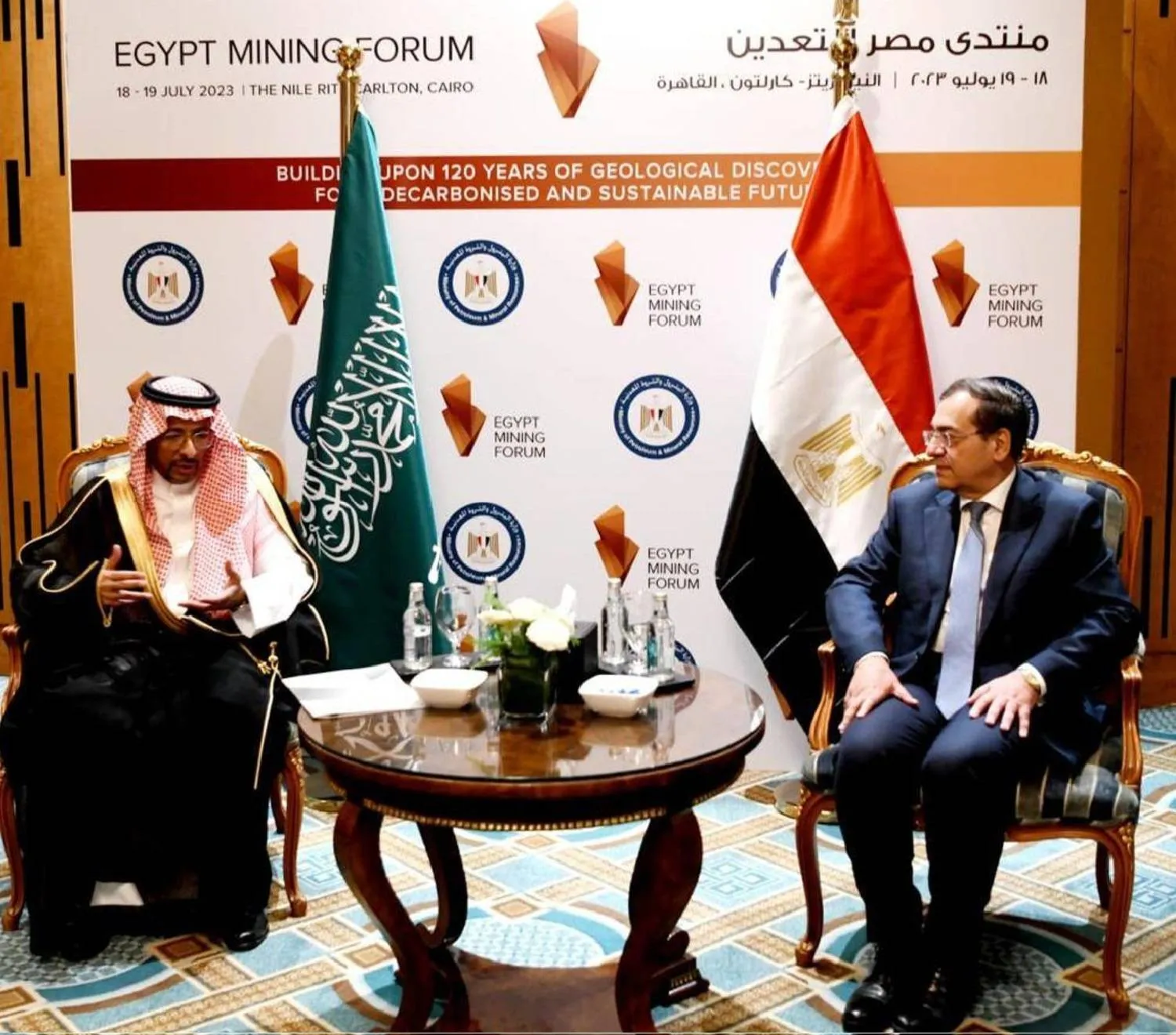
Egyptian Minister of Petroleum and Mineral Resource Tarek el-Molla during a session of talks with Saudi Minister of Industry Bandar al-Khorayef (Asharq Al-Awsat)
TT

Egypt to Launch Bids to Explore Precious Metals Within Weeks

Egyptian Minister of Petroleum and Mineral Resource Tarek el-Molla during a session of talks with Saudi Minister of Industry Bandar al-Khorayef (Asharq Al-Awsat)

Egypt is about to launch a set of bids for precious and basic metals, in addition to phosphates, sulfur, and potash, during the current quarter, Minister of Petroleum and Mineral Resources Tarek el-Molla has announced.

Speaking at the Egypt Mining Forum 2023, Molla referred to efforts to place Egypt as a prominent player at the global investment map, attracting worldwide interest and engagement.

Egypt launched global bids to search for gold and other minerals in 2020, with a total of 290 sectors and resulted in the winning of 13 local and international mining companies with initial investments and a minimum commitment of about $65 million.

Egypt launched the Special Economic Zone of the Golden Triangle, a dedicated platform to foster the growth of mining and value-added projects within the resource-rich region encompassing Qena, Safaga, and al-Qusair.

The Golden Triangle represents approximately 75 percent of the country's mineral wealth, with a vast reserve of iron, copper, gold, silver, granite, and phosphates.

About 11 Egyptian and international companies own concession areas for research and exploration of gold in the Iqat concession area in southern Egypt, in addition to the Sukari Gold Mine (SGM) expansion.

Egypt's raw materials and products production increased 32.5 percent during the last fiscal year, and mineral exports amounted to $1.6 billion over the past year.

Cairo aims to increase its mineral exports to $10 billion in 2040.

In his speech, Molla said the Ministry embarked on an ambitious project for development and modernization, as it adopted the development program in cooperation with the Wood Mackenzie research group.

He indicated that the Ministry aims to increase the mining sector's contribution to the nation's GDP to five percent, focusing on legislating the mining field, amending the financial and licensing systems, and developing organizational structure, mining strategies, and communication.

In 2019, the Ministry amended provisions of the Mineral Resources Law and its executive regulations.

The Minister noted that the authorities were able to adopt a new policy to maximize the added value of mineral wealth by establishing investment projects for the private sector to provide intermediate products.

Several value-added projects have been implemented to provide high-value minerals such as metallic silicon, soda ash, and tantalum.

Molla met Saudi Minister of Industry and Mineral Resources Bandar al-Khorayef and discussed boosting cooperation in mining.

Khorayef stressed that Egypt and Saudi Arabia are joined by integration opportunities in the mining sector, taking advantage of the recent positive developments witnessed by this sector in both countries.

He added that Egypt has recently attracted investors' attention to its mining sector after it achieved several developments, stressing the importance of services in adding momentum to the mining activities.

During the meeting, the two ministers agreed to sign a memorandum of understanding (MoU) for cooperation between the mining sector in both countries.



Japan, South Korea Say Ready to Act Against FX Volatility

FILE PHOTO: Japan's Finance Minister Satsuki Katayama speaks on the day Japan's Prime Minister Sanae Takaichi delivers her policy speech in the parliament, in Tokyo, Japan, February 20, 2026. REUTERS/Kim Kyung-Hoon/File Photo
TT

Japan, South Korea Say Ready to Act Against FX Volatility

FILE PHOTO: Japan's Finance Minister Satsuki Katayama speaks on the day Japan's Prime Minister Sanae Takaichi delivers her policy speech in the parliament, in Tokyo, Japan, February 20, 2026. REUTERS/Kim Kyung-Hoon/File Photo

Japan and South Korea expressed concern on Saturday about the rapid declines in their currencies, saying they were ready to act against excessive foreign-exchange volatility.

Finance Ministers Satsuki Katayama of Japan and Koo Yun-cheol of South Korea "expressed serious concern over the recent sharp depreciation of the Korean won and the Japanese yen," they said in a statement after their annual meeting in Tokyo.

The yen and won have slid as mounting tensions from the US-Israeli war on Iran have driven the dollar higher ⁠on safe-haven demand and ⁠battered the currencies of countries heavily reliant on imported oil.

"Furthermore, they reaffirmed that they will closely monitor foreign exchange markets and continue to take appropriate actions against excessive volatility and disorderly movements in exchange rates," the statement said.

The yen touched its lowest in 20 ⁠months on Friday and is near the line of 160.00 to the dollar that many in the market think might prompt Japan to intervene to support the currency. The won breached a psychological barrier of 1,500 per dollar this month for the first time since March 2009.

Tokyo and Seoul shared the view that significant volatility had emerged in financial markets, including foreign exchange, Katayama told a press conference after the meeting.

"The Japanese government ⁠is ⁠fully prepared to respond at any time, bearing in mind the impact that currency moves may have on people's livelihoods amid surging oil prices, and I believe both sides share that understanding," she said.

Katayama regularly says Japan is ready to act regarding yen moves, although some policymakers privately say that intervening to prop up the yen now could prove futile, as the flood of dollar demand will only intensify if the war persists.


BP Wins US Approval for Kaskida Project in Gulf of Mexico

FILE PHOTO: 3D-printed oil pump jacks and the British Petroleum (BP) logo appear in this illustration taken March 2, 2026. REUTERS/Dado Ruvic/Illustration/File Photo
TT

BP Wins US Approval for Kaskida Project in Gulf of Mexico

FILE PHOTO: 3D-printed oil pump jacks and the British Petroleum (BP) logo appear in this illustration taken March 2, 2026. REUTERS/Dado Ruvic/Illustration/File Photo

British energy major BP has received approval from the Trump administration to advance its Kaskida project in the Gulf of Mexico, a company spokesperson told Reuters in an emailed statement late ⁠on Friday.

The $5 billion ⁠investment would unlock 10 billion barrels of resources that BP has discovered in the Paleogene fields of the US Gulf, the spokesperson said.

The US Department of ⁠the Interior's approval of Kaskida follows a year-long review of the company's development plan, the statement said, according to Reuters.

Bloomberg News first reported on Friday that the Kaskida project is scheduled to start crude production in 2029. The Kaskida project will follow BP’s 2023 start-up of the Argos project, which ⁠was ⁠its first platform launch in the US. Gulf since 2008 and the first since the Deepwater Horizon disaster.

The explosion of BP's Deepwater Horizon rig in April 2010 killed 11 rig workers and caused $70 billion in damages in the largest oil spill in US history.


S&P: Saudi Arabia’s Robust Economy Guarantees its Ability to Withstand Regional Conflict

King Abdullah Financial District in Riyadh (Asharq Al-Awsat)
TT

S&P: Saudi Arabia’s Robust Economy Guarantees its Ability to Withstand Regional Conflict

King Abdullah Financial District in Riyadh (Asharq Al-Awsat)

Credit ratings agency S&P Global affirmed Saudi Arabia’s sovereign credit rating at “A+/A-1,” with a “stable outlook” on Friday.

The agency said that the Kingdom was well-positioned to withstand the ongoing conflict in the Middle East.

S&P stated in a press release that “the outlook reflects the Kingdom’s ability to redirect oil exports to the Red Sea port via the East-West oil pipeline, utilize its large oil storage capacity, and its ability to increase oil production post-conflict.”

It noted that “the outlook also reflects our view that non-oil growth momentum and associated non-oil revenues, as well as the government’s ability to calibrate investment expenditure tied to Vision 2030, should support the economy and fiscal trajectory.”

S&P forecast real GDP growth of 4.4% for 2026, saying real GDP growth will average 3.3% per year for 2027-2028.

It said the government diversifying away from oil, economic volatility is starting to decrease--albeit sensitivity to oil remains. “The non-oil sector (including government activities) now accounts for about 70% of GDP, up from 65% in 2018. This structural shift is a key objective of Vision 2030,” the agency noted.

It added that “Saudi Arabia’s substantial asset position should remain a key strength over our forecast period even as gross debt rises.”

The ratings agency noted that before the conflict, the government in Riyadh had already been looking at adjusting spending on diversification projects tied to Vision 2030 to manage plans more in line with available resources.

Saudi Arabia's Vision 2030, the Kingdom's “long-term transformation” plan, has a fiscal policy that is expansive to encourage economic diversification. This has been done despite oil price volatility which has put pressure on public finances.

The agency said: “We expect the authorities will continue to adopt a prudent and flexible approach in this regard, having stressed a commitment to achieving Vision 2030 goals without jeopardizing public finances.”

The US and Israeli war on Iran is causing the Strait of Hormuz to be close to shutting down, forcing regional producers to reduce oil output.